How to Remove Stains from Marble: Haldi, Oil, Chai, Rust and Hard-Water Marks
Lift haldi, oil, chai, rust, ink and mould from marble with the right poultice, tell a stain from an etch and learn what never to use. Read the full guide.
Captivating Marble Design Team · · Updated · 17 min read
Key takeaways
- A stain is something soaked into marble and is drawn out with a poultice; an etch is acid damage to the surface and needs polishing instead.
- Oil and ghee stains lift with a baking-soda or talc poultice wetted with acetone, left under plastic for 24 to 48 hours.
- Haldi, chai and mould respond to 12% hydrogen peroxide in a poultice on light marble; test first on dark stone, which peroxide can lighten.
- Never use tile acid, teezab, vinegar, lemon, bleach-based cleaners or bathroom rust removers on marble: they etch it within minutes.
- Reseal the spot once a stain is out, because a poultice pulls sealer out of the pores along with the stain.
The short answer
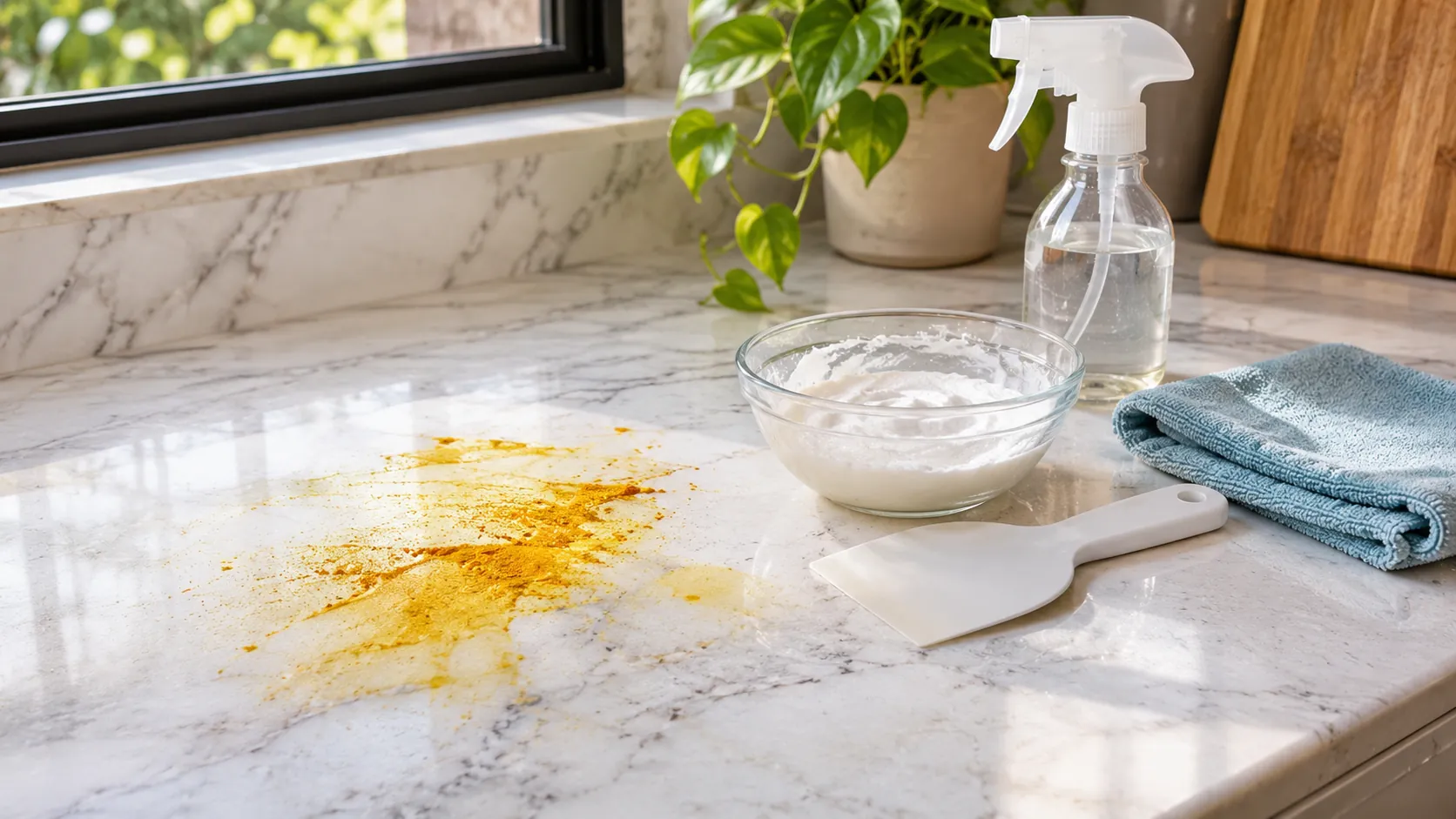
Here is how to remove stains from marble: identify what soaked in, mix a poultice (an absorbent powder such as baking soda or talc wetted with the right chemical), spread it 6 mm thick over the mark, cover it with plastic for 24 to 48 hours, then scrape it off dry. Oil needs acetone, haldi and chai need 12% hydrogen peroxide, rust needs a stone-safe rust remover.
Two rules sit above every recipe. First, check that the mark really is a stain and not an etch, because a dull ring left by lemon or tile acid will never come out with a poultice. Second, keep acids away: the cleaners sold for bathroom tiles in every Pakistani bazaar will turn a small stain into a large etch in under a minute. This guide covers the seven stains we see most often in homes in Lahore, Karachi and Islamabad, the recipe for each, what never to use, and when it is time to call a polisher.
How we priced this: stone prices in this post are our catalogue quote ranges per square foot as of November 2026, fabricated and installed in our service area (cutting, standard edge, finish, fitting and sealing on fitting day). Cut-outs, seams and freight outside our fitting cities are itemised on the quote. Household products have no price here because they vary by shop and city.
Is it a stain or an etch?
It is a stain if the mark is darker or coloured and the surface still feels smooth; it is an etch if the mark is dull, paler than the stone around it and feels slightly rough under a fingertip. That one check decides everything that follows, so do it before buying anything.
A stain is a substance absorbed into the pores of the stone. The stones we stock absorb roughly 0.2 to 0.35% of their weight in water, which sounds tiny but is enough for oil, haldi or tea to travel a few millimetres below the surface. An [etch](/glossary/etching) is a chemical burn: an acid has dissolved a thin layer of the calcite that marble is made of, removing the polish. Nothing has gone in; something has been taken away.
| Check | Stain | Etch |
|---|---|---|
| Colour | Darker, yellow, orange, brown or grey patch | Lighter, whitish or cloudy patch |
| Shine | Polish intact over the mark | Dull ring or spot that kills the reflection |
| Touch | Smooth, same as the rest of the stone | Slightly rough or chalky |
| Water drop on it | Mark often darkens further as it wets | Mark briefly disappears, then returns as it dries |
| Usual cause | Oil, ghee, haldi, chai, ink, rust, mould | Lemon, imli, vinegar, cola, tomato, tile acid |
| Fix | Poultice, repeated if needed | Polishing powder for light marks; re-polish for deep ones |
Kitchens often have both at once. A spoon of tomato and lemon salan left overnight on a white counter leaves a dull ring from the acid and an orange tint from the oil and spices. Treat the stain first with a poultice, then deal with the etch, because polishing first would only close the surface over the colour.
The poultice: the one method behind almost every fix
A poultice is a paste of absorbent powder and a liquid chemical, left on a stain until it dries completely. The liquid soaks into the stone and dissolves the stain; as the paste dries, it pulls the dissolved stain back up into the powder. Scrubbing only works on the top surface, so a poultice is what does the deep work.
Absorbent powders you can find locally
- Baking soda (meetha soda): cheap, white, available in every karyana store; the default for oil and general stains.
- Plain unscented talcum powder: fine and white, good on polished white stone. Avoid scented or coloured talc.
- Whiting or chalk powder: sold by paint and hardware shops; a classic poultice base.
- Multani mitti (fuller's earth): a very absorbent clay and excellent on oil, but it is beige, so use it on beige, grey or dark stone and test it on white.
- White kitchen tissue or cotton wool: for small fresh stains, soaked in the chemical and laid on the mark under plastic.
The method
- Clean the area with warm water and a pH-neutral stone cleaner, and let it dry.
- Test the chemical on a hidden corner or an offcut of the same stone, especially on dark stone, onyx and resin-filled travertine.
- Wet the stain with the same liquid you will use in the paste, so it starts working into the pores.
- Mix the paste to the thickness of peanut butter and spread it about 6 mm thick, overlapping the stain by a finger-width on every side.
- Cover it with cling film taped at the edges and prick a few small holes so it dries slowly.
- Wait 24 to 48 hours until the paste is completely dry. In a Karachi monsoon week, allow the longer time.
- Scrape it off with a plastic spatula or an old card, never a metal blade, then rinse with clean water and let the stone dry before judging the result.
- Repeat if the stain has faded but not gone. Deep or old stains often need two or three rounds.
Homemade poultice or a ready-made stain remover?
Ready-made poultice powders and stain removers sold for natural stone work the same way: an absorbent base and a chemical, left on the mark until dry. They save mixing and cling better on a wall or a vertical vanity edge. Check two things on the label before buying: that it says it is safe for marble or natural stone, and which stain it is made for, because an oil remover will not shift haldi or rust. Anything sold for tiles, grout or porcelain is usually acidic or bleach-based and belongs nowhere near marble. For most single household stains, the homemade recipes in the next section work just as well.
Wear gloves, open a window and run a fan whenever you use acetone, hydrogen peroxide or ammonia, keep children out of the room, and never mix chemicals. Ammonia and bleach together release a toxic gas.
Which poultice removes which stain?
Match the chemical to what caused the stain: solvents for oil, an oxidiser for organic colour, a dedicated remover for rust. The table covers the seven stains we see most in Pakistani homes; each one has a fuller note below.
| Stain | Where it shows up | Powder | Liquid | Dwell |
|---|---|---|---|---|
| Haldi (turmeric) | Kitchen counters, hob surrounds | Baking soda or talc | 12% hydrogen peroxide (light stone) | 24–48 h, then sunlight if possible |
| Oil, ghee, achaar, hair oil | Kitchen, dining table, vanity | Baking soda, talc or multani mitti | Acetone, or water with a few drops of washing-up liquid | 24–48 h; repeat |
| Chai, coffee, juice | Counters, side tables, floors | Baking soda or talc | 12% hydrogen peroxide plus a few drops of ammonia (light stone); acetone (dark stone) | 24 h |
| Rust from bore water or metal | Around taps, shower floors, under pots and stands | As the product directs | Stone-safe, non-acidic rust remover only | As labelled |
| Hard-water rings | Vanities, around taps, shower kerbs | None | Not a poultice job: plastic scraper and buffing | n/a |
| Ink and marker | Study tables, children's rooms | Talc or tissue | Hydrogen peroxide (light stone); acetone (dark stone) | 24 h |
| Mould and mildew | Shower corners, grout lines, damp walls | Baking soda or talc | Hydrogen peroxide | 24 h, then fix the damp |
Haldi (turmeric)
Haldi is the classic Pakistani kitchen stain: bright yellow, fast to soak in and stubborn on white stone such as Ziarat White. The colouring in turmeric, curcumin, behaves like a pH indicator, so a haldi mark often turns red-brown when you wash it with soap or baking soda. That is alarming but harmless; the stain has not spread, it has only changed colour. A 12% hydrogen peroxide poultice breaks the colour down, usually over one or two rounds. Curcumin also fades in sunlight, so a stain on a verandah counter or a sunny window sill often keeps fading for days after the poultice comes off.
Oil, ghee, achaar and hair oil
Oil darkens the stone in a soft-edged patch that spreads slowly outwards, and it is the most common stain we see next to hobs, on dining tables and on bathroom vanity tops where hair oil bottles stand. Fresh oil can often be drawn out with plain talc or multani mitti left on overnight with no liquid at all. Older stains need a solvent: mix the powder with acetone, or with water and a few drops of washing-up liquid, and expect to repeat. Achaar is a double problem because it carries oil, spices and acid together, so it often leaves an etch under the stain. Keep oil bottles and achaar jars on a small tray and the problem disappears.
Chai, coffee and juice
Tea and coffee leave brown rings, usually under cups set down on a side table or a counter. On light stone, a hydrogen peroxide poultice with a few drops of ammonia lifts them well. On dark stone, peroxide can bleach the colour, so use an acetone poultice instead. Fruit juices and cola are acidic as well as coloured, so check for an etch ring once the colour is gone.
Rust from bore water and metal
Many houses in Lahore, Karachi and Rawalpindi run on bore water with dissolved iron, which leaves orange-brown streaks below taps, on shower floors and wherever water sits. Metal furniture legs, a steel bucket left on a bathroom floor or a wet gas cylinder base do the same. Rust is the one stain where the chemical matters more than the method: the rust removers sold for toilets and tiles are acidic and will etch marble badly. Use only a remover labelled as safe for marble or natural stone, follow the label, and rinse well. A small water filter or softener on the bathroom line stops the stain coming back.
Some rust comes from inside the stone. A few stones carry tiny iron-bearing minerals that rust when they stay wet, leaving orange spots that seem to grow out of the stone itself. A poultice can lighten these, but they usually return while the area stays damp. Keep the surface dry and ask a professional to look at it.
Hard-water rings, ink and mould
Hard-water rings
The white crust round taps and on shower kerbs is not a stain at all. It is a mineral deposit sitting on the surface, mostly calcium carbonate, which is the same mineral as marble. That is why descalers are dangerous here: anything strong enough to dissolve the scale quickly will dissolve the polish under it too. Lift fresh crust with warm soapy water and a plastic scraper, and wipe the top dry after use. Older, thicker rings can be buffed off with a marble polishing powder. Our guide to choosing marble for a bathroom vanity covers daily hard-water habits in more detail.
Ink, marker and hair dye
Ballpoint ink and marker on a study table or a child's bedroom floor usually respond to a hydrogen peroxide poultice on light stone and an acetone poultice on dark stone. Hair dye and mehndi on a vanity top are organic colour and behave like haldi: peroxide in a poultice, repeated as needed. Try a cotton bud dipped in the solvent on a fresh mark first; if it only smears, switch to a poultice so the ink is drawn out rather than spread.
Mould and mildew
Black or green spots in shower corners and along grout lines are common in monsoon months and in bathrooms without an exhaust fan. A hydrogen peroxide poultice clears the colour from the stone, and a soft brush with a pH-neutral cleaner deals with the grout. Do not use bleach-based bathroom sprays on marble. Mould is a symptom, though: unless the room dries out between showers, it will be back within weeks. Fix the ventilation or the leak first.
Does the type of stone change the method?
Yes. Colour, finish and whether the slab carries resin all change which chemical is safe. White and beige marble tolerate peroxide; dark stone may lighten with it; onyx and resin-filled travertine can be damaged by strong solvents.
| Stone | Example | Watch out for |
|---|---|---|
| White and grey marble | Ziarat White, China White, Sunny Grey | Shows haldi and oil clearly; peroxide is safe. Grey cement or rust from below can shadow through. |
| Beige and cream marble | Verona Plain, Tavera Light | Hides light stains; multani mitti is fine. Honed floors absorb faster. |
| Black and dark marble | Jet Black, Black & Gold | Peroxide may lighten the colour; use acetone. Etch rings show more than stains. |
| Granite | Galaxy Black, Khyber Black Granite | Rarely stains and does not etch; pale granite can hold oil. Same poultice method works. |
| Onyx | Pak Green Onyx, Honey Onyx | Resin-backed and soft: avoid soaking with acetone, test everything, call a professional for anything large. |
| Travertine | Dawezai Badal Travertine | Resin fills can soften under acetone; dirt sits in open pits. Use peroxide or detergent poultices. |
| Chips Dana terrazzo | Chips Dana | Cement matrix: no acids, no strong bleach. Neutral cleaner and peroxide poultice. |
Dark stone such as Jet Black hides most stains but makes every etch ring and water spot obvious, which is why the honed and leathered finishes are popular on black kitchen tops. If you are still choosing stone and stains worry you, a granite such as Galaxy Black at PKR 900 to 1,700 per sq ft installed shrugs off haldi, oil and lemon alike.
Onyx deserves particular care. Slabs such as Pak Green Onyx are cut thin and bonded to a resin and mesh backing, and acetone can soften both the backing and any resin fills in the face. Work with water-based poultices only, keep them small, and ask for help with anything larger than a coin. Travertine is similar: Dawezai Badal Travertine is supplied resin-filled, so test any solvent on a filled pit before using it widely.
What should you never use on marble?
Never use acids, bleach-based cleaners, abrasive powders or metal scourers on marble. Each one does more damage in a minute than the stain could do in a year, and most of them are sitting in the bathroom cupboard of every Pakistani house.
| Product | Why people reach for it | What it does to marble |
|---|---|---|
| Tile acid, teezab, toilet cleaner | Strong, cheap, removes anything from tiles | Etches polished marble in seconds and can eat into the surface |
| Vinegar or lemon | Natural, sold as safe online | Acid: dull etch rings wherever it touches |
| Bleach-based tile sprays | Kills mould, whitens grout | Can discolour and dull the stone; never mix with ammonia |
| Bathroom rust removers | Made for orange marks | Acidic: removes the rust and the polish together |
| Scouring powder, steel wool, scrubbers | Hard rubbing feels effective | Scratches the polish; steel can leave rust specks |
| Descaler for kettles and taps | Dissolves hard-water crust | Dissolves calcite, which is what marble is made of |
| Wax, oil or "shine" products | Instant gloss | Traps dirt, yellows and must be stripped later |
The single most useful thing you can do is tell whoever cleans the house which bottle is for which surface. In most homes we visit, the etch rings on a marble floor line up exactly with where a tile cleaner was used on the bathroom threshold. Keep one labelled bottle of neutral stone cleaner for the marble, and our stone care guide has the full list of safe daily products.
When should you call a polisher?
Call a polisher when the problem is an etch larger than your palm, when a stain has survived three poultice rounds, or when the stone is onyx or a large area of floor. A poultice treats what is inside the stone; it cannot restore a surface that has been dissolved or scratched.
- Etching across a counter or floor. A light etch on a polished top can be buffed with a marble polishing powder; a dull path across a floor needs a machine.
- Stain and etch together, as with achaar or tomato salan: poultice first, then polish.
- Stains that keep coming back from below, such as rust from inside the stone or shadowing from damp walls or grey cement beneath.
- Very old oil stains in honed or brushed stone, where the oil has travelled deep.
- Onyx, resin-filled travertine and thin slabs, where a mistake is expensive.
- Large areas. One stain is a DIY job; a whole floor of pocha marks is not.
If the mark turns out to be a crack, a chipped edge or a pit that holds dirt rather than a stain, a poultice will not help; our marble crack and chip repair guide covers filling and edge repairs.
We re-polish and re-hone stone we fabricated in our service area. For other stone, our marble polishing guide explains how ragrai, honing and polishing work, what a fair rate looks like and the questions to ask a polishing team before they start.
Is it cheaper to replace the piece?
Sometimes. On a small item such as a vanity top or a window sill, replacing the stone can cost less than repeated callouts. A 60 x 22 inch vanity top is about 9.2 sq ft, which at our November 2026 installed ranges comes to roughly PKR 4,100–7,300 in China White or PKR 7,800–14,700 in Ziarat White, with the basin cut-out itemised. A whole floor is the opposite: polishing is far cheaper than relaying.
| Situation | Best option | Why |
|---|---|---|
| Single stain on a counter or floor | Poultice at home | Cheap, safe, usually works in one to three rounds |
| Light etch on polished stone | Polishing powder at home | Restores the shine on a small area |
| Etching or dull paths across a floor | Professional re-polish | Needs a machine and diamond pads |
| Cracked, chipped and stained small top | Replace the piece | A new top may cost less than the repair |
| Rust or damp coming through from behind | Fix the cause, then treat | Otherwise the stain returns |
After the stain is gone: reseal and prevent
A poultice pulls sealer out of the pores along with the stain, so the treated spot is now more absorbent than the stone around it. Let it dry for a day and reseal that patch. For the everyday routine that keeps a floor from staining in the first place, see how to clean marble floors. Our guide on how to seal marble in Pakistan covers the water test, the right type of sealer and how often each surface needs it, so we will not repeat it here.
- Wipe spills at once. Sealer buys minutes, not hours; haldi and oil still stain sealed stone if left overnight.
- Use trays and coasters under oil bottles, achaar jars, perfume, hair oil and tea cups.
- Keep the bathroom dry. A squeegee or microfibre cloth after the morning rush prevents hard-water rings and mould.
- Put mats at entrances so grit and mud from the street stay off the floor.
- Choose the finish for the room. A honed finish hides etching and water spots better than a mirror polish, which matters on kitchen tops and vanities.
- Mop with a neutral cleaner, not the floor cleaner meant for tiles.
For new kitchens, the choice of stone matters as much as the care routine. A warm beige such as Verona Plain at PKR 600 to 1,100 per sq ft hides haldi and oil far better than a bright white, and our stone kitchen countertops page compares the options by how a Pakistani kitchen actually cooks.
Need help with a stubborn mark?
If a stain will not move after three rounds, send us a clear daylight photograph of the mark, a close-up showing whether the surface is shiny or dull, and the name of the stone if you know it. For a replacement top or new stone that suits the way your house is used, request a free quote or order samples and test your own haldi, oil and lemon on them before you decide.
Written by
The Captivating Marble Design Team
Fabricators, templaters and stone designers
We template, cut and install natural stone every day and write about what we learn — pricing, layouts, care and the mistakes we help clients avoid.
Book a free design consultation