Marble Polishing in Pakistan: Process, Price per Sq Ft and Care
Marble polishing costs an indicative PKR 25–90 per sq ft (2026). How ragrai, honing and polishing work, how long it takes and what to ask. Read before you book.
Captivating Marble Design Team · · Updated · 16 min read
Key takeaways
- Marble polishing has four stages: ragrai (wet grinding), honing, polishing and sealing.
- Indicative 2026 market rates run PKR 25–50 per sq ft for a light re-polish and PKR 50–90 for full restoration, labour only.
- A typical 1,000–1,500 sq ft house floor takes two to four working days, plus overnight drying before sealing.
- A resin diamond-pad finish holds its shine longest because nothing sits on top of the stone; wax coats wear off within weeks.
- Never use tezab (hydrochloric acid) or acid tile cleaners on marble: they etch the polish instantly.
What does marble polishing involve?
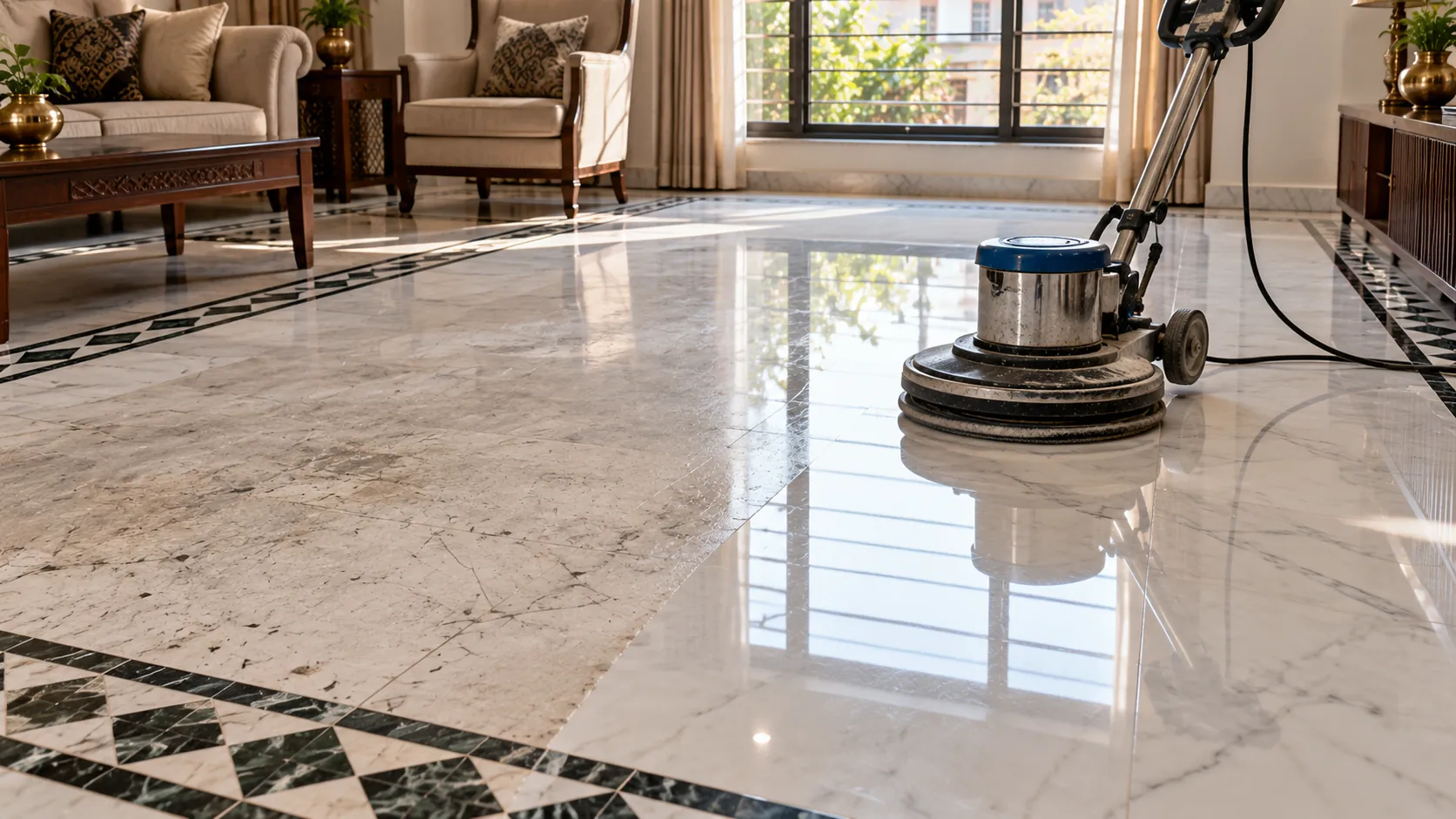
Marble polishing in Pakistan means grinding the floor flat with a heavy rotary machine (ragrai), refining it through finer abrasives, bringing up the shine with powder, crystallizer or diamond pads, then sealing. As an indicative 2026 market range it costs PKR 25–90 per sq ft, and a typical house floor takes two to four days.
Done properly it removes lippage between tiles, traffic dullness, light scratches and most etch marks. This guide explains each stage in plain terms, what a fair rate looks like per square foot, how the three common shine methods compare, what to check before you hand your house over to a polishing team, and how to keep the result looking new. It applies to Ziarat whites, Verona and Tavera beiges, greys, blacks and the Fancy marbles, with notes on granite, onyx and chips at the end.
Polishing is a cutting process, not a coating. Every proper polish removes a very thin layer of stone. A shine that comes out of a bottle and sits on top of the floor is a wax or acrylic, and it will scuff, yellow and wear off in traffic lanes within weeks.
What is ragrai, and how is it different from polishing?
Ragrai is the coarse wet grinding that flattens a floor; polishing is the final stage that makes it reflective. Pakistani polishers use a mix of Urdu trade words and English ones, and quotes often lump everything under "polish". It helps to know the stages separately, because a cheap quote often skips one of them.
- [Ragrai](/glossary/ragrai) (grinding, also called ghisai): the heavy first stage. A weighted single-disc machine runs coarse abrasive stones or metal-bond diamonds over the wet floor to cut down lippage (raised tile edges), deep scratches and uneven joints. On a newly laid floor, this is what makes separate tiles read as one flat surface.
- Honing: progressively finer abrasives that remove the scratch pattern left by grinding. A floor stopped at a mid grit is matte and smooth; that is a honed finish.
- Polishing: the final stage that turns a smooth honed face into a reflective one, either with a polishing powder rubbed in under a felt or pad, with a crystallizer, or by continuing through very fine resin diamond pads.
- Sealing: a penetrating impregnator applied after the floor is fully dry, so oil, tea and turmeric do not soak into the freshly opened pores.
Why does marble take a polish so readily? It is mostly calcite, a mineral of about 3 on the Mohs scale. That softness is why it scratches and etches, but it is also why a worn floor can be brought back in place, which is far harder with granite at 6 to 7.
Does your floor need polishing, or just cleaning?
Not every dull floor needs a machine. Before paying for a full job, try a proper clean with warm water and a pH-neutral stone cleaner, and let it dry. Many floors in Lahore and Karachi look tired because of a film of detergent, dust and hard-water residue, not because the polish has gone.
Signs that only polishing will fix
- Dull paths along the routes people walk, from the gate to the lounge, around the dining table, at the foot of the stairs.
- Rings and patches where lemon, vinegar, cola or an acid tile cleaner has burnt the surface. These are etch marks: the shine is chemically removed, so no cleaner brings it back.
- Fine scratches from sand and grit carried in during dust storms and building work next door.
- Tile edges you can feel with your foot (lippage), often because the floor was laid but never ground.
- Grey or yellow grout lines and a cloudy look left by a wax or "shine coat" that has worn unevenly.
Signs polishing will not fix
- Cracked tiles, or tiles that sound hollow when you tap them with a coin. The bed underneath has failed and the piece needs lifting and relaying.
- Deep rust or oil stains that have soaked into the stone. These need a poultice first, as our guide on how to remove stains from marble explains; polishing only removes the surface.
- Floors already ground thin by repeated heavy restoration, or tiles with large resin-filled holes.
The process, step by step
This is the sequence a good team follows on an existing house floor. On a brand-new floor the same steps apply, but the bed must cure first: most polishers wait two to three weeks after laying, longer in monsoon humidity, so the mortar has stopped moving before they grind it flat.
- Clear and protect. Furniture out, skirting, door frames and kitchen cabinet plinths masked with tape and plastic. Wet grinding makes a grey slurry that stains wood and paint if it is left to dry on them.
- Test patch. A square metre in a corner is taken through the whole sequence so you can approve the final shine and colour before the full job starts.
- Ragrai. Coarse grinding with water to level lippage and cut out deep scratches. This is the slowest and loudest stage.
- Joint filling. Gaps and chips are filled with a colour-matched stone epoxy or polyester filler, so the joints read as fine lines and do not trap dirt.
- Honing. Two to four passes with finer abrasives, rinsing and squeegeeing the slurry between each pass.
- Polishing. Powder, crystallizer or fine diamond pads bring up the reflection (see the comparison below).
- Rinse and dry. All residue is removed with clean water. The floor needs to dry fully before sealing, usually overnight, and longer in humid weather.
- Seal. A penetrating impregnator, applied thin and buffed off before it sets, so it does not leave a sticky film.
- Hand work. Edges against the wall, corners and stair nosings are finished with a hand-held grinder and small pads that the big machine cannot reach.
Plan around power and weather. Floor machines draw heavy current, so ask the team how they handle load-shedding (a generator on site, or a schedule built around the outage timetable). In June heat the slurry dries fast and is harder to clean; in the monsoon the floor takes far longer to dry before sealing.
Which polishing method lasts longest?
A resin diamond-pad finish lasts longest, because the stone itself reflects and nothing sits on top to wear off. The final shine is where quotes differ most, and where the cheapest option often costs you more within a year. There are three common ways to finish a Pakistani marble floor.
| Method | How it works | Shine | How long it holds | Watch out for |
|---|---|---|---|---|
| Polishing powder | An abrasive powder (often with a mild acid) worked into the wet stone under a felt or pad | High gloss | Good on low-traffic rooms | Overuse can etch or haze; must be rinsed off completely |
| Crystallization | A fluorosilicate spray buffed in with steel wool under the machine, reacting with the calcite surface | Very high, glassy | Wears in traffic lanes and needs topping up | Can make the surface slippery and less breathable; not for every stone |
| Resin diamond pads | Continuing honing through fine grits until the stone itself reflects | High, natural depth | Longest, because nothing sits on top | Takes longer and costs more; needs a skilled operator |
On a busy family floor we prefer a diamond-pad finish taken to a moderate gloss, then sealed. It looks slightly softer on the first day than a crystallized floor, but it does not turn patchy in the walkways, and future touch-ups are quicker. For a formal drawing room that is rarely walked on, a powder polish over a well-honed surface gives a deep, glassy look at a lower price.
Avoid anything described as a "polish coat", wax or "shine liquid" applied as a final layer. It hides the real condition of the stone, traps dirt, turns yellow under sunlight from a window, and has to be stripped with harsh chemicals before the floor can ever be properly polished again.
How much does marble polishing cost per sq ft?
Polishing costs about PKR 25 to PKR 90 per sq ft as an indicative 2026 market range, from a light re-polish to full restoration. It is quoted per square foot of floor in most cities, with stairs, skirting and small jobs priced separately. The figures below are indicative market ranges gathered for Lahore, Karachi and Islamabad. They are not our rate card, and they vary with the condition of the floor, the method and the size of the job.
| Job | How it is charged | Indicative range |
|---|---|---|
| Light re-polish of a sound floor (no ragrai) | Per sq ft | PKR 25 – 50 |
| New floor: ragrai, honing and polish | Per sq ft | PKR 30 – 60 |
| Restoration of an old, scratched or uneven floor | Per sq ft | PKR 50 – 90 |
| Crystallization or fine diamond-pad finish | Extra per sq ft | PKR 20 – 50 |
| Sealing after polish (material and labour) | Per sq ft | PKR 10 – 25 |
| Stairs (tread and riser, hand-finished nosing) | Per step | PKR 300 – 800 |
| Small jobs under a few hundred sq ft | Minimum visit charge | PKR 3,000 – 8,000 |
Worked example: a 1,200 sq ft ground floor that is basically sound but dull in the walkways, re-polished without ragrai and sealed, comes to roughly 1,200 x (PKR 25 – 50) for the polish plus 1,200 x (PKR 10 – 25) for sealing, so about PKR 42,000 – 90,000 at these indicative rates. The same floor needing full restoration would sit nearer PKR 72,000 – 138,000 with sealing.
What moves the marble polish price
- Starting condition. A floor with lippage and deep scratches needs coarse grinding, which takes the most time and abrasive.
- Stone type. Soft, veined whites polish fast; dark and highly figured stones show every swirl mark and need more passes.
- Finish level. Matte honed costs less than a mirror gloss; a diamond-pad finish costs more than powder.
- Furniture and access. Fully furnished rooms, upper floors without a lift and narrow lanes for the machine all add time.
- Edges and stairs. Hand work is slow and is often where a low quote quietly adds charges. Our stair marble design guide explains why nosings wear first.
Very low rates, well below the bottom of these ranges, usually mean the team will skip ragrai, use only powder or a wax coat, or charge extra for edges, stairs and filling once the job has started. Ask for the stages in writing.
Polishing machines: hire a team or buy your own?
Searches for a polish machine price usually come from two groups: homeowners wondering whether to do it themselves, and small contractors equipping a team. The answer is different for each.
| Equipment | Used for | Indicative price |
|---|---|---|
| Hand angle grinder with backer pad and diamond pad set | Edges, corners, stair nosings, small repairs | PKR 10,000 – 30,000 |
| Locally built single-disc ragrai machine | Grinding and polishing house floors | PKR 50,000 – 120,000 |
| 17-inch floor buffer / scrubber | Powder polishing, crystallization, cleaning | PKR 60,000 – 150,000 |
| Imported planetary floor grinder | Large commercial floors, fast flattening | PKR 300,000 and above |
| Daily hire of a floor machine (where available) | One-off jobs | PKR 2,000 – 5,000 per day |
For a homeowner, buying a machine rarely makes sense. Abrasives, pads and powder add up, the first few hundred square feet are a learning curve, and a heavy grinder handled badly can gouge a floor in seconds, leaving dips that a professional then has to grind out. DIY is reasonable only for a small etch mark or a dull patch on a worktop, using a hand polishing pad and powder with care.
For a contractor, the single-disc machine plus a hand grinder covers most residential work. The real cost is not the machine but consumables and skill: a good operator knows when to move up a grit, how much water to run and when a stone needs a different method.
Stone by stone: what to expect
Every Pakistani marble polishes a little differently. Tell the polisher which stone you have, or show them the original quote, before they start.
- Ziarat whites. Ziarat White (Ziarat, Balochistan), Ziarat Supreme and Medium White take a bright, crisp polish quickly. Their weakness is that dulling and etching show clearly on white, so they benefit most from good sealing and a pH-neutral cleaning routine afterwards.
- Beiges and creams. Verona Plain, Tiger Verona, Tavera Light and New Tavera polish easily and hide wear well. Many owners choose a satin or honed finish on these for kitchens and lounges, because it forgives marks.
- Greys. Sunny Grey, Sunny Grey White and Superline Grey polish evenly; check that fine scratches are fully removed at each grit, because grey shows a hazy scratch pattern under a window.
- Blacks. Jet Black and Black & Gold give the deepest reflection of any marble, but they show swirl marks from coarse grits and every footprint. They need the most careful, patient finishing.
- Fancy and multicolour marbles. Green Fancy, Royal Fancy and Commando Fancy have softer and harder bands side by side; a rushed polish leaves the soft veins slightly lower. Go up the grits slowly.
- Chips Dana. A chip-and-cement surface, ground and polished much like terrazzo. It needs coarse grinding after laying and the cement matrix needs sealing; our terrazzo and chips flooring guide covers it in detail.
- Travertine and Gadap Stone. Usually honed or brushed rather than mirror polished. Open holes must be filled before honing; our travertine guide covers filled and unfilled stone.
- Onyx. Soft and brittle. Polish by hand or with light pressure only, never with heavy ragrai.
- Granite. Far harder; it needs diamond tooling throughout and is rarely re-polished on site. See our granite price guide if you are weighing it against marble for a heavy-use area.
Hiring a polisher: checklist and red flags
Most polishing in Pakistan is done by small independent teams found through a marble yard, a builder or a neighbour. Plenty are excellent. The way to tell is to ask specific questions before they start, not after.
- Measure the floor yourself. Multiply the length and width of each room, add them up, and agree the area in writing. Disputes over square feet are the most common argument at the end of a job.
- Ask for the stages in writing: ragrai yes or no, how many honing passes, which shine method, whether sealing is included, and what is charged extra (stairs, skirting, filling, furniture moving).
- Insist on a test patch and approve it in daylight before the full floor is done.
- Ask what they use for the shine. If the answer is a wax, a "coat" or a liquid that is mopped on, keep looking.
- Agree slurry handling. Slurry must be squeegeed and collected, not washed into a drain or onto the street, where it sets like cement.
- Check edges and corners before final payment. Machine-only jobs leave a dull band along every wall.
- Keep acids away. No team should use hydrochloric acid ("tezab") or an acid tile cleaner on marble, even to remove cement stains. It burns the surface instantly.
- Hold back part of the payment until the floor has dried and you have seen it in morning light.
A floor polished on a hot, dusty day can look perfect while wet and disappointing once dry. Judge the result the next morning, after it has dried completely, with the curtains open.
Keeping the shine afterwards
Most of a polished floor's life is decided by what happens in the weeks after the team leaves. The stone is freshly opened and most vulnerable until the sealer has fully cured, which usually takes a day or two.
- Clean with warm water and a pH-neutral stone cleaner. Do not use vinegar, lemon, bleach-based floor cleaners or acid toilet cleaners anywhere near marble.
- Put doormats at every outside door. Sand and grit carried in on shoes are the main cause of dull walkways, especially in dust-storm season.
- Use felt pads under furniture legs and lift, do not drag, heavy pieces.
- Wipe spills immediately, especially tea, cola, juice and cooking oil.
- Dust-mop daily rather than wet-mopping with a dirty bucket, which leaves a grey film.
- Re-seal floors roughly once a year and kitchen worktops every six to nine months.
Our full stone care guide covers cleaning products and stain removal, and how to seal marble in Pakistan explains the water-drop test that tells you when the sealer has worn through. With this routine, most home floors need only a light re-polish every three to five years rather than full ragrai.
When polishing is not enough
Sometimes the honest answer is replacement, not another round of grinding. If tiles are cracked, hollow or badly stained deep into the body, if a floor has been ground so many times that the joints are dished, or if you are renovating a room anyway, new stone may cost less in the long run than repeated restoration.
Replacing only a few damaged tiles is possible when the original stone is still available, but colour and veining will never match exactly; an older floor also has a slightly different tone from years of light and cleaning. A short restoration across the whole room after the new pieces go in helps them blend.
The stone we supply is finished in our Lahore workshop, polished or honed to the face you choose, so a new worktop or floor piece arrives at its final finish rather than relying on an on-site polish. If you are pricing a replacement, compare stones and rates in our marble range, see our marble floor design guide for layouts and borders, or send room sizes through our quote form for an itemised figure.
Planning a new floor or worktop?
Choosing the right stone and finish at the start saves a lot of polishing later. A honed or satin finish on a busy family floor, a darker or veined stone in a kitchen, and granite where acids and heat are daily facts all reduce how often you will need a machine in the house.
Order samples in polished and honed finishes, try a drop of lemon and a smear of oil on the back of each, and see for yourself how they behave. When you are ready, send us your measurements through the quote page and we will send an installed price, with any cut-outs, seams and freight itemised.
Written by
The Captivating Marble Design Team
Fabricators, templaters and stone designers
We template, cut and install natural stone every day and write about what we learn — pricing, layouts, care and the mistakes we help clients avoid.
Book a free design consultation