Marble Floor Design in Pakistan: 7 Patterns, Borders and Costs
7 laying patterns, patti borders, colours by room and floor marble at PKR 520–1,600 per sq ft laid (Nov 2026). See the designs and plan your floor with us.
Captivating Marble Design Team · · Updated · 20 min read
Key takeaways
- Most Pakistani homes suit one calm field stone in large pieces, one darker patti border and a honed finish in wet areas.
- Popular field stones cost PKR 520–1,600 per sq ft laid and polished in our current range, from Tavera Light to Ziarat White (November 2026).
- Allow about 5–8% cutting wastage for a straight lay and 12–18% for herringbone or chevron.
- Our ranges are installed prices; if you buy stone only, budget an indicative PKR 50–120 per sq ft for laying and PKR 30–80 for ragrai and polish.
- Use 2 cm marble for most home floors and 3 cm for lobbies, stair landings and large-format pieces.
What makes a good marble floor?
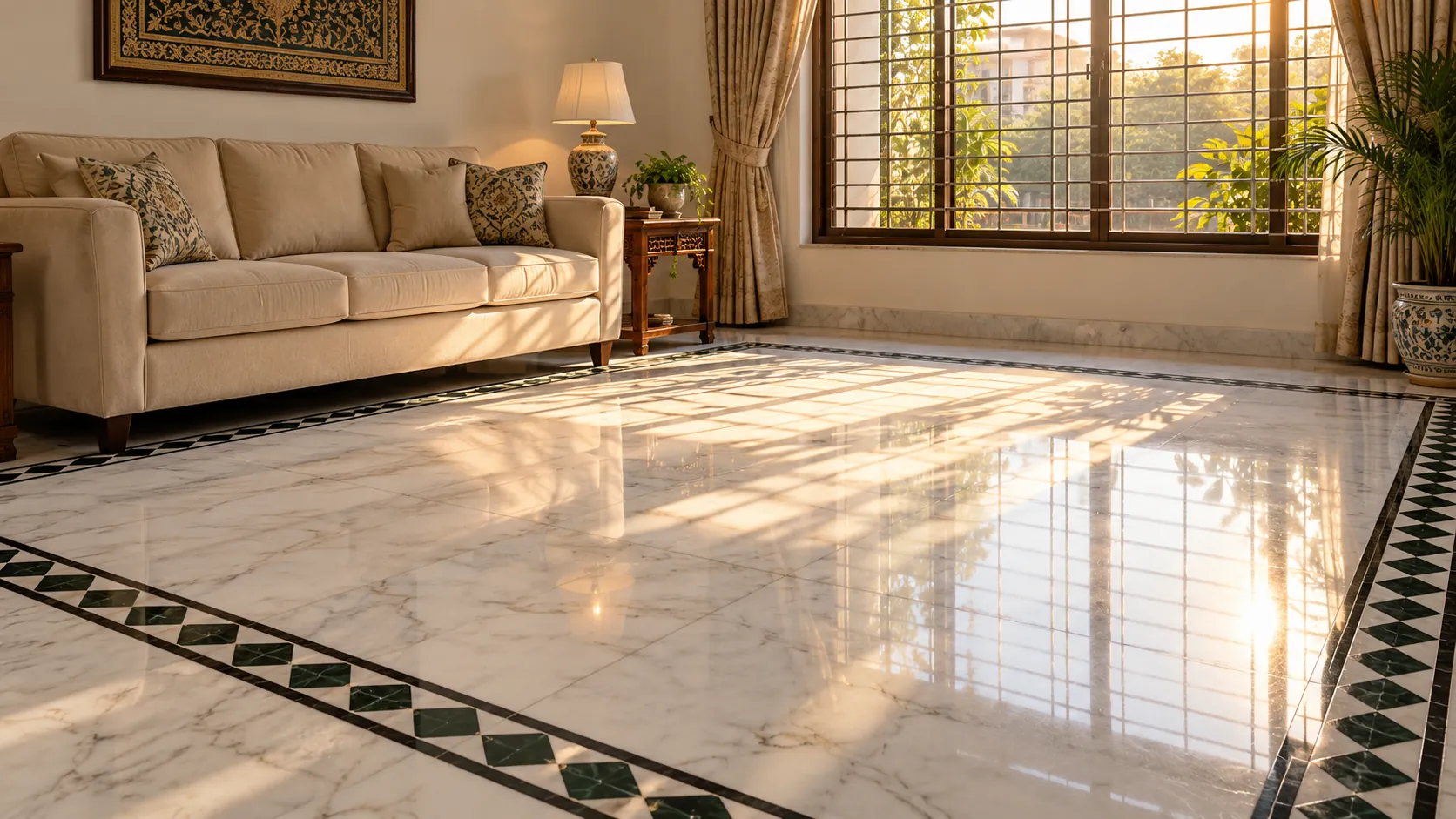
A good marble floor design in Pakistan pairs one calm field stone, laid in large 24 x 24 or 24 x 48 inch pieces, with a single darker patti border and a honed finish in wet areas. Popular field stones cost PKR 520–1,600 per sq ft laid and polished in our current range, from Tavera Light to Ziarat White.
Get there by making three decisions in order: the stone colour that suits the room's light, the laying pattern that suits its shape, and the border that frames it. Everything else is decoration. If you have not picked a stone yet, start with the best marble for floors and the pros and cons of a marble floor. This guide walks through the layouts that actually get laid in Pakistani houses, how border work is made and priced, which stones suit which rooms, what a floor costs per square foot, and the mistakes we see most often at handover. Rates quoted for stones we stock are our current quote ranges (November 2026), installed in our service area; separate labour and polishing figures are indicative market ranges for buyers who take stone only.
Plan the floor before the plaster goes on (see the right stage to lay stone). Skirting height, door clearances and the finished floor level all depend on the stone thickness and bed you choose, and changing them later is expensive.
Start with the room, not the catalogue
Buyers usually walk into a yard and fall for a slab. The better order is the reverse: measure the room, note where daylight comes from, decide how the space is used, and only then choose a stone. A marble that glows in a sunlit Lahore lounge can look flat and grey in a north-facing bedroom in Islamabad, and a mirror polish that looks rich in a drawing room becomes a skating rink in a bathroom.
Four questions to answer first
- How much daylight does the room get? Low light favours whites and pale creams; strong light lets you use beige, grey and darker fields without the room closing in.
- How hard will the floor work? Entrances, kitchens and stair landings take grit, oil and dragged furniture. They need a denser stone or a honed finish that hides wear.
- Will it get wet? Bathrooms, wash areas, porches and anywhere near a mopping drain need a finish with grip, not a gloss.
- What is next to it? Floors run through doorways. Choose stones for adjoining rooms together so the thresholds line up in colour and level.
Once those answers are written down, the shortlist usually shrinks from forty stones to four or five, and the pattern decision becomes obvious.
Which laying pattern should you choose?
Choose a straight lay for most rooms, a diagonal for narrow or out-of-square rooms, and save herringbone for a feature zone. The pattern is how the pieces are set out on the floor. It changes how big the room feels, how much stone is wasted in cutting, and how much the mason charges. These are the layouts we see specified most, from simplest to most demanding.
Straight lay (grid)
Square or rectangular pieces in straight rows, joints aligned both ways. It is the cheapest to lay, wastes the least stone and suits almost any room. With large pieces such as 24 x 24 inch or 24 x 48 inch, a grid in a plain stone like Perlino Crystal Plain or Verona Plain reads almost seamless. Its weakness is that it shows any wall that is out of square, so the mason should start from the room's centre line, not from a wall.
Diagonal (45 degree)
The same grid turned 45 degrees to the walls. It makes a narrow room or corridor feel wider and hides walls that are slightly out of true, which is common in older houses. It costs more: every perimeter piece is a triangular cut, so wastage rises and laying takes longer.
Brick bond (running bond)
Rectangular pieces offset by half or a third of their length, like brickwork. It suits long rooms and lobbies and works well with directional stones such as Tiger Verona or Superline Grey, where the vein can run along the length of the room. Keep the offset at a third, not a half, on long pieces to avoid lippage at the joints.
Herringbone and chevron
Narrow strips set in a zigzag. It is the most fashionable layout right now and looks best in a foyer, a dining area or a single feature zone inside a larger plain floor. Herringbone needs accurate workshop cutting and a patient mason; chevron needs every strip end cut to an angle. Both waste more stone and take noticeably longer to lay than a grid.
Chequerboard
Alternating light and dark squares, usually a white such as Ziarat White against Jet Black. It is classic in entrance halls and old-style verandas. It is unforgiving: any colour variation inside the white squares shows instantly against the black, so buy the whites from one block.
Large format and slab floors
Pieces cut from full slabs, often 24 x 48 inch or bigger, to minimise joints. Fewer joints means a cleaner look and easier cleaning, but each piece is heavy and the sub-floor must be dead level. This is where vein matching (laying consecutive pieces so the veins continue) pays off, especially with Ziarat White and the Sunny family.
Field with a feature zone
A plain floor across the room with a framed panel in the middle: a rug-sized rectangle of a contrasting stone, a herringbone inset, or a medallion under a chandelier. This is the most common approach in Pakistani drawing rooms and entrance lobbies because it gives a strong focal point while keeping most of the area simple and affordable.
| Pattern | Best for | Typical cutting wastage* | Labour effort |
|---|---|---|---|
| Straight lay | Any room, large areas | 5–8% | Low |
| Brick bond | Corridors, lobbies, long rooms | 6–10% | Low to medium |
| Diagonal | Narrow rooms, out-of-square walls | 10–15% | Medium |
| Chequerboard | Entrance halls, verandas | 8–12% | Medium |
| Herringbone / chevron | Foyers, dining zones, feature panels | 12–18% | High |
| Large format | Open-plan lounges, villas | 5–10% | Medium (heavy pieces) |
*Wastage figures are indicative trade allowances for a typical rectangular room, not fixed rules. Irregular rooms, many door openings or a heavily patterned stone push them up. Always order the allowance on top of the measured area, and keep a few spare pieces from the same lot for future repairs.
Floor borders: patti, dighin and inlay
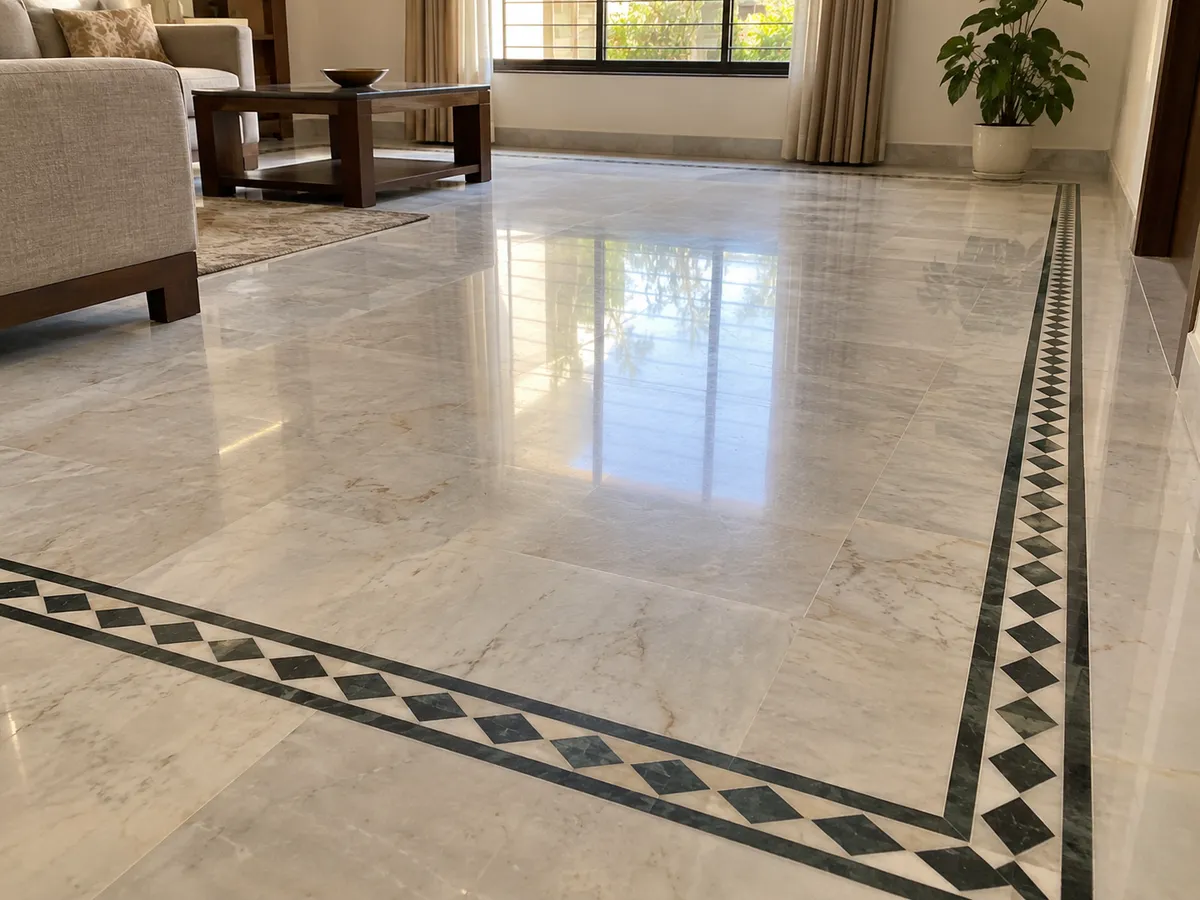
Borders are where marble design in Pakistan has its own identity. A border (patti) is a strip of contrasting stone that runs around the room a short distance from the walls, framing the field the way a mount frames a picture. It also solves a practical problem: the border absorbs the out-of-square edges of the room so the main field can stay perfectly straight. Our full guide to marble border design covers types, widths, corners and costs.
Plain line borders
One or two straight strips of a darker stone, usually 2 to 4 inches wide, set 12 to 24 inches from the wall. Jet Black, Black & Gold and the green Fancy stones are the usual choices on a white or cream field. It is the cheapest border and the hardest to get wrong.
Design Patti
Pre-assembled decorative strips made in the workshop from coloured offcuts: diamonds, triangles, Greek keys, rope and floral repeats. Our Design Patti comes in standard widths of roughly two to six inches, and custom repeats can be cut from a drawing. Because it arrives assembled, the mason sets it like a long tile, which keeps site labour down.
Dighin border
Dighin Border is the carved version: the inlay has a profile that sits slightly proud and catches the light along its length. Each course is cut by hand, mixing black, green, red and cream stone. It suits formal drawing rooms and entrance halls, and it needs a careful polisher at the end so the raised edge is not ground flat.
Medallions and waterjet inlay
A medallion is a circular or star-shaped inlay, typically 3 to 6 feet across, set in the centre of a lobby or under a dome. Simple geometric medallions can be hand-cut; complex floral or calligraphic designs are cut by CNC waterjet from a digital drawing and assembled on a mesh before delivery. Ask to see the assembled piece laid out at the workshop before it is packed.
Border rules that save money
- Keep the border parallel to the longest wall, then let the gap to the other walls vary slightly. Nobody notices a 1 inch difference at the skirting; everybody notices a crooked border.
- Do not run a border into a doorway. Stop it at the door frame and fill the threshold with field stone or a single threshold piece.
- Leave space for furniture. A border hidden under a sofa is money on the floor; set it where it will actually be seen.
- One strong border per room is enough. Two decorative bands plus a medallion usually looks busy in a typical 14 x 18 foot room.
Which marble colour suits each room?
Bright whites suit formal drawing rooms, soft greys and creams suit lounges and bedrooms, and dense or darker honed stones suit entrances, kitchens and stairs. The table below is our starting point when clients ask which stone will hold up in each room. Rates are our current quote ranges (November 2026) per square foot for each stone; the final figure depends on grade, thickness, finish and the size of the job.
| Room | Stones to shortlist | Finish | Quote range | Why |
|---|---|---|---|---|
| Drawing room | Ziarat White, Perlino Crystal Plain, Verona Plain | Polished | PKR 600 – 1,700 | Formal, bright, takes a border well |
| Lounge / TV room | Sunny Grey White, Tavera Light, Medium White | Polished or honed | PKR 520 – 1,080 | Calm field, forgives slab variation |
| Bedrooms | Verona Plain, Dawezai Basaf, Sunny Grey | Honed or soft polish | PKR 480 – 1,100 | Warm, quiet, cooler underfoot in summer |
| Entrance / lobby | New Tavera, Denso, Tropical | Honed | PKR 450 – 1,200 | Dense or darker, hides grit and wear |
| Kitchen floor | Tropical, Denso, Superline Grey | Honed | PKR 450 – 1,200 | Hides oil marks and traffic |
| Bathrooms | Sunny Grey, Tavera Light, Pampo White | Honed | PKR 500 – 1,000 | Grip when wet, hard-water marks show less |
| Porch / veranda (covered) | Gadap Stone, Denso, Chips Dana | Honed or brushed | PKR 180 – 820 | Textured, affordable, easy to repair |
| Stair landings | New Tavera, Jet Black (nosings) | Honed | PKR 580 – 2,000 | Holds an edge, safer underfoot |
Stair landings have their own rules on nosings and grip, covered in our stair marble design guide. Most of these stones can be compared side by side in our flooring and wall tile range, where each product page lists finishes, thicknesses and the same quote range shown here.
White floors: Ziarat, Sunny and the budget whites
White is still the most requested floor colour in the country, and for good reason: it bounces light, makes rooms feel larger and pairs with any furniture. The catch is that whites show dust, hard-water marks and patchy polish more than any other colour, so the grade matters.
Ziarat White and Ziarat Supreme
Ziarat White from Balochistan is the benchmark: an ivory to milk-white ground with faint grey drift, at PKR 850 – 1,600 per sq ft in our current range. Ziarat Supreme is the hand-picked top grade, whiter and less spotted, at PKR 1,100 – 2,100. Use Supreme where the floor is the star of the room; use standard Ziarat White where furniture and rugs will cover part of it. Every white grade is priced side by side in our white marble price guide.
Sunny white floors
Many buyers search for a sunny white marble floor design, meaning the lightest selection of the Sunny family from Ziarat. Yards use the name loosely, so ask to see the actual lot. The closest stone we list is Sunny Grey White at PKR 600 – 1,080, which pushes more white into the field and leaves grey as a soft wash. Its strength on a floor is that it has no hard lines, so slab-to-slab differences blend rather than jump out, and it suits large, wall-to-wall lounges.
Budget whites
Medium White (PKR 550 – 950) is the working lot from the Ziarat belt, with grey cloud and light spotting that still reads clean once polished. China White, cut near Chiniot in Punjab (PKR 450 – 800), is chalkier and stays closer to matte. Pampo White from Mohmand (PKR 500 – 900) is cooler with grey shadowing and the odd pale gold fleck, and varies between blocks. All three are sensible for rental units, upper floors and large areas where Ziarat would stretch the budget.
With any white floor, see the whole lot laid out in the yard before you pay. A white that looks uniform on one slab can show a visible colour shift across forty pieces.
Beige, grey, dark and fancy floors
Beige and cream
Verona Plain (PKR 600 – 1,100) is the calm honey-beige that suits bedrooms, corridors and prayer rooms. Tavera Light (PKR 520 – 980) from Khuzdar is a pale cream with sandy grain, a contractor favourite for large areas. New Tavera (PKR 580 – 1,050) is denser and darker and holds an edge on stair nosings. Beige hides dust far better than white, which matters in houses near unpaved roads or construction.
Greys
Sunny Grey (PKR 560 – 1,000) is warm rather than cold and buys well in quantity because the tone forgives small differences. Superline Grey (PKR 620 – 1,150) has straight, parallel veins that suit a brick-bond layout along a corridor. Denso (PKR 450 – 820) is a tight-grained grey that stays semi-matte and hides scratches, a good choice for lobbies and stair cores.
Dark stones
Jet Black (PKR 1,100 – 2,000) and Black & Gold (PKR 1,400 – 2,800) are rarely used across a whole floor in Pakistan, and with reason: dark polished floors show every footprint and dust film. They are at their best as borders, chequerboard squares, thresholds and medallion accents. Tropical (PKR 650 – 1,200), a warm brown, is the dark-ish field stone that does work across a whole room without showing every mark.
Fancy and coloured
The Mohmand Fancy stones (Green Fancy, Royal Fancy, Commando Fancy, PKR 740 – 1,550) and Tippi Flower (PKR 680 – 1,250) have strong, random pattern. On a floor they work as a feature panel or a border, rarely wall to wall. Lay out every piece in the yard and number them in order; random stones need a layout plan, not a mason picking pieces off the pile.
Marble floor design in Pakistan: what it costs
A floor price has two halves: the stone, and the work to turn it into a finished floor. The stone side depends on which marble you pick and the grade. The work side depends on the pattern, the border and the condition of the site. Our cost estimator gives a first figure for your area, and the full marble price guide lists every stone we stock. If you are buying cut tiles rather than slab-cut pieces, see marble tile prices. Our quote ranges cover both halves: the stone plus cutting, laying and polishing in our service area, with border mitres and freight outside our fitting cities itemised.
Stone rates for common floor choices
| Stone | Origin | Quote range (PKR / sq ft) | Floor role |
|---|---|---|---|
| Chips Dana | Lahore, Punjab (made on site) | PKR 180 – 420 | Budget floors, porches, schools |
| Gadap Stone | Gadap, Karachi | PKR 260 – 520 | Covered outdoor areas |
| Design Patti (border) | Lahore workshop | PKR 300 – 700 | Decorative strip |
| Dighin Border | Lahore workshop | PKR 320 – 740 | Carved inlay border |
| Denso | Mohmand, KP | PKR 450 – 820 | Lobbies, stairs |
| Tavera Light | Khuzdar, Balochistan | PKR 520 – 980 | Large cream floors |
| Medium White | Ziarat, Balochistan | PKR 550 – 950 | Budget white field |
| Sunny Grey | Ziarat, Balochistan | PKR 560 – 1,000 | Wall-to-wall grey |
| Verona Plain | Chaghi, Balochistan | PKR 600 – 1,100 | Calm beige field |
| Ziarat White | Ziarat, Balochistan | PKR 850 – 1,600 | Premium white field |
| Perlino Crystal Plain | Chaghi, Balochistan | PKR 900 – 1,700 | Seamless plain white |
| Jet Black | Chaghi, Balochistan | PKR 1,100 – 2,000 | Borders, chequerboard |
If you buy stone only and hire your own mason
Our ranges already include laying, grinding and polishing. If you buy stone only, these labour lines are where quotes differ most between contractors. The figures below are indicative market ranges for labour only, not our rates.
| Work item | Indicative range | What changes it |
|---|---|---|
| Laying field stone on mortar bed | PKR 50 – 120 per sq ft | Pattern, piece size, city, floor level |
| Ragrai (grinding) and polish after laying | PKR 30 – 80 per sq ft | Number of grinding passes, finish level |
| Fitting a patti or line border | PKR 100 – 300 per running ft | Border width, corners, mitres |
| Setting a medallion | Quoted per piece | Size, complexity, levelling |
Two worked examples show how the pieces fit together. A 14 x 18 foot lounge is 252 sq ft. In Sunny Grey White laid straight, with roughly 7% wastage, you are paying for about 270 sq ft at the installed rate. Add a plain Jet Black line border and the total changes little, though its corners add mitres. Switch the same room to a diagonal Ziarat White with a Dighin Border and the cost rises with the rate, the wastage rises to 10–15%, and the border adds both stone and fitting time. In practice, pattern and border choices can move the total as much as the choice of stone.
How to avoid being overcharged
- Ask for a quote with supply, cutting, border, transport, laying and polishing on separate lines. A single lump-sum figure hides where the money goes.
- Check whether wastage is included in the area or charged on top, and at what percentage.
- Confirm the thickness in writing (2 cm or 3 cm, or the local tile thickness) and that every piece is calibrated to it.
- Ask whether the rate is for a selected lot or a mixed lot. Cheap rates found online are often the gate price for an unselected mixed lot.
- Get the final polish level agreed in writing: how many grinding passes, and whether crystallisation or a sealer is included.
Sizes, thickness and finish
Local floor marble is commonly cut to 12 x 12, 12 x 24, 24 x 24 and 24 x 48 inch pieces, either on a block cutter that produces tiles directly or from gang-saw slabs cut down in the workshop. Slab-cut pieces are flatter and more consistent in thickness, which makes for tighter joints and less grinding after laying. We supply floor stone in 2 cm and 3 cm; 2 cm suits most residential floors on a good bed, and 3 cm is worth it for heavy-traffic lobbies, stair landings and large-format pieces. For sizes, laying patterns and grout in porcelain as well as stone, see our floor tile design guide.
Polished, honed or brushed
- Polished: high gloss, deepest colour, the classic drawing-room look. Slippery when wet and shows scratches on dark stones.
- Honed: smooth matte or satin. More grip, hides wear and etching, and suits bathrooms, kitchens and entrances.
- Brushed: textured, slightly rustic, good for covered porches and travertine-look floors.
Our polished vs honed vs leathered guide compares slip, etching and upkeep for each finish room by room.
Marble is a calcite stone, around 3 on the Mohs hardness scale, so sand and grit carried in on shoes will scratch a high polish over time. That is why an entrance mat, a honed finish at the door and periodic re-polishing are part of any realistic floor plan. The good news is that marble can be ground and re-polished in place many times over its life, which no ceramic or porcelain tile can offer.
Buying checklist: inspecting floor marble at the yard
Most problems with a finished floor were visible in the yard, and that is true of every marble floor design in Pakistan, from a simple grid to a full inlay. Take this list with you, go in daylight, and take a bucket of water.
- See the actual lot. Not a sample chip, not a showroom board. Ask for the pieces or slabs your floor will be cut from.
- Wet the surface. Water shows roughly how the polished colour will read and reveals hairline cracks and resin-filled areas.
- Check colour consistency. Lay out ten or twenty pieces side by side. Reject lots with sudden shifts in tone unless you are happy to use them in a less visible room.
- Measure thickness at several points. Pieces that vary by a few millimetres mean extra grinding and a weaker bed.
- Look at the edges and corners. Chipped corners become visible gaps at the joints.
- Check for fissures and heavy filling. Some natural fissures and resin filling are normal in many Pakistani stones, but a lot riddled with filled cracks is a weaker floor.
- Count the spare. Make sure the order includes your wastage allowance plus a few spare pieces from the same lot.
- Agree the border in drawing. Get the border width, distance from the wall and corner detail on paper before cutting starts.
If you cannot get to a yard, order stone samples first, then ask for photos or a video of the actual lot laid out before it is cut.
Installation and care that protect the design
Even the best design fails on a poor bed. The standard Pakistani method is a sand-cement mortar bed with the stone buttered and tapped down; thin-set adhesive is used where the sub-floor is already flat and level, or where floor height is tight. Our step-by-step marble installation process guide covers measurement, cutting, transport and fitting day in detail.
On-site points that matter
- Level first. A sub-floor that is out by more than a few millimetres over a few feet shows up as lippage at every joint.
- Avoid hollow spots. Full mortar contact under each piece prevents cracking when furniture is dragged over it.
- Plan for the weather. In peak summer, mortar dries too fast; in the monsoon, damp beds take longer to cure before grinding. Ragrai should wait until the bed has properly set.
- Plan for power cuts. Grinding and polishing machines need steady power. On sites hit by load-shedding, arrange a generator so polishing is not done in rushed bursts.
- Protect the floor. Once polished, cover it with board or thick sheeting until the painters, carpenters and electricians are finished.
Living with it
Sweep or dust-mop daily, mop with a pH-neutral cleaner, wipe spills quickly and keep acids (lemon, vinegar, toilet cleaners) off the stone. Seal honed floors in kitchens and bathrooms; our guide on how to seal marble in Pakistan explains when and how. A light re-polish every few years in heavy-traffic rooms brings the shine back without replacing anything; our marble polishing guide explains ragrai, crystallisation and indicative rates.
Common floor design mistakes
- Mirror polish in the bathroom. It looks wonderful on handover day and is dangerous every day after. Hone wet-area floors.
- Dark polished floors in dusty cities. Every footprint shows. Use dark stones for borders and accents instead.
- Mixing too many stones. Three stones in one room (field, border, accent) is usually the limit for a calm result.
- Buying the field and the border from different lots in different weeks. Colour matching later is difficult; buy everything for one floor together.
- Forgetting the skirting. Skirting in the same stone ties the floor to the walls; plan its height and quantity with the floor order (see our marble skirting guide).
- Ignoring the thresholds. Where two rooms meet, the levels and the stone change need a deliberate threshold piece, not an awkward cut.
Next steps
Measure your rooms, decide where the light comes from and how each space is used, and shortlist two or three field stones with one border. Order stone samples so you can see them in your own light, then send us your floor plan for a written quote that states the installed rate for the field and border and itemises mitres and freight. We will tell you honestly if a cheaper stone or a simpler pattern would get you the same look.
Written by
The Captivating Marble Design Team
Fabricators, templaters and stone designers
We template, cut and install natural stone every day and write about what we learn — pricing, layouts, care and the mistakes we help clients avoid.
Book a free design consultation