Polished vs Honed Marble (and Leathered): Which Finish Suits Each Room?
Polished vs honed marble, plus leathered: how each finish handles slip, etching and upkeep, the right one for each room and the cost per sq ft. Order samples.
Captivating Marble Design Team · · Updated · 16 min read
Key takeaways
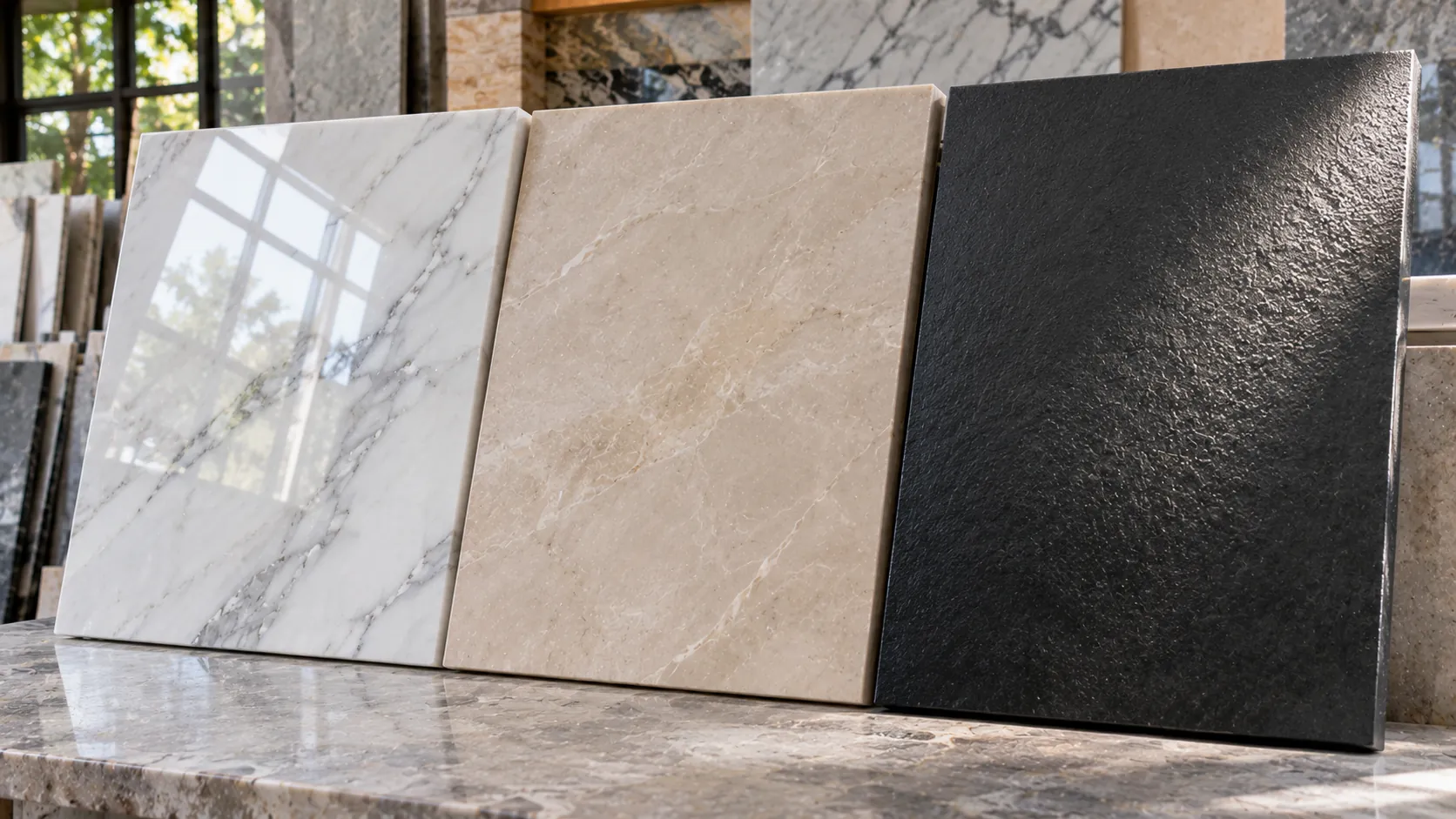
- A polished finish is a mirror gloss, a honed finish is smooth matte, and a leathered finish is a soft textured sheen; all three are the same stone ground differently.
- Honed marble hides lemon and vinegar etch marks far better than polished, because the dull spot matches the matte surface around it.
- Polished stone is the most slippery when wet; honed, brushed and leathered surfaces give better grip in bathrooms, kitchens and verandahs.
- In our November 2026 catalogue, Jet Black and Tropical are the marbles offered leathered; Galaxy Black, Nagar Parkar Grey, Khyber Black and Swat White are the leathered granites.
- Marble cannot be flamed; flamed is a granite-only texture for outdoor paving and is confirmed per job at quotation.
The short answer
In polished vs honed marble, polished gives a mirror shine and deeper colour but shows every etch mark and is slippery when wet; honed is a smooth matte that hides lemon and vinegar etching and grips better. Leathered adds a soft texture that hides fingerprints. All three are the same stone, ground to a different point.
The finish is the last step in cutting a slab, and it decides how the stone looks on day one and how it ages through years of pocha, haldi, hard bore water and dust. Most Pakistani homes end up mixing finishes: polished on walls, vanities and dry drawing-room floors, honed on marble kitchen tops and bathroom floors, and leathered or brushed on dark stone and covered outdoor areas. This guide explains how each finish is made, how they compare on slip, etch visibility and maintenance, which finish to choose for each room, and exactly which of our stones are offered in which finish.
How we priced this: stone figures in this post are our current catalogue quote ranges per square foot as of November 2026. They are fabricated and installed prices in our service area, covering the stone, cutting, a standard edge, a polished finish, fitting and sealing on fitting day; honed and leathered add-ons are taken from our cost estimator. Cut-outs, seams or mitres and freight outside our fitting cities are itemised on the quote. Re-polishing rates for an existing floor are indicative market ranges from our polishing guide, not our rates.
What is the difference between polished, honed and leathered?
The difference is how far the stone is ground and with what. Every finish starts from a sawn slab that is flattened under rotating diamond heads; the finish is simply where the workshop stops and which tool it uses last. Nothing is painted or coated onto the stone in any of them.
- Polished: a polished finish is a mirror-like surface made by grinding with progressively finer abrasives and then buffing until the face reflects light. It deepens colour, sharpens veining and closes the surface.
- Honed: a honed finish is the same grinding sequence stopped before the final buffing, leaving a smooth, flat, low-sheen face. Pale stones read a shade lighter and dark stones a shade greyer than when polished.
- Leathered: a leathered finish is a honed slab run under diamond-tipped brushes that wear the softer minerals slightly faster than the harder ones, leaving a gentle undulating texture you can feel with your palm and a faint sheen.
- Brushed: a brushed finish is a lighter version of the same brushing, giving a satin, slightly rippled face. It is common on travertine and limestone.
- Flamed: a flamed finish is a rough, non-slip texture made by passing a torch over granite so the surface crystals crack and pop. It only works on hard, silica-rich stone such as granite, never on marble.
| Finish | Look and feel | Grip when wet | Shows etching | Shows fingerprints and water spots | Absorbs stains |
|---|---|---|---|---|---|
| Polished | Mirror gloss, deepest colour | Lowest | Very clearly, as dull patches | Yes, especially on black | Least absorbent |
| Honed | Smooth matte, silky to touch | Better than polished | Hardly, blends into the matte | Less; dark stone can show oil marks | A little faster than polished |
| Leathered | Soft sheen, gentle pebbled texture | Good | Hardly | Hides them best | Similar to honed; seal after brushing |
| Brushed | Satin, lightly rippled | Good | Hardly | Hides them well | Similar to honed |
| Flamed (granite only) | Rough, crystalline, lighter colour | Highest | Not applicable: granite does not etch | Hides them | Seal with a penetrating sealer |
The stone underneath does not change. A honed Ziarat White has the same hardness, the same porosity and the same reaction to acid as a polished one; the finish only changes how those properties show up in daily life. That is why the question is less about which finish is better and more about which weaknesses you would rather live with.
Is polished marble more slippery than honed?
Yes. Polished marble is the most slippery stone finish when wet, and a honed or textured surface gives noticeably better grip underfoot. Dry and clean, a polished floor is safe to walk on in socks or chappals; the danger comes from water, soap, oil and fine dust, which turn a mirror face into a skating rink.
In a Pakistani house that matters in more places than people expect. Floors are mopped daily, bathrooms have no shower tray in many homes, ablution (wuzu) water reaches the floor near basins, children run in from the lawn with wet feet, and monsoon rain blows onto verandahs and porch steps. Our flooring guidance is simple: honed and brushed for bathrooms, kitchens, verandahs and stairs, and keep high polish for dry rooms and wall cladding. For floors that must grip, see our anti-slip options for marble floors.
Where the finish makes the biggest safety difference
- Bathroom floors and wet zones: honed or brushed marble, or brushed travertine. Avoid polish where water stands.
- Stair treads: honed or leathered treads, with anti-slip grooves near the nosing if the stair is near an entrance. Our stair marble design guide covers groove and nosing details.
- Kitchen floors: honed, because oil and water both reach the floor in front of the hob and sink.
- Verandahs and porch steps: brushed or leathered at minimum; for steps exposed to rain, a textured granite. Our black granite stairs guide compares tread finishes on dark granite.
- Elderly family members: if anyone in the house is unsteady on their feet, choose matte or textured floors throughout their route from bedroom to bathroom.
No floor finish is slip-proof. We do not publish slip-test ratings for our stones, so treat these comparisons as relative. Dry mats at bathroom doors, quick wiping of spills and a well-wrung mop matter as much as the finish.
Which finish hides etching and scratches best?
Honed and leathered finishes hide etching and fine scratches best; polished marble shows both clearly. Etching is not a stain. It is a chemical burn: marble is calcite, which reacts with acid, so lemon, imli (tamarind), vinegar, tomato, yoghurt-based marinades, cold drinks and acidic bathroom cleaners dissolve a microscopic layer of the surface and leave a dull spot. The glossary entry on etching explains the chemistry.
On a polished top the etched spot is matte against a gloss, so it catches the light and looks like a water ring that will not wipe off. On a honed top the etched spot is matte against matte, so it nearly disappears. Sealing does not stop etching, because the acid attacks the stone itself rather than soaking in. That is the main reason we suggest honed for marble kitchen worktops, where lemon and masala spills are part of every day.
| Problem | Polished | Honed | Leathered or brushed |
|---|---|---|---|
| Lemon, imli or vinegar etch | Obvious dull patch | Barely visible | Barely visible |
| Fine scratches from grit and chair legs | Visible in reflected light | Hidden in the matte | Hidden in the texture |
| Fingerprints and hand oil on dark stone | Very visible | Visible as darker patches | Hidden |
| Hard bore-water spots | Visible white rings on dark stone | Less visible | Least visible |
| Haldi, oil or tea stain (absorbed) | Slowest to absorb, easiest to wipe in time | Absorbs a little faster | Absorbs a little faster; dirt can sit in the texture |
| Dust on a dark surface | Very visible | Visible | Least visible |
Granite behaves differently. With a hardness of Mohs 6 to 7 against 3 to 4 for marble, it does not etch from kitchen acids and resists scratching from steel utensils, so a polished granite worktop stays glossy for years. On dark granite the reason to choose leathered is fingerprints and water spots, not etching. Our guide to marble vs granite covers the wider trade-off.
Absorbed stains are a separate problem. Haldi, cooking oil, tea and ink soak into any marble that is not sealed, whatever the finish. Our guide on how to remove stains from marble covers poultices for each type of stain.
Maintenance and sealing for each finish
Every finish needs the same basic care: an impregnating sealer at fitting, a pH-neutral stone cleaner, and no acids or scouring powder. What changes is how often you notice wear and how easily the surface can be brought back.
Polished
- Easiest to wipe clean, because the closed surface lets spills sit on top for longer.
- Shows wear first. Traffic lanes in corridors and the area in front of the kitchen sink turn dull over time, and grit carried in from the street acts like sandpaper. Door mats at every entrance help more than any product.
- Dry dark stone after mopping to avoid hard-water rings, especially where bore water is high in salts.
- Restoring the gloss is done with an on-site re-polish. Our marble polishing guide explains ragrai, honing and polishing on an installed floor, with indicative market rates.
Honed
- Seal on schedule. The open matte face absorbs a little faster, so we seal at installation and suggest resealing marble kitchen and bathroom surfaces every 6 to 12 months. The sealing entry explains the water-drop test.
- Expect a patina. Dark honed stone can show hand-oil patches for the first months; these even out as the surface is used and cleaned.
- Easy to refresh. A worn or etched honed surface can be re-honed on site without chasing a mirror gloss, which makes repairs less visible.
Leathered and brushed
- Seal after brushing and at the same interval as honed stone; the texture opens the surface slightly.
- Use a soft brush, not just a cloth, so dirt does not settle in the low points of the texture, especially on verandahs and outdoor counters.
- Avoid heavy oily cleaners, which leave a film in the texture that collects dust.
- Wear hides itself. Fine scratches, crumbs, prints and dust disappear into the texture, which is why leathered dark stone is so forgiving in busy kitchens.
Never use teezab (hydrochloric acid), tile acid, vinegar or bleach-based bathroom cleaners on marble, travertine or limestone in any finish. On polished stone they leave instant dull marks; on honed and brushed stone they slowly eat into the surface and the grout.
Which finish should you choose for each room?
Choose polished where the stone is mostly looked at and stays dry, honed where it is worked on or walked on wet, and leathered or brushed where it is touched constantly or sits outdoors. The table below is our starting point for Pakistani homes; your own habits may move a room one way or the other.
| Room or surface | First choice | Also works | Avoid |
|---|---|---|---|
| Drawing and dining room floors | Polished | Honed for a modern look | Textured finishes indoors (hard to mop) |
| Bedrooms and lounges | Polished or honed | Either | None, if kept dry |
| Corridors and entrance halls | Honed | Polished with mats at every door | High polish where street grit comes in |
| Bathroom floors | Honed or brushed | Brushed travertine | Polished |
| Bathroom walls and vanity tops | Polished | Honed | None |
| Marble kitchen worktops | Honed | Leathered on dark marble | Polished light marble beside the hob and sink |
| Granite kitchen worktops | Polished or leathered | Honed | None; granite does not etch |
| Stair treads | Honed or leathered | Brushed | Polished on outdoor or entrance stairs |
| Feature walls and fireplaces | Polished | Honed for a calm look | None |
| Verandahs, porches and outdoor counters | Brushed or leathered | Flamed granite, if confirmed for your lot | Polished stone of any kind |
Kitchens
For a marble kitchen top, honed is the practical choice: etch marks from lemon, chutney and imli blend in, and the surface can be refreshed on site. If you love gloss, use polished marble on the island or a breakfast counter that sees less cooking, and keep the working run beside the hob in granite. Our kitchen marble design guide covers layouts and stone pairings. On dark granite such as Galaxy Black, a leathered top hides water marks and fingerprints better than a polished one.
Bathrooms
Use polished on walls and vanity tops, where the gloss is easy to wipe and nobody stands on it, and honed or brushed on the floor. Using one stone in two finishes keeps the colour story unified while putting grip where it is needed.
Floors through the house
Most Pakistani families still choose a polished floor in the main rooms, and that is a reasonable choice in dry rooms with mats at the doors. If you want the floor to look the same after ten years of daily pocha, a honed floor ages more evenly and can be machine-polished later if you change your mind. Our marble floor design guide has layout and border ideas for both.
Which of our stones come in which finish?
Almost every stone in our catalogue is offered polished and honed; Gadap Stone and Badal travertine come only honed or brushed. Leathered and brushed are listed on fewer stones, because brushing suits dense stones that take a texture evenly. The table lists the finishes each product page shows, with our current quote ranges as of November 2026.
| Stone | Type | Finishes listed | Quote range |
|---|---|---|---|
| Jet Black | Marble | Polished, honed, leathered | 1,100 – 2,000 |
| Tropical | Marble | Polished, honed, leathered | 650 – 1,200 |
| Denso | Marble | Polished, honed, brushed | 450 – 820 |
| Gadap Stone | Limestone, sold as marble | Honed, brushed | 260 – 520 |
| Dawezai Badal Travertine | Travertine | Honed, brushed | 640 – 1,180 |
| Galaxy Black | Granite | Polished, honed, leathered, brushed | 900 – 1,700 |
| Nagar Parkar Grey | Granite | Polished, honed, brushed, leathered | 650 – 1,200 |
| Khyber Black Granite | Granite | Polished, honed, leathered | 850 – 1,600 |
| Swat White Granite | Granite | Polished, honed, leathered | 720 – 1,350 |
| Nagar Parkar Pink | Granite | Polished, honed, brushed | 700 – 1,300 |
| Balochistan Red Granite | Granite | Polished, honed, brushed | 780 – 1,450 |
All other marbles, including Ziarat White (PKR 850 – 1,600), Verona Plain (600 – 1,100), Sunny Grey (560 – 1,000), Tavera Light (520 – 980), Black & Gold (1,400 – 2,800) and the Fancy stones, are offered polished or honed. Chips Dana (180 – 420) is ground and finished on site, polished or honed. The three onyxes are offered polished or honed and stay on light-duty surfaces. Browse every stone with its finishes on our stone catalogue.
Leathered marble: Jet Black and Tropical
Jet Black is a dense, near-uniform black that takes a glass-like polish, but fingerprints show on a polished face, so honed or leathered is easier to live with in a working kitchen. Tropical is a warm brown with tan drift; its leathered slabs pick up a subtle texture that suits verandah floors and covered outdoor areas. The Jet Black collection shows the stone in kitchens, stairs and skirting.
Brushed marble, travertine and limestone
Denso is a tight-grained grey whose grain stays semi-matte even when fully polished; brushed, it is a budget option for stairs, service areas and porches. Badal travertine is supplied resin-filled and honed as standard, or brushed for verandahs, shower floors and porches; the Badal collection shows both. Gadap Stone is honestly a limestone from the hills outside Karachi, offered only honed or brushed, for cladding, plinths and shaded paving.
What about flamed?
Marble cannot be flamed: it is calcite, and intense heat breaks it down towards lime instead of cracking the surface cleanly. Flaming is a granite texture. It is not one of the listed finishes on any of our granite product pages, so if you want flamed granite for a driveway, pool edge or exposed steps, ask at quotation and we will confirm whether it can be done on your chosen lot and thickness.
Does the finish change the price?
Yes, a little: polished is the baseline, and the extra workshop passes for honed or leathered add to the rate. Our stone cost estimator adds PKR 180 per sq ft for a honed worktop and PKR 300 per sq ft for a leathered one, with polished included, as of November 2026. Your written quote states the finish for every surface and the rate that goes with it.
| Finish | Estimator add-on | Installed, 40 sq ft (PKR) |
|---|---|---|
| Polished | Included | 44,000 – 80,000 |
| Honed | +180 per sq ft (+7,200) | 51,200 – 87,200 |
| Leathered | +300 per sq ft (+12,000) | 56,000 – 92,000 |
Seen across a whole job, the finish is a small share of the total. Where you land within a stone's range depends far more on grade, lot, slab size and thickness. Cut-outs, mitres and freight outside our fitting cities are itemised separately on the quote.
Changing the finish after installation is a different job. Converting a polished floor to honed, or bringing a dull honed floor up to a gloss, is done with on-site grinding and polishing; our marble polishing guide explains the work.
As an indicative market range, a light re-polish runs about PKR 25 to 50 per sq ft and a full restoration about PKR 50 to 90, labour only.
Mixing finishes in one house
Using one stone in two finishes is one of the easiest ways to give a house a considered look, and it solves practical problems at the same time. Common pairings we see work well:
- Polished walls, honed floor in bathrooms: the gloss on the walls reflects light; the matte floor grips.
- Polished risers, honed or leathered treads on stairs: risers are never walked on, so they can shine.
- Polished island, honed perimeter worktops in a marble kitchen: the island is the showpiece, the working run hides etching.
- Leathered granite worktop, polished granite backsplash: the top hides prints, the splashback wipes clean.
- Polished indoor floor, brushed verandah in the same stone family: the colour flows from inside to outside while the outdoor surface grips.
Two cautions. First, a honed slab reads lighter than a polished slab of the same stone, and dark stones turn slightly grey when matte, so view both finishes side by side before deciding. Second, order every finish from one lot so the base colour matches; the finish will not hide a shade difference between two blocks.
Common mistakes to avoid
- Polished light marble beside the hob. It will etch within weeks; choose honed or put granite on the cooking run.
- Polished floors in bathrooms and at entrances. They are the most common cause of slips on stone.
- Judging a finish from a phone photo. Gloss photographs well and matte photographs flat; hold real samples under your own light.
- Expecting honed to be maintenance-free. It hides etching, but it still needs sealing against haldi, oil and tea.
- Applying wax or acrylic for shine. Coatings scuff, yellow and trap dirt; a real polish comes from grinding, not a bottle.
- Asking for flamed marble. It cannot be done; ask for brushed marble or flamed granite instead.
- Ordering finishes from different lots. Reserve all the stone for one project from one block.
See the finishes before you choose
The quickest way to decide is to put samples of the same stone in two finishes on your counter or floor for a day: spill a drop of lemon on each, wipe it after a minute, and see which one you would rather live with. Order samples in the finishes you are considering, then send us your room sizes for a free written quote that names the stone, the finish for each surface and the installed rate.
Written by
The Captivating Marble Design Team
Fabricators, templaters and stone designers
We template, cut and install natural stone every day and write about what we learn — pricing, layouts, care and the mistakes we help clients avoid.
Book a free design consultation