Black Granite Steps in Pakistan: Treads, Nosing, Finishes and Costs
Treads, risers, nosing profiles, anti-slip finishes and PKR cost per step for black granite stairs indoors and out in Pakistan. Get a free stair quote today.
Captivating Marble Design Team · · Updated · 23 min read
Key takeaways
- Galaxy Black (Karachi) costs PKR 900–1,700 per sq ft and Khyber Black Granite (Nowshera) PKR 850–1,600 at our November 2026 quote ranges.
- A 4 ft step with a 12 inch tread and 7 inch riser costs roughly PKR 5,400–10,900 cut and fitted at our quote ranges.
- Granite rates 6–7 on the Mohs scale against about 3 for marble, so street grit barely wears a granite nosing.
- Polished granite is slippery when wet; use honed, leathered or brushed treads with two or three anti-slip grooves.
- Flamed granite gives the most grip outdoors but turns black stone grey and needs thicker material.
The short answer
Black granite steps are the toughest stair finish in Pakistan: at Mohs 6–7 against about 3 for marble, they shrug off grit, rain and acids for decades. We supply Galaxy Black from Karachi (PKR 900–1,700 per sq ft) and Khyber Black Granite from Nowshera (PKR 850–1,600), roughly PKR 5,400–10,900 per 4 ft step, cut and fitted.
That per-step figure assumes a 4 ft wide step with a 12 inch tread and a 7 inch riser, and it holds on porch, garage, roof and commercial stairs where marble would dull within a few seasons. The decisions that matter more than the price are the finish on the tread (honed, leathered or brushed for grip, not a mirror polish outdoors), the nosing profile, whether each tread is one piece, and how the steps are bedded. This guide covers each one, with worked costs and a checklist for the yard.
How we priced this: Galaxy Black and Khyber Black Granite rates are our current catalogue quote ranges per square foot as of November 2026, fabricated and installed in our service area. The cutting, nosing, groove and fitting labour figures further down are indicative market ranges that apply only if you buy stone alone and hire your own fabricator and fitter. Confirm the final figure against a written quotation.
Is black granite good for stairs?
Yes: black granite is one of the best stair stones because it is hard enough to resist the grit that wears marble and dense enough to cope with rain and mopping. A staircase concentrates wear on a narrow strip at the front of every tread. Each footstep lands, pivots and pushes off on the same few inches, and every shoe carries grit from the street. The quartz in that grit sits at about 7 on the Mohs scale. Marble, being calcite, sits at about 3, so the grit sands it with every step. Granite sits at roughly 6 to 7, which is why the same dust barely marks it.
What granite handles that marble does not
- Acid. Rain in industrial areas, bird droppings, spilled cold drinks and tile-cleaning acids all etch marble. Granite is a silicate stone and shrugs them off.
- Abrasion. Driveway grit, construction dust and the sand that blows in during Lahore and Karachi dust storms dull a polished marble nosing in months. A granite nosing keeps its edge.
- Impact. Gas cylinders, water tanks, furniture and motorbikes get dragged up and down Pakistani stairs. A well detailed granite nosing chips far less than marble of the same thickness.
- Sun and heat. Granite does not fade or soften in full sun, and it takes the summer temperature swing on a roof stair without trouble.
- Absorption. Dark granites are dense and absorb very little water, so they cope with monsoon rain and mopping better than open-textured stones.
What black adds on top
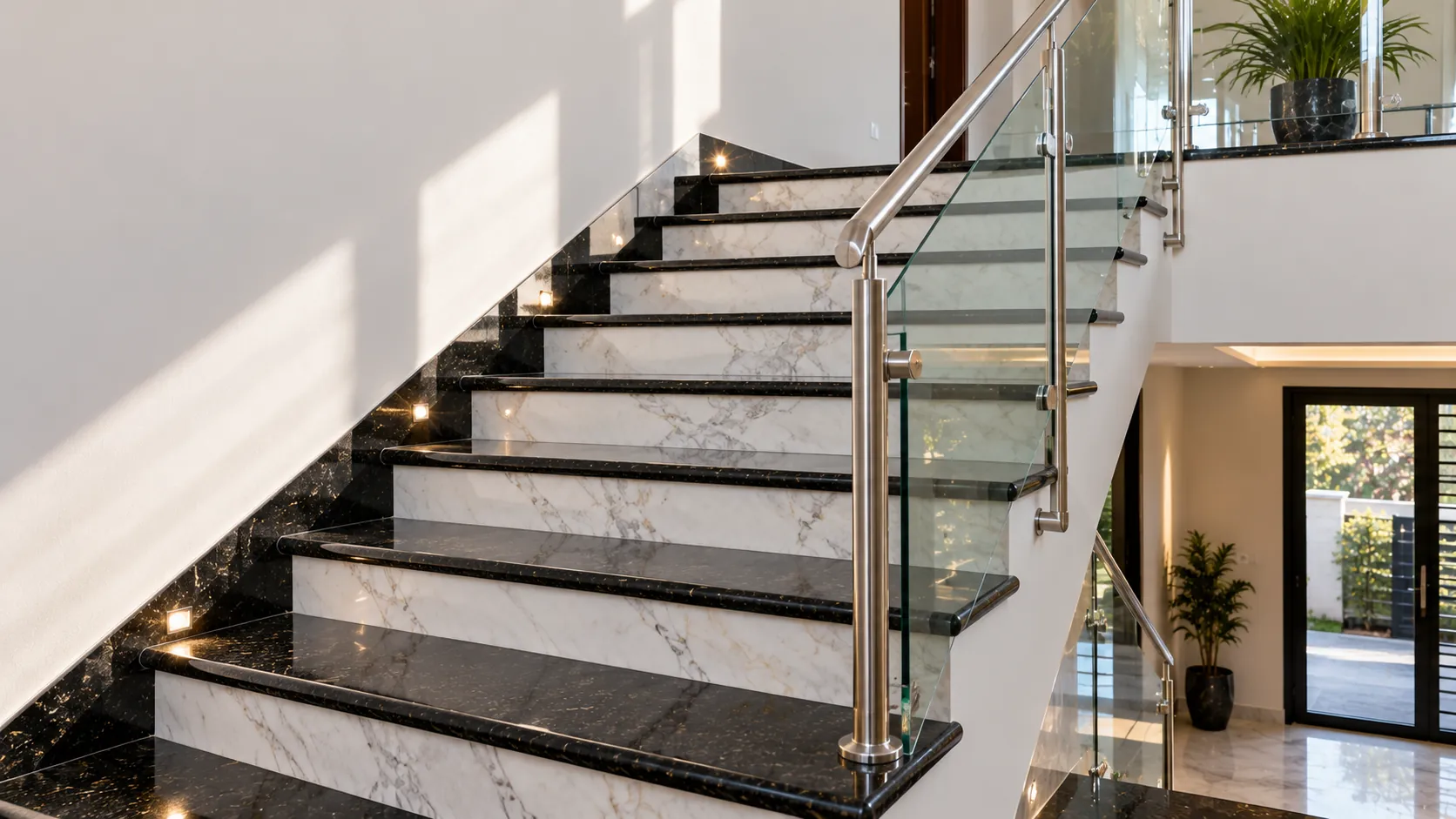
Colour matters on a stair for practical reasons too. Black hides oil from car tyres, tea stains and the grey film that builds up on a pale step near a gate. It gives strong visual contrast against a white or beige floor, which helps anyone with weak eyesight judge where the stair starts. And it frames a lighter interior: black treads with white risers, as in the photo at the top of this guide, are a popular look in new houses.
Black has downsides as well, covered honestly further down: polished black shows footprints, dust and hard-water marks, and a black step in full sun gets hot underfoot.
Our two black granites for stairs
Both of our black stones are hard, dense and quarried in Pakistan. They look quite different up close, and the difference decides where each one works best.
| Galaxy Black | Khyber Black Granite | |
|---|---|---|
| Origin | Karachi, Sindh | Nowshera, KP |
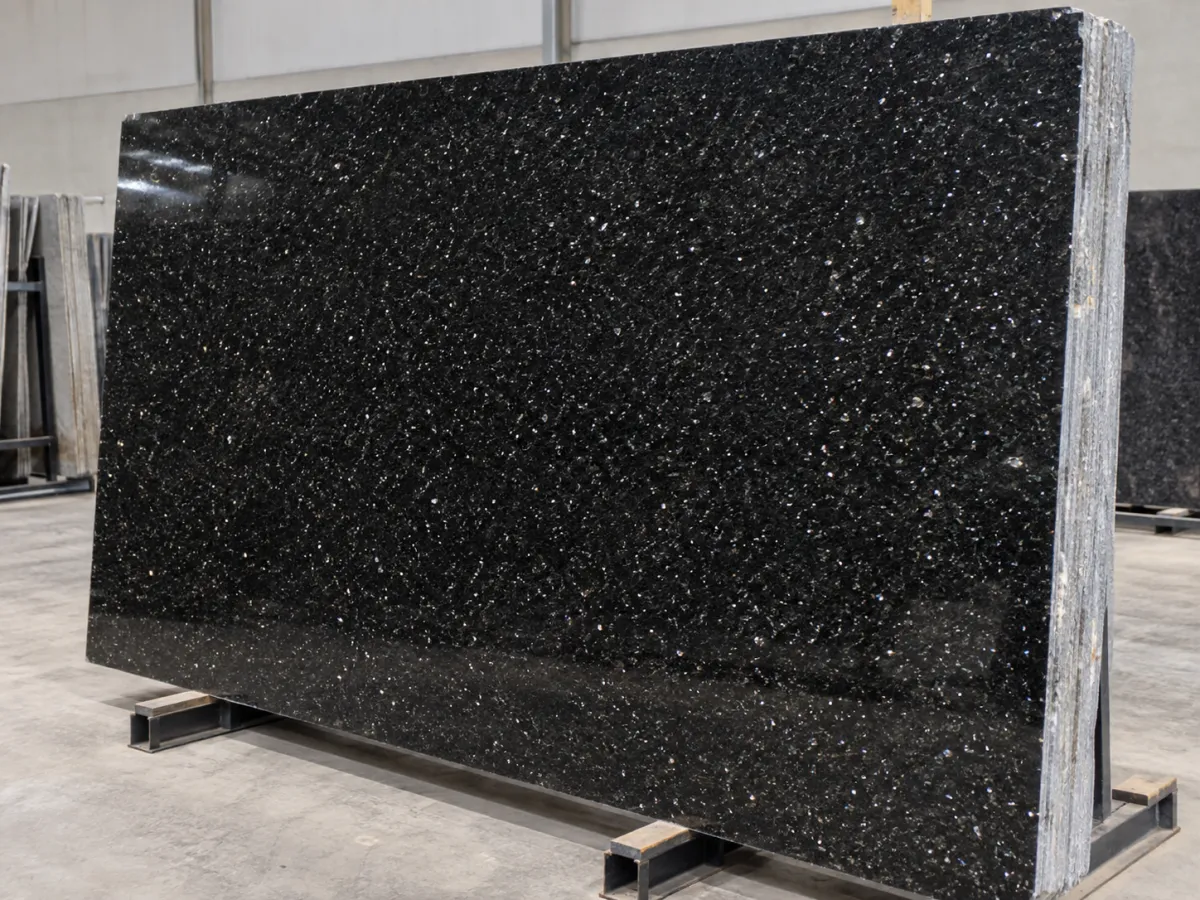
| Look | Black ground with silvery mica flecks that sparkle under light | Dense charcoal with a very fine grain, near-solid from a metre away |
| Listed finishes | Polished, honed, leathered, brushed | Polished, honed, leathered |
| Thickness | 2 cm and 3 cm | 2 cm and 3 cm |
| Slab size we list | About 108 x 66 in (sizes vary by lot) | About 96 x 62 in (sizes vary by lot) |
| Our current quote range | PKR 900 – 1,700 / sq ft | PKR 850 – 1,600 / sq ft |
| Best stair use | Entrance steps, commercial stairs, feature landings | Treads and risers where a calm, solid black is wanted; engraved step names or house numbers |
Galaxy Black
Galaxy Black is the toughest surface on our list. Its flecks of mica catch light, which makes it lively on an entrance stair and helps hide the dust that settles on any step near a gate. The longer slabs we list (about 9 ft) are an advantage on stairs: two 4 ft treads can usually be cut end to end from one length, which reduces wastage on a standard flight. Builders use it for stair treads and commercial entrances for exactly these reasons.
Khyber Black Granite
Khyber Black Granite comes from the dolerite quarries around Nowshera; geologically it is a dolerite, sold in the trade as black granite. Its grain is so fine that it reads as solid charcoal, closer to the imported absolute blacks than anything else quarried locally. That calm look suits modern interiors and minimal staircases. It also takes engraving crisply, so a house name or number cut into the bottom step stays sharp. The slabs we list are about 8 ft long, so on a stair wider than about 3 ft 10 in you will usually get one full tread per length rather than two; ask the yard to plan the cut before you compare quotes.
Both stones show dust and water spots on a polished face. On treads, that is the main reason to choose a honed or leathered finish, as explained below. For how these blacks compare with imported names such as Black Galaxy and Absolute Black, see our granite price guide, which covers the market for black granite in more detail.
Anatomy of a granite step: treads, risers and nosing
Fitters and yards use a small set of terms. Knowing them makes it far easier to compare two quotes line by line.
- Tread: the horizontal piece you stand on, usually 10 to 12 inches deep in Pakistani houses plus the nosing projection. Entrance and porch steps are often deeper, 14 inches or more.
- Riser: the vertical face between treads, usually 6 to 7 inches high. Risers take almost no foot traffic, so they can be thinner, cheaper or a contrasting stone.
- Nosing: the front edge of the tread, projecting about 3/4 to 1 inch past the riser. It takes the knocks and the wear, so its shape and thickness matter most.
- Landing: the flat platform where a flight turns, laid like a small floor.
- Skirting: the strip along the wall, cut in a stepped zigzag that follows each step or as a straight slanted band.
- Stringer or side face: on an open-sided stair, the exposed edge of the concrete flight, which can be clad in matching strips.
One-piece treads or joined tiles
A one-piece tread is a single length of granite across the full width of the stair. A joined tread uses two or more tiles with a joint somewhere in the middle. One-piece treads cost more because they need long, sound offcuts, but they look far better, carry load evenly and never open a joint where people step. On any stair wider than a single tile, ask the yard to write "one-piece treads" on the quote.
2 cm or 3 cm
Both of our black granites come in 2 cm and 3 cm. On an indoor stair laid on a full bed, 2 cm treads are common and perform well. A 3 cm tread gives a heavier, more solid nosing and suits entrance steps, commercial stairs and any step that may take wheeled loads. Risers rarely need 3 cm. A middle route is a 2 cm tread with a laminated (double) nosing, which makes the front edge look about 4 cm thick for less stone.
Nosing profiles for granite stairs
The nosing is the part people see, touch and trip on. Granite is harder than marble, so shaping and polishing an edge takes the workshop longer, and most quotes price nosing by the running foot rather than including it in the stone rate.
| Profile | What it looks like | Good for | Watch out for |
|---|---|---|---|
| Eased (pencil) edge | Square edge with the sharp arris lightly rounded | Modern interiors, risers, skirting tops | A near-square corner chips more easily under heavy knocks |
| Half bullnose | Top corner rounded, underside flat | Most indoor and porch steps | A balanced, current choice; keeps a crisp shadow line |
| Full bullnose | Half-round across the whole thickness | Family homes, traditional stairs | Soft underfoot; can look heavy on thin 2 cm stone |
| Laminated (double) nosing | A second strip bonded under the front edge, then profiled | Making 2 cm treads look thick and solid | Ask for a colour-matched epoxy joint; a grey line shows on black |
| Bevelled edge | A flat 45 degree chamfer on the top corner | Contemporary stairs and thresholds | Sharper than a bullnose on bare shins |
On a family stair, a bullnose edge, full or half, is kinder to heels and shins and the least likely to chip. On black granite the curve also catches light in a thin bright line that marks the edge of each step at night, which is a quiet safety bonus.
Contrast strips and inserts
Some commercial stairs add a contrasting strip near the nosing, either a groove filled with a lighter material or a separate inlaid band. On black granite, a lighter strip helps people with low vision see each edge. Plain grooves without infill (covered below) give grip without changing the look.
Which tread finish gives the best grip?
Leathered, brushed or honed treads give good grip indoors and on covered steps, while a flamed finish gives the most grip outdoors but turns black granite grey. Polished granite is no less slippery than polished marble when it is wet. A mirror finish on a porch step with monsoon rain on it, or on an indoor step being mopped, is a fall waiting to happen. The finish you choose for the tread is the single biggest safety decision on the stair.
| Finish | Look on black stone | Grip | Where it fits |
|---|---|---|---|
| Polished | Deep, glossy black; mica flecks sparkle | Lowest, especially when wet | Risers, skirting and dry indoor treads only |
| Honed | Smooth matte charcoal, slightly lighter than polished | Better than polished indoors | Indoor treads, landings |
| Leathered | Soft sheen with a gentle undulating texture; stays dark | Good | Indoor and covered outdoor steps; hides water spots and prints |
| Brushed | Matte with a fine texture | Good | Covered porches, verandas (Galaxy Black lists it) |
| Flamed | Rough, crystalline and noticeably greyer than the polished stone | Highest | Fully exposed outdoor steps, pool surrounds, driveways |
Leathered is the usual sweet spot
A leathered finish is brushed with abrasive heads until the surface takes on a soft, slightly textured sheen. On black granite it keeps the colour deep, gives your sole something to grip and hides footprints and hard-water marks far better than a polish. Both Galaxy Black and Khyber Black Granite list it. For most porch, entrance and indoor treads it is the finish we would suggest you look at first.
Flamed finish: maximum grip, different colour
A flamed finish is made by passing a high-temperature torch over the stone so that crystals in the top millimetre crack and pop. The result is the roughest, most slip-resistant granite surface, which is why it is used on driveways, pool decks and fully exposed steps. Two things to know before you ask for it. First, flaming lightens black granite to a grey, crystalline look, so a flamed black step will not match polished black risers. Second, the heat shock can crack thin material, so it needs thicker stone. Flamed is not one of the standard finishes listed on our two black granite product pages; if you want it, ask for it at quotation stage so we can confirm whether it can be done on your lot and thickness.
Grooves
Two or three grooves cut a short distance behind the nosing, typically about 4 to 5 mm wide and around 3 mm deep, add grip on any finish and are hardly visible from a standing position. They are especially useful on honed indoor treads. Keep them clean: on outdoor steps, grit packs into grooves and should be brushed out when you sweep.
Outdoor steps: porches, gates, roofs and garages
Outdoor stairs are where granite earns its price. Marble on a sun-baked porch in Multan or a rain-soaked gate step in Islamabad loses its polish within a season or two and starts to etch. Black granite steps in the same position keep their colour and edge for years. A few details make the difference between an outdoor stair that lasts and one that cracks, stains or turns into a slide.
Fall and drainage
Every outdoor tread should fall slightly towards the nosing so rainwater runs off instead of pooling at the back against the riser. Landings and porch platforms need a fall away from the house. Standing water in the monsoon leaves algae and grime on any stone and, on a polished step, creates a skating rink.
Heat underfoot
Any dark surface absorbs more of the sun than a light one, and black granite in direct June sun becomes uncomfortably hot to walk on barefoot. That matters on roof stairs, pool steps and the steps where people take off their shoes before entering. Shade the stair, choose a lighter grey granite for fully exposed barefoot areas, or accept that the step is for shoes in summer.
Movement joints
Outdoor stone expands and contracts with the day-night temperature swing. Long runs of porch paving and wide landings need movement joints filled with a flexible sealant rather than rigid grout, especially where the stone meets a wall or a different slab. A stair that is grouted solid from wall to wall is more likely to crack or lift a piece after a few summers.
Efflorescence: the white bloom on black stone
When water moves through a cement bed it can carry salts to the surface and leave a white crust along joints and edges. On a beige marble it is barely noticed; on black granite it stands out immediately. Reduce it by using a properly mixed bed, curing it correctly, sealing the joints and sorting out any rising damp before the stone goes down. If bloom appears, brush it off dry first and use a cleaner made for efflorescence, tested on a hidden corner, rather than raw tile acid, which attacks cement joints and any marble nearby.
Garage ramps and car entrances
Where cars drive over the stone, use 3 cm material on a solid, well compacted bed, keep pieces smaller so they do not crack under a wheel, and choose a textured finish. Hot tyres and engine oil leave marks; on black stone they are far less visible than on beige or white.
How much do black granite steps cost?
Yards quote stone per square foot, while stair fitters often quote per step or per running foot. Convert everything to a cost per step to compare. The table uses two common sizes: an indoor step 4 ft wide with a 12 inch tread and a 7 inch riser (about 6.4 sq ft of finished stone), and a porch step 6 ft wide with a 14 inch tread and a 6 inch riser (about 10 sq ft).
| Stone | PKR per sq ft | Indoor step, 4 ft (about 6.4 sq ft) | Porch step, 6 ft (about 10 sq ft) |
|---|---|---|---|
| Khyber Black Granite | 850 – 1,600 | PKR 5,440 – 10,240 | PKR 8,500 – 16,000 |
| Galaxy Black | 900 – 1,700 | PKR 5,760 – 10,880 | PKR 9,000 – 17,000 |
Worked example: a full indoor flight
A typical 10 marla double-storey house with one flight from ground to first floor and one landing needs about 68 sq ft of treads, 43 sq ft of risers, 32 sq ft of landing and 8 sq ft of skirting, around 151 sq ft in total, or about 165 sq ft with 10 per cent wastage. The table shows three ways to build it.
| Design | Areas | Estimated installed cost (PKR) |
|---|---|---|
| All Khyber Black Granite | 165 sq ft granite | 140,250 – 264,000 |
| All Galaxy Black | 165 sq ft granite | 148,500 – 280,500 |
| Galaxy Black treads and landing, Ziarat White risers and skirting | 110 sq ft granite + 56 sq ft marble | 146,600 – 276,600 |
| Galaxy Black treads and landing, Medium White risers and skirting | 110 sq ft granite + 56 sq ft marble | 129,800 – 240,200 |
The black-and-white look in the photo at the top of this guide pairs granite treads with white marble risers such as Ziarat White. Risers take almost no wear, so a softer, lighter stone is fine there. Swapping to a cheaper white on the risers saves money without touching the part of the stair that works hardest.
Worked example: three porch steps
Three porch steps 6 ft wide need about 30 sq ft of stone, or about 33 sq ft with wastage: roughly PKR 28,050 to 52,800 in Khyber Black Granite or PKR 29,700 to 56,100 in Galaxy Black, cut, finished and fitted; special nosing profiles and freight outside our fitting cities are itemised on the quote. Put your own sizes into our stone cost estimator for a first figure.
If you buy the stone only: indicative labour rates
| Item | How it is usually quoted | Indicative market range |
|---|---|---|
| Cutting, polishing and a simple edge | Per sq ft | PKR 150 – 400 |
| Bullnose or half-round nosing polish | Per running ft | PKR 100 – 250 |
| Double (laminated) nosing | Per running ft | PKR 250 – 600 |
| Anti-slip grooves, 2 – 3 lines | Per running ft | PKR 60 – 150 |
| Fitting labour, tread and riser | Per step | PKR 700 – 1,800 |
These labour figures are indicative ranges seen in the Punjab trade, not our rate card, and apply only to stone bought on its own; our quote ranges above already include cutting, finishing and fitting. Granite is slower to cut and profile than marble, so edge work on black granite often sits towards the upper end. Ask every bidder to list stone, wastage, cutting, nosing, grooves, finish, transport and fitting as separate lines.
Why online stair rates look lower
Rate lists online often show stair or step prices well below our installed figures. Usually they are yard rates for ungraded stock, sometimes thinner or in short pieces that need a joint in every tread, and they leave out the nosing, grooves and fitting. Some "black granite" at the bottom of the market is not granite at all but black marble or dyed stone. Compare like with like: the same stone, thickness, finish and scope.
Is it really granite? Three tests at the yard
Black stone is the easiest category to misrepresent, because dark marble, dyed limestone and resin-treated material can all look similar to granite when polished. Take an offcut and run three simple checks before you pay an advance.
- The scratch test. Draw a steel key firmly across the back or an edge. Real granite will not scratch; marble and limestone will show a pale line.
- The vinegar test. Put a drop of vinegar or lemon juice on an offcut and wait a few minutes. Marble fizzes or dulls; granite stays unchanged.
- The acetone test. Wipe an edge with a cloth dampened with nail polish remover. Black or grey colour on the cloth suggests dye or a colour-enhancing coating. A surface that turns noticeably greyer once the solvent dries suggests it was oiled or waxed to look darker.
A real, untreated black granite passes all three. If a seller will not let you test an offcut, treat that as an answer.
Fitting granite stairs: the order of work
Most Pakistani stairs are an RCC waist slab with brick or concrete steps on top, finished in stone. Good stone cannot rescue a bad base, so the first job is checking the concrete.
- Check the base. Every step should be the same height to within a few millimetres. Build up low steps and grind high ones before ordering stone; the first and last risers in older houses are often different.
- Measure or template. Measure each step after the base is finished, not from drawings. Curved or winder steps need a hardboard template for each piece.
- Cut in the workshop. Treads are cut, the nosings profiled and polished, and grooves cut before the stone reaches site. Granite is hard to shape on site with hand tools.
- Fix risers first. Risers are set back so each tread nosing projects evenly past them.
- Bed treads fully. Each tread goes on a full bed of mortar or a thick adhesive, back-buttered, with a slight fall forward. Spot fixing on dabs leaves hollows that crack under a heel.
- Tap-test every tread. A hollow sound means an air pocket. Lift and re-lay it the same day.
- Fill joints with colour-matched grout or epoxy. A grey cement line is very visible on black stone.
- Protect and cure. Keep the stair closed for a day or two. If it is the only route upstairs, fit alternate steps first.
Summer heat dries a mortar bed too quickly and monsoon humidity slows it, so experienced fitters adjust water and curing to the season and keep fresh stone out of direct sun. Our stone installation service covers measuring, cutting and fitting, and our stair marble design guide has more on layouts, skirting and landing borders. For the strip along the wall, see our marble skirting guide.
Design ideas for dark granite stairs
- Black treads, white risers. The classic contrast: granite where the wear is, a white marble such as Ziarat White on the risers and skirting. It works with steel and glass railings and with timber handrails.
- All black, leathered. Treads, risers and skirting in one leathered black granite give a calm, monolithic stair that suits concrete, white plaster and black metal.
- Black edge, light tread. A black granite nosing strip or border on a beige or white marble stair adds grip, contrast and protection at the edge, while the rest of the tread stays light.
- Feature landing. A polished Galaxy Black landing, where nobody steps when wet, with honed or leathered treads either side.
- Engraved bottom step. A house name, family name or verse cut into a Khyber Black Granite riser at the gate, where its fine grain keeps the lettering crisp. The same fine-grained black is used for engraved headstones; see grave stone design.
- Lighting in the skirting. Small LED step lights set into the wall beside each tread throw light across the stone and mark every edge at night.
Black stone reads best against light walls and good daylight. On a narrow, dark stairwell, all-black treads and risers can make the space feel heavier; there, black treads with light risers keep the stair bright.
Buying checklist for granite treads
- Give the yard the full quantity (treads, risers, landing, skirting, side faces) so everything can come from one lot.
- Check slab length against your stair width, and ask how many treads they expect from each slab.
- Wet a corner to see the true colour and look at it in daylight, not under shed lights.
- Look along the surface for cracks and resin-filled lines. Keep them off treads and nosings.
- Measure thickness at several points; uneven slabs give uneven nosings.
- Run the scratch, vinegar and acetone tests on an offcut.
- Agree the finish for treads and for risers separately, the nosing profile, groove count and whether treads are one piece, and write all of it on the quote.
- Order two spare treads from the same lot. Replacing a chipped step years later is easy with a match and very hard without one.
If you cannot get to the yard, order stone samples of Galaxy Black and Khyber Black Granite first, ideally in the finish you plan to use, and look at them on the actual stair in morning and evening light.
Caring for black granite treads
- Sweep or dust-mop daily. Fine dust is the main thing that makes a dark stair look tired, and grit is what wears any finish.
- Wash with plain water or a pH-neutral stone cleaner. Avoid acid-based bathroom and tile cleaners; they will not etch granite, but they dull polish over time and attack cement joints.
- Dry polished steps after mopping in areas with hard water, such as much of Karachi and Lahore, to prevent white rings and streaks.
- Sealing is rarely needed. Dense dark granite absorbs very little; an impregnating sealer on the joints and on any textured outdoor finish is usually enough. Do the water-drop test on a hidden corner if in doubt.
- Keep doormats at the top and bottom of outdoor stairs to stop grit being carried inside.
- Brush out grooves on outdoor treads when you sweep so grit does not pack into them.
Get a quote for your stair
Send us the number of steps, the stair width, tread and riser sizes, whether it is indoors or out and a photo of the concrete flight, and we will return a free written quote with the installed rate for your stone and wastage, and any special nosing, grooves or freight itemised. If you are deciding between Galaxy Black and Khyber Black Granite, or between leathered and honed, start with samples and see them on the stair itself.
Written by
The Captivating Marble Design Team
Fabricators, templaters and stone designers
We template, cut and install natural stone every day and write about what we learn — pricing, layouts, care and the mistakes we help clients avoid.
Book a free design consultation