Grave Marble Design in Pakistan: Enclosures, Headstones, Stone Choice and Care
Choosing stone for a qabar: enclosure, top slab and kutba, white marble or black granite for sun and rain, finishes and upkeep. Ask for a cut-to-size quote.
Captivating Marble Design Team · · 15 min read
Key takeaways
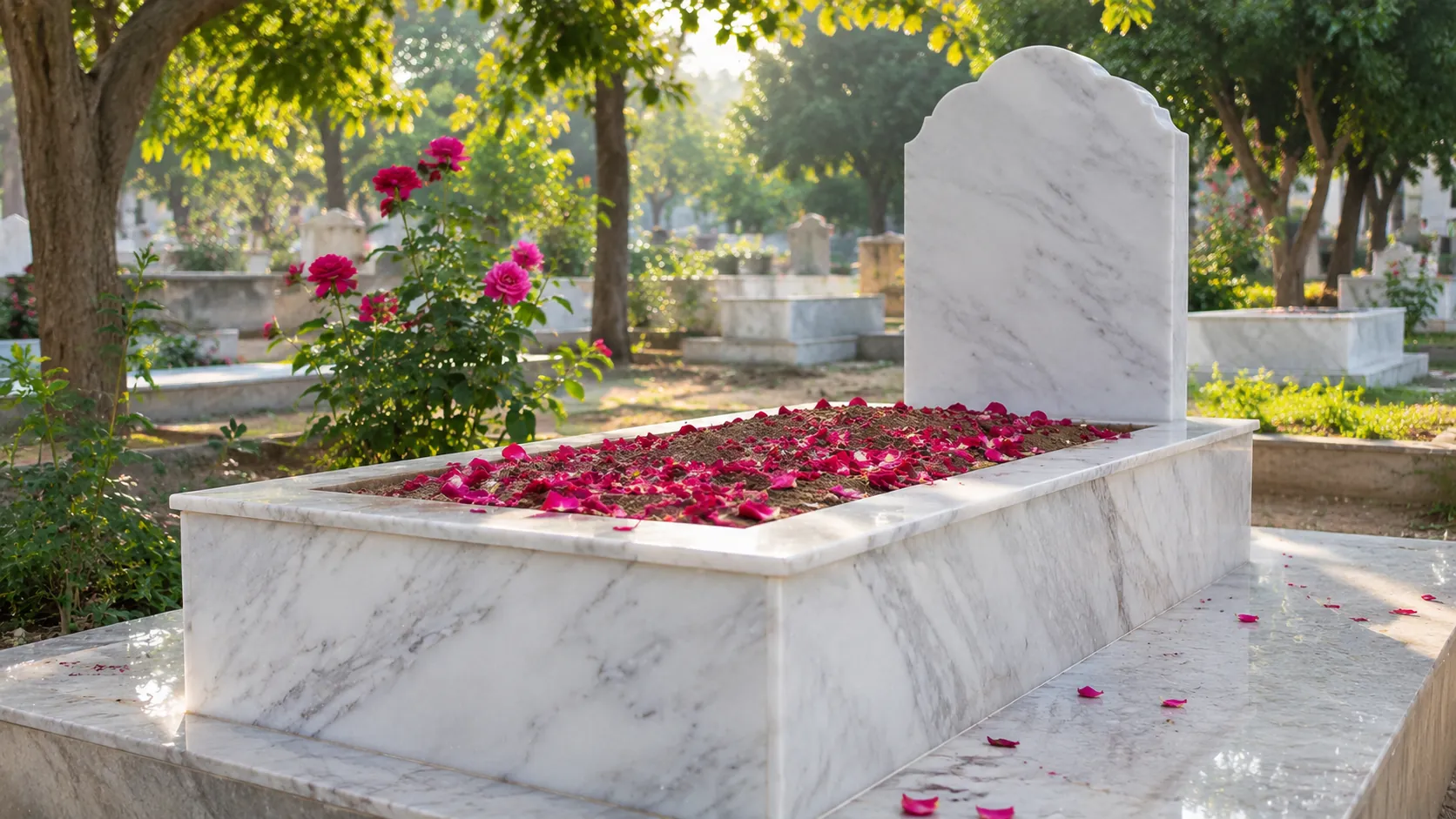
- A typical grave in stone has three parts: an enclosure around the plot, an optional top slab, and an upright headstone, often called the kutba.
- Granite stands up to sun, monsoon rain and dust better than marble; white marble looks brighter at first but slowly dulls and stains outdoors.
- Khyber Black Granite takes crisp engraved lettering and is a traditional choice for headstones at PKR 850–1,600 per sq ft on our November 2026 ranges.
- Customs and graveyard rules on raised structures, height and materials vary, so check with your family and the graveyard committee before ordering.
- Clean grave stone with plain water, a soft brush and a pH-neutral cleaner; acid cleaners such as teezab etch marble permanently.
The short answer
A lasting grave marble design in Pakistan is usually a simple enclosure around the plot, with or without a top slab, and an upright headstone (kutba) carrying the name and dates. For a grave that stands in open sun and monsoon rain, granite such as Khyber Black or Swat White lasts best, while white marble such as Ziarat White looks bright but needs more care. As of November 2026 our catalogue ranges for these stones run from PKR 550 to 2,000 per sq ft.
Choosing stone for a loved one's grave is rarely a purchase anyone plans for, and it often happens within weeks of a loss. This guide is meant to make the practical side easier: the parts of a qabar, the common design styles, which stones survive Pakistani weather, white marble against black granite, finishes, lettering, upkeep and how to order. Customs differ between families, communities and graveyards, so we describe options rather than recommend what a grave should or should not have.
How we priced this: the PKR figures are our current catalogue ranges per square foot as of November 2026, which are fabricated and installed prices for our usual indoor and outdoor work. Grave pieces are quoted individually as stone cut to size, so use the ranges to compare stones and ask for a quote for your exact pieces. Engraving is done by a specialist engraver and is priced by them.
The parts of a grave in stone
Most stone graves in Pakistan are made from a few standard parts. Knowing the names helps when you speak to a stone supplier, a mason or a graveyard committee.
| Part | Also called | What it is | Stone notes |
|---|---|---|---|
| Enclosure | Boundary, kerb, chaukhat | Stone sides around the plot, low or raised | Takes knocks and splashing water; a hard stone lasts longest |
| Top slab | Cover slab, takhti | A flat slab over the whole or part of the grave | Collects rain, dust and leaves; a honed or textured face hides marks |
| Headstone | Kutba, lauh-e-mazar | Upright slab at the head carrying the inscription | Needs a fine-grained face for clear lettering |
| Footstone | Foot stone | Smaller upright or flat stone at the foot | Usually the same stone as the headstone |
| Base or plinth | Chabutra, platform | A raised platform or step the grave sits on | Granite resists ground moisture better than marble |
Not every grave uses all of these. Many families keep the centre of the grave as open soil, planted or left plain, with only a low stone enclosure and a headstone. Others prefer a full top slab. Some graveyards set their own rules on raised structures, height and materials. Speak to your family, your local imam if you wish, and the graveyard committee or caretaker before finalising a design.
Common qabar design styles
Most designs we see fall into a handful of styles. The simplest are often the most durable, because there are fewer joints for water to get into and fewer edges to chip.
Simple kerb enclosure with open soil
A low rectangular border of stone around the plot, with soil or gravel inside and a headstone at one end. It uses the least stone, keeps the grave close to the ground, and is the style many graveyard committees prefer. A plain white or grey kerb with a dark headstone is a common combination.
Enclosure with a full top slab
The enclosure is closed with one or more flat slabs over the top. It looks tidy and is easy to wipe clean, but a horizontal slab catches rain, bird droppings and leaves, so finish and drainage matter more. A slight fall to one side, or a raised centre, helps water run off rather than pool.
Raised platform (chabutra)
The grave sits on a stepped platform, sometimes with a second step or a band in a contrasting stone. It gives a grander look and lifts the stone above ground moisture and splashing mud during the monsoon. It uses more stone and needs a solid base, and some graveyards limit platform height.
Headstone shapes
- Plain rectangle: the simplest and easiest to letter; edges can be chamfered or rounded so they do not chip.
- Arched or rounded top: a softer outline, cut from a rectangle; slightly more cutting work.
- Pointed arch or niche shape: an outline echoing a doorway or niche, popular on taller headstones.
- Flat headstone set into the top slab: for graveyards that do not allow upright stones.
Two-tone designs
A white or grey enclosure with a black headstone, or a black border strip around a white top slab, is the most popular contrast. Use separate pieces of each stone rather than inlay. Fine inlay joints such as Design Patti look beautiful indoors but are more exposed to weather in an open graveyard, where water and grit get into every joint.
Which stone lasts outdoors in Pakistani weather?
Granite lasts best in a graveyard. It is hard, absorbs very little water, does not etch, and holds its colour in full sun. Marble is softer and more porous: it looks bright when new, but in open sun and rain a polished light marble dulls within a few seasons and can pick up grey or green streaks after the monsoon. Both can serve well for many years with sensible care.
Pakistani graveyards are hard on stone. Summer sun bakes it, the monsoon soaks it, dust and grit settle on it every day, trees drop leaves and sap, birds perch on headstones, and visitors pour water on the grave. A stone that copes with all of this without staining, cracking or losing its lettering is the right one.
| Stone | Type | PKR / sq ft | Finishes listed | Outdoors |
|---|---|---|---|---|
| China White | Marble | 450 – 800 | Polished, honed | Economical but softer and chalky; best kept to sheltered parts |
| Medium White | Marble | 550 – 950 | Polished, honed | Warm white with grey cloud; hides light marks better than pure white |
| Sunny Grey | Marble | 560 – 1,000 | Polished, honed | Soft grey hides dust and streaks better than white |
| Ziarat White | Marble | 850 – 1,600 | Polished, honed | The classic bright white; needs regular sealing and gentle cleaning |
| Jet Black | Marble | 1,100 – 2,000 | Polished, honed, leathered | Dense solid black, traditional for monument work |
| Nagar Parkar Grey | Granite | 650 – 1,200 | Polished, honed, brushed, leathered | Even salt-and-pepper grain; hides dust; very durable |
| Nagar Parkar Pink | Granite | 700 – 1,300 | Polished, honed, brushed | Colour holds in full sun; long used for monument work in Sindh |
| Swat White Granite | Granite | 720 – 1,350 | Polished, honed, leathered | Lightest local granite; reseal yearly |
| Balochistan Red Granite | Granite | 780 – 1,450 | Polished, honed, brushed | Holds colour under sun and monsoon rain |
| Khyber Black Granite | Granite | 850 – 1,600 | Polished, honed, leathered | Fine grain that takes crisp lettering; used for grave markers |
| Galaxy Black | Granite | 900 – 1,700 | Polished, honed, leathered, brushed | Black with silver flecks; very hard |
White marble
White marble is the look most families picture for a qabar: clean, bright and calm. Ziarat White is the benchmark, with an even ivory ground and minimal veining. Medium White is a warmer working grade with grey cloud that hides light marks and costs less. China White is the economical white, but it is softer than the Balochistan whites and stays near-matte even when polished, so it suits sheltered parts rather than a top slab in full rain. Any white marble outdoors should be sealed and cleaned gently, never with acid.
Grey marble and granite
Grey is the practical middle ground. Sunny Grey marble hides dust and the faint streaks that show on white. Nagar Parkar Grey granite has an even salt-and-pepper grain, matches closely across pieces and shrugs off sun and rain. Swat White Granite is among the lightest hard stones quarried in Pakistan, for families who want a pale grave with granite durability; reseal its pale surface yearly.
Black stone
Khyber Black Granite from Nowshera is a dense charcoal stone whose fine grain lets lettering cut crisply, which is why it is used for grave markers and engraved signage. Jet Black marble is near-uniform black, takes a glass-like polish and is a traditional choice for monument work. Galaxy Black granite carries silver mica flecks; it is very hard, but the flecks compete with lettering. Dark stone gets very hot in summer sun, so if family members sit by the grave, consider a lighter enclosure with a black headstone.
Coloured granite
Nagar Parkar Pink has been a standard for monuments and plinths across Sindh for decades because its colour holds in full sun. Balochistan Red Granite is deeper brick to maroon and also holds colour under sun and rain. Both suit a base, a platform step or a border more often than a whole grave.
White marble or black granite?
White marble gives the brightest, most traditional look; black granite gives the clearest lettering and the least upkeep. Many families use both, a white enclosure and top with a black granite headstone, which combines the two.
| Factor | White marble (e.g. Ziarat White) | Black granite (e.g. Khyber Black) |
|---|---|---|
| Look | Bright, soft and calm | Formal, solid and dark |
| Weathering | Slowly dulls outdoors; can streak after monsoon | Very little change over years |
| Staining | Absorbs dirt, leaf sap and bird droppings if left | Resists most stains; shows dust and water spots |
| Acid | Etched by acid cleaners | Not etched by everyday acids |
| Lettering | Cut letters usually need paint to read | Cut letters show lighter against the polish |
| Heat in summer sun | Stays cool to the touch | Gets very hot |
| Catalogue range, PKR / sq ft | 850 – 1,600 | 850 – 1,600 |
For more on how the two families of stone behave, see our marble vs granite comparison, our white marble price guide and our black granite stairs guide, which covers Khyber Black and Galaxy Black outdoors. The granite range shows every colour we cut.
Finishes, thickness and edges
Finish
- Polished: deepest colour and the best contrast for lettering on a black headstone. On horizontal marble outdoors, the polish fades fastest and shows every water mark.
- Honed: a soft matte face that hides dulling, dust and water spots; a good choice for a white top slab or enclosure.
- Brushed or leathered: a gently textured surface that grips underfoot and hides marks; useful for platform steps where visitors stand.
A common, sensible combination is a polished headstone face for the inscription with honed or brushed horizontal surfaces. Our guide to polished, honed and leathered marble and the glossary entries for the honed finish and brushed finish explain each one.
Thickness
Our standard slab thicknesses are 2 cm and 3 cm. For a headstone or a top slab that may be knocked or stood on, the heavier 3 cm stone is the safer choice; 2 cm suits enclosure facings fixed to a solid backing. If your mason wants a thicker headstone, ask at quotation. Our 2 cm vs 3 cm entry and marble thickness guide explain the trade-off.
Edges
Sharp square corners chip easily in a busy graveyard. A small chamfer or a rounded edge on the top of the enclosure and the headstone lasts much longer. Our edge profile and bullnose edge entries show the options.
Lettering and the inscription
The inscription on the kutba is the most personal part of the grave. Lettering, calligraphy and verses are cut by a specialist engraver, by hand or by machine, and gold or black paint is often applied to the cut letters. We can cut and finish the stone to the size and shape your engraver or mason asks for; the engraving itself is arranged and priced by the engraver.
- Choose a fine-grained face. Fine, even stone such as Khyber Black Granite or Ziarat White holds sharp letters; speckled or heavily veined stone makes small text hard to read.
- Agree the text in writing. Write out the full name, father's or husband's name, dates and any verse, and have more than one family member check spellings, especially where Urdu, Arabic and English appear together.
- Check both calendars. If you include Hijri and Gregorian dates, confirm both before cutting.
- Ask for a full-size proof of the layout before the stone is engraved; letters cannot be removed once cut.
- Leave a margin around the text, so the inscription is not crowded against the edge of the headstone.
- Repaint over time. Painted letters fade in sun; many families have them refreshed every few years.
On polished black granite, engraved letters show as a lighter grey against the dark face and read without paint. On white marble, letters are usually filled with black or gold to read clearly. Whatever is written, wording and verses are a matter for the family and, if you wish, your local religious scholar.
Foundation and fixing in the graveyard
A stone grave is only as good as what sits under it. Most cracks and tilting headstones come from a weak base or poor drainage, not from the stone itself. Fixing in a graveyard is usually done by a local mason or the graveyard's own workers, under the committee's rules, so share these points with whoever is building it.
- Wait for the ground to settle. Many families wait some weeks or months after burial before stone work, so the soil has settled; ask the graveyard caretaker what is usual there.
- Build on a firm base. Enclosure stones need a solid brick or concrete foundation below them, not loose soil.
- Set the headstone deep and plumb, or into a slot in the base, so it does not lean over time.
- Let water out. A top slab needs a slight fall, and the enclosure needs a way for water to drain rather than collect.
- Use a suitable mortar or adhesive for natural stone; some cement mixes can stain light marble from behind.
- Leave tidy joints, filled and sealed, so water and grit cannot work their way in.
Ask the graveyard committee before work starts about permitted dimensions, height limits, whether a top slab is allowed, and access for bringing stone in. Narrow paths between graves often mean pieces must be carried by hand, which limits the size of any single piece.
Cleaning and maintenance
A grave stone needs gentle, regular cleaning. Most damage to marble in graveyards comes from harsh cleaners rather than the weather.
| When | What to do |
|---|---|
| Each visit | Brush off leaves and dust; rinse with plain water; wipe bird droppings promptly |
| Every few months | Wash with a pH-neutral stone cleaner and a soft brush; rinse well |
| After the monsoon | Check for green or black growth and treat it gently; check joints for gaps |
| Marble, every 6–12 months | Reseal with an impregnating sealer once the stone is completely dry |
| Light granite, yearly | Reseal Swat White and other pale granites; dark granite rarely needs it |
| Every few years | Have painted lettering refreshed by the engraver if it has faded |
- Never use teezab, tile acid, vinegar or descalers on marble. They etch it permanently and can eat into lettering.
- No wire brushes or scouring powder. They scratch polished stone and wear the edges of letters.
- Go easy on pressure washers. A high setting can damage joints and the stone face.
- Treat stains early. Leaf sap, rust from nearby metal and bird droppings are easier to remove when fresh; a poultice draws out deeper stains.
Our guides on how to remove stains from marble, sealing and etching, and the outdoor stone guide cover monsoon growth and white salts in more detail. If a corner is chipped, our crack and chip repair guide explains what can be done.
How much stone does a grave need?
The amount of stone depends on the plot size, the height of the enclosure, whether there is a top slab or platform, and the headstone size. Graveyards set their own plot sizes, so measure the actual plot and ask the committee for its limits before asking for a price.
| Stone | PKR / sq ft | Approximate total, PKR |
|---|---|---|
| Medium White | 550 – 950 | 16,500 – 28,500 |
| Sunny Grey | 560 – 1,000 | 16,800 – 30,000 |
| Nagar Parkar Grey | 650 – 1,200 | 19,500 – 36,000 |
| Swat White Granite | 720 – 1,350 | 21,600 – 40,500 |
| Ziarat White | 850 – 1,600 | 25,500 – 48,000 |
| Khyber Black Granite | 850 – 1,600 | 25,500 – 48,000 |
| Jet Black | 1,100 – 2,000 | 33,000 – 60,000 |
The 30 sq ft figure is our illustrative assumption, not a standard grave size. Because grave pieces are quoted individually as cut-to-size stone, your quote may differ from these figures. Engraving, the mason's work in the graveyard, the foundation and transport are separate costs from other people. A mixed design, such as a Medium White enclosure and top with a small Khyber Black headstone, often costs less than an all-black grave while giving the lettering a dark face.
How to order stone for a grave
- Check the rules first. Ask the graveyard committee about permitted size, height, top slabs, headstones and access.
- Agree the design as a family. Decide on the style, the stone and the headstone shape; a simple sketch with measurements is enough.
- Measure the plot and list every piece with its length, width and thickness: enclosure sides, top slab, headstone, footstone and any platform.
- Look at the stone. Order samples or visit the yard to see colour and finish; white marble in particular varies from lot to lot.
- Ask for a quote for the pieces cut to size and finished, with edges, thickness and finish stated.
- Arrange the engraver and the mason, and give them the stone sizes so the inscription layout and the foundation match.
- Check the pieces on collection or delivery for chips, size and finish before they go to the graveyard.
We can cut and finish marble and granite to the sizes you send us. We do not list engraving, calligraphy or graveyard fixing as our services; please arrange these with a specialist engraver and a local mason, and tell us their requirements so the stone suits their work.
Browse the marble range and granite range, or the Ziarat collection and Jet Black collection. When your sizes are ready, send them for a free quote and we will reply with prices for the stone you have chosen.
Written by
The Captivating Marble Design Team
Fabricators, templaters and stone designers
We template, cut and install natural stone every day and write about what we learn — pricing, layouts, care and the mistakes we help clients avoid.
Book a free design consultation