Outdoor Stone Flooring: Best Stones, Finishes and Costs for Pakistani Terraces, Paths and Pool Decks
Granite, travertine, Gadap or Chips Dana for terraces, roofs, lawn paths and pool decks: finishes that grip, heat, monsoon, laying and cost. Get a free quote.
Captivating Marble Design Team · · 16 min read
Key takeaways
- Light granite and brushed travertine are the most dependable natural stones for open terraces, paths and pool decks in Pakistan.
- Polished stone is slippery when wet; outdoors use honed, brushed, leathered or tumbled finishes, and ask about flamed granite at quotation.
- A 20 x 20 ft roof terrace in Nagar Parkar Grey granite costs about PKR 286,000–528,000 installed at our November 2026 ranges, with 10% wastage.
- Stone on a roof adds weight: 2 cm stone is about 5 kg per sq ft before the mortar bed, so check the slab with an engineer first.
- Waterproof the roof, slope every outdoor floor to a drain and leave flexible movement joints; most outdoor failures start beneath the stone.
The short answer
For outdoor stone flooring in Pakistan, choose light granite or brushed travertine with a textured, non-polished finish, laid to a fall on a waterproofed, sound base. Light granite costs PKR 650–1,350 per sq ft installed at our November 2026 ranges, Badal travertine PKR 640–1,180, and poured Chips Dana from PKR 180.
Outside, a floor has to survive summer sun above 45°C, dust storms, monsoon downpours and, in Quetta or the northern hills, winter frost. The stone matters, but the finish and what lies underneath matter just as much: polished stone is dangerous when wet, and most cracked or lifting terraces fail because of the base, the slope or missing movement joints. This guide covers which of our stones work in each outdoor space, which finishes grip, how heat and the monsoon affect each choice, what changes when you lay stone on a roof slab, and what a terrace, a garden path and a pool deck cost.
How we priced this: stone figures are our current catalogue quote ranges per square foot as of November 2026. They are installed prices that include cutting, a standard edge, fitting and sealing on fitting day in our service area; cut-outs, mitres and freight outside our fitting cities are itemised. Waterproofing, concrete bases, drains and other civil works are not included and should be priced by your contractor on their own line.
What does an outdoor floor have to survive in Pakistan?
An outdoor floor here has to cope with heat and UV, monsoon water, dust and, in a few cities, frost, all in the same year. Each one points to a different property of the stone.
| Condition | What happens to a weak floor | What to look for |
|---|---|---|
| Summer sun (May–July) | Dark stone gets too hot for bare feet; polish dulls; joints crack from expansion | Light or mid-tone stone, matte finish, movement joints |
| Monsoon rain (July–September) | Polished stone turns slippery; water stands and grows algae; salts bloom on the surface | Textured finish, a fall to a drain, sealed stone |
| Dust storms and daily grit | Grit grinds polish away along walking lines; pores fill with dirt | Hard stone or a finish that hides wear, sealed pores |
| Winter frost (Quetta, Murree, Abbottabad nights) | Water inside porous stone freezes and spalls the surface | Dense stone such as granite, good drainage |
| Bore water and garden watering | White hard-water rings on dark, polished surfaces | Honed or textured finish, mid-tone colours |
Most plains cities rarely see a hard frost, so in Lahore, Karachi or Multan the monsoon and the sun are the real tests. In Quetta and the hill towns, a dense stone that absorbs little water is worth paying for, because porous stone can flake after a few freezing winters. Granite is the safest choice there; our granite category page explains why it is used outdoors.
Which stones work outdoors?
Granite is the most forgiving outdoor stone, travertine the most comfortable underfoot, Gadap limestone the cheapest natural slab for shaded areas, and Chips Dana the cheapest poured surface. Polished white marble and onyx should stay indoors. The same logic applies to grave stones and headstones, which stand in sun and rain all year.
| Stone | Type | PKR / sq ft | Outdoor finishes listed | Best outdoors for |
|---|---|---|---|---|
| Chips Dana | Poured chip terrazzo | 180 – 420 | Honed | Paths, service yards, roof terraces on a budget |
| Gadap Stone | Limestone | 260 – 520 | Honed, brushed | Shaded paving, boundary walks; must be sealed |
| Denso | Marble | 450 – 820 | Honed, brushed | Service areas, side passages, steps |
| Dawezai Badal Travertine | Travertine | 640 – 1,180 | Honed, brushed | Verandahs, courtyards, pool decks, roof terraces |
| Tropical | Marble | 650 – 1,200 | Honed, leathered | Covered verandahs |
| Nagar Parkar Grey | Granite | 650 – 1,200 | Honed, brushed, leathered | Open terraces, paths, pool decks |
| Nagar Parkar Pink | Granite | 700 – 1,300 | Honed, brushed | Paths, steps, warm-toned terraces |
| Swat White Granite | Granite | 720 – 1,350 | Honed, leathered | Pool decks and open roofs where heat matters |
| Balochistan Red Granite | Granite | 780 – 1,450 | Honed, brushed | Borders, steps, accents |
| Galaxy Black | Granite | 900 – 1,700 | Honed, brushed, leathered | Borders and steps in shade; too hot in open sun |
Granite
Granite does not etch, holds its colour in full sun and absorbs very little water, so it survives frost and monsoon alike. Nagar Parkar Grey is the workhorse: even salt-and-pepper colour that matches well over a big area and hides dust. Swat White Granite is the lightest hard stone we stock and the best choice where the floor sits in open sun all afternoon; reseal the pale surface yearly.
Travertine
Brushed or tumbled travertine stays noticeably cooler underfoot than dark granite in June and grips in rain, which is why our Badal collection is popular for courtyards, roof terraces and pool surrounds. It needs sealing twice a year outdoors. Our travertine vs marble flooring guide compares it with marble in detail, including filled and unfilled slabs.
Gadap Stone and Chips Dana
Gadap Stone is honestly a limestone, softer and more absorbent than marble; it suits shaded paving and boundary walks, and a penetrating sealer is essential. Chips Dana is poured and ground on site, seamless and repairable, and is the lowest-cost hard surface for paths and service yards. Our terrazzo and Chips Dana guide explains how it is laid.
Marble outside
Marble can work under a deep verandah roof in a honed or leathered finish, and Tropical's brown tone hides traffic marks well. In open sun and rain, polished light marble dulls within a few seasons and becomes slippery, so keep it indoors and step down to granite or travertine at the door.
Which finish is safe when wet?
A textured finish is safest when wet: flamed granite grips best, then leathered and brushed, then honed, while polished stone should never be used on an open floor. The finish also changes how hot the stone feels and how much dust and water marks show.
| Finish | Grip when wet | Shows dust and water marks | Use outdoors |
|---|---|---|---|
| Polished | Lowest | Every mark | Avoid on floors; vertical surfaces only |
| Honed | Fair | Some | Covered verandahs and shaded courtyards |
| Brushed | Good | Few | Open terraces, paths, pool decks |
| Leathered | Good | Few; keeps dark stone rich | Terraces, steps, verandahs |
| Tumbled (travertine) | Good | Few; rustic look | Courtyards and pool surrounds |
| Flamed (granite only) | Highest | Few; lightens the colour | Exposed paths, pool edges, steps; ask at quotation |
A brushed finish or leathered surface is the practical default for most open floors. A flamed finish gives the most grip but is not one of the listed finishes on our granite product pages; if you want it for a pool edge or exposed path, ask at quotation and we will confirm whether it can be done on your lot and thickness. Our guide to polished, honed and leathered stone explains each finish in more depth.
We do not publish slip-test ratings for our stones, so treat these comparisons as relative. Whatever the finish, a floor that drains and never holds a film of water is the biggest safety factor.
Heat: which stone stays cooler in summer?
Light, matte stone stays coolest in the sun; black or dark polished stone gets too hot to walk on barefoot on a June afternoon. Colour matters more than the type of stone, and finish comes second. Our guide on which floors stay cool explains why, indoors and out.
- Coolest: Swat White Granite, light Chips Dana mixes, Gadap Stone and brushed Badal travertine.
- Middle: Nagar Parkar Grey, Nagar Parkar Pink, Denso and Tropical.
- Hottest: Galaxy Black, Khyber Black and other near-black stones. Keep them for borders, steps in shade and covered areas.
Where the family walks barefoot, for example on a roof used for evening sitting, a namaz area or around a pool, the light end of the list is the right choice. A pergola, a shade sail or a planted edge does as much to keep a terrace usable in summer as the stone itself.
Space by space: terraces, paths, pool decks and verandahs
Roof terraces
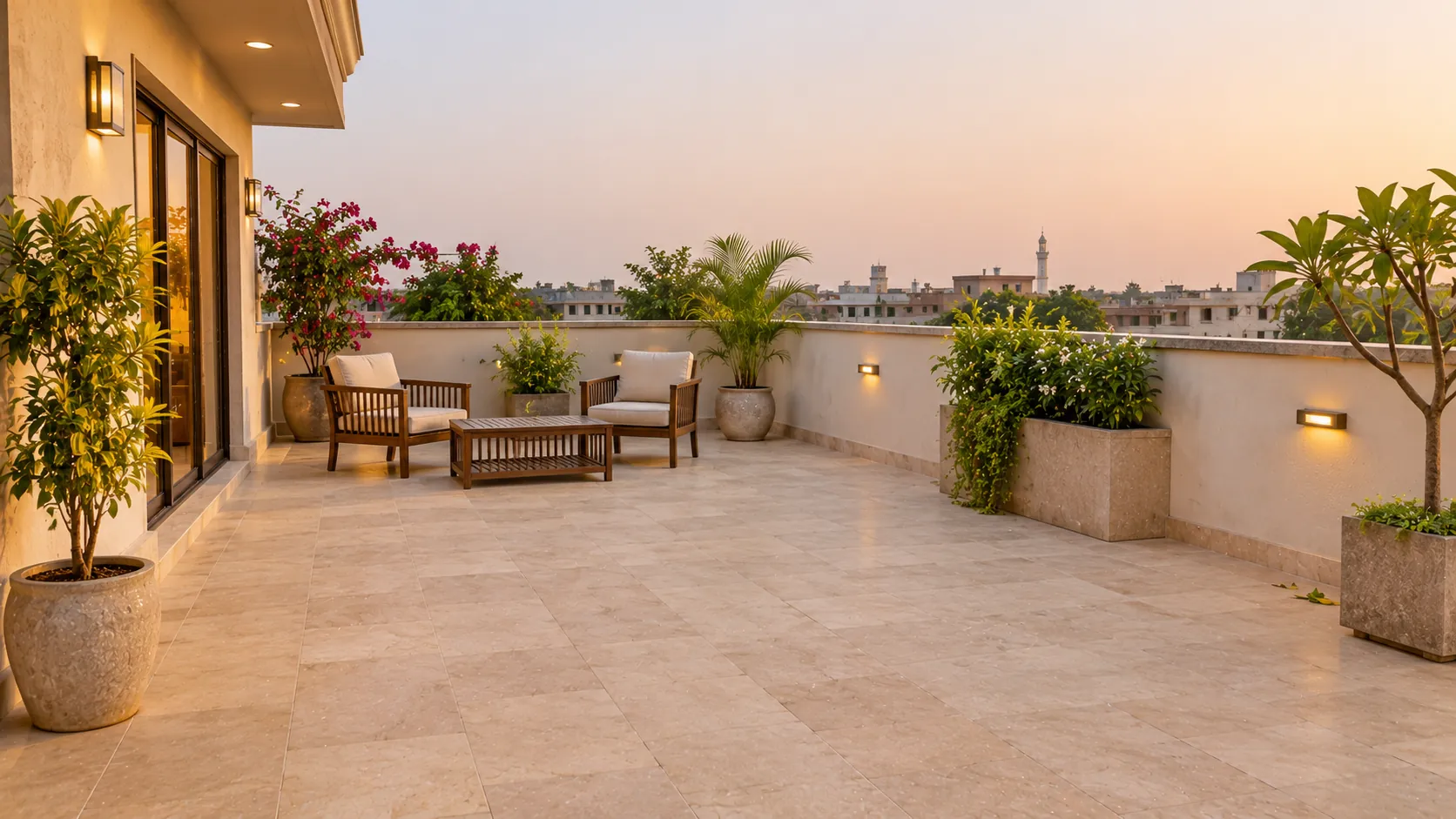
Roof terraces take the most sun and the most standing water of any outdoor floor. Use light granite or brushed travertine, in 2 cm on a well-supported slab, with tiles of 12 x 24 or 24 x 24 inches. Fewer joints mean fewer places for water to get in, but very large tiles crack if the slab below moves. See the roof slab section below before you order.
Lawn and garden paths
A path needs a firm base more than an expensive stone. Gadap Stone, Nagar Parkar Pink or a Chips Dana strip all work. Keep the path slightly above the lawn so watering does not flood it, give it a gentle cross-fall, and edge it with a kerb or a border strip so the edge tiles do not rock loose. Stepping-stone paths set directly in soil move with every monsoon; set them on a concrete pad.
Pool decks
Around a pool the floor is wet most of the day and walked on barefoot, so grip and heat come first. Brushed or tumbled travertine and light granite are the usual choices, with 3 cm pieces and a bullnose edge on the coping that people sit on. Rinse chlorinated or salt water off the deck regularly, seal travertine twice a year, and slope the deck away from the pool so dirty water does not run back into it.
Verandahs and courtyards
A covered verandah sees less rain, so honed travertine, honed or leathered Tropical, or Denso all work, and the floor can match the drawing room colour if you want a seamless line. An open courtyard behaves like a terrace: textured finish, fall to a drain, light colour.
Car porches and steps
A porch carries vehicle weight, oil and tyre marks, so it needs thicker stone and a stronger base than a terrace; our car porch tiles guide covers that floor in full. For entrance, garden and roof steps, our black granite stairs guide covers treads and nosings. If you are building an outdoor cooking area on the terrace, our outdoor kitchen countertops page lists the stones we use for counters outside.
Laying stone on a roof slab
Before any stone goes on a roof, three things must be settled: the slab can carry the extra weight, the roof is waterproofed, and the finished floor will drain. Stone does not waterproof a roof; it sits on top of the waterproofing and protects it.
Weight
| Layer | Per sq ft | Over 400 sq ft |
|---|---|---|
| 2 cm stone | about 5.0 kg | about 2,000 kg |
| 3 cm stone | about 7.5 kg | about 3,000 kg |
| Sand-cement bed, about 1 inch | about 4.6 kg | about 1,850 kg |
| 2 cm stone on a 1-inch bed | about 9.6 kg | about 3,850 kg |
Roughly four tonnes on a modest terrace is a real load, more so on an older house that already carries a traditional mud-and-brick-tile insulation layer or a water tank. Ask a structural engineer to check the slab before laying stone on a roof, as our marble thickness guide also advises. On roofs, 2 cm stone on a thin adhesive bed is lighter than 3 cm on a thick mortar screed.
Waterproofing and insulation
- Waterproof first. A membrane or coating laid and tested by the waterproofing contractor, turned up the parapet walls, before any stone work starts.
- Flood-test it. Ask for the roof to be ponded with water for a day or two and the ceiling below checked for damp before it is covered.
- Protect the membrane. A protective screed over the membrane stops stone fitters damaging it with tools and spacers.
- Decide on insulation. If the old roof has a mud and brick-tile layer for heat, ask your engineer whether to keep it, replace it with lighter insulation, or remove it before adding stone.
Falls and drains
The finished floor should fall towards the roof drains or parapet spouts so monsoon water clears within minutes. As an indicative guide, a fall of about 1 in 80 to 1 in 100 drains well without being noticeable; build it into the screed, not the stone bed. Never let stone or grout block a drain outlet, and keep the outlets cleared of leaves before every monsoon.
Movement joints
A roof heats up through the day and cools at night, and the stone moves with it. Leave a flexible joint around the perimeter where the floor meets the parapet and at regular intervals across open areas, as an indicative guide every 10 to 15 ft, filled with a flexible sealant rather than cement grout. A roof floor grouted solid from wall to wall is the classic cause of tiles lifting after a few summers.
We supply, cut, fit and seal the stone. Waterproofing, structural checks, screeds and drains are civil works; agree who is responsible for each before work begins.
Ground-level floors: base and drainage
Terraces, courtyards and paths at ground level fail for the same reasons as porches: soft fill settles, water has nowhere to go, and joints are grouted solid.
- Compact the fill. Loose earth settles after the first monsoon and takes the stone with it.
- Cast a concrete base. As an indicative guide, a plain cement concrete (PCC) slab of about 3 inches over compacted fill is common for foot traffic; anywhere a vehicle may drive needs more, as covered in the porch guide.
- Bed every piece fully. Spot-fixing with dabs of mortar at the corners leaves voids that crack when a heavy planter or a charpai leg lands on them.
- Tap-test after laying. A hollow sound means a void; lift and re-bed that piece.
- Keep the floor above the soil line and away from flower-bed watering, so mud and salts are not drawn into the stone.
- Plan the water route. A channel drain along the house wall or a gentle fall towards the lawn stops water collecting against the building.
Thickness follows use: 2 cm for terraces, verandahs and paths that see foot traffic only, and at least 25 mm, which in practice means our 3 cm stone, for steps, pool copings and anywhere a vehicle may cross.
Monsoon, algae and white salts
- Algae and moss grow wherever water stands in shade. A good fall and a stiff brush with a neutral cleaner every few weeks in the monsoon stop it. Avoid bleach and acid on travertine, marble and Chips Dana.
- White salts (efflorescence) are minerals carried up through the stone by water from the base. Brush them off dry; if they keep coming back, water is getting in beneath the floor, so check waterproofing and drainage.
- Muddy pores in unfilled travertine and Gadap Stone are prevented by sealing before grouting and again after; on unsealed stone they are hard to clean.
- Leaf stains from wet leaves lying on light stone usually fade in sun; stubborn ones respond to a poultice, as explained in our guide on removing stains from stone.
How much does outdoor stone flooring cost?
A 400 sq ft roof terrace costs from about PKR 72,000 in Chips Dana to about PKR 594,000 in Swat White Granite as of November 2026, installed at our quote ranges. The table shows three common outdoor jobs, with 10% wastage added for slab and tile stones; poured Chips Dana has little wastage, so its area is unchanged.
| Stone | PKR / sq ft | Roof terrace 20 x 20 ft | Lawn path 3 x 40 ft | Pool deck, 4 ft round a 30 x 15 ft pool |
|---|---|---|---|---|
| Chips Dana (poured, no wastage) | 180 – 420 | 72,000 – 168,000 | 21,600 – 50,400 | 76,320 – 178,080 |
| Gadap Stone | 260 – 520 | 114,400 – 228,800 | 34,320 – 68,640 | 121,160 – 242,320 |
| Denso | 450 – 820 | 198,000 – 360,800 | 59,400 – 108,240 | 209,700 – 382,120 |
| Dawezai Badal Travertine | 640 – 1,180 | 281,600 – 519,200 | 84,480 – 155,760 | 298,240 – 549,880 |
| Nagar Parkar Grey | 650 – 1,200 | 286,000 – 528,000 | 85,800 – 158,400 | 302,900 – 559,200 |
| Nagar Parkar Pink | 700 – 1,300 | 308,000 – 572,000 | 92,400 – 171,600 | 326,200 – 605,800 |
| Swat White Granite | 720 – 1,350 | 316,800 – 594,000 | 95,040 – 178,200 | 335,520 – 629,100 |
Areas: terrace 400 sq ft (440 with wastage), path 120 sq ft (132), pool deck 424 sq ft (about 466). Chips Dana uses 400, 120 and 424 sq ft.
What moves the figure
- Stone and grade set most of the cost; see the ranges above.
- Finish. Textured finishes can change the rate; the quote states the finish and the price.
- Thickness. 3 cm for copings and steps uses more stone than 2 cm on a terrace.
- Borders, copings and steps. Bullnosed copings and step nosings are extra cutting and polishing.
- Freight. Delivery outside our fitting cities is itemised.
- Civil works. Waterproofing, screeds, concrete bases and drains are priced separately by your contractor.
To run your own figures, multiply length by width in feet, add 10%, and enter the area in our stone cost estimator. Our granite price guide and limestone price guide compare those stones in more depth.
Everyday care for outdoor stone
- Sweep daily or every other day. Grit is what wears an outdoor floor; a stiff broom does more than any chemical.
- Wash with a pH-neutral stone cleaner and a deck brush. Avoid tile acid, teezab and bleach, which etch calcium stones and attack grout.
- Seal on schedule. Travertine twice a year outdoors, pale granite and Gadap yearly, dark granite rarely; use the water-drop test to check.
- Clear drains before the monsoon and after every dust storm.
- Lift pots onto feet. Planters standing flat on stone trap water and leave rings and algae.
- Keep a few spare pieces from the same lot for repairs; matching a replacement years later is much harder.
Common mistakes to avoid
- Polished stone outdoors. It is slippery in the first shower and dull within a few seasons.
- Black stone in full sun. Too hot to walk on in summer; keep it for borders and shade.
- Stone instead of waterproofing. Stone is not a roof membrane; leaks will appear in the ceiling below.
- No fall. Standing water means algae, salts and a slippery film.
- Grouting wall to wall. Without movement joints, sun-heated stone lifts or cracks.
- Soft fill under paths. The path sinks after the first monsoon.
- Ignoring the roof load. Have an engineer check the slab before adding several tonnes of stone and mortar.
Get a quote for your outdoor floor
Send us the area in feet, whether it is a roof, ground-level terrace, path, pool deck or verandah, how much sun it gets and the finish you prefer. We will reserve the stone from one lot and send a free written quote with the installed rate, finish and any itemised extras. To compare grip and colour in your own light, order samples and wet them before deciding. If the porch columns are being redone at the same time, our pillar cladding guide covers them.
Written by
The Captivating Marble Design Team
Fabricators, templaters and stone designers
We template, cut and install natural stone every day and write about what we learn — pricing, layouts, care and the mistakes we help clients avoid.
Book a free design consultation