Mosque Marble Flooring in Pakistan: Prayer Halls, Wuzu Areas, Sehan and Saff Lines
Stone for masjid prayer halls, wuzu khanas and sunlit sehans: cool light stones, slip-safe finishes, saff line inlays, cost per sq ft, care. Get a free quote.
Captivating Marble Design Team · · 17 min read
Key takeaways
- A masjid prayer hall is best floored in a calm, light, honed stone such as Verona Plain, Sunny Grey or Tavera Light, bought from one lot.
- Wuzu khanas need a brushed or honed surface, a fall to the drain and no polished stone underfoot, because soap and water make polish slippery.
- Light stone stays far cooler than dark granite in a sunlit sehan; brushed travertine or Gadap Stone suit open courtyards.
- At our November 2026 quote ranges a 4,800 sq ft prayer hall costs about PKR 2.9–5.3 million installed in Verona Plain, before wastage.
- Saff lines are usually 2- to 4-inch inlaid strips set parallel to the qibla wall; the spacing is set by the masjid committee before cutting.
The short answer
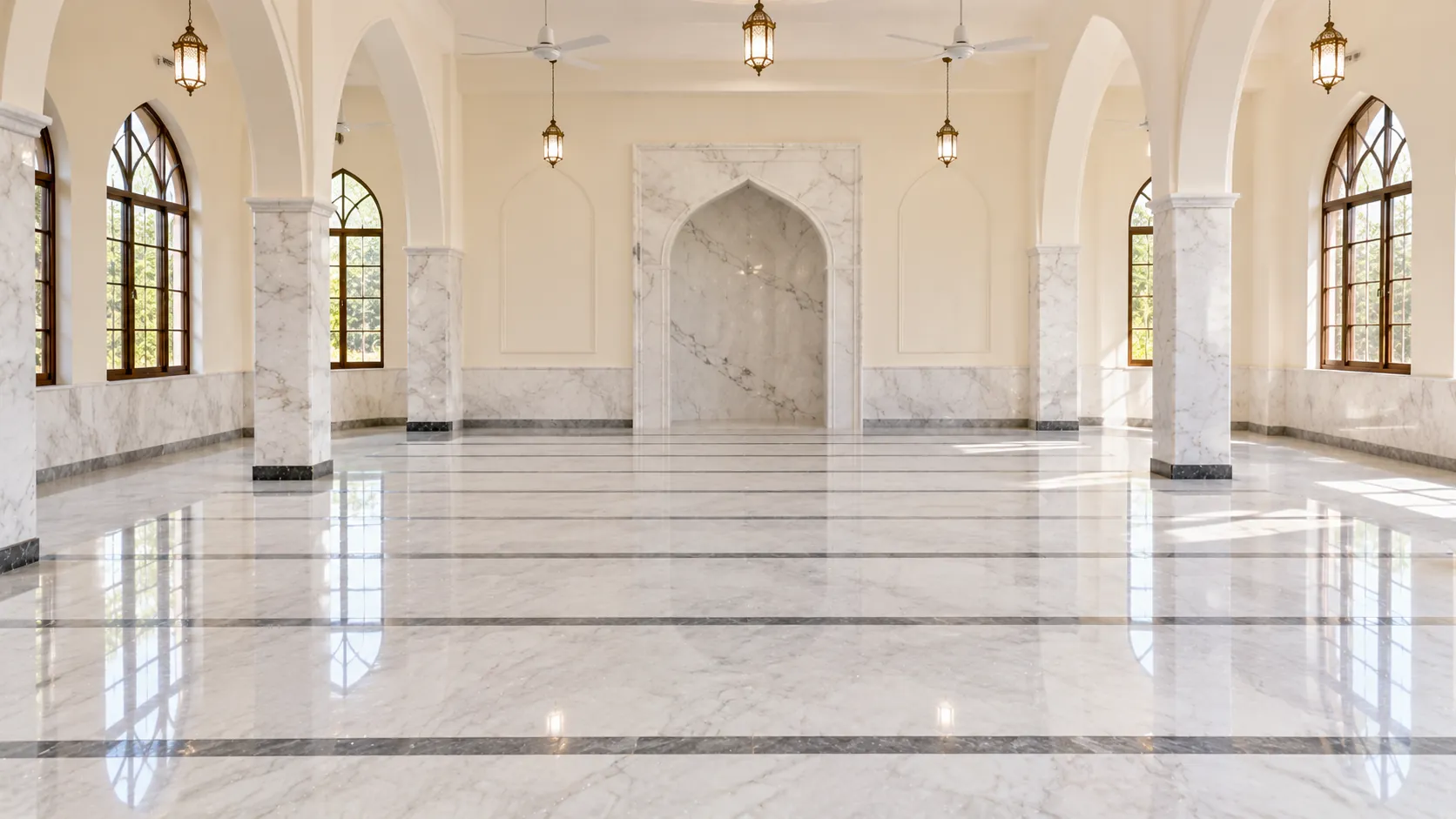
Good mosque marble flooring uses a calm, light, honed stone in the prayer hall, a brushed slip-resistant stone in the wuzu khana and a pale, heat-friendly stone in the sehan. At our November 2026 quote ranges, Verona Plain costs PKR 600–1,100 per sq ft installed and Sunny Grey PKR 560–1,000, with saff lines inlaid in contrasting strips.
A masjid floor is unlike a house floor in three ways. It is very large and has to look even from one wall to the other. It is walked barefoot, so temperature and grip matter more than gloss. And it is used five times a day, every day, often for decades, with the heaviest crowds on Fridays, in Ramadan and on Eid. This guide goes zone by zone through the prayer hall, wuzu khana, sehan, mehrab and minbar, then covers saff lines, cost for large areas, durability and upkeep.
How we priced this: stone rates are our current catalogue quote ranges per square foot as of November 2026. They are installed prices in our service area that include cutting, a standard polished finish, fitting and sealing on fitting day. Inlay strips, mitres, special finishes and freight outside our fitting cities are itemised on the quote. Hall sizes in the worked examples are our assumptions; use your own drawings.
Planning the floor zone by zone
Each part of a masjid asks something different of the stone. Choosing one stone and one finish for the whole building is the most common mistake: a polish that looks right in the hall becomes a slip hazard by the taps, and a dark stone that looks dignified indoors becomes too hot to cross in a June courtyard.
| Zone | Main demand | Finish | Stones to consider |
|---|---|---|---|
| Prayer hall | Even colour over a large area, comfort barefoot, easy upkeep | Honed, or a soft polish | Verona Plain, Sunny Grey, Tavera Light, Medium White |
| Wuzu khana | Grip when wet with soap, resistance to hard water | Brushed or honed | Galaxy Black, Nagar Parkar Grey, Denso, Badal travertine |
| Sehan (courtyard) | Stays cool in sun, grip in monsoon rain | Brushed or honed | Badal travertine, Gadap Stone, Tavera Light, Chips Dana |
| Entrances and shoe racks | Grit, heavy wear, wet feet | Brushed or honed | Nagar Parkar Grey, Galaxy Black, Denso |
| Mehrab and walls | Dignified focal point, no foot traffic | Polished | Ziarat White, Jet Black, Pak Green Onyx |
| Minbar and steps | Safe treads, crisp edges | Honed treads, polished risers | Ziarat White, Galaxy Black, Jet Black |
Draw these zones on the plan before you ask for prices. A quote that gives one rate for "marble floor, whole masjid" cannot be compared with one that separates the hall, the wet areas and the courtyard, and it usually hides a finish that is wrong for at least one of them.
Which marble is best for a masjid prayer hall?
The best stone for a prayer hall is a light, even-toned marble with little veining, laid with a honed or soft-polished finish and bought from a single lot. A calm field lets the saff lines and the mehrab carry the design, keeps the hall bright, and hides the slight shade changes that any large area of natural stone shows.
Stones that suit large halls
- [Verona Plain](/products/verona-plain) (PKR 600–1,100 / sq ft): a flat honey-beige field with almost no pattern. Our catalogue notes it is specified by the thousand square feet for hotel corridors and prayer halls, and supply is steady enough to re-order matching stone months later.
- [Sunny Grey](/products/sunny-grey) (PKR 560–1,000): a warm light grey with soft cloud and no hard lines. Its tone forgives small differences from slab to slab, which helps over a big floor.
- [Tavera Light](/products/tavera-light) (PKR 520–980): a pale cream with fine sandy speckle that hides dust well, and a comfortable barefoot surface when honed.
- Medium White (PKR 550–950): the value grade of the Ziarat white family, with grey cloud and light spotting. It reads clean once finished and is a sensible choice where budget leads.
- Ziarat White (PKR 850–1,600): the premium white, from large consistent blocks that keep seams few. Beautiful, but it shows dust, footmarks and stains sooner than beige or grey.
Busy stones such as the fancy marbles, zebra patterns or strong black-and-gold veining are best kept to the mehrab or a border. Across a whole hall they compete with the saff lines and make the floor feel restless, and every block difference becomes obvious.
Honed or polished in the hall?
Our flooring range is honed for floors and polished for walls as a rule, because a mirror polish is slippery when wet and shows every wear path. In a prayer hall that matters: water is carried in on feet from the wuzu khana, and a polished floor soon shows dull tracks along the routes people walk. A honed finish ages evenly and can be machine-polished on site later. If the committee wants some shine, ask for a soft polish rather than a mirror one. Our guide to polished, honed and leathered marble compares them side by side.
Carpet over stone, or stone left bare
Many halls lay fitted prayer carpet with printed rows over the stone, especially for winter. If carpet will cover most of the floor for most of the year, an economical stone such as China White, Medium White or Chips Dana under it is a reasonable choice, with better stone kept to the uncovered margins, the mehrab end and the circulation routes. If the floor will stay bare with individual mats, spend on the field stone and the saff inlay, because they will be seen every day.
Wuzu khana: grip, water and hard-water scale
The wuzu khana is the hardest-working wet area in the building. Floors are wet for hours each day, soap and water mix into a slippery film, and elderly worshippers walk there barefoot. The stone must grip when wet, shed water quickly and stand up to the scale that bore water leaves behind.
- No polished stone underfoot. Use a brushed finish or honed surface. In our catalogue, Galaxy Black (PKR 900–1,700), Nagar Parkar Grey (650–1,200) and Denso (450–820) are all available brushed.
- Granite is the safer choice. Granite is far harder than marble (about 6 to 7 on the Mohs scale against about 3) and is not etched by the acid in descaling products, so it keeps its surface where cleaners are used daily.
- Build in a fall to the drain. The floor bed should slope gently towards channel or point drains so water never stands. The fall is set by your engineer or plumber and must be in the screed before the stone goes on.
- Use small or narrow pieces near drains. Smaller pieces follow a sloped bed better than large slabs and give more grout lines for grip.
- Raise the seating and splash zones. The seats (chowki) and the wall behind the taps take constant splash; polished stone is fine there because no one stands on it.
- Seal every joint and edge, and use a cement-based or epoxy grout suited to permanently wet areas.
Hard-water scale is the long-term enemy. Bore water in much of Lahore, Karachi and Islamabad leaves a white crust on stone around taps. It is tempting to remove it with teezab or a tile acid, but acid etches marble and damages the polish on granite. Clean scale often with a pH-neutral stone cleaner and a soft brush so it never builds up; where it has, ask for a stone-safe scale remover and test it on a hidden piece first.
Keep the transition from the wuzu khana to the hall short and well matted. A strip of brushed granite or a drainage mat at the threshold stops wet feet carrying water onto the honed hall floor.
Which stone stays cool in a masjid courtyard in summer?
Light-coloured, matte stone stays coolest in a sunlit sehan, because it reflects more of the sun and does not soak up heat the way dark granite does. In a Pakistani June, a black or deep red stone in full sun becomes too hot to cross barefoot by midday, while a pale cream or light grey surface stays bearable. The same rules apply inside a house; see keeping stone floors cool in summer.
| Stone | PKR / sq ft | Finishes listed | Notes for a sehan |
|---|---|---|---|
| Gadap Stone | 260 – 520 | Honed, brushed | A sandy beige limestone; pale and economical, needs a penetrating sealer renewed yearly outdoors |
| Chips Dana | 180 – 420 | Polished, honed | Seamless chip terrazzo poured on site; choose a light chip mix and a honed finish |
| Tavera Light | 520 – 980 | Polished, honed | Pale cream; honed for grip and comfort |
| Dawezai Badal Travertine | 640 – 1,180 | Honed, brushed | Our flooring range suggests it for verandahs and courtyards; supplied resin-filled |
| Nagar Parkar Grey | 650 – 1,200 | Brushed, leathered, honed | Hard and consistent; mid-grey runs warmer than cream in sun |
| Galaxy Black | 900 – 1,700 | Brushed, leathered | Best kept to shaded paths, borders and steps, not open sun |
- Matte, not polished. Polished stone outdoors is slippery in monsoon rain and glares in sun. Use brushed or honed.
- Use dark stone only as accents. A dark border or saff line in a courtyard is fine; a dark field is not.
- Plan drainage first. A sehan collects monsoon rain fast. The slope and outlets must be in the base before the stone, or water will stand and stain.
- Allow for movement. Large outdoor areas need movement joints so the stone does not crack as it heats and cools; your engineer should mark them.
- Seal outdoor stone on installation and yearly after, especially the softer limestone and travertine.
Our guide to outdoor stone flooring goes further into finishes, bedding and drainage for open paving, and the Badal collection shows the travertine in honed and brushed finishes.
Mehrab and minbar cladding
The mehrab is the one place in the hall where a finer or more expressive stone belongs. It is a wall surface, so it carries no foot traffic, and a polished face there is appropriate.
- White and calm: Ziarat White or Ziarat Supreme (PKR 1,100–2,100) polished, with a carved or moulded arch surround, gives a quiet, bright focal point.
- Contrast frame: a Jet Black (PKR 1,100–2,000) or Black & Gold (PKR 1,400–2,800) border around a white niche outlines the arch clearly from the back of the hall.
- Backlit onyx: Pak Green Onyx (PKR 2,400–5,200) is translucent and can be lit from behind for a soft glow inside the niche. It is a soft, light-duty stone, so keep it to wall panels above hand height, never on steps.
- Inlay and calligraphy panels: our Lahore workshop cuts geometric and floral inlay from coloured offcuts. Any calligraphy should be drawn by a qualified calligrapher and approved by the committee; ask whether the inlay can be cut from that drawing, and never let anyone alter the text.
The minbar
A stone minbar is a small staircase, so treat it like one. Treads should be honed or lightly textured with an eased or rounded nosing; risers can be polished. Keep every tread the same depth and every riser the same height, and fix the stone fully bedded so nothing rocks. Our stair marble design guide covers nosings, thickness and riser details in more depth. Columns and arches in the hall are covered in our guide to marble pillar design.
Saff lines: inlaying the prayer rows
Saff lines are straight strips set into the floor to mark the prayer rows, so worshippers stand shoulder to shoulder in a straight line facing the qibla. In stone they are usually inlaid strips of a contrasting colour, cut flush with the field so nothing catches a bare foot.
Setting out
- Fix the qibla direction first, through the masjid committee, the imam and the architect, using an accurate method. Every line depends on it.
- Set out the lines parallel to the qibla wall, so each row runs at right angles to the qibla direction.
- Agree the spacing between lines with the committee before any stone is cut. It must give each worshipper room for sajdah.
- Snap the lines from a fixed baseline, not from the side walls, which are rarely exactly square.
- Mark the first row's distance from the mehrab wall, and leave the imam's position in front of it clear.
As an indicative planning figure only, rows are often set roughly 4 ft apart from line to line, but halls vary and the committee's decision is what counts. Lines are commonly 2 to 4 inches wide, which reads clearly across the hall without breaking up the floor.
| Option | PKR / sq ft | Look | Notes |
|---|---|---|---|
| Design Patti strip | 300 – 700 | Plain or patterned strip, 2 to 6 in wide | Cut in our Lahore workshop; long runs quoted per running foot |
| Dighin Border | 320 – 740 | Carved, slightly raised border | Better as a hall border than a saff line, because a raised edge can be felt barefoot |
| Jet Black strip | 1,100 – 2,000 | Solid black line | Strong contrast on beige or white; honed to match the field |
| Brass or aluminium divider | Quoted per run | Thin metal line | Common in Chips Dana floors, set before pouring |
Inlaid lines must be cut and bedded at exactly the same level as the field stone, then ground flush during floor finishing (ragrai). Choose a strip stone with similar hardness to the field so it wears at the same rate; a very soft strip in a hard floor will dip over the years. Design Patti strips can be cut from the same family as the field in a darker tone for a quiet line, or from black for a strong one. Our marble inlay design guide explains how inlay is cut and fitted.
Quantity of strip
Work out the strip by the running foot: number of rows multiplied by the hall width. A 3-inch strip uses a quarter of a square foot per running foot. In a hall 80 ft wide and 60 ft deep with lines about 4 ft apart, that is around 14 rows and 1,120 running ft, or about 280 sq ft of strip. At the Design Patti range that is roughly PKR 84,000–196,000 before wastage, and it replaces the same area of field stone.
How much does a masjid floor cost per square foot?
At our November 2026 quote ranges, an installed stone floor for a prayer hall costs from PKR 180–420 per sq ft in Chips Dana, PKR 560–1,100 in Sunny Grey or Verona Plain, and PKR 850–1,600 in Ziarat White. The stone choice moves the total far more than anything else, so settle it zone by zone.
| Stone | PKR / sq ft | Hall total, PKR |
|---|---|---|
| Chips Dana | 180 – 420 | 864,000 – 2,016,000 |
| China White | 450 – 800 | 2,160,000 – 3,840,000 |
| Tavera Light | 520 – 980 | 2,496,000 – 4,704,000 |
| Medium White | 550 – 950 | 2,640,000 – 4,560,000 |
| Sunny Grey | 560 – 1,000 | 2,688,000 – 4,800,000 |
| Verona Plain | 600 – 1,100 | 2,880,000 – 5,280,000 |
| Ziarat White | 850 – 1,600 | 4,080,000 – 7,680,000 |
Add 5–8% for cutting and breakage, and ask for a small reserve from the same lot for future repairs. Saff strips, borders, the mehrab, steps and the wuzu khana are priced separately. The range within each stone reflects grade, slab size and the work involved; a large, simple rectangle with few cuts sits towards the lower end, while many columns, curves and inlays push towards the top.
Keeping a large budget under control
- Spend where it is seen. A better stone in the mehrab end and on uncovered margins, a value stone under fitted carpet.
- Use Chips Dana for service areas, stairwells and long passages. It is seamless and repairable, and our catalogue notes it is widely used in schools, hospitals and stairwells across Punjab. See our Chips Dana flooring guide.
- Phase by zone, not by stone. If funds arrive in stages, finish the hall in one stone from one lot rather than buying half now and half next year from a different block.
- Get one itemised quote that lists each zone, finish, inlay and freight line, so donors and the committee can see where the money goes.
Our stone cost estimator gives an installed figure for any of our stones once you enter the area, and our guide to marble flooring cost for a house explains wastage and quantity in more detail.
Durability under heavy footfall
Marble is a soft stone, and a busy prayer hall will show wear paths over the years along the entrances, the routes to the front rows and in front of the wuzu khana. That is normal, and it is why marble floors are designed to be re-ground and re-polished rather than replaced.
- Grit is the main cause of wear. Sand carried in on feet scratches polish like sandpaper. Shoe racks outside the hall, a shoe line people respect, and mats at every entrance cut wear sharply.
- Honed hides wear, because there is no gloss to lose. Polished floors show dull paths sooner.
- Thicker stone lasts longer. Interior floor tile is gauged at about 16–20 mm; our slabs come in 2 cm and 3 cm. Every re-grind removes a little surface, so the thicker the stone, the more re-polishes it can take.
- Use granite where wear concentrates: entrance thresholds, steps and the strip in front of shoe racks. A brushed Nagar Parkar Grey or Galaxy Black threshold takes the grit so the hall does not.
- Buy the whole floor from one lot, and keep a few spare pieces. A cracked piece replaced from a different block years later will always stand out.
A good bed matters as much as the stone. Hollow spots under a piece crack under heavy, repeated loads, so every piece should be fully bedded, and the floor should be laid on a cured, level screed with movement joints where the engineer marks them.
Cleaning and maintenance for a busy masjid
A simple routine, written down for the khadim or cleaning staff, keeps a stone floor looking right for decades. Most damage comes from the wrong cleaner, not from use.
| When | Task |
|---|---|
| Before each prayer time, or at least daily | Dry dust-mop the hall to lift grit; shake out entrance mats |
| Daily | Damp mop with a pH-neutral stone cleaner; wring the mop well; dry the wuzu khana floor |
| Weekly | Scrub the wuzu khana with a soft brush and neutral cleaner to stop scale building up |
| Before Ramadan and Eid | Deep clean, check grout, re-seal heavy-traffic areas if water no longer beads |
| Every year | Re-seal light stone and outdoor stone; check for loose or hollow pieces |
| Every few years, as needed | Machine grind and re-polish or re-hone the hall |
- Never use teezab, tile acid, vinegar or bleach-based cleaners on marble. They etch a dull patch that only re-polishing removes.
- Wipe spills of attar, oil and tea quickly, especially on light stone, before they soak in.
- Lift carpets now and then to clean and dry the stone beneath, so trapped damp and dust do not mark it.
- Protect the floor during any building work. Scaffolding, cement and paint cause more damage in a day than years of prayer.
Our guides on how to clean marble floors and marble polishing cover products, methods and how often a floor needs re-polishing.
Ordering stone for a masjid project
- Prepare a plan with each zone measured: hall, wuzu khana, sehan, entrances, stairs, mehrab wall.
- Agree the qibla direction and saff spacing with the committee and imam before setting out.
- Order samples of two or three field stones and a strip stone, and look at them in the hall in daylight, wet and dry.
- Ask for slab or lot photographs of the actual stone reserved, and keep the whole quantity from one lot.
- Get one itemised quote covering stone, finish, inlay, steps, freight and fitting for every zone.
- Schedule the work around Friday prayers and avoid starting the hall just before Ramadan.
Stock floor sizes in our range load from Lahore within a few days, and we deliver to the cities on our delivery page. Builders and contractors fitting out a masjid can also apply to our contractor programme. Send your plan and zone sizes for a free written quote, and browse our flooring and wall tile range for formats and finishes.
Written by
The Captivating Marble Design Team
Fabricators, templaters and stone designers
We template, cut and install natural stone every day and write about what we learn — pricing, layouts, care and the mistakes we help clients avoid.
Book a free design consultation