Stone Wall Cladding in Pakistan: Types, Fixing, Weather and PKR Costs (2026)
Marble, granite, Gadap and travertine wall cladding compared: indoor vs front elevation, adhesive vs clamps, monsoon care and PKR rates. Get a free quote.
Captivating Marble Design Team · · Updated · 18 min read
Key takeaways
- Installed wall stone costs PKR 260–520 per sq ft for Gadap limestone and PKR 650–1,700 for Pakistani granite on our November 2026 quotes.
- Our rates include standard adhesive fixing; mechanical anchors for exterior panels at height, and scaffolding, are quoted as extra lines.
- Granite is the safest stone for exposed front elevations because acid rain and sun do not etch or bow it.
- Exterior stone above about 10 ft, and any large panel, should be mechanically restrained with stainless-steel fixings.
- A 10 × 9 ft TV wall needs about 99 sq ft of stone including 10% wastage.
What is stone cladding, and what does it cost?
Stone wall cladding in Pakistan is natural marble, granite, Gadap limestone or travertine fixed as tiles or panels to a brick or block wall, indoors or on the front elevation. On our November 2026 quotes it costs PKR 260–520 per sq ft installed for Gadap and up to PKR 1,700 for granite, with mechanical anchoring and scaffolding at height itemised.
Our rates cover cutting, a standard polished edge and adhesive fixing indoors and at low level; mechanically anchored panels at height cost more. Statement marbles such as Black & Gold run higher still, to PKR 2,800 per sq ft.
The right choice is decided less by looks than by three practical questions: is the wall inside or outside, how high does the stone go, and how harsh is the local weather. Granite and dense, honed marble handle a sun-baked Multan or Karachi elevation; soft limestone and polished white marble are happier indoors or under a deep chajja. Everything below expands on that, with prices, fixing methods, weather problems and a buying checklist.
| Option | Installed, PKR / sq ft | Best for |
|---|---|---|
| Gadap Stone (limestone) | 260–520 | Budget beige walls, boundary walls under cover, interiors |
| Grey and white marble tile | 450–1,100 | TV walls, staircases, lobbies, bathrooms |
| Local granite | 650–1,700 | Front elevations, gate pillars, plinths, exposed walls |
| Travertine | 640–1,180 | Textured feature walls, verandahs, courtyards |
| Fancy and dark marble | 700–2,800 | Statement walls, fireplaces, reception areas |
| Split-face / ledge panels (market option) | Not stocked by us | Rustic elevations and garden walls |
How we priced this: our rates are current quote ranges from the product catalogue, as of November 2026, fabricated and installed with standard fixing in our service area, and match each product page. Fixing, scaffolding, mitre and look-alike figures are indicative market ranges to help you check a quotation, not our fixed prices.
Wall tiles, panels, strips and split-face: the four formats
Cladding is a non-structural skin. The brick, block or concrete wall still carries the building; the stone protects it, finishes it and adds weight and character. That distinction matters because the stone must be held on the wall for decades through heat, rain and movement, and how it is held depends on its size, thickness and height above ground.
In the Pakistani trade you will hear four broad formats:
- Wall tiles: stone cut to repeatable sizes such as 12 × 12, 12 × 24 and 24 × 24 inches, usually 16–20 mm thick, fixed with adhesive or mortar. This is what most people mean by "stone wall tiles". Our wall tile design ideas cover patterns and layouts.
- Cut-to-size panels: larger pieces cut from full slabs to fit a specific wall, for example 2 × 4 ft panels on a TV wall or a bookmatched pair behind a staircase. Fewer joints, heavier pieces, more careful fixing.
- Strips (patti): narrow bands of stone used as borders, horizontal lines across an elevation or a frame around windows and the main gate.
- Split-face and ledge (stacked) stone: rough-faced strips, either loose or glued to a backing in interlocking panels, giving a rugged three-dimensional texture. Popular on elevations and garden walls; sold by cladding specialists rather than marble yards.
We cut the first three formats from our own tiles and slabs in Lahore, in polished, honed, brushed and (for some stones) leathered finishes. Split-face and ledge panels are not in our range, so we cover them below as a market option you should understand before comparing quotes.
Types of wall stone used in Pakistan
Marble for walls: tiles and slabs
Marble (sang-e-marmar) is the default indoor wall stone in Pakistani homes. It cuts cleanly, polishes to a mirror and comes in every tone from Ziarat white to Chaghi black. For walls, the softer and cheaper whites and greys work well because nobody walks on them: Sunny Grey at PKR 560–1,000 per sq ft, Verona Plain at PKR 600–1,100 and Tavera Light at PKR 520–980 are common choices for staircase walls and TV units. The more dramatic stones (Tiger Verona, Royal Fancy, Zebrano, Black & Gold) are best used on a single statement wall where the veining can be seen whole.
Marble is a calcite stone, around 3 on the Mohs scale. It etches with acid, and outdoors that includes acidic rain and city pollution, which slowly dulls a polished face. That is why marble on an exterior wall should usually be honed or brushed rather than polished, and why white marble is a better interior choice than an exterior one.
Granite
Granite is mostly feldspar and quartz, roughly 6 to 7 on the Mohs scale, far less porous than marble and not etched by acid rain. That makes it the safest stone for a front elevation, plinth, gate pillar or boundary wall exposed to full sun and monsoon. Our Pakistani granites include Nagar Parkar Grey (PKR 650–1,200), Nagar Parkar Pink (PKR 700–1,300), Balochistan Red (PKR 780–1,450), Khyber Black (PKR 850–1,600) and Galaxy Black (PKR 900–1,700). A brushed or leathered finish hides dust and water marks better than polish on an outside wall. Our granite colours guide shows how each one looks and weathers.
Gadap Stone and other limestone
Gadap Stone comes from the hills north of Karachi and is the classic beige wall stone of Sindh, at PKR 260–520 per sq ft installed on our current quotes. It is sold alongside marble but is honestly a limestone: softer, lighter in weight and more absorbent. We supply it honed or brushed. It looks warm and calm on a large wall and costs a fraction of granite, but it needs a good penetrating sealer, a sheltered position or regular cleaning outdoors, and care around soil and sprinklers, which feed salts and algae into the stone. The limestone price guide compares Gadap with other local limestones.
In Punjab, the other familiar wall stone is Chakwal stone, a rough split-face sandstone from the Salt Range used on elevations, gate pillars and boundary walls; our Chakwal stone guide covers its uses and how it compares.
Travertine
Travertine is a layered limestone formed around mineral springs, with natural holes and a soft, linear texture. Our Dawezai Badal Travertine from Mohmand is supplied honed or brushed at PKR 640–1,180 per sq ft and makes an excellent feature wall in a lounge, verandah or bathroom. On an exposed exterior, the open pores collect dust and water unless they are filled and sealed. Our travertine guide covers filled versus unfilled travertine in detail.
Split-face and ledge stone panels (market option)
Split-face stone is broken rather than sawn, so each strip shows a rough, natural face. Ledge stone panels group several such strips on a backing so they can be laid quickly in an interlocking pattern. In Pakistan you will mostly see sandstone, slate and limestone in this format, both local and imported. They suit rustic elevations, garden and boundary walls, and barbecue areas. They are heavier per square foot than flat tile because of their thickness, they trap dust in their ledges, and their quality varies a lot, so inspect a full panel and its backing before buying. We do not stock them.
Onyx for backlit walls
Pakistani onyx (Pak Green, Honey and Snow White) is translucent, which lets you light a wall from behind. It is an interior stone only and is handled very differently from ordinary cladding; our backlit onyx feature wall guide explains the frame, lighting and costs.
Look-alikes: porcelain, PU panels and cultured stone
Stone-look porcelain wall tiles (indicatively PKR 150–450 per sq ft in the market) and lightweight polyurethane or cement "faux stone" panels are cheaper and lighter. They are a reasonable choice for a rental or a quick refresh, but they cannot be re-honed or polished when worn, edge chips show the body underneath, and printed patterns repeat across a large wall. Natural stone ages; most imitations simply wear out.
Indoor feature walls vs exterior elevations
The same stone can succeed indoors and fail outdoors. Inside, a wall stone only has to look good and stay put. Outside, it has to survive surface temperatures well above air temperature in May and June, driving monsoon rain, dust storms, salts rising from the ground and, in Quetta, Murree and the northern areas, winter frost.
Inside the house
- TV and lounge walls: a single wall in polished or honed marble, often with bookmatched panels or a recessed niche. Sunny Grey, Verona Plain and Tiger Verona are popular.
- Staircase walls: stone up the stair wall matching the treads and risers, which also protects the plaster from scuffs.
- Bathrooms and shower walls: honed or polished marble or travertine to full height, sealed, with silicone movement joints at corners.
- Entrance lobbies and drawing rooms: larger cut-to-size panels in a fancy marble, or onyx with backlighting.
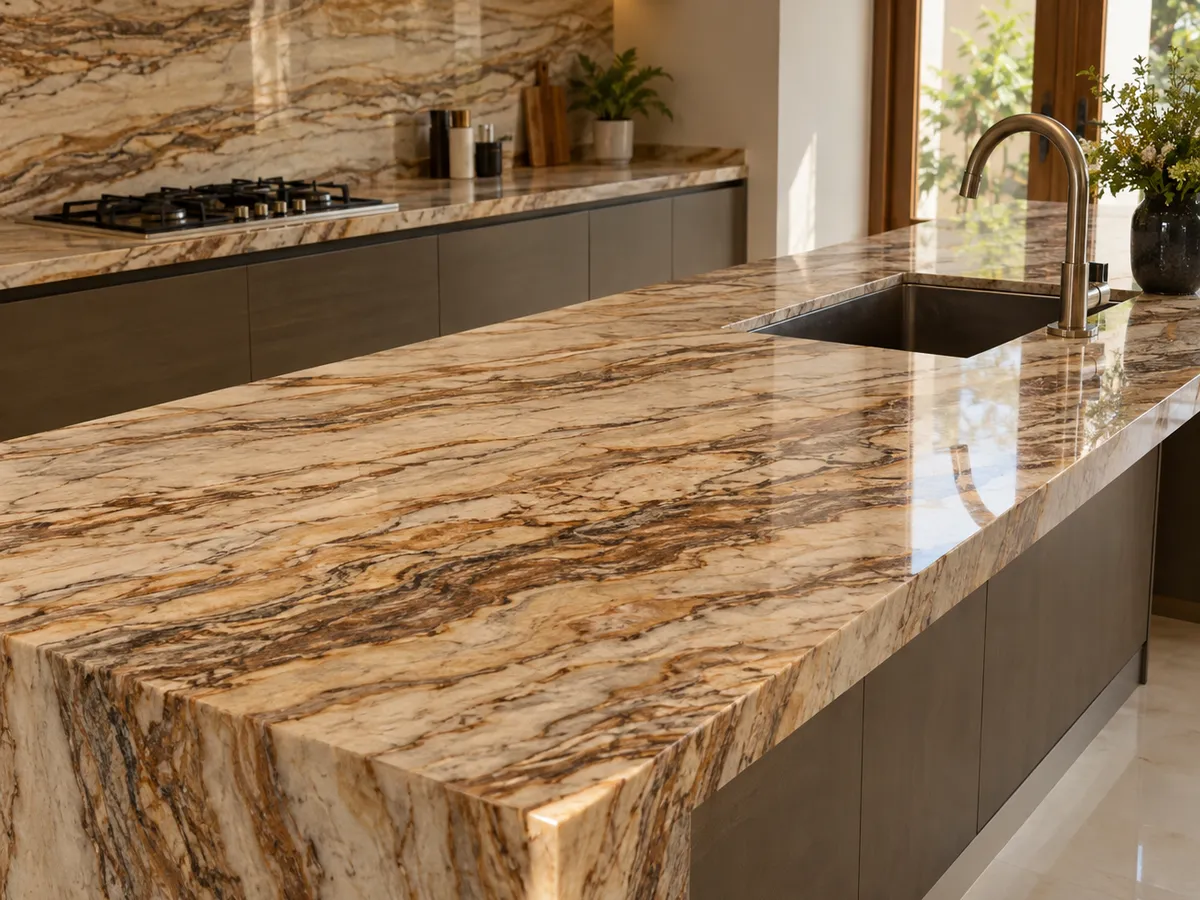
- Kitchens: full-height backsplash walls in the same stone as the worktop, as in the Tiger Verona kitchen in the photo below.
Outside: front elevation and boundary walls
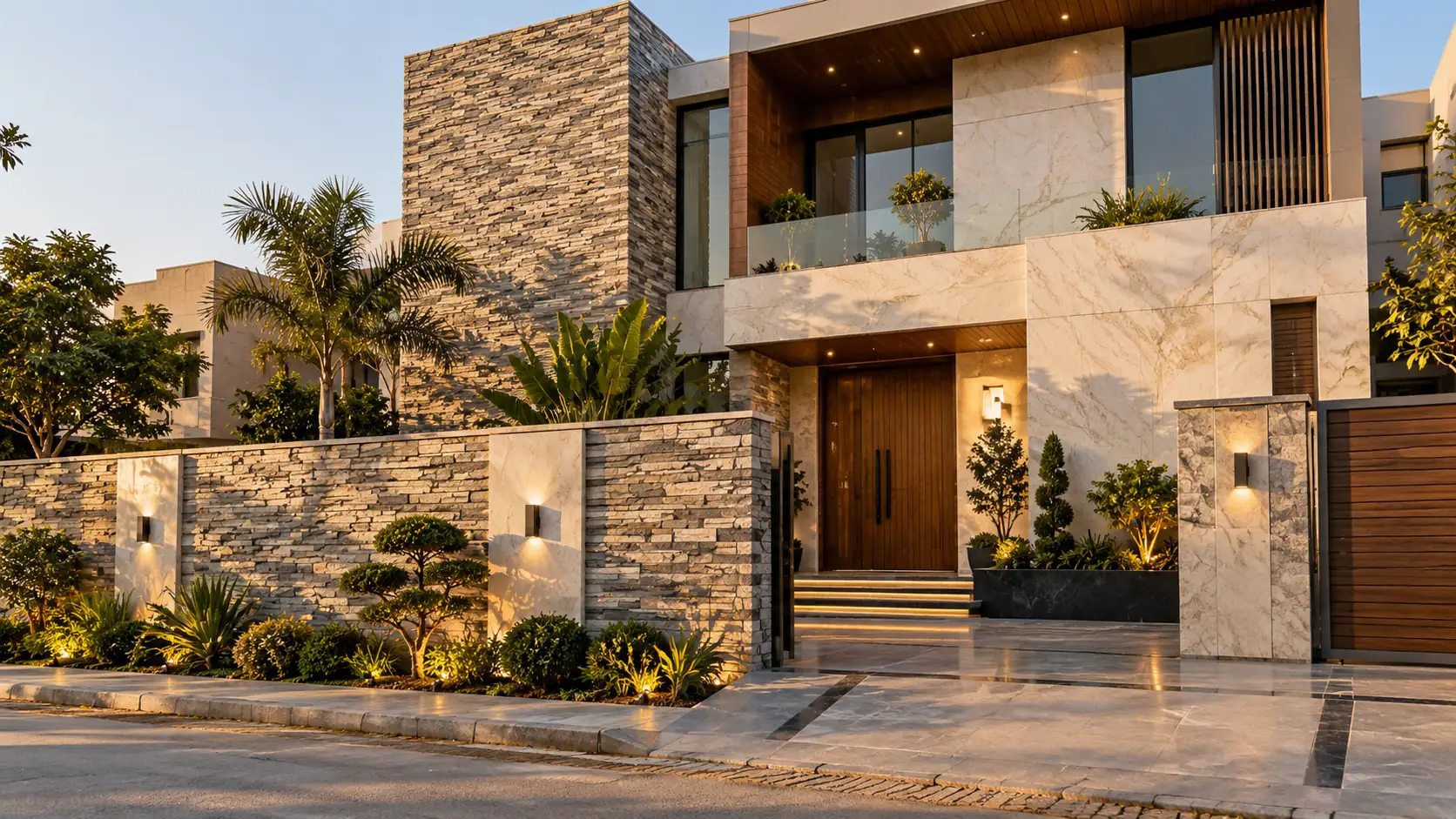
- Front elevation bands and frames: granite or honed marble strips framing the main door, windows or porch columns, rather than a full wall. Our guide to door frames and window sills covers sizes and drip grooves.
- Plinth (the bottom 2–3 ft): dense granite, which takes splashing, cleaning and soil contact best.
- Gate pillars and boundary walls: granite, brushed Gadap under a coping, or split-face panels for a rustic look. Our guide to pillar cladding covers sizes and stone choice.
- Feature panels above the porch: cut-to-size panels on mechanical fixings, because they are high above the ground.
| Stone | PKR / sq ft | Indoor wall | Exterior wall |
|---|---|---|---|
| Gadap Stone (limestone) | 260–520 | Yes | Sheltered or sealed; avoid ground contact |
| Denso (grey marble, brushed available) | 450–820 | Yes | Honed or brushed, sheltered walls |
| Sunny Grey | 560–1,000 | Yes | Under cover only |
| Verona Plain | 600–1,100 | Yes | Honed, under cover |
| Dawezai Badal Travertine | 640–1,180 | Yes | Filled and sealed, sheltered |
| Tropical (leathered available) | 650–1,200 | Yes | Leathered, partly exposed walls |
| Nagar Parkar Grey (granite) | 650–1,200 | Yes | Yes, including plinths |
| Nagar Parkar Pink (granite) | 700–1,300 | Yes | Yes |
| Tiger Verona | 750–1,350 | Statement walls | Not recommended |
| Balochistan Red (granite) | 780–1,450 | Yes | Yes |
| Khyber Black (granite) | 850–1,600 | Yes | Yes; dark stone runs hot in sun |
| Ziarat White | 850–1,600 | Yes | Not recommended (polish dulls, stains show) |
| Galaxy Black (granite) | 900–1,700 | Yes | Yes; brushed or leathered outside |
Every stone here links through from our flooring and wall tile range, where you can compare colours side by side.
How is stone fixed to a wall?
Stone is fixed to a wall in one of three ways: thin-bed adhesive, a mortar bed with wire ties, or mechanical anchors and clamps, chosen by the stone's weight, size and height above ground. Most cladding failures in Pakistan are fixing failures, not stone failures: tiles sliding off a gypsum-plastered wall, panels dropping in the first monsoon, or white marble turning yellow from the mortar behind it. Weight is the starting point. Marble and granite weigh roughly 2,700 kg per cubic metre, which works out to about 4.5 kg per sq ft at 18 mm thick, 5 kg at 20 mm and 7.5 kg at 30 mm. Gadap and travertine are a little lighter, around 4.3–4.7 kg per sq ft at 20 mm. A 10 × 9 ft wall in 20 mm marble therefore hangs close to 450 kg of stone.
1. Adhesive fixing (thin-bed)
Tiles are fixed with a polymer-modified cement tile adhesive, combed on the wall and back-buttered on the stone so the bed is solid with no hollow spots. This is the right method for indoor walls and for small tiles at low level outside. Use a white adhesive under white and light marble, because grey cement can bleed through and shadow the stone. Outside, choose an improved, deformable adhesive (classed C2 with S1 flexibility under the European EN 12004 system) and never use the "five dabs" spot-fixing method, which leaves cavities that collect rainwater.
Adhesive has limits. Each brand rates its product for a maximum tile weight on a given background, and the background matters as much as the glue: stone should go on sand-cement plaster or bare masonry, never on gypsum (plaster of Paris) finish, paint or putty, which must be scraped back first. A common rule of thumb in international practice is to add mechanical restraint for exterior stone fixed above about 3 m (10 ft), and for large or heavy pieces at any height.
2. Mortar bed with wire ties (traditional method)
The traditional Pakistani method is to drill or groove the top edge of each stone, tie it back to nails or hooks in the wall with copper or galvanised wire, and pour sand-cement mortar into the gap behind. Done carefully, it holds heavy stone well and has lasted decades on older buildings. Its weaknesses are moisture and staining: a thick wet mortar bed carries salts to the face (efflorescence) and can darken light stone, and ordinary steel wire rusts. Use non-rusting wire, keep the bed as thin as practical, and back-seal light stones before fixing.
3. Mechanical fixing: anchors, pins and clamps
For exterior panels at height, the stone is carried on stainless-steel brackets, dowel pins set into holes or kerfs cut in the panel edges, or hidden clamps on an aluminium sub-frame. In a ventilated (rainscreen) system the panels stand off the wall with an air gap, so water drains away and the wall can breathe. Mechanical fixing needs thicker stone, usually 30 mm for kerf and pin fixings, a fixing layout from an engineer, and stainless steel throughout (grade 316 near the Karachi coast, where salt air attacks lesser metals). It costs several times more than adhesive, and on a two-storey elevation it is the only method we would recommend for large panels above the porch.
| Method | Where it fits | Watch out for | Indicative PKR / sq ft |
|---|---|---|---|
| Adhesive, thin-bed | Interiors; small tiles outside at low level | Gypsum walls, spot-fixing, grey adhesive under white stone | 80–200 |
| Mortar bed with wire ties | Heavier tiles, older-style elevations | Efflorescence, staining, rusting wire | 100–250 |
| Mechanical anchors / clamps | Large panels and anything at height outside | Needs 30 mm stone, design and stainless hardware | 350–900 |
| Ledge-panel adhesive fixing | Split-face panels on low walls | Weight per sq ft, dust in ledges | 100–250 |
Mesh, backing and preparation
Two kinds of mesh appear on cladding jobs. Fragile or heavily veined stones (some fancy marbles, onyx) are often supplied with fibreglass mesh resin-bonded to the back to hold them together during cutting and fixing; check the resin is well bonded before using adhesive on it. Separately, smooth concrete or patched walls are sometimes given a galvanised wire mesh and a scratch coat of sand-cement plaster so the bed has something to grip. In both cases, the wall must be plumb, sound and cured, and old paint, putty and gypsum removed. For a full walk-through of site preparation see our marble installation process, and the stone installation service page explains what our teams handle.
Safety first: anything above head height that could fall onto a porch, gate or footpath should be mechanically restrained, whatever the yard or mason says about the glue. Ask who designed the fixing and who is responsible if a panel moves.
Heat, monsoon and efflorescence: designing for Pakistani weather
Summer heat and movement
A west-facing wall in Multan, Lahore or Jacobabad can heat far above the air temperature by late afternoon, then cool overnight. Stone, adhesive and the wall behind all expand and contract at different rates. Without movement joints that stress collects until tiles crack or debond. Leave flexible (silicone or polyurethane) joints at corners, at changes of background (brick to concrete column), at floor level and at regular intervals across large walls, and never butt stone tight against a window frame or slab edge. Dark stones such as Khyber Black and Galaxy Black absorb more heat than greys and creams, which is worth knowing before cladding a whole sunny elevation in black.
Thin polished marble on a sunny exterior has a further, well documented weakness: repeated heating and cooling can slowly loosen its crystal structure so the panel bows and loses strength. Granite does not behave this way, which is another reason it is the default for hot, exposed walls.
Monsoon rain and water behind the stone
Rain itself rarely harms good stone; water trapped behind it does. Water enters through open joints, cracked copings and the top edge of the cladding, then sits in voids in the bed. Protect the top of every clad wall with a projecting coping or drip, fill joints fully, keep the bottom course a few inches above finished ground or paving, and make sure the wall has a damp-proof course so groundwater is not drawn up into the stone.
Efflorescence and staining
Efflorescence is the white, powdery bloom that appears on new cladding after rain. It is soluble salt from cement, bricks or soil carried to the surface by water and left behind as it evaporates, and it is common in areas with brackish groundwater. Brush it off dry; do not wash it in with lots of water, and never use acid on marble or limestone. Prevent it by using a polymer-modified adhesive rather than a thick wet mortar bed, letting new brickwork dry before cladding, and stopping garden water and soil touching the wall. Iron staining (orange spots) usually comes from rusting fixings or steel in the wall; the cure is non-corroding hardware from the start.
Dust, salt air and frost
Dust storms favour smooth, honed or brushed faces that rinse clean over deep textures that hold grit. Near the coast in Karachi and Gwadar, salt air shortens the life of ordinary steel fixings, so stainless hardware is essential. In cold areas where walls freeze while wet, porous stones like Gadap and unfilled travertine can spall at the surface; seal them and keep water out of them, or use granite on exposed faces.
Stone wall cladding cost in Pakistan
A cladding quote has the same building blocks as a floor quote, plus a few that only apply to walls. Our rates in this guide are installed quote ranges covering the stone, cutting, a standard polished edge and adhesive fixing in our service area; mechanical anchoring, mitres, scaffolding and freight outside our fitting cities are itemised. The other lines are indicative market ranges to help you check a quotation, or to budget if you buy stone only and hire your own mason, not our fixed prices.
| Line | What it covers | Indicative cost |
|---|---|---|
| Installed stone | Tiles or panels in your grade and thickness, cut, edged and adhesive-fixed | PKR 260–2,800 / sq ft (see tables above) |
| Wastage | Cuts around openings, breakage, vein matching | 10% simple walls; 15–20% with many openings or bookmatching |
| Mitres | 45° mitred corners on columns (standard polished edges are in our rate) | PKR 50–150 / running ft |
| Mechanical fixing | Anchors or clamps for panels at height (see fixing table); adhesive fixing is in our rate | PKR 350–900 / sq ft |
| Scaffolding | Needed above about 8 ft on elevations | Per job or per day |
| Sealing | Penetrating sealer on porous or light stone | PKR 15–40 / sq ft |
| Split-face / ledge panels (if chosen) | Market product, not supplied by us | PKR 250–800 / sq ft |
Worked example 1: a 10 × 9 ft TV wall
The wall is 90 sq ft. Allowing 10 per cent for cuts gives 99 sq ft of stone. In Sunny Grey at PKR 560–1,000 that is about PKR 55,440–99,000 installed; in Tiger Verona at PKR 750–1,350 it is about PKR 74,250–133,650. Our rate includes the adhesive fixing, with niches and mitres itemised. If you buy stone only and hire your own mason, indoor fixing at an indicative PKR 80–200 per sq ft adds roughly PKR 7,200–18,000 for the 90 sq ft wall.
Worked example 2: a 300 sq ft front elevation feature
Take 300 sq ft of bands, door frame and porch panels, plus 10 per cent wastage, so 330 sq ft of stone:
| Stone | PKR / sq ft | Installed total (PKR) |
|---|---|---|
| Gadap Stone | 260–520 | 85,800–171,600 |
| Nagar Parkar Grey granite | 650–1,200 | 214,500–396,000 |
| Balochistan Red granite | 780–1,450 | 257,400–478,500 |
| Galaxy Black granite | 900–1,700 | 297,000–561,000 |
These totals assume adhesive fixing. If the porch panels above about 10 ft need mechanical anchors and scaffolding, those are itemised on top, and on a tall elevation they can cost as much as the stone choice, so budget the two areas separately. Run your own numbers in the cost estimator, or send us the elevation drawing for a measured figure.
How to avoid being overcharged: ask for the stone rate, thickness, finish, wastage, edges, fixing method and scaffolding as separate lines, all on the same square footage. A single "per sq ft complete" figure with no thickness or fixing method stated is impossible to compare.
Design ideas that work on Pakistani homes
- Frame, don't smother: on most elevations a granite plinth, stone bands at floor levels and a framed entrance look richer than stone on every surface, and cost less.
- Two-tone elevations: dark granite at the plinth and gate pillars with honed Gadap or cream marble above is a classic combination that hides dirt where it collects.
- Horizontal lines: long, narrow strips laid in running bond make a modern house look wider and lower; vertical panels make a narrow plot look taller.
- Bookmatched TV walls: two consecutive slices of a veined stone such as Tiger Verona opened like a book, centred on the screen.
- Stair walls that match the treads: the same stone on treads, risers and the wall skirting ties a double-height hall together.
- Texture against polish: a brushed or leathered wall beside polished floors adds depth without adding colour.
- Light from above: a recessed LED strip washing down a textured travertine or split-face wall shows its relief at night.
- Patti borders and inlay lines: a thin black or contrasting strip framing a lounge wall echoes a bordered floor.
For room-by-room combinations, colour pairing and inlay ideas across the whole house, see our marble design ideas guide.
Buying checklist for wall stone
- Decide inside or outside, and how high the stone goes. This decides stone type, thickness and fixing method before colour does.
- Measure each wall and subtract large openings, then add 10–20 per cent wastage depending on openings and pattern.
- Choose the finish for the location: polished indoors, honed, brushed or leathered outside and in wet areas.
- See the actual lot. Colour shifts block to block, so ask for photographs of the tiles or slabs that will be loaded, or visit the yard.
- Check thickness and calibration with a tape on several pieces; uneven tiles make an uneven wall.
- Look for cracks, resin-filled fissures and loose mesh on the back of fancy marbles.
- Confirm the wall background: sand-cement plaster or bare brick, not gypsum or paint.
- Agree the fixing method in writing, including stainless fixings for anything outside at height.
- Ask for movement joints, coping and drip details on exterior walls.
- Order 5 per cent extra from the same lot and keep it for future repairs.
If you are torn between two stones, a sample next to your paint and window frames in daylight settles it quickly. Our stone samples cost PKR 500 each, credited against your order.
Care and maintenance of clad walls
Walls need far less care than floors, but they are not maintenance-free.
- Seal porous and light stone: marble, Gadap and travertine take a penetrating (impregnating) sealer after fixing and every year or two outside. Granite needs it less often. Our sealing guide explains how to test and apply it.
- Dust before washing: brush or blow off dust first, then wash with clean water and a pH-neutral stone cleaner. Grit rubbed in with a wet cloth scratches polished faces.
- No acids: lemon, vinegar, toilet cleaners and "tile acid" etch marble and limestone. Efflorescence is brushed off dry, not dissolved.
- No high-pressure jets on joints: a pressure washer can blow out grout and drive water behind the stone.
- Watch the joints after each monsoon: re-seal open silicone joints and cracked copings before water gets behind the cladding.
- Re-honing: a weathered marble or Gadap wall can be honed back on site, which is one of the real advantages of natural stone over imitations.
Our stone care guide has cleaner and stain-removal advice for every stone type we supply.
Getting a quote for your walls
For a stone wall cladding quote, send us the wall sizes or an elevation drawing, photographs of the wall as it stands, the city and the height of the highest stone, and tell us which stones you are considering. We will come back with an installed rate that states the stone, thickness, finish and recommended fixing method, with mechanical fixings, scaffolding, mitres and freight itemised, so you can compare like with like. A free quote takes a few minutes to request, and samples let you check colour against your own paint and light before committing. We deliver across Pakistan, with stone cut to size in Lahore.
Written by
The Captivating Marble Design Team
Fabricators, templaters and stone designers
We template, cut and install natural stone every day and write about what we learn — pricing, layouts, care and the mistakes we help clients avoid.
Book a free design consultation