Limestone Price in Pakistan: Rates, Types, Uses and How It Differs From Marble
What limestone costs per sq ft in Pakistan, how it differs from marble, where it works outdoors and in, and which stones to choose instead. Get a free quote.
Captivating Marble Design Team · · Updated · 19 min read
Key takeaways
- Gadap Stone, a sandy beige limestone quarried outside Karachi, costs PKR 260–520 per sq ft installed at our November 2026 quote range.
- Local sawn limestone tile and split-face panels run roughly PKR 150–450 per sq ft as indicative market ranges; imported slabs start around PKR 1,500.
- Marble is limestone recrystallised by heat and pressure; both are calcite, so both etch in acid.
- Soft limestone suits cladding, boundary walls, plinths and shaded paving, not kitchen worktops, vanities or driveways.
- Seal limestone with a penetrating sealer after fixing and renew it about once a year outdoors.
The short answer
The limestone price in Pakistan runs from roughly PKR 150–450 per sq ft for local sawn tile and split-face panels (indicative market ranges) to PKR 1,500 or more for imported slabs. Our Gadap Stone, a sandy beige limestone quarried outside Karachi, costs PKR 260–520 per sq ft fitted as of November 2026, the lowest rate on our list.
The format matters more than the rock: rough building stone for foundations and boundary walls is sold by the load and costs very little, sawn and honed stone for cladding and paving is sold per square foot, and imported interior slabs cost as much as good marble. Two things surprise most buyers. First, a great deal of what Pakistani yards sell as "marble" is, in geological terms, a dense crystalline limestone that takes a polish. Second, the softer, more porous limestones that are sold under their own name are not the right choice for kitchen tops or bathroom vanities. This guide explains the difference, gives indicative rates for each format, shows where this stone works in Pakistani heat, dust and monsoon, and tells you which of our stones to choose when it does not fit the job.
How we priced this: Gadap Stone and Dawezai Badal Travertine rates are our current catalogue quote ranges per square foot as of November 2026. Every other figure in this post, including local building stone, split-face panels, imported limestone and labour, is an indicative market range only. Confirm the final rate against a written quotation.
What is the difference between limestone and marble?
Limestone is a porous sedimentary rock that still holds its fossils and pores, while marble is limestone recrystallised by heat and pressure into a denser stone that takes a mirror polish. Limestone is made mainly of calcium carbonate, the mineral calcite. Most of it formed on the floors of ancient seas from shells, coral fragments and lime mud that settled in layers and slowly hardened. That origin is still visible in many slabs: fossil shells, fine bedding lines and tiny pores where the sediment never fully closed up.
Marble starts as the same rock. When limestone is buried deep and cooked by heat and pressure over a very long time, its calcite grains recrystallise into a tighter interlocking mosaic. The pores close, the fossils disappear and the stone becomes able to take a mirror polish. That is why the two stones share a chemistry but behave so differently in use.
The Pakistani trade name problem
In Pakistani yards, "marble" (sang-e-marmar) is a commercial name rather than a geological one. Any calcite stone that is hard enough to cut thin and polish well is usually sold as marble, whether a geologist would call it a true marble or a well-compacted crystalline limestone. That is not a scam; it is how the stone trade works in many countries. It does mean the label tells you less than you think. What matters for a buyer is how dense the stone is, how much water it absorbs, how well it holds a polish and whether it has open fossils or pits.
At the other end of the scale are stones sold openly as limestone. These are typically softer, sandier and more porous, with a matt or honed character rather than a shine. Gadap Stone is a good example: it is sold across Sindh as a marble, but we describe it honestly as a limestone because that is how it behaves in use. Travertine is a relative too, formed around mineral springs rather than in the sea; see our guide to travertine marble in Pakistan for that stone specifically. Rough Salt Range walling sold as Chakwal stone is mostly sandstone, explained in our Chakwal stone guide.
| Property | Soft limestone (e.g. Gadap) | Crystalline stone sold as marble | Travertine |
|---|---|---|---|
| Mineral | Calcite | Calcite (sometimes dolomite) | Calcite |
| How it formed | Sea-floor sediment, compacted | Limestone recrystallised by heat and pressure | Deposited around mineral springs |
| Typical look | Sandy, matt, fossil flecks | Fine crystals, veining, deep polish | Layered bands with natural pits |
| Porosity | High | Low | Medium to high (pits usually resin-filled) |
| Usual finish | Honed, brushed, split | Polished or honed | Honed, filled or unfilled |
| Best uses | Cladding, plinths, shaded paving | Floors, vanities, walls, stairs | Walls, bathrooms, fireplaces, floors |
| Reacts to acid? | Yes | Yes | Yes |
Note the last row. Every calcite stone fizzes in acid, so the old vinegar test does not separate limestone from marble; it only separates both of them from granite and quartz. To tell them apart you look at crystal sparkle, fossils, pores and how quickly a drop of water soaks in, as described in the checklist further down.
Lime stone in Pakistan: where it comes from and what it is used for
Pakistan has very large limestone deposits. The Margalla Hills behind Islamabad, the Salt Range in Punjab, the Kirthar Range in Sindh and wide areas of Balochistan and Khyber Pakhtunkhwa are all built largely of it. Most of that rock never becomes a floor or a wall. It goes into cement kilns, lime burning and crushed aggregate, and only a small share is quarried in blocks big and sound enough to saw into slabs.
Main uses of the rock
- Cement. Limestone is the main raw material of Portland cement, which is why the country's cement plants sit close to limestone hills.
- Lime (choona). Burnt limestone gives quicklime, used for whitewash, lime plaster and traditional mortars, and in several industries.
- Crushed aggregate (bajri/crush). Crushed limestone is used in concrete, road bases and under floors.
- Rough building stone (pathar). Irregular blocks are used for foundations, retaining walls, boundary walls and farm buildings, especially in the hills and in Sindh.
- Dimension stone. Sawn blocks become tiles, cladding panels, copings, plinths, steps and paving, which is the part that concerns home builders and the subject of this guide.
What you will find at the yards
In Karachi and the rest of Sindh, beige and sandy limestones from the hills around the city are common for boundary walls, house fronts and plinths, and Gadap Stone is one of them. In Punjab and Islamabad you are more likely to see limestone as split-face wall panels, rough walling stone and crush, while polished interior work is done almost entirely in marble. Imported limestone, typically creamy European stones with fine fossil texture, is sold by a handful of importers for high-end interiors. Ask every seller for the quarry district and whether the stone is local or imported, because the trade names change from city to city.
We do not stock a range of limestones as such, and we do not import foreign limestone. Our one true limestone is Gadap Stone; our travertine is a spring-deposited relative. For most interior work we recommend a dense Pakistani marble instead, and the reasons are given below.
Limestone price in Pakistan per square foot
Rates vary because "limestone" covers everything from a trolley of rough walling stone to a selected imported slab. The table separates the main formats so you compare like with like. Our two catalogue stones are shown with our current quote range; everything else is an indicative market range.
| Stone and format | Typical use | Source of figure | PKR / sq ft |
|---|---|---|---|
| Rough walling stone (pathar) | Foundations, boundary walls | Sold by load or cubic foot, not per sq ft | Ask per load |
| Local sawn limestone tile, honed | Cladding, plinths, shaded paving | Indicative market range | 150 – 350 |
| Split-face limestone wall panels | Feature walls, house fronts | Indicative market range | 200 – 450 |
| Gadap Stone, honed or brushed | Cladding, boundary walls, plinths, shaded paving | Our current quote range | 260 – 520 |
| Dawezai Badal Travertine | Walls, bathrooms, fireplaces, floors | Our current quote range | 640 – 1,180 |
| Imported limestone slab | High-end interior floors and walls | Indicative market range | 1,500 – 4,000+ |
Market figures in this table are indicative only and change with the lot, the city, the thickness and the season. They are supply rates for stone, usually before cutting to size, edge work, transport, fixing and sealing. Our two ranges are installed prices in our service area, so part of the gap is labour.
Why the same name can cost five times as much
- Density and grade. Dense, even stone with few pits yields more good tiles per block and costs more. Soft, sandy lots are cheap but break and stain more easily.
- Format. Rough stone costs least, sawn tile more, and calibrated cut-to-size pieces such as copings, steps and sills the most, because of workshop time and offcut loss.
- Finish. Brushed and honed faces are standard. A split or rock face is cheap to produce but uses more stone per square foot of wall. Few soft limestones hold a real polish.
- Thickness. Paving and cladding are usually thicker than interior tile, and thicker stone costs more to buy, move and fix.
- Origin. Imported limestone carries freight, duty and an importer's margin; local stone does not.
- Resin and sealer. Pitted lots may need filling, and every porous stone needs a penetrating sealer, which some quotes include and others do not.
Worked installed costs at the Gadap Stone range
| Job | Area incl. wastage | Estimated installed cost (PKR) |
|---|---|---|
| Front plinth band, 40 ft long x 2 ft high | About 88 sq ft (10%) | 22,880 – 45,760 |
| Gate pillars, two at 2 x 2 ft x 7 ft high | About 123 sq ft (10%) | 31,980 – 63,960 |
| House-front feature wall, 15 x 10 ft | About 165 sq ft (10%) | 42,900 – 85,800 |
| Boundary wall facing, 60 ft x 6 ft | About 396 sq ft (10%) | 102,960 – 205,920 |
| Shaded porch floor, 20 x 12 ft | About 264 sq ft (10%) | 68,640 – 137,280 |
To work out your own figure, multiply length by height (or width) in feet, add around 10% for cutting and breakage on a straight layout, and multiply by the rate. Our stone cost estimator does the arithmetic for any of our stones. Cut-outs, mitres, freight outside our fitting cities and façade scaffolding are itemised on the quote.
If you buy stone only and hire your own fixer
Supply-only pricing is quoted separately on request. If you take stone only and hire your own team, budget labour as its own line. As an indicative market range only, fixing cladding with adhesive and mechanical clamps is often quoted around PKR 80 to 200 per sq ft depending on height and scaffolding, paving on a mortar bed somewhat less, and edge work, grooves and drip channels per running foot on top. Add stone adhesive, grout, sealer, transport and, for a façade, scaffolding hire. Ask for each line in writing.
Where does limestone work well in Pakistani homes?
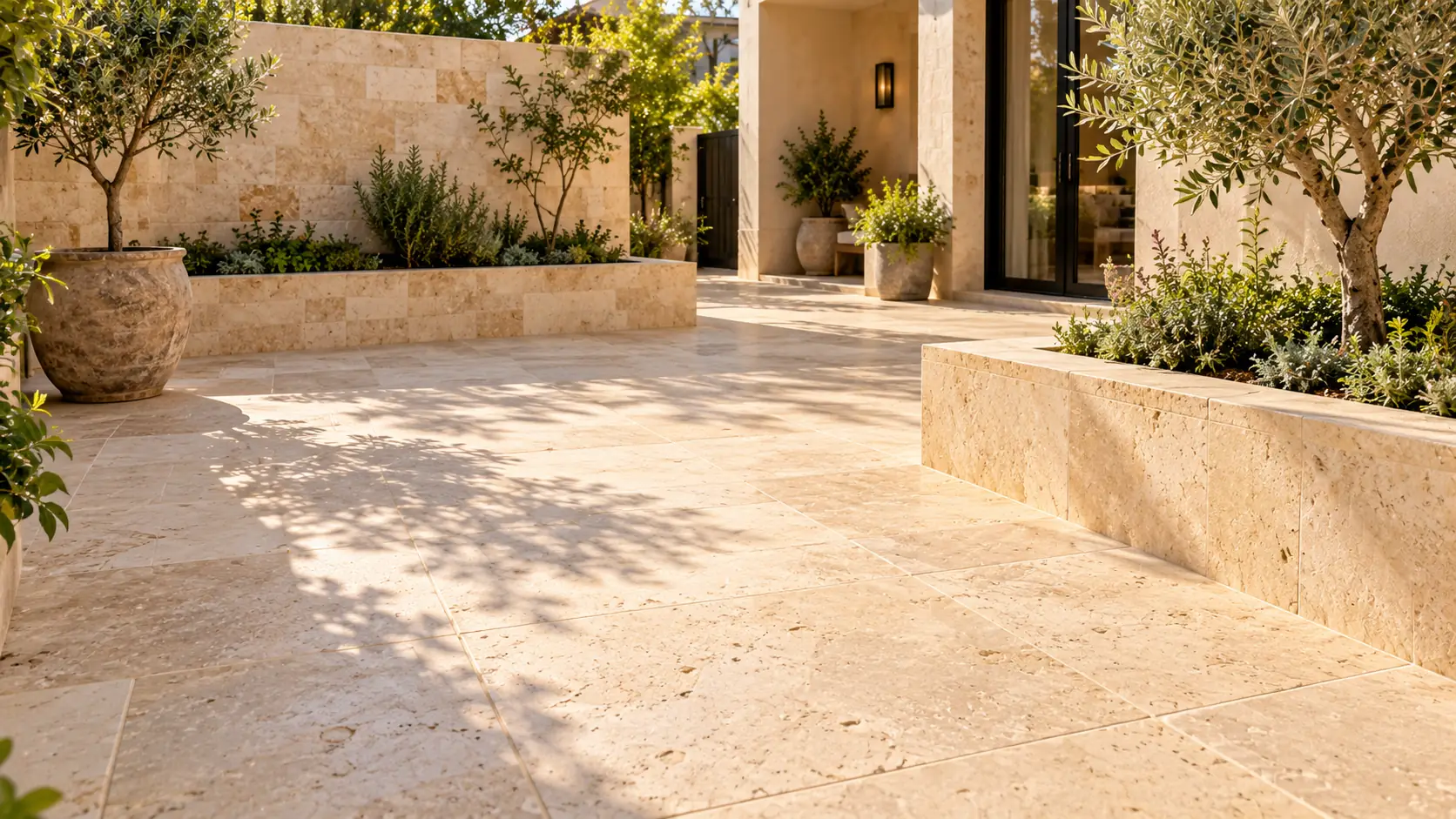
Limestone works best on house fronts, boundary walls, plinths and shaded paving, and poorly on kitchen tops, vanities and driveways. Soft, honed limestone has a quiet, sandy character that suits modern façades and garden walls, and it is cheap enough to use generously. It is at its best where it is seen, touched occasionally and washed by rain, rather than scrubbed every day.
- House fronts and elevation bands. A honed or brushed beige face against white plaster is a common modern look in DHA and Bahria developments in Karachi and Lahore. Our guide to stone wall cladding in Pakistan covers clamps, joints and weathering.
- Boundary walls and gate pillars. Large areas, little traffic and a natural patina that most owners like.
- Plinths and dado bands. A 2 to 3 ft band at the base of an outside wall hides mud splash from the monsoon better than paint.
- Shaded courtyards and covered porches. A brushed face gives grip underfoot and stays cooler than dark granite in summer.
- Garden copings, planters and steps where a soft, rounded edge and a weathered look are wanted.
Where to choose something else
- Kitchen worktops. Porous limestone drinks oil, haldi and chai and etches under lemon and tamarind. Choose granite for the work surface.
- Bathroom vanities and shower floors. Soap, shampoo and hard water stain and roughen soft stone. A dense marble or travertine with a good sealer is a better fit.
- Car porches and driveways. Tyres, engine oil and the weight of a car crack and stain soft stone. Use granite or a hard, thick floor stone.
- Sunny, uncovered paving in Sindh and southern Punjab. Full sun, salt in the air near the sea and sudden monsoon storms age soft limestone quickly. Granite or a well-sealed, thicker stone lasts longer.
- Polished interior floors. Most soft limestones will not hold a mirror polish under foot traffic. If you want shine, buy marble.
Gadap Stone: the limestone we supply
Gadap Stone is quarried in the Gadap hills outside Karachi. It is sandy beige, flecked with fossil shell, and has a natural, unpolished character that suits contemporary façades. It is sold across Sindh as a marble, but in use it behaves like a limestone: softer and more absorbent than true marble, so we recommend it for cladding, boundary walls, plinths and shaded paving rather than kitchen tops.
- Origin: Gadap, Karachi, Sindh.
- Colour: sandy beige with fossil flecking.
- Finishes: honed and brushed. We do not supply it polished.
- Slab size: the slabs we list measure about 72 x 48 inches (24 sq ft); sizes vary from lot to lot.
- Best uses: wall cladding, boundary walls, gate pillars, plinths and shaded paving.
- Care: a penetrating sealer on installation is essential and should be renewed yearly outdoors.
- Our current quote range: PKR 260 to 520 per sq ft, installed in our service area.
Every order is cut and finished in our Lahore workshop and then delivered by road. For projects in Sindh, our page on stone delivery in Karachi explains the freight lane and its 2–3 day transit time.
Better choices from our catalogue for interior work
Most people searching for limestone want one of three things: a soft, warm beige look; a low price; or a natural, matt surface instead of a glossy one. Each of those can be had in a denser Pakistani stone that copes better with daily use indoors.
| If you want | Consider | Why | PKR / sq ft |
|---|---|---|---|
| A warm, plain beige | Verona Plain | Even beige from Chaghi; honed it looks like limestone but is denser | 600 – 1,100 |
| A soft cream, close to limestone in feel | Tavera Light | Pale cream Khuzdar marble with fine sandy speckle; our Tavera vs Verona guide compares the two | 520 – 980 |
| Natural texture and a layered look | Dawezai Badal Travertine | Supplied resin-filled and honed as standard | 640 – 1,180 |
| The lowest price for a light floor | China White | Chiniot white at the economy end of our list | 450 – 800 |
| A brushed, matt grey | Denso | Mohmand stone available polished, honed or brushed | 450 – 820 |
| A tough surface for kitchens or porches | Nagar Parkar Grey | Granite: heat-proof, hard and consistent | 650 – 1,200 |
A honed finish is the key to the limestone look. Honing grinds the surface flat without the final polishing steps, leaving a soft, satin face that hides etching and scratches far better than a mirror polish. Our glossary page on the honed finish shows what it looks like, and a brushed finish goes one step further with a gently textured, more slip-resistant face.
How to check a limestone lot at the yard
Soft stone varies more from lot to lot than marble does, so inspection matters. Take a bottle of water, a cloth, a coin and a tape measure, and go in daylight.
- Ask for the quarry district and whether it is local or imported. Write it on the quotation.
- Do the water-drop test. Put a few drops on the face and time them. If the stone darkens and the water disappears within a minute or two, it is very porous and needs a good penetrating sealer; if the drops sit for several minutes, it is denser.
- Look for open pits and soft fossil pockets. A few are part of the character. Large holes, crumbly patches or shells that flake out under a fingernail are weak points.
- Scratch an offcut edge with a coin. Soft limestone marks easily; that is normal, but very powdery stone will wear fast underfoot.
- Check the bedding lines. Lines that open into cracks when wet can split, especially outdoors where water gets in and the stone heats and cools daily.
- Measure thickness at several points. Uneven tiles make uneven walls and floors and cost more to fix.
- See the whole lot. Colour can drift from cream to grey within one quarry. Make sure all the stone for one wall or floor comes from the same batch.
- Ask what the rate includes. Cutting, edges, sealing, transport, fixing and wastage should each be written as included or extra.
If you cannot visit, order samples of the stones you are considering. A sample from our samples page costs PKR 500, is cut from current slabs and is credited on a countertop order, so you can see the colour and finish in your own light before you commit.
Fixing and caring for limestone in Pakistani conditions
Fixing
- Use a white stone adhesive or a lime-rich mortar, not a heavy grey cement bed. Porous stone wicks cement salts and grey water into its face, leaving shadows and white bloom.
- Use mechanical clamps on façades, especially above head height and on panels heavier than a single tile. Adhesive alone is not enough on an exterior wall that heats up in the sun every day.
- Leave movement joints on long walls and large paved areas so the stone can expand in the summer heat without cracking.
- Add a drip groove and a sloped top on copings and window sills so rainwater runs off rather than soaking into the wall below.
- Seal before grouting where possible, so grout haze does not stain the face.
The same principles apply to every stone job: measure carefully, dry-lay before fixing, and let each stage cure before the next one starts.
Weather, damp and salts
Porous stone and Pakistani weather need managing. Monsoon rain drives water into unsealed faces; where walls stay damp, black algae and green moss appear within a season. Rising damp in older boundary walls carries salts that crystallise on the surface as a white powder (efflorescence) and can slowly flake the face. Near the sea in Karachi, salt-laden air does the same from the outside. A penetrating sealer, a damp-proof course at the base of new walls and good drainage at the foot of the wall prevent most of this.
Sealing and cleaning
- Apply a penetrating (impregnating) sealer after fixing and again roughly once a year outdoors. Our guide to sealing stone in Pakistan covers products and the water-drop test.
- Wash with plain water and a pH-neutral stone cleaner. Never use acid washes, tile acid or "teezab"; they dissolve calcite and leave a rough, pale surface.
- Brush off algae with a soft brush and a cleaner sold for stone, not bleach mixed with acid.
- Treat efflorescence by dry brushing first, then finding and stopping the source of moisture; washing it with water just carries the salts back in.
- Accept some patina outside. Most owners like the softened, weathered look a limestone wall takes on over a few years.
In June and July fixing adhesives cure too fast in direct sun; ask the fitters to work early in the day and to keep stone shaded. In the monsoon, let walls dry out before cladding and before sealing, or moisture is trapped behind the sealer.
Lead times and ordering
Local limestone and our catalogue stones are usually available from yard stock, so the time goes into measuring, cutting and transport rather than waiting for stone. Imported limestone depends on what an importer has in the country; a special order means shipping time on top. Cladding jobs also depend on the plaster, electrical and damp-proofing work being finished first.
- Measure each wall or floor and send us the sizes with photos.
- Choose between Gadap Stone, a travertine or a denser marble using samples.
- Agree the finish, thickness, edge details and the joint layout on a drawing.
- Confirm the written quote, then the stone is cut, packed and dispatched.
- Fix, grout, seal, and keep the sealer receipt for next year's reseal.
Our yard and workshop are in Lahore, where our own team fits. Orders for Islamabad usually travel overnight, and Karachi is a two-to-three-day road lane, so allow for transit when you plan the fitting date.
Get a quote or order samples
Tell us what you are building, the area in square feet, whether the stone is inside or outside, and the look you are after. We will recommend Gadap Stone where it fits and a denser stone where it does not, and send a free written quote that states the installed rate and itemises any cut-outs, mitres, freight and scaffolding. If you are torn between a matt beige limestone look and a honed marble, order samples of both and compare them wet and dry in your own light.
Written by
The Captivating Marble Design Team
Fabricators, templaters and stone designers
We template, cut and install natural stone every day and write about what we learn — pricing, layouts, care and the mistakes we help clients avoid.
Book a free design consultation