Black Marble Price in Pakistan 2026: Jet Black, Black & Gold and Granite Options
Black marble rates per sq ft for Jet Black, Black & Gold and Black & White, what pushes the price up, and when black granite is smarter. Get a free quote.
Captivating Marble Design Team · · Updated · 15 min read
Key takeaways
- Black marble costs PKR 900–2,800 per sq ft in Pakistan on our November 2026 quotes, depending on stone, grade, thickness and finish.
- Black & White is the cheapest black marble we stock at PKR 900–1,700 per sq ft; Jet Black costs PKR 1,100–2,000.
- Black & Gold is the most expensive at PKR 1,400–2,800 per sq ft because only a small share of each Chaghi block carries clean gold veining.
- Black granite (Khyber Black PKR 850–1,600, Galaxy Black PKR 900–1,700) resists lemon, heat and scratches far better than black marble.
- Book-matched black marble needs 20–30% wastage; a plain Jet Black floor or straight top needs about 10%.
How much does black marble cost per square foot?
The black marble price in Pakistan is PKR 900–2,800 per sq ft on our November 2026 quotes. Black & White costs PKR 900–1,700, Jet Black PKR 1,100–2,000 and Black & Gold PKR 1,400–2,800, all quarried in Chaghi, Balochistan. A plain floor lands near the bottom of each band; a book-matched island lands near the top.
Where a job sits inside those bands depends on grade, thickness, finish and how much cutting and edge work it needs. The spread is wider than for white or beige stone. Dark slabs are scarcer, more of each block is rejected, and the best pieces are sold slab by slab rather than by the truckload. This guide explains every one of those variables, puts the dark granites beside the marbles so you can compare honestly, and ends with a yard checklist and a quote-comparison method that protects you from the most common overcharges.
| Stone | Type | Origin | Finishes | PKR / sq ft |
|---|---|---|---|---|
| Black & White | Marble | Chaghi, Balochistan | Polished, honed | 900–1,700 |
| Jet Black | Marble | Chaghi, Balochistan | Polished, honed, leathered | 1,100–2,000 |
| Black & Gold | Marble | Chaghi, Balochistan | Polished, honed | 1,400–2,800 |
| Khyber Black Granite | Granite | Nowshera, KP | Polished, honed, leathered | 850–1,600 |
| Galaxy Black | Granite | Karachi, Sindh | Polished, honed, leathered, brushed | 900–1,700 |
Every stone above is available in 2 cm and 3 cm thickness. Each range covers the stone cut, finished with a standard edge and fitted in our service area; sink cut-outs, seams, mitres and freight outside our fitting cities are itemised on the quotation.
How we priced this: the ranges are our own current quote bands from the product catalogue, the same figures printed on each product page, as of November 2026. They are installed prices, not averaged from other yards' rate lists. Labour rates further down are indicative market ranges that apply only if you buy stone alone.
The black stones sold in Pakistan, and where they come from
Most dark marble on the Pakistani market comes out of the Chaghi district of Balochistan, the same belt that produces onyx and the Verona beiges. Blocks travel by road to cutting yards in Karachi, Lahore and Islamabad, where they are sawn into slabs or tiles and polished. Names change from yard to yard, so learn to judge the stone by what you see, not by what it is called.
Jet Black
A dense, near-uniform black with only faint grey threads. Because it has almost no figure, joints practically disappear and a piece cut next year will match one cut today, which makes it the safe choice for phased construction and for anyone who wants black without drama. It is the most versatile of the group: we quote it for kitchen tops, splashbacks, islands, fireplace frames and even floors. At PKR 1,100–2,000 per sq ft it sits mid-pack, and it is the only one of the three marbles also offered leathered.
Black & Gold
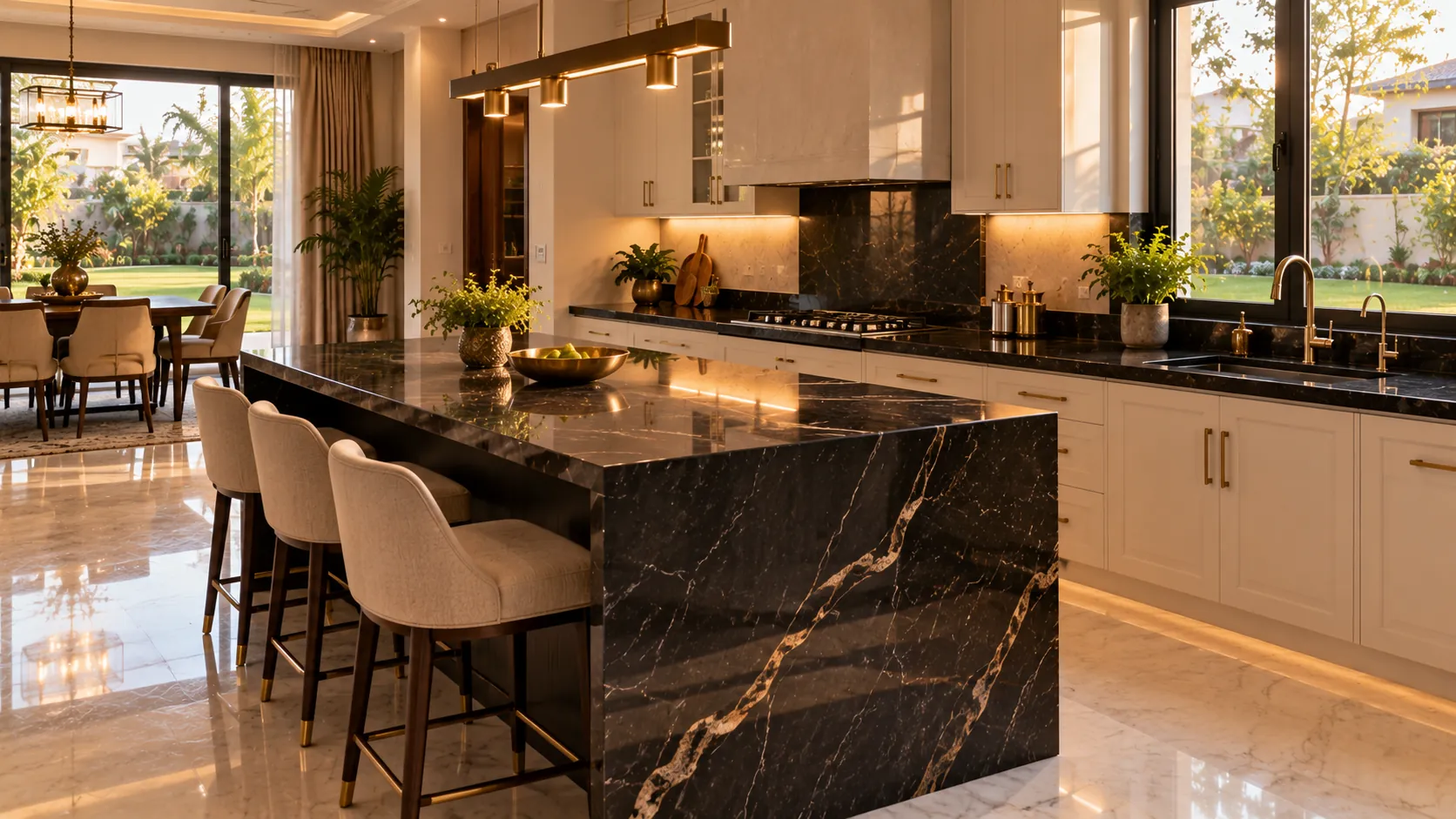
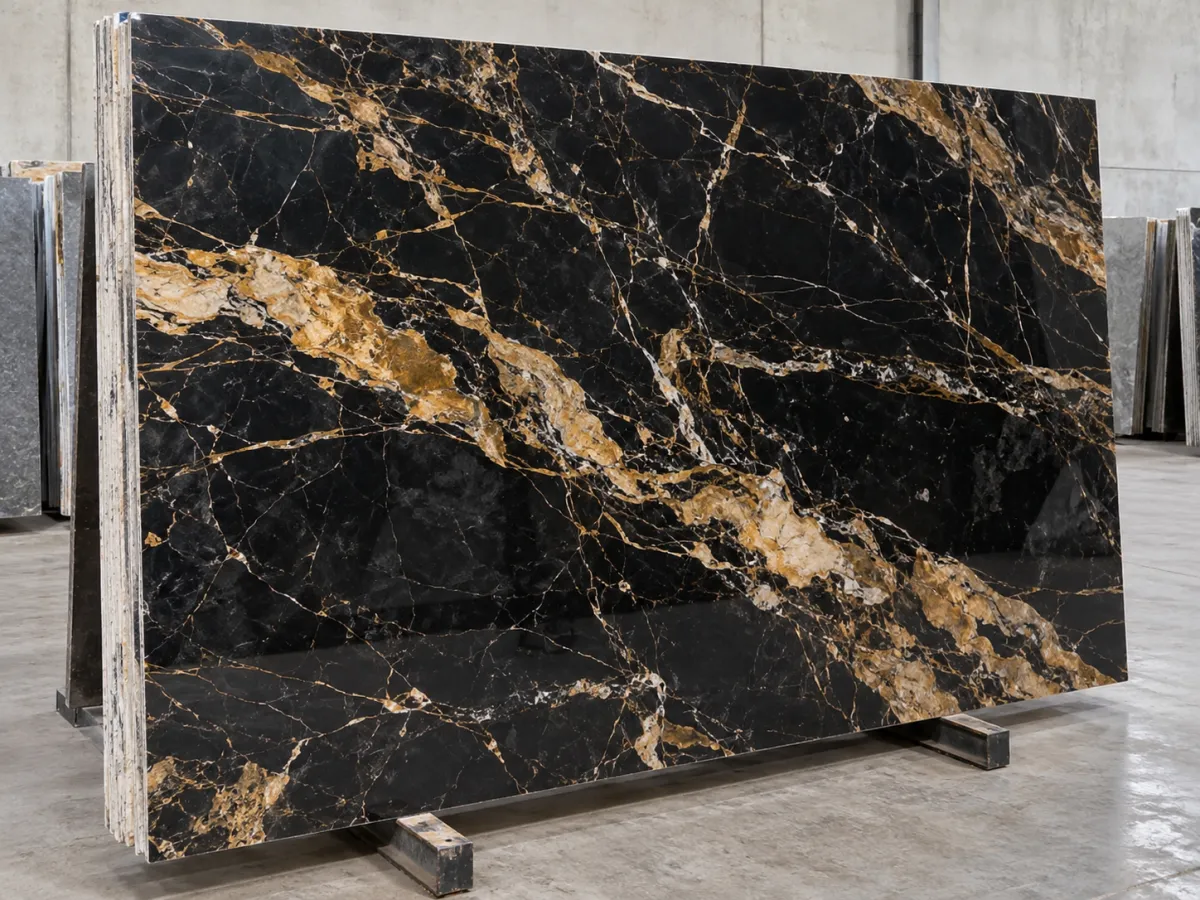
The showpiece. A black to charcoal body crossed by gold, copper and white veins that fork across the slab instead of running straight. No two slabs are alike, and the top grade (a genuinely black field with clean, continuous gold) is a small fraction of each block. That selection is why it tops the table at PKR 1,400–2,800 per sq ft. It is the stone for an island, a bar front or a book-matched feature wall, and many clients use it in one place only. Our Black & Gold collection shows the grades side by side.
Black & White
The companion grade: the same dark body with crisp white veining in place of gold. It reads graphic and cool rather than warm and opulent, and at PKR 900–1,700 per sq ft it costs roughly half of top-grade Black & Gold. It suits powder-room vanities, fireplace surrounds and splashbacks, especially against white joinery.
Silky Black and other yard names
"Silky Black" is a trade name you will see on rate lists and yard boards, usually for a plain dark marble sold mainly as floor and stair tile. It is not a stone we catalogue, and the name is not standardised: two yards can apply it to visibly different material. If you are offered it, compare the actual piece against a Jet Black sample in daylight, check the colour depth when wet and dry, and ask which quarry the block came from. The same caution applies to "Black Gold", "Dark & Gold" and "Michelangelo", which are usually other names for Black & Gold-type stone in varying grades.
The black granites
Galaxy Black (listed from Karachi) and Khyber Black Granite (Nowshera, KP) are not marble at all, but they are what many buyers really need. Both are harder, far less porous and heat-tolerant, at PKR 850–1,700 per sq ft. If your black surface will be cooked on daily, read the comparison further down before you choose.
Why does one black slab cost three times another?
Block yield, slab size, thickness, finish and repair work explain the gap. Two quotes for the same dark stone can differ by PKR 1,000 per sq ft or more and both be honest.
Block yield and grading
A quarried block is not uniform. Part of it carries a deep, even black; part shows grey patches, white spots, open fissures or brownish zones. Yards sort the sawn slabs into grades, and the first selection carries the price. With Black & Gold the effect is extreme: the slabs with balanced gold veining and no grey clouding may be a minority of the block, and the rest is sold as a lower grade or cut down into tiles and borders.
Slab or tile
Full slabs (about 8 × 5 ft for Jet Black and up to 9 × 5.5 ft for Black & Gold in our catalogue) cost more per square foot than tiles cut from the same block, because big defect-free pieces are rarer. Floor tile can use the smaller clean areas between fissures. If you only need a floor, you do not have to pay slab prices; if you need a seamless island, you cannot avoid them.
Thickness: 2 cm against 3 cm
A 3 cm slab uses half as much stone again as a 2 cm slab, weighs more, and is harder to cut and move, so it costs more. For kitchen tops, 2 cm with a built-up (laminated) front edge gives a thick look at lower cost; 3 cm suits islands with an overhang and waterfall ends. Thickness also decides how far an overhang can project without support.
Finish and edge work
Polishing black to a true mirror takes more passes than polishing a light stone, because every swirl mark shows. Honed and leathered finishes add their own processing step. Then come edges: a straight polished edge is the cheapest, while mitred waterfall joints, ogee profiles and sink cut-outs are charged separately or folded into a higher rate.
Resin, mesh and repairs
Veined black stone is often fissured, so yards fill cracks with tinted resin and back fragile slabs with fibreglass mesh. Done well, this is normal practice and makes the slab usable. Done badly, it hides weakness. Properly filled, meshed slabs are not cheaper; badly treated ones are sometimes sold cheaply for a reason.
Rate lists you find online often quote plain black floor tile at well under PKR 300 per sq ft. Those are bare yard rates for thin, small-format, ungraded tile, loaded at the gate, with no cutting, polishing, transport or fitting, while our ranges are fabricated and installed. Compare like with like before deciding a quote is expensive.
What a black floor, stair, kitchen or vanity really costs
Per-square-foot rates only become useful once you know how many square feet a job takes. The table below uses typical Pakistani sizes and our installed quote ranges for the stone named. Treat them as budgeting figures; the real number comes from site measurement.
| Job | Typical area | Stone | Approx. budget (PKR) |
|---|---|---|---|
| Powder-room vanity top with 4-inch upstand | 5 ft × 2 ft top + upstand ≈ 12 sq ft | Black & White | 10,800–20,400 |
| Kitchen island with two waterfall ends | 8 ft × 3 ft top + two 3 ft × 3 ft ends + 20% wastage ≈ 50 sq ft | Black & Gold | 70,000–140,000 |
| L-shaped kitchen top with splashback strip | ≈ 40 sq ft top + 10 sq ft splash + 15% wastage ≈ 58 sq ft | Jet Black | 63,800–116,000 |
| Fireplace surround and hearth | ≈ 25 sq ft + 15% wastage ≈ 29 sq ft | Black & White | 26,100–49,300 |
| Staircase, 14 steps × 4 ft wide (tread + riser) | ≈ 6.8 sq ft per step × 14 + 10% ≈ 105 sq ft | Jet Black | 115,500–210,000 |
| Drawing-room border band only | 60 running ft × 6 inch ≈ 30 sq ft + 10% | Jet Black | 36,300–66,000 |
Two patterns stand out. First, black works best in small, high-impact doses: a vanity, a fireplace, an island or a border. Those jobs need tens of square feet, not hundreds, so even the top grade stays affordable. Second, a whole-house black floor is a large spend and, as explained below, not always a wise one. If you want a dark floor, a black patti border or a medallion set into a light Ziarat or Verona field gives the look for a fraction of the cost; our marble floor design guide shows the layouts.
For a figure built on your own dimensions, run the room through our stone cost estimator; it applies wastage and lets you swap stones to see how the total moves.
Black marble or black granite: which should you buy?
This is the most important decision on the page, and it is about chemistry, not looks. Marble is mostly calcite, about 3 on the Mohs scale, and it reacts with acid. Granite is mostly feldspar and quartz, around 6 to 7, and does not. On a light marble an etch mark is a faint dull ring; on polished black it shows as a pale grey patch that catches every bit of light.
| Property | Jet Black / Black & Gold (marble) | Galaxy Black / Khyber Black (granite) |
|---|---|---|
| Hardness | Mohs 3–4; scratches from grit and steel | Mohs 6–7; shrugs off daily wear |
| Acid (lemon, imli, vinegar) | Etches within minutes on polish | Not affected |
| Hot pans | Avoid; use a trivet | Tolerates heat well |
| Look | Deep flat black, or dramatic veining | Speckled or flecked; Galaxy Black shows silver mica sparkle |
| Repair | Re-honed or re-polished in place | Harder to re-polish on site |
| Price on our quotes | PKR 900–2,800 / sq ft | PKR 850–1,700 / sq ft |
| Best for | Islands, vanities, fireplaces, feature walls | Working kitchen tops, outdoor kitchens, steps |
Our rule of thumb: if the surface sits next to a hob where tomatoes, lemon and tamarind are handled every day, choose granite or accept a honed marble that will patina. If the surface is for show (an island used for serving, a powder room, a bar) the marble gives a depth and figure granite cannot. Our marble vs granite guide goes further, and the black marble kitchen guide covers finishes and layouts for a dark kitchen specifically.
Polished, honed or leathered: the finish changes the upkeep
Finish affects the price a little and the experience of living with the stone a great deal. Black is unforgiving because it shows contrast: dust, fingerprints, water spots and fine scratches are all lighter than the surface.
- Polished gives the mirror depth people buy black for. It also shows every smear and, in Pakistani homes with hard tap water, white calcium rings where glasses and wet hands rest. Best on vertical surfaces and low-use tops.
- Honed is a smooth matte finish that turns black into deep charcoal. It hides fingerprints and fine scratches, and an etch mark blends in instead of standing out. It absorbs a little faster, so it needs sealing on schedule.
- Leathered (offered on Jet Black and both black granites) has a soft, textured sheen. It is the most forgiving finish for a working kitchen and grips better underfoot.
Ask the yard to show you the same stone in two finishes. A small honed and polished sample pair on your own counter, under your own lights, settles this faster than any photo.
Where black stone works, and where it does not
We would rather lose an order than sell a black floor into the wrong room. Be realistic about these conditions.
- Entrances and lounges in dusty cities. Fine Lahore, Multan or Karachi dust settles grey on a black floor within hours and every footprint shows. A mid-tone floor hides it; black demands daily mopping.
- Outdoors and sun-facing verandahs. A dark surface in direct June sun gets too hot to walk on and the polish dulls within a couple of seasons. Use a light, honed stone or flamed granite outside.
- Wet bathroom floors. Polished black is slippery when wet and shows soap and hard-water film. Keep it to the vanity top or a feature wall, and use a honed light stone underfoot. Our bathroom marble design guide covers finishes for wet floors.
- Small, dim rooms. A black floor and walls together shrink a room with little daylight. Use black as a frame or accent instead.
Where it shines: islands and breakfast bars, powder-room vanities, fireplace surrounds, staircase risers paired with lighter treads, inlay borders and medallions, and feature walls where the veining of Black & Gold can be book-matched. Torn between the two veined blacks? See Black & Gold vs Black Zebra marble.
How to inspect black slabs at a yard
Black hides defects better than white, which is exactly why you should inspect it more carefully. Take a torch, a tape measure, a bottle of water, a cloth and a phone camera, and go in daylight.
- Wet a patch and compare. Polished stone should look the same wet and dry. If the dry surface looks noticeably greyer, the polish is shallow or the stone has been oiled or waxed to deepen the colour.
- Rub an offcut edge with a cloth. Colour coming off on the cloth suggests dye or colour wax. Genuine black marble does not transfer colour.
- Rake the torch at a low angle. Grazing light shows resin fills, hairline cracks, pitting and swirl marks from poor polishing that are invisible head-on.
- Turn the slab or look at the back. Note fibreglass mesh and resin. Mesh is acceptable; deep cracks running right through are not.
- Measure thickness at several points. A slab sold as 2 cm should not be 16 mm at one end. Uneven thickness causes lippage and weak edges.
- Check the lot, not one piece. Ask to see every slab or tile crate you will receive. Shade varies block to block, and Black & Gold veining varies slab to slab.
- Photograph and number your selection. Write the slab numbers on the quotation so the pieces you approved are the pieces delivered.
Our team numbers and photographs every slab in daylight before cutting and maps your island, waterfall and splash onto the actual pieces. If you cannot visit, ask us for those photos; for full detail on yard selection see the installation process guide.
Comparing quotes without getting overcharged
Most disputes over dark-stone pricing come from quotes that are not written on the same basis. Put each one into the same columns before you compare totals.
- Stone name, grade and slab numbers, not just "black marble".
- Thickness (2 cm or 3 cm) and finish (polished, honed, leathered).
- Total square feet including wastage, and the wastage percentage used.
- Edge profile and running feet, plus mitres, sink and hob cut-outs.
- Transport and unloading, including floors carried by hand where there is no lift.
- Fitting labour, adhesive and on-site polishing, and who supplies them.
- Sealing at handover, and whether a site visit after fitting is included.
Wastage is where quotes quietly diverge. About 10 per cent covers a plain Jet Black floor or straight top. Book-matched Black & Gold, where slabs must be cut so the veins line up, can need 20 to 30 per cent, because some stone is sacrificed to get the pattern right. A quote that shows 5 per cent on a matched island is either very confident or about to come back for more stone.
Our quote ranges already include fabrication and fitting. If you buy stone alone from a yard and hire your own mistri, budget the labour lines separately. As an indicative market range only, floor laying is typically quoted around PKR 60–150 per sq ft and fabrication with a simple edge around PKR 150–400 per sq ft, varying by city and difficulty. Ask for these in writing before work starts.
Be wary of a total that is far below everyone else. On dark stone the usual shortcuts are a lower grade substituted at delivery, colour-enhanced (oiled) tiles that fade after the first wash, or thinner material than quoted. Slab numbers and a thickness written into the quote protect you from all three.
Installing and caring for a dark marble surface
Installation follows the same steps as any marble job (template, cut, transport, fit), with a few points specific to dark stone. Use a colour-matched black or charcoal grout or epoxy; a grey cement joint draws a grid across a black floor. Fit floors on a full adhesive bed to avoid hollow spots that crack under load, and keep acid-based tile cleaners off site entirely, because one careless wash of the tiles before handover can etch a polished floor.
Seal the stone before grouting and again at handover. Kitchen tops in black marble want resealing every six months or so; floors about once a year. The sealing guide explains the water test and the right products for Pakistani heat and humidity; below are the daily habits that matter most.
- Wipe with a microfibre cloth and pH-neutral stone cleaner; dry polished surfaces to stop hard-water spots.
- Use coasters and a tray under oil bottles, and trivets for anything hot.
- Wipe lemon, imli, vinegar, cola and tomato immediately; these etch rather than stain.
- Sweep or dust-mop floors daily, since grit scratches a dark polish faster than a light one shows it.
- Have dull areas re-honed or re-polished by a machine rather than scrubbing with abrasive powders.
Get a firm price on your black stone
The ranges on this page are a starting point. A firm figure needs your measurements, the stone and grade you have chosen and the delivery city. Send drawings or rough dimensions through the free quote form and we will return a written quotation that states the installed rate and itemises cut-outs, seams and freight.
Before you commit to a dark stone, see it in person. Order samples of Jet Black, Black & White and Black & Gold to compare beside your cabinet colour and under your own lights, or browse the whole marble range. We deliver to Lahore, Karachi, Islamabad and other cities listed on our delivery page.
Written by
The Captivating Marble Design Team
Fabricators, templaters and stone designers
We template, cut and install natural stone every day and write about what we learn — pricing, layouts, care and the mistakes we help clients avoid.
Book a free design consultation