Marble Quality Check: Grades, Defects and Yard Tests Before You Buy
How to judge marble before you pay: Supreme to commercial grades, cracks, fills, pits, thickness, polish and simple yard tests. Book a slab viewing with us.
Captivating Marble Design Team · · 17 min read
Key takeaways
- Supreme, A-grade, B-grade and commercial are yard selection labels, not separate stones or a written national standard, so compare the actual slabs.
- Ziarat Supreme costs PKR 1,100–2,100 per sq ft fitted at our November 2026 quote ranges, against PKR 550–950 for Medium White from the same belt.
- A clean resin fill in a natural fissure is normal; an open crack you can catch with a fingernail, or a fill that sounds dull when tapped, is not.
- Measure thickness at several points: more than a millimetre or two of variation across a slab or tile shows up as lippage on a floor.
- Buy the whole quantity from one lot, approve tagged slab numbers in writing, and check every crate against those numbers on delivery.
The short answer
A marble quality check covers five things: the grade label, visible defects, a few simple yard tests, lot matching and the right questions. Look for open cracks, badly filled fissures, pits, colour patches, uneven thickness and wavy polish, then wet, tap and measure the slab. As of November 2026, Ziarat Supreme costs PKR 1,100–2,100 per sq ft fitted.
Grade names such as Supreme, A-grade and commercial tell you roughly where a lot sits in a yard's own sorting, but they are not a written standard, and one yard's A-grade can be another's B. The only reliable test is the stone in front of you. This guide explains what the grade labels usually mean, the defects that matter and the ones that do not, ten-minute tests you can do with a bottle of water and a coin, how to keep a whole house in one lot, and what to ask before paying an advance. If you are still deciding who to buy from, our guide to choosing a marble supplier covers the seller; this one covers the stone.
How we priced this: every rupee figure is our current catalogue quote range per square foot as of November 2026. These are fabricated and installed prices in our service area, covering stone, cutting, a standard edge, a standard polish, fitting and sealing on fitting day. Cut-outs, seams and freight outside our fitting cities are itemised on the quote; slab-only rates are quoted separately. Tolerances below are indicative trade guidance.
What do Supreme, A-grade, B-grade and commercial mean?
They are selection labels: the yard has sorted slabs or tiles cut from the same quarry by how clean, even and sound they are, and priced the best of them higher. A grade is not a different stone. Ziarat Supreme and Medium White can come from the same Balochistan belt; the difference is how much spotting, cloud and filler each piece carries. Our overview of types of marble in Pakistan uses the same definition.
| Label you will hear | What it usually means | Where it makes sense |
|---|---|---|
| Supreme, Super, Export | Hand-picked at the block; the cleanest ground, fewest spots, tight grain, small filled fissures if any | Feature walls, islands, vanities, reception fronts, book-matched panels |
| A-grade, first selection | Even colour, light spotting, a few neat resin fills, gauged thickness | Drawing and dining rooms, lounges, kitchens on a budget |
| B-grade, second selection | More cloud and spotting, more fills, some colour drift between pieces | Bedrooms, stairs, upper floors, rental units |
| Commercial, mix, lot maal | What remains after sorting: mixed tones, heavier fills, chipped edges, often ungauged | Utility rooms, servant quarters, roof stairs, areas you will cover with rugs |
Two practical points follow. First, the label is only as honest as the person sorting, so always look at every slab or open several crates rather than one polished sample. Second, a lower grade is not a worse buy if it suits the room. A B-grade white with grey cloud on a staircase hides footprints better than Supreme does.
How grade shows up in price
In our catalogue the clearest example is the Ziarat family, where grade is sold as three separate products. For every other stone, grade is one of the things that decides where a quote lands inside the range.
| Stone | Selection | PKR / sq ft | Slab size in our yard |
|---|---|---|---|
| Ziarat Supreme | Hand-picked top grade | 1,100 – 2,100 | 108 x 66 in |
| Ziarat White | Standard lot | 850 – 1,600 | 96 x 60 in |
| Medium White | Working lot with grey cloud and light spotting | 550 – 950 | 96 x 60 in |
| Black & Gold | Wide range: clean gold veining at the top, busier lots lower | 1,400 – 2,800 | 108 x 66 in |
On a 1,000 sq ft floor, the gap between the bottom of Medium White and the top of Ziarat Supreme is more than PKR 15 lakh, so it pays to decide which rooms truly need the top grade and which can take a working lot.
Which defects should you look for in a slab or tile?
Look for open cracks, loose or sunken fills, pits, colour patches, rust spots, chipped edges, bowing, uneven thickness and poor polish. Natural marks such as veins, cloud and small filled fissures are part of the stone; the question is whether a mark is stable and whether you can live with it in that room.
| Defect | What it looks like | How serious |
|---|---|---|
| Open crack | A line you can catch with a fingernail, often running across the veins, sometimes visible on the back too | Serious on counters, treads and long pieces; reject or cut it out |
| Resin-filled fissure | A natural seam filled with clear or tinted resin, smooth to the touch, slightly different sheen | Normal if flush, hard and tinted to match; a problem if sunken, cloudy or cracked |
| Pits | Small holes left where soft minerals plucked out during polishing | Minor if filled; open pits on a kitchen top or floor collect dirt and oil |
| Colour patches | Darker or yellowish blotches, grey clouds, or a band of different colour across the piece | Taste and grade; serious only if the lot is meant to be uniform |
| Rust or brown spots | Small brown or orange dots, more visible when wet | Can grow on light stones in wet areas; avoid in showers and on vanities |
| Chipped or broken edges | Missing corners and nicks along the sawn edge | Acceptable on floor tile that will be trimmed; not on finished edges |
| Bow or twist | A slab that rocks on a flat surface or shows a gap under a straight edge | Causes lippage and hollow spots; reject for floors and counters |
| Thickness variation | Different readings at corners and centre, steps at the edge | Shows as lippage; more than a millimetre or two needs grinding |
| Poor polish | Wavy reflections, dull patches, swirl marks, haze over fills | Fixable by re-polishing, but it tells you about the workshop |
Cracks versus fissures
This is the distinction buyers most often get wrong. A fissure is a natural seam that formed in the rock millions of years ago; it is usually closed or tightly bonded, follows the veining and is often filled with resin at the factory. A crack is a fresh break, usually from blasting, handling or transport. Fissures are the reason most Pakistani slabs go through resin treatment, and our glossary page on resin-filled slabs explains the process. A neat, hard, colour-matched fill is a sign the factory did its job. A fill that is soft, sunken, milky or cracked along its length is not.
Pits and porosity
Some stones carry more pitting than others because softer mineral grains pluck out under the polishing heads. Small filled pits on a wall are invisible from a metre away. On a kitchen top or a dining-room floor, open pits fill with oil, haldi and dirt, so ask for them to be filled before the stone leaves the workshop. Pitting often goes with higher porosity, which makes sealing more important.
Polish quality
Stand at an angle to the slab with a tube light or the sky reflected in it. Straight lines should stay straight as you move. Waves, ripples or a soft blur mean the grinding before polishing was poor, and every joint will show it once the stone is laid. Dull islands usually sit over resin fills, which polish differently from stone. A polished finish should look even from edge to edge; if you have chosen honed instead, it should be uniformly matte, without shiny patches.
A marble quality check at the yard, step by step
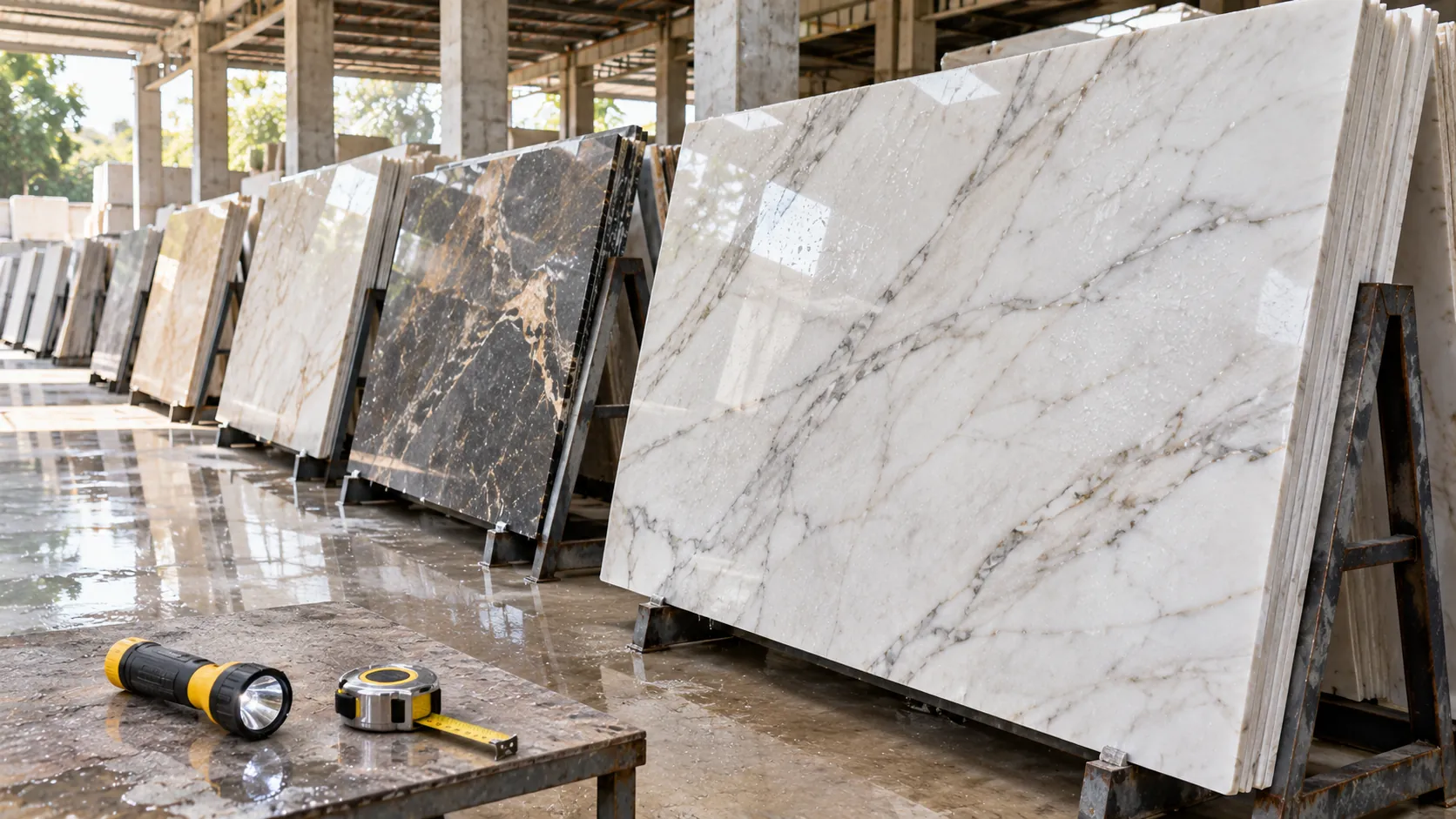
Take a bottle of water, a soft cloth, a one-rupee or five-rupee coin, a steel tape, a small straight edge or spirit level, your phone torch and your room drawing. Go in daylight. These tests take about ten minutes per lot and need no special tools.
| Test | How to do it | Pass | Warning sign |
|---|---|---|---|
| Wet the face | Wipe water across the whole slab with the cloth | Even colour; veins and cloud look as expected | Hairline lines appear; patches darken unevenly |
| Water drop | Leave a few drops on an unsealed area or offcut for 5–10 minutes | Water sits on the surface, slight darkening at most | A dark ring spreads fast: a thirsty stone that needs good sealing |
| Fingernail | Run a nail across every vein, fill and line | Smooth; you cannot catch the line | Your nail catches: an open crack or a sunken fill |
| Tap | Tap a coin or knuckle along the slab, especially over fills | A clear, ringing note | A dull thud or buzz: a hidden crack or a loose fill |
| Straight edge | Lay a level or straight edge across and along the face | Sits flat | Light under the middle or the ends: bow or twist |
| Tape at corners | Measure thickness at each corner and mid-edge | Readings within a millimetre or two | Larger differences: ungauged stone, lippage later |
| Reflection | View a tube light or window in the polish at an angle | Lines stay straight and sharp | Wavy or blurred reflections |
| Back of the slab | Ask for the slab to be tilted forward on the A-frame | Clean back, or neat mesh and resin | Cracks visible on the back, mesh peeling, fresh patches |
The water drop, explained
Marble is calcite, and all calcite absorbs some liquid. Most Pakistani whites and beiges darken slightly under a water drop and dry back within a few minutes; that is normal. What you are looking for is a stone that drinks water fast, because it will drink oil, chai and haldi just as fast in a kitchen. That is not a reason to reject it for a bedroom floor, but it is a reason to seal it properly. Our guide to sealing marble in Pakistan explains how and how often.
The tap test
A sound slab rings when tapped with a coin; a cracked one sounds dull past the crack. Tap along the length of a long piece, such as a kitchen top or stair tread, and especially either side of any fill. The same test works after fitting: a hollow, drummy note from a floor tile or skirting means there is no adhesive or mortar under that part, and that is where cracks will start.
The scratch test
Marble sits at about 3 to 4 on the Mohs scale, so a steel key or knife point will mark it. Granite and quartz will not mark. Do this only on an offcut or the back of a piece, never on the face of a slab you are buying. The test does not grade marble, since every true marble will scratch, but it tells you whether a stone sold as granite is really marble, and it helps you decide whether a soft stone belongs on a busy kitchen top. A surface that feels warm and plasticky and scratches very easily may be resin rather than stone; our guide to natural vs artificial marble covers the other signs.
The torch test for onyx
Onyx is bought for its translucency, so check it with light. Hold a phone torch flat against the face, or behind a thin offcut, in a shaded corner of the yard. Good onyx glows through its bands, and the light shows what daylight hides: hidden cracks appear as sharp dark lines, resin-filled areas glow differently from the stone, and thick or uneven mesh on the back casts shadows. Onyx slabs always arrive resin-treated and mesh-backed, which is normal; the question is whether the treatment is neat. Our onyx price guide explains why onyx such as Pak Green Onyx (PKR 2,400–5,200 per sq ft) costs what it does. Light-coloured marble only glows at very thin edges, so the torch test is mainly useful on onyx and thin wall panels.
Checking backs and mesh
Fibreglass mesh glued to the back of fragile slabs is normal on onyx, on heavily fissured stones and on thin wall panels. It should be bonded flat across the whole back with no loose corners. Mesh is a problem only when it is hiding something: a crack that runs right through the slab will often be visible on the back as well, so look there before you approve a piece. Mesh-backed stone is fine on a wall or a vanity, but ask how it will be fixed, because some adhesives bond poorly to resin.
If you cannot travel to the yard, ask for a video of the exact slabs with their tag numbers visible, wetted and filmed at an angle to the light. Every slab in our yard is photographed and numbered, and out-of-city buyers approve tagged photos by WhatsApp before any cutting.
Lot matching: why one block matters more than the grade
A lot is a batch of slabs or tiles cut from one block, or from blocks that match closely. Colour, veining and cloud change from block to block even within one quarry, so two orders of "Ziarat White A-grade" placed three months apart can look like different stones. Lot matching means buying the whole quantity for a floor, a staircase or a kitchen from one lot, at one time.
- Give the full quantity up front: floors, skirting, stairs, sills and a reserve for repairs. A small top-up later rarely matches.
- Ask for the lot or block number and check that every slab or crate carries it.
- Ask for sequential slabs where the veining is strong. Slabs cut one after another from a block can be laid out so the pattern flows, or book-matched as mirror pairs.
- Lay out the tiles dry on site before fixing. Shuffle crates so slight drift is spread across the floor rather than concentrated in one corner.
- Keep a few spare pieces. One or two spare tiles or an offcut from the same slab makes a future repair invisible.
As an indicative guide, keep around 2–3% of a floor's area, from the same lot, stored flat in a dry place after the job, on top of normal cutting wastage. Our marble flooring cost guide shows how wastage changes a whole-house quantity.
Grade versus job: where can you save?
Use the best grade where the stone is seen up close and in long unbroken pieces, and a working grade where it is walked on, broken up by furniture or out of sight. The table is a starting point, not a rule.
| Job | Suggested selection | Why |
|---|---|---|
| Kitchen top or island | Supreme or A-grade, gauged, no open cracks | Long pieces over cabinets; every fill and pit is at eye level and in contact with oil and acid |
| Vanity top | A-grade or better, no rust spots | Constant water; brown spots and soft fills show quickly |
| Feature wall or reception front | Supreme, sequential or book-matched | The stone is the whole design; colour drift is obvious |
| Drawing and dining room floor | A-grade, one lot | Large open areas show colour drift |
| Bedrooms and lounges | A or B-grade, one lot | Rugs and furniture break up the field |
| Stairs and skirting | B-grade is often fine | Short pieces; cloud hides footprints and scuffs |
| Utility, roof stairs, store rooms | Commercial | Function over finish |
Thickness belongs in the same decision: a Supreme slab cut thin and ungauged is a worse kitchen top than a sound A-grade slab at a full 20 or 30 mm. Our marble thickness guide explains gauging and which thickness each job needs. To see what a grade change does to your total, enter your area in the stone cost estimator.
Checking stone on delivery and on site
Approval at the yard is half the job. Stone can be swapped, damaged in transit or cut badly, so check again before anything is fixed, because once a piece is laid in mortar it is very hard to argue that it was faulty when it arrived.
- Count crates and pieces against the delivery note, and match slab or lot numbers to the photos you approved.
- Open a few crates from different parts of the load and compare colour in daylight, not under the truck's shade.
- Check edges and corners for transit chips, and tap long pieces for cracks.
- Measure a sample of tiles for size and thickness. Cut-to-size pieces should match the drawing to within a couple of millimetres.
- Photograph any damage before signing, and write it on the delivery note.
Lippage after laying
Lippage is the height difference between the edges of two neighbouring pieces. On a floor you can feel it with bare feet and see it in raking light from a window. Some lippage is expected on a traditional mortar-bed floor, which is why Pakistani floors are usually ground flat afterwards in the process called ragrai, then polished. Heavy lippage on wall cladding or a counter cannot be ground out so easily, so it must be avoided at the cutting and fitting stage with gauged stone. Our marble polishing guide explains what grinding can and cannot correct.
As an indicative guide, gauged tiles laid on adhesive should finish within about a millimetre of each other before grinding; a step you can catch with a fingernail on a wall or worktop is a fitting fault. Floors of ungauged tile will show more lippage and need more grinding, which removes stone and adds cost.
Questions to ask before you pay an advance
Good answers to these questions tell you more about quality than any grade label. Write the answers on the quotation.
- Which quarry area does this stone come from, and is this the whole lot I will receive?
- What do you mean by Supreme, A or B on this stone, and can I see the next grade down for comparison?
- Has the slab been resin-treated or mesh-backed, and on which side?
- Is the stone gauged, and to what thickness: 18 mm, 20 mm or 30 mm?
- Are these slab or crate numbers reserved in my name, and will the same numbers be delivered?
- Will pits and fissures be filled before polishing, and with tinted or clear resin?
- What happens if a piece arrives cracked or does not match the approved photos?
- Does the price include cutting, edges, polishing, fitting and sealing, or only the stone?
The last question matters because a cheap bare-yard rate and a fitted quote are different products. Our white marble price guide explains how the whites are priced grade by grade, and the supplier guide linked above covers paperwork, advances and red flags in more detail.
Common mistakes when judging marble
- Choosing from a polished sample in the office. A 6-inch sample is the best part of the best slab. Look at the lot.
- Judging colour under shade or tube light only. Daylight shows yellow and grey drift that indoor lighting hides.
- Treating every fill as a defect. Neat resin fills are normal in Pakistani marble. Focus on open cracks and loose fills.
- Paying for Supreme everywhere. Use the top grade where it is seen and a working lot where it is walked on.
- Ordering in instalments. Each top-up risks a new lot and a visible colour change.
- Skipping the thickness check. Ungauged stone is the main cause of lippage and uneven worktop joints.
- Signing the delivery note without opening crates. Damage found after fixing is very hard to claim.
None of these cost money to avoid; they cost ten minutes and a little patience at the yard.
See the stone before you decide
The simplest way to judge a stone is to hold it in your own light. Order samples of the grades you are comparing, at PKR 500 each and credited back on your order, or book an appointment to see tagged slabs in our Lahore slab yard with a tape and a bottle of water in hand. When you are ready, send your drawing for a free written quote that names the stone, the selection, the thickness and the lot.
If you are also deciding between full slabs and cut tiles for the same floor, our companion guide on slabs vs tiles compares joints, wastage and handling.
Written by
The Captivating Marble Design Team
Fabricators, templaters and stone designers
We template, cut and install natural stone every day and write about what we learn — pricing, layouts, care and the mistakes we help clients avoid.
Book a free design consultation