Onyx Marble Price in Pakistan 2026: Rates, Grades and Uses
Green, Honey and Snow White onyx rates per sq ft, why onyx costs more than marble, worked vanity and backlit wall costs, and a yard checklist. Get a quote.
Captivating Marble Design Team · · Updated · 14 min read
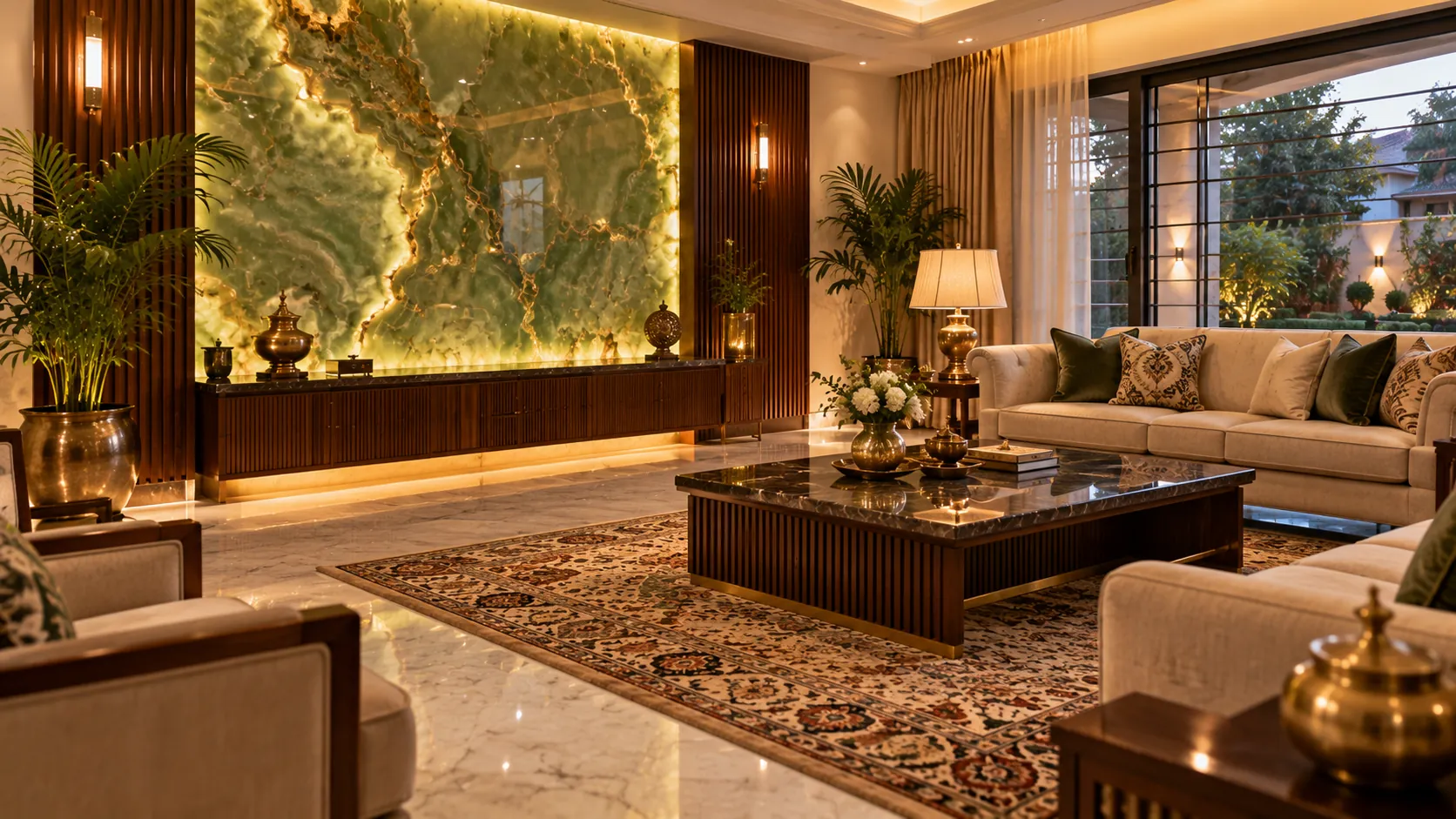
Key takeaways
- Pakistani onyx costs PKR 2,200–5,600 per sq ft at our November 2026 quote ranges, about three times a good Ziarat White.
- Honey Onyx runs PKR 2,200–4,800, Pak Green Onyx PKR 2,400–5,200 and Snow White Onyx PKR 2,600–5,600 per sq ft.
- All three onyx colours we stock come from Chaghi, Balochistan, where onyx is known locally as malmal.
- A backlit panel adds an indicative PKR 600–1,200 per sq ft for the LED light box and aluminium frame.
- Onyx (about Mohs 3) suits walls, vanities and bar fronts, not floors or kitchen prep worktops.
How much does onyx cost in Pakistan?
The onyx marble price in Pakistan runs from PKR 2,200 to PKR 5,600 per square foot installed at our current quotes (November 2026): Honey Onyx from PKR 2,200, Pak Green Onyx from PKR 2,400 and Snow White Onyx up to PKR 5,600. All three come from Chaghi, Balochistan, and cost roughly three times a good Ziarat White.
The premium exists because onyx comes from small, fissured blocks, needs resin and mesh backing, and loses more stone to breakage at every step from quarry to wall.
Below you will find the rate for each colour, what pushes a slab to the top or bottom of its range, worked costs for a vanity, a fireplace and a backlit wall, honest advice on where this stone fails, and a checklist for inspecting slabs at the yard.
Catalogue figures are our current quote ranges per square foot, fabricated and installed in our service area. Sink cut-outs, freight outside our fitting cities, and the light box and frame for backlit panels are itemised separately. Market figures for imported onyx, look-alike materials and lighting are indicative only.
Onyx marble price in Pakistan by colour
All three colours we stock come from the Chaghi district of Balochistan. They behave the same way in fabrication; the price difference comes from how clean, translucent and large the usable pieces are.
| Stone | Colour and character | Light transmission | PKR / sq ft | Typical use |
|---|---|---|---|---|
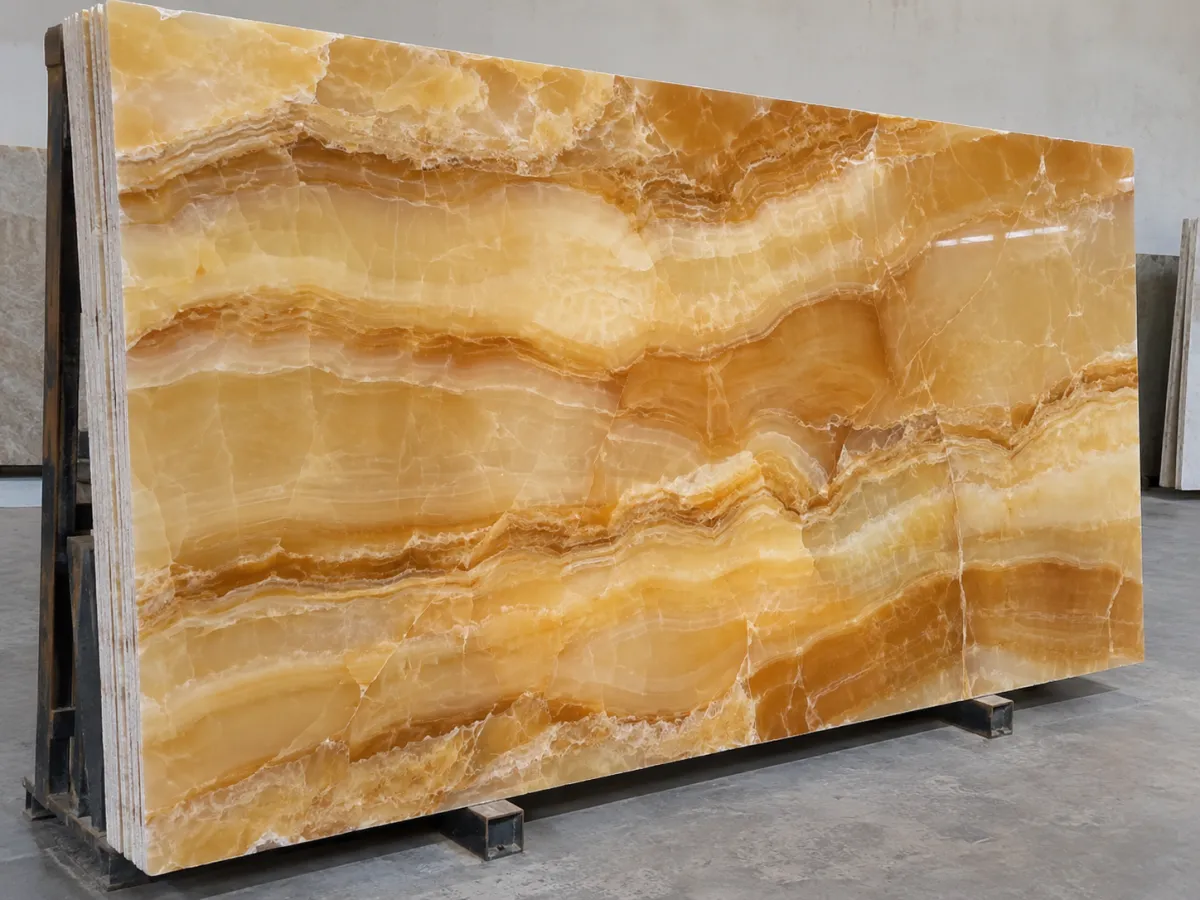
| Honey Onyx | Amber to caramel bands | Good, glows warm | 2,200 – 4,800 | Bar fronts, vanities, fireplace panels |
| Pak Green Onyx | Jade-green bands with golden veins | Good, deep green glow | 2,400 – 5,200 | Feature walls, vanities, table tops |
| Snow White Onyx | Milky white with faint grey ghosting | Highest, even soft white | 2,600 – 5,600 | Backlit walls, bath surrounds, reception desks |
Each stone has its own page with photographs of current lots: Pak Green Onyx, Honey Onyx and Snow White Onyx. Our onyx slabs page shows them together with slab sizes, thickness and finish details.
You will also hear other names in Karachi and Lahore markets: light green, dark green, multi-green, "Afghan" green, pink and multicolour onyx, plus onyx mosaic made from offcuts. Most are colour sorts of the same family. Treat the name as a description, not a grade, and judge each slab on the points in the checklist further down.
What onyx actually is, and why Chaghi matters
In the stone trade, "onyx marble" means a banded, translucent calcite deposited from mineral-rich water in caves and springs, not the black gemstone sold in jewellery shops. It is closer to travertine than to Ziarat marble in origin, which is why it is softer, more fissured and so different in the way light passes through it.
Pakistan onyx comes overwhelmingly from Chaghi, where it is known locally as "malmal". According to a Planning Commission feasibility study on the Chaghi dimension stone cluster, the belt has been quarried since the 1950s at localities including Zard Kan, Patkok, Julli, Butak, Mashki Chah, Tozghi and Zeh, and the stone is processed at Hub or in Karachi for the local market and export. The same study notes that green is the most valued colour, with bands of red, brown and white common and golden patches rare.
Why that geology drives the price
- Small blocks. Spring and cave deposits do not form the large, even beds a Ziarat quarry gives. Onyx slabs are typically around 6–7 ft by 4 ft, and large clean pieces are rare.
- Natural fissures. The bands that make onyx beautiful are also planes of weakness. Almost every slab is resin-filled and backed with fibreglass mesh before cutting.
- Softness. Like all calcite, onyx sits around 3 on the Mohs scale. Steel scratches it, lemon and vinegar etch it, and it chips if knocked on an edge.
- Low yield. Between the quarry, the gang saw, the polishing line and the workshop, a larger share of each block ends up as breakage or offcut than with marble — and you pay for that loss in the rate.
Why does onyx cost three times more than marble?
Onyx costs more because far less of each small, fragile block becomes a usable translucent panel. People are often surprised that a "marble" can cost PKR 5,000 a foot when Ziarat White is quoted at a fraction of that. The difference is not branding; it is the cost of getting a usable, translucent panel onto your wall.
| Pak Green Onyx | Ziarat Supreme | Black & Gold | Green Fancy | |
|---|---|---|---|---|
| PKR / sq ft | 2,400 – 5,200 | 1,100 – 2,100 | 1,400 – 2,800 | 780 – 1,450 |
| Translucent when backlit | Yes | No | No | No |
| Typical slab size | Small, about 6–7 x 4 ft | Large | Medium | Medium |
| Resin and mesh backing | Standard | Occasional | Common | Common |
| Kitchen worktop | No | With care | With care | Not ideal |
| Best for | Lit walls, vanities, bars | Islands, floors | Islands, fireplaces | Fireplaces, accent walls |
If you want drama on a smaller budget, Black & Gold or a Fancy marble gives a bold look at a half to a third of the rate. If you specifically want light to glow through the stone, nothing else in the Pakistani range does it, and onyx is worth the premium on a well-chosen area. Our types of marble guide sets onyx against the full Pakistani range.
What moves a slab up or down its range
Within each colour the rate can more than double. These are the factors a yard prices in, roughly in order of impact.
Translucency and colour depth
Hold a torch behind the slab. A panel that glows evenly across its face, with clear, saturated bands, sits at the top of the range. Cloudy patches that block light, or washed-out colour, bring it down. Deep, even green is the most sought-after Pakistan green onyx sort.
Fissures and resin
Every slab has filled fissures. What matters is how many, how wide and where they fall. A few fine lines following the bands are normal; open cracks crossing the bands, or large resin patches that show dark when lit, are reasons for a lower grade.
Size and sequence
Large, clean panels command a premium because so few survive. Sequential slabs from one block — needed to bookmatch a wall so the pattern mirrors across the joint — are also priced higher, but they are what turns a panel into a centrepiece.
Thickness and finish
Panels for backlighting are commonly cut around 18 mm and mesh-backed; vanity tops can be cut slightly thicker for strength. Polished faces show translucency best; a honed face gives a softer, diffused glow and hides fine scratches.
Stock and timing
Onyx production from Chaghi has never been steady, so the choice in any one yard changes from month to month. When a good block arrives, its best sequential slabs are often reserved for export or for a single large project. If you see a lot you love, reserving it with a deposit is usually cheaper than waiting and paying more later for a second-best match. Conversely, if nothing in stock suits your wall, it is better to wait for the next block than to accept a lot you will look at every day.
Offcuts and mosaic: the budget route
Not every onyx job needs a full slab. Offcuts from panel work are cut into strips, small tiles and mosaic for niches, shelf backs, a border inside a marble floor or a band around a mirror. Because the material is a by-product, the rate per square foot is usually well below full-slab pricing, and a lit niche in green onyx mosaic gives much of the effect of a feature wall at a fraction of its cost. Ask what offcuts are available from current lots before you design the space.
Worked costs: vanity, fireplace, bar and backlit wall
These figures multiply real areas by our catalogue ranges, so you can redo the arithmetic for your own sizes. They are installed costs at our quoted rate; the extras listed underneath are itemised separately.
| Project | Area | Stone | Estimated installed cost (PKR) |
|---|---|---|---|
| Powder-room vanity top 5 x 2 ft plus splash | About 12 sq ft | Honey Onyx (2,200 – 4,800) | 26,400 – 57,600 |
| Fireplace surround | About 20 sq ft | Pak Green Onyx (2,400 – 5,200) | 48,000 – 104,000 |
| Bar or reception counter front, 8 x 3.5 ft | 28 sq ft | Honey Onyx (2,200 – 4,800) | 61,600 – 134,400 |
| Backlit feature wall, 6 x 8 ft | 48 sq ft | Snow White Onyx (2,600 – 5,600) | 124,800 – 268,800 |
What is itemised on top
- Backlighting. The LED sheet, diffuser, aluminium frame and light box add an indicative PKR 600–1,200 per square foot of lit panel, plus the electrician and the driver position.
- Cut-outs and edges. A basin cut-out, a polished undermount edge or a mitred corner on a bar front is workshop time and is itemised.
- Wastage. Plan on more spare than with marble. Bookmatched walls need whole sequential slabs, so you buy by the slab, not only by the square foot you see.
- Freight and handling. Onyx travels flat on padded frames, not stacked upright like marble, which costs more per load; freight outside our fitting cities is itemised.
The useful lesson from the table: onyx rewards a small, deliberate area. A 12 sq ft vanity in Honey Onyx can cost less than the imported fittings in the same washroom, while a whole lounge wall quickly runs into lakhs. For a step-by-step on the lit wall itself, read our backlit Pak onyx feature wall guide; for vanity tops and basins, see marble sink and wash basin designs. To run your own sizes, use the cost estimator.
Pakistani onyx vs imported onyx and look-alikes
Onyx is also quarried in Iran, Turkey, Mexico and elsewhere, and some imported slabs reach Pakistani showrooms. Pakistani green is itself an export material, so buying it here, close to the source, is usually the better value.
As an indicative market guide, imported onyx tends to cost more again once freight and duty are added, and a matching repeat order is hard to get. Choose it only if you want a colour Chaghi does not produce.
At the other end are onyx-look porcelain slabs and translucent resin panels. They cost an indicative fraction of real onyx, resist acids and scratches far better, and repeat exactly. What they cannot do is give the depth of real banding when lit. For a kitchen splashback that gets splashed daily, a look-alike is a reasonable choice; for a drawing room wall people walk up to, the real stone is what you are paying for.
Where onyx works, and where it fails
The most expensive onyx mistake is putting it in the wrong place. Use this as a quick filter. Our guide to onyx uses at home has room-by-room ideas.
| Works well | Use with care | Avoid |
|---|---|---|
| Backlit feature walls and niches | Powder-room vanity tops | Kitchen prep worktops |
| Bar and reception counter fronts | Dining or coffee table tops | Floors and stair treads |
| Fireplace surround panels | Bath surrounds out of direct splash | Shower floors and wet benches |
| Headboard walls, lamp bases, inlay | Serving islands that never see a knife | Outdoor or sun-facing walls |
The reasons are simple: onyx scratches under steel and grit, etches with lemon, vinegar and many bathroom cleaners, and chips on edges that get knocked. Strong sunlight can also fade colour and yellow the resin over time. If a surface will be walked on, cooked on or scrubbed, choose granite or a harder marble there and save the onyx for vertical, admired surfaces. Our kitchen countertops page covers the stones that do suit cooking areas.
Buying checklist: inspecting onyx at the yard
Onyx must be chosen in person or from detailed photos of the actual slab, never from a catalogue swatch. Take this list.
- Do the torch test. Hold a phone torch flat against the back. The light should spread through the stone, not show as a small hot spot.
- Look at the back as well as the face. Mesh and resin are normal; check the mesh is bonded flat with no hollow patches that sound different when tapped.
- Trace the fissures. Lines along the bands are acceptable; open cracks across the bands, especially near where a cut-out will go, are not.
- Ask for the sequence. For a bookmatched wall, slabs must be consecutive from one block and marked in order. Photograph the numbers.
- Measure every slab. Usable size is what matters, after edges with chips or heavy resin are trimmed.
- Buy the whole job at once. Banding changes quickly through a block; a panel added later will not match.
- Check how it will travel. Slabs should leave on padded A-frames or flat crates, never loose on a truck bed.
- Get it in writing: stone and colour sort, slab numbers, thickness, finish, backing, cut-outs, light box (if any), transport and fitting.
How to avoid being overcharged: ask for the price per slab as well as per square foot. With small, irregular onyx slabs, the usable area can be well below the gross size, and a low per-foot rate on gross area can cost more than a higher rate on trimmed area.
Fitting and care
Onyx is fitted differently from floor marble, and most failures we see come from fitting it like ordinary stone.
- No thick grey cement bed. Every ridge of mortar behind a translucent panel shows as a shadow when lit, and grey cement can stain pale onyx. Use a white stone adhesive, plus mechanical clips on walls.
- Dry-fit lit panels first. The light box, frame and panel should be assembled and switched on in the workshop before they come to site.
- Keep drivers accessible and cool. In a Lahore or Multan summer, a sealed light box gets hot; heat shortens LED life and can discolour resin.
- Seal and wipe. An impregnating sealer slows staining, though it cannot stop acid etching. Clean with a pH-neutral cleaner and a soft cloth only.
Sealing intervals and the water test are in our guide on how to seal marble in Pakistan; the same method suits onyx, with a shorter interval on vanity tops. Allow about two to four weeks from slab selection to fitting, since resin filling, backing and careful handling all take time.
Is onyx worth it for your home?
Yes, when three things are true: the surface is vertical or rarely touched, the area is deliberate rather than wall-to-wall, and you want light or translucency that no other stone gives. In that case, Pakistani onyx is one of the few luxury materials that costs less here than almost anywhere else, because it is quarried in Balochistan and processed in Karachi.
No, if the stone must survive cooking, foot traffic or harsh cleaners, or if the budget only stretches to a large area in a low grade. A bold marble or a granite will serve better, and you can still use an onyx niche or vanity as the single accent.
Get an onyx quote and see the slabs
Because every onyx slab is different, a quote starts with the area and the use: send your sizes, a photo of the wall or vanity, and whether you want it backlit through our onyx quote form. We will suggest a colour, check the slab sequence available and quote the installed price, with cut-outs, lighting and freight itemised. To see the colour and translucency at home first, order onyx samples — a small piece held up to a window tells you more than any photo.
Written by
The Captivating Marble Design Team
Fabricators, templaters and stone designers
We template, cut and install natural stone every day and write about what we learn — pricing, layouts, care and the mistakes we help clients avoid.
Book a free design consultation