Book Matched Marble Feature Walls: Sequencing, Stones, Cost and Ordering
How mirrored slab pairs are sequenced, which stones and onyx suit them, where they work, what drives the cost and how to approve a layout. Get a free quote.
Captivating Marble Design Team · · 17 min read
Key takeaways
- A mirror pair must come from consecutive slabs of one block, reserved together and numbered before any cutting starts.
- Our longest slabs are 108 in (9 ft), so a wall taller than about 9 ft needs a planned horizontal joint or a four-slab layout.
- Bold directional figure such as Black & Gold, Tiger Verona, Zebrano, Fancy and onyx gains most; plain stones such as Verona Plain gain little.
- At our November 2026 installed ranges, a 10 x 8 ft wall costs about PKR 60,000–108,000 in Tiger Verona before wastage.
- Approve the layout on photographs of your actual slabs, with the mirror line, joints and socket cut-outs marked, before the saw touches the stone.
The short answer
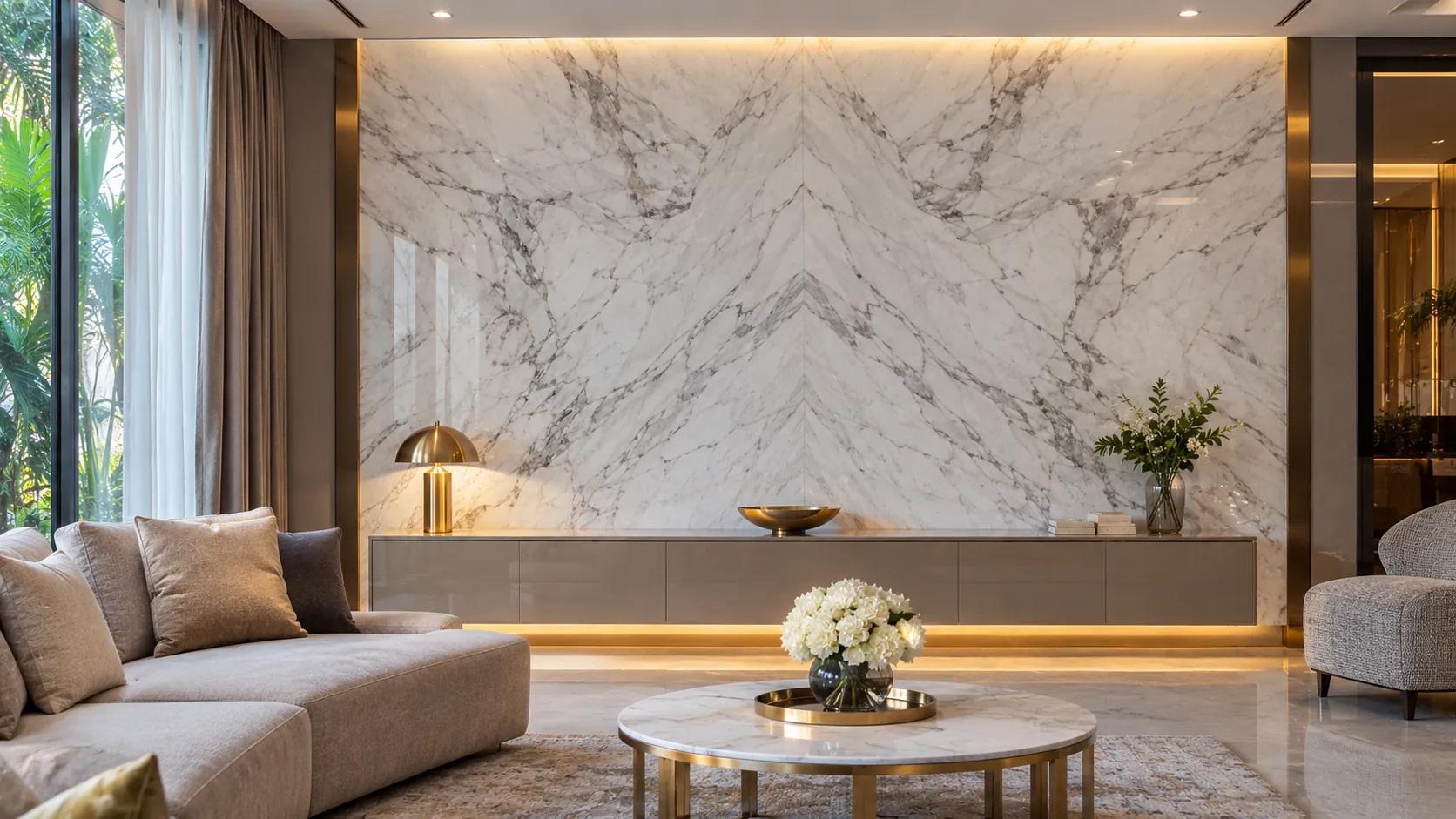
Book matched marble is two or more consecutive slabs from the same block, set side by side with alternate slabs flipped, so the veining mirrors across the joint like the pages of an open book. It suits stones with bold, directional figure, needs sequential slabs reserved together, and should be laid out on photographs before any cutting. At our November 2026 installed ranges, a 10 x 8 ft wall runs from about PKR 60,000 in Tiger Verona to PKR 224,000 in Black & Gold, before wastage.
Our glossary entry on bookmatching explains the term and the difference between a book, slip and quad match. This guide goes further: how slabs come off the saw in sequence, which Pakistani stones and onyx mirror well, where a mirrored layout earns its cost in a house, what pushes the price up, and how to order, reserve and sign off a layout so the wall you receive is the wall you approved.
How we priced this: stone figures are our current catalogue quote ranges per square foot as of November 2026. They are fabricated and installed prices in our service area, covering stone, cutting, a standard edge and polish, fixing and sealing on fitting day. Mitres, socket cut-outs, onyx light boxes and freight outside our fitting cities are itemised on the quote. The wall size in the examples is our assumption.
How a mirrored pair is made: blocks, saws and sequence
A marble block is sawn into slabs one after another, like slicing a loaf. Each slab is only a couple of centimetres thick, so the veins that run through the block barely move from one slab to the next. Slab 7 and slab 8 carry almost the same pattern; slab 7 and slab 15 may not.
To mirror the pattern, the fabricator takes two neighbouring slabs and opens them like a book: the face of one and the back of the next become the show faces. Set edge to edge, the veins meet at the joint and fan out in reverse on either side. That is why the effect cannot be faked with two random slabs of the same stone. Even two slabs from the same lot, if they are not neighbours, will not mirror cleanly.
Why both faces matter
Because one slab of each pair is turned over, the face that usually sits against the wall becomes visible. The yard has to finish the correct face of each slab, and any resin repair, fill or backing has to go on the side that will be hidden. Ask the yard to confirm which face of each numbered slab will be polished before the order is processed.
Slab numbers are the whole system
Good yards chalk or label every slab with its block and position as it comes off the saw. Those numbers are how you reserve a sequence, how the fabricator checks the layout, and how you confirm on delivery that the slabs you approved are the ones that arrived. A missing number, or a gap in the sequence because one slab was sold to another customer, breaks the mirror. Our slab yard glossary entry explains how stock is stored and selected.
| Pattern | How the slabs are set | Effect | Best for |
|---|---|---|---|
| Book match | Two neighbours side by side, one flipped | Symmetrical mirror on one vertical joint | Feature walls, fireplace breasts, behind a bed or vanity |
| Slip match | Neighbours in order, none flipped | Pattern repeats and flows in one direction | Long walls and linear stones such as Superline Grey |
| Quad (diamond) match | Four neighbours mirrored around a centre point | Medallion-like figure, joints in a cross | Large lobby walls, tall walls, floor centrepieces |
| End match | Upper slab mirrored onto the lower one | Vein mirrors across a horizontal joint | Walls taller than one slab |
| Continuous vein match | Top and legs cut from one slab in order | Vein runs unbroken round a corner | Waterfall islands and mitred returns |
Which stones mirror well?
The stones that gain most from a mirrored layout have bold, directional figure: wide veins, stripes or bands that make a clear shape when reflected. Fine, even stones such as Tavera Light or Verona Plain look almost the same whether you mirror them or not, so the extra planning buys little.
| Stone | Slab size (in) | PKR / sq ft | How it mirrors |
|---|---|---|---|
| Sunny Grey | 96 x 60 | 560 – 1,000 | Subtle; soft cloud gives a gentle symmetry |
| Superline Grey | 102 x 64 | 620 – 1,150 | Straight parallel veins; better slip-matched or chevroned |
| Dawezai Badal Travertine | 96 x 60 | 640 – 1,180 | Vein-cut stripes mirror cleanly; cross-cut clouds less so |
| Indus Gold | 96 x 62 | 700 – 1,300 | Strongly figured lots mirror well; lots vary |
| Tiger Verona | 102 x 64 | 750 – 1,350 | Excellent; bold brown stripes form chevrons at the joint |
| Green Fancy | 90 x 58 | 780 – 1,450 | Dramatic but random; approve the actual pair |
| Royal Fancy | 90 x 58 | 820 – 1,550 | Painterly; two slabs can look like different stones, so check neighbours |
| Ziarat White | 96 x 60 | 850 – 1,600 | Yes; calm, with faint grey drift |
| Zebrano | 102 x 64 | 900 – 1,650 | Tight cream and chocolate stripes; settle orientation first |
| Perlino Crystal Plain | 108 x 66 | 900 – 1,700 | Little figure to mirror; chosen for seamless panels |
| Ziarat Supreme | 108 x 66 | 1,100 – 2,100 | Specified for mirrored feature walls; whiter, tighter grain |
| Black & Gold | 108 x 66 | 1,400 – 2,800 | Spectacular; gold veins pool into wide flashes |
| Honey Onyx | 72 x 48 | 2,200 – 4,800 | Amber bands mirror and glow when backlit |
| Pak Green Onyx | 78 x 48 | 2,400 – 5,200 | Jade banding; small blocks, so walls use four or more panels |
| Snow White Onyx | 72 x 44 | 2,600 – 5,600 | Faint grey ghosting; soft symmetry, best lit from behind |
Bold marbles
Black & Gold is the stone most people picture: a near-black ground with gold, bronze and white veins. Blocks are small and heavily selected, and our catalogue notes that mirroring doubles the effect and is worth the extra slab. Tiger Verona gives the same drama in the beige family; its stripes run roughly parallel, so a mirrored pair turns them into a chevron or a V at the joint. Zebrano stripes cream and chocolate tightly, and running the stripe vertically makes a wall look taller while running it across makes the room feel wider.
Whites and greys
Ziarat Supreme is the hand-picked top grade of the Ziarat quarries and is the white our catalogue names for mirrored feature walls; its large 108 x 66 in slabs cover a tall wall in two pieces. Standard Ziarat White mirrors too, with a quieter result. Sunny Grey gives only a subtle symmetry, which suits a bedroom or a calm lounge. Superline Grey has ruler-straight veins, so a slip match or a chevron usually looks better than a strict mirror.
Fancy marbles
The Mohmand Fancy collection is dramatic but random. Royal Fancy can look like two different stones within one block, so the pair you mirror must be checked as a pair, not chosen from a sample chip. Resin fill on porous pockets is normal in this family and should sit on the hidden face of each slab.
Onyx
Onyx is the other natural candidate. Chaghi blocks are cut in sequence, so neighbouring slabs mirror along their bands, and a four-panel layout behind a reception desk or a bath reads as one symmetrical picture. Honey Onyx, Pak Green Onyx and Snow White Onyx are all resin-backed and mesh-supported, and their slabs are smaller than marble, so walls are built from several panels. Backlighting adds PKR 600–1,200 per sq ft for the light box and frame, according to our onyx range. Our guides to onyx uses at home and backlit onyx feature walls cover lighting and placement.
Stones to skip for mirroring
Speckled granites such as Nagar Parkar Grey, solid stones such as Jet Black and plain grades such as Verona Plain have no strong figure, so a mirror line is invisible. They are excellent stones for other jobs, but there is no reason to pay for sequenced slabs. Our veining and vein cut vs cross cut entries explain why the same stone can look striped or clouded depending on how the block was sawn.
Where a mirrored layout works in a house
Mirroring works anywhere the stone is seen as one large, uninterrupted picture: a wall, a chimney breast, the face of an island. It works less well where the surface is chopped up by cabinets, windows or a long run of tiles.
Lounge and drawing-room feature walls
The most common use is a single wall in the lounge or drawing room, often behind the main sofa or around a TV. Keep the wall clear of switches near the mirror line, centre the joint on the wall or on the furniture in front of it, and finish the stone just above a skirting or a recessed shadow gap. TV-specific planning, including screen size, niches and cables, is covered in our TV wall guide.
Fireplace breasts
Two or three sequential slabs mirrored on the centre line can clad a whole chimney breast, and the joint sits naturally on the line of the firebox. Our fireplace design guide and the fireplace surrounds page cover clearances and fixings.
Bedrooms and headboard walls
A mirrored pair behind the bed gives a calm, symmetrical focus, with the joint on the bed's centre line. Softer stones such as Sunny Grey or Ziarat White, honed rather than polished, keep the room restful. Zebrano and Tiger Verona suit a bolder headboard wall.
Bathrooms and vanity walls
Behind a vanity, the joint can be centred on a single basin or placed between two basins, and the mirror cabinet framed by the pattern. In a shower, large mirrored panels replace grout lines, which means less mildew and easier cleaning. See our bathroom vanities and shower walls pages, and our guide to choosing marble for a vanity.
Kitchen islands and backsplashes
On an island, the top and the waterfall legs can be cut so the vein runs from the top down the ends, or the two ends can mirror each other across the island. Behind a hob, a full-height backsplash in a mirrored pair makes the cooker wall the centrepiece. Our waterfall island guide, the kitchen islands range and the backsplashes page explain the details.
Floors and reception counters
A quad match laid as a floor centrepiece, under a chandelier or in an entrance hall, creates a medallion without inlay work. Reception desk fronts and bar counters in onyx or Black & Gold use the same idea at a smaller scale. Our marble inlay design guide compares a mirrored centrepiece with cut-stone medallions.
Planning the wall: size, joints and cut-outs
The slab size decides the layout. Our longest marble slabs are 108 in (9 ft) by 66 in, and many stones come at 96 x 60 in or smaller. Slab sizes are nominal; the rough edges are trimmed, so plan for a little less usable stone than the figure on the product page.
| Slab size | Example stones | Two slabs side by side | Notes |
|---|---|---|---|
| 108 x 66 in | Ziarat Supreme, Black & Gold, Perlino Crystal Plain | About 11 ft wide x 9 ft high | Covers most single walls under a 9 ft ceiling line |
| 102 x 64 in | Tiger Verona, Zebrano, Superline Grey | About 10.6 ft wide x 8.5 ft high | Good for a wall above a skirting or console |
| 96 x 60 in | Ziarat White, Sunny Grey, Badal travertine | About 10 ft wide x 8 ft high | Tight on a 10 ft wall once edges are trimmed |
| 90 x 58 in | Green Fancy, Royal Fancy | About 9.6 ft wide x 7.5 ft high | Often used as a framed panel rather than full height |
| 72 x 48 in | Honey Onyx | About 8 ft wide x 6 ft high | Most onyx walls use four or more panels |
Walls taller than one slab
Many new Pakistani houses have lounge ceilings of 10 ft or more, which is taller than any single slab we stock. There are three honest ways to deal with it: a quad layout with a horizontal joint at a planned line, an end match where the upper slabs mirror the lower ones, or a stone panel that stops at a shelf, a ceiling bulkhead or a lighting cove. What does not work is an unplanned joint at whatever height the slab ran out.
Where the joints go
- Centre the mirror line on whatever the eye will measure it against: the wall, the bed, the fireplace or the vanity basin.
- Keep joints tight and straight. A gap or a lip at the mirror line breaks the symmetry more than any colour difference. Our seam entry covers joint widths and colour-matched filler.
- Line horizontal joints up with something real, such as the top of a door frame or a shelf, rather than leaving them floating.
- Return corners with mitres where the stone wraps round, so the vein carries on and no raw edge shows; mitres are itemised on the quote.
Sockets, switches and fixings
Every switch, socket, speaker, bracket and light has to be fixed in position before the layout is drawn, because a hole cut in the wrong place cannot be moved. Keep cut-outs away from the mirror line and from bold veins if you can. Wall panels are usually 18–20 mm thick, weigh about 5 kg per sq ft at 20 mm, and are fixed with mechanical clips as well as adhesive. For a 10 x 8 ft wall that is roughly 400 kg of stone, so the wall must be sound and plumb. Our stone wall cladding guide and marble thickness guide cover fixing and thickness.
Finish
Polish deepens the colour and shows the figure at its strongest, which is why most mirrored walls are polished. Honed stone softens the contrast and reflects less light, which suits bedrooms and walls facing a window. Our guide to polished, honed and leathered marble shows the difference.
What drives the cost of a mirrored wall?
The stone itself is still the biggest number, but a mirrored layout adds costs that a plain wall does not have. Knowing them helps you read a quote and decide where to spend.
- The stone grade. Rates in our catalogue run from PKR 560 per sq ft for Sunny Grey to PKR 5,600 for Snow White Onyx.
- Whole sequential slabs. You reserve complete neighbouring slabs, so offcuts cannot be swapped for cheaper stone. Ask whether the quote is based on the wall area or on the full area of the reserved slabs.
- Wastage. Trimming, centring the figure and cut-outs waste more than a plain wall; allowing about 15% is a sensible planning figure.
- Larger slabs. Bigger slabs mean fewer joints, but they sit at the top of a stone's price range and need more care in handling and access.
- Mitres, cut-outs and returns. These are itemised separately on our quotes.
- Backlighting for onyx: about PKR 600–1,200 per sq ft for the light box and frame.
- Freight and access outside our fitting cities, or to upper floors without a lift.
| Stone | PKR / sq ft | Wall total, PKR |
|---|---|---|
| Sunny Grey | 560 – 1,000 | 44,800 – 80,000 |
| Tiger Verona | 750 – 1,350 | 60,000 – 108,000 |
| Ziarat White | 850 – 1,600 | 68,000 – 128,000 |
| Zebrano | 900 – 1,650 | 72,000 – 132,000 |
| Ziarat Supreme | 1,100 – 2,100 | 88,000 – 168,000 |
| Black & Gold | 1,400 – 2,800 | 112,000 – 224,000 |
| Honey Onyx, not lit | 2,200 – 4,800 | 176,000 – 384,000 |
With a 15% wastage allowance, the Tiger Verona wall comes to about PKR 69,000–124,200 and the Black & Gold wall to about PKR 128,800–257,600. Backlighting the Honey Onyx wall would add about PKR 48,000–96,000. Our cost estimator works out figures for any stone we cut, and the price per square foot entry explains how rates are built up.
Ways to keep it within budget
- Mirror one wall and run a calm, cheaper stone from the same colour family across the rest of the room.
- Use a framed panel that stops at a shelf or console instead of full height.
- Choose Tiger Verona or Sunny Grey rather than Black & Gold, and spend the difference on lighting.
- Ask for a pair from the end of a lot; smaller jobs can sometimes use matched remnants, if two neighbours are still together.
How to order and approve the layout
Ordering stone for a mirrored wall is different from ordering a floor. You are not buying square feet of a colour; you are buying particular slabs in a particular order. Follow the steps below and the wall you approved is the wall that goes up.
- Shortlist the stone from samples, then look at full slabs. A chip cannot show how a vein behaves across 9 ft. Order samples to check colour at home, or book a yard visit.
- Ask for photographs of the sequence, with slab numbers visible, so you can see the neighbours side by side.
- Reserve the slabs together. The pair, or four slabs for a quad, should be held under your name so none is sold separately.
- Fix the wall first. Plaster, electrical points, brackets and any ceiling bulkhead should be in place before the site is measured.
- Measure and template once the wall is ready. Our templating entry explains what is measured.
- Approve the layout on photographs. We lay mirror pairs out on photographs with you before a single cut is made, marking the mirror line, the trim on each edge, the horizontal joints and every cut-out. Sign and keep a copy.
- Dry-fit and check numbers. Panels are cut, numbered and dry-laid in the workshop; on delivery, check that the slab numbers match the ones you approved.
- Fit and seal. Panels go up with clips and adhesive, joints are filled with a colour-matched filler, and the stone is sealed on fitting day.
Lead times
| Stone | Typical lead time |
|---|---|
| Ziarat whites from stock | 5–10 days |
| Black & Gold and Fancy marbles | 7–14 days |
| Onyx | 2–3 weeks, for resin filling and careful handling |
| Stocked slabs on a contractor programme | 2–3 weeks from template to fitting |
| Onyx and rare fancy lots on a contractor programme | 3–5 weeks from template to fitting |
Ziarat Supreme carries slightly longer lead times than the standard grade, because only a small share of each block earns the name. If the sequence you want is not in the yard, ask how long a fresh block would take; our lead time entry explains where the weeks go.
Before you pay a deposit, confirm in writing: the stone and grade, the slab numbers reserved, the face to be finished on each slab, the finish, the thickness, the layout drawing you signed and whether the price is on wall area or slab area.
Mistakes that spoil the mirror
- Buying slabs that are not neighbours. Same stone, same lot, wrong sequence: the pattern will not meet.
- Choosing from a sample chip. Fancy marbles and onyx change across a slab; judge the actual pair.
- Moving a socket after approval. A new cut-out through the mirror line cannot be hidden.
- A floating horizontal joint. On tall walls, decide the joint line on the drawing, not on site.
- A wide or uneven joint at the mirror line, or panels that sit proud of each other.
- Ignoring the light. A polished wall opposite a window reflects glare; side lighting from above shows the figure best.
- Skipping the sealer. Light marble and onyx should be sealed on fitting day; see sealing.
Caring for a mirrored stone wall
Walls get far less wear than floors or worktops, so care is simple. Dust with a soft dry cloth, wipe with a damp cloth and a pH-neutral cleaner, and never use bathroom acid, vinegar or scouring powder. Marble walls in bathrooms and kitchens should be resealed every 6–12 months; onyx every six months. In a shower, squeegee the panels after use to keep hard-water marks down. If a panel is chipped, a colour-matched repair is usually possible; our crack and chip repair guide explains the options.
Plan your feature wall with us
Send us the wall size, a photograph of the room and the stones you like. We will check which sequences are in the yard, suggest a layout and send photographs of the actual slabs for approval. Browse the marble range and the Ziarat and Black & Gold collections, or ask our design service to draw the layout. When you are ready, request a free itemised quote.
Written by
The Captivating Marble Design Team
Fabricators, templaters and stone designers
We template, cut and install natural stone every day and write about what we learn — pricing, layouts, care and the mistakes we help clients avoid.
Book a free design consultation