Onyx Uses in Pakistani Homes: Backlit Walls, Vanities, Tables and Limits
Where onyx works at home: backlit walls, vanities, bar fronts, tables and prayer-room panels, plus where it fails, thickness, backing and care. Get a quote.
Captivating Marble Design Team · · 16 min read
Key takeaways
- Onyx is a translucent banded calcium carbonate stone; all three of our colours come from the Chaghi district of Balochistan.
- Our November 2026 quote ranges: Honey Onyx PKR 2,200–4,800, Pak Green Onyx 2,400–5,200 and Snow White Onyx 2,600–5,600 per sq ft.
- Onyx suits backlit walls, guest vanities, bar fronts, fireplace outer surrounds and occasional tables; it fails on floors, stairs and kitchen prep counters.
- Backlit onyx panels are cut around 18 mm, mesh-backed and set about 40–60 mm in front of an LED sheet or strip grid.
- Seal onyx tops about every six months and allow roughly two to three weeks from slab selection to fitting.
The short answer
The best onyx uses in Pakistani homes are surfaces people look at rather than work on: backlit feature walls, guest-washroom vanities, bar fronts, fireplace surrounds, side tables and prayer-room panels. Onyx is a translucent, soft stone from Chaghi, Balochistan, costing PKR 2,200 to 5,600 per square foot with us, so keep it off floors and kitchen counters.
It is the one natural stone that lets light through, which is why a lit panel of green or honey onyx can carry a whole room. Small decorative pieces such as lamp bases and offcut mosaic make the most of it on a smaller budget.
The same qualities set its limits. Onyx is soft, fissured and acid-sensitive, so it does not belong on a kitchen prep counter, a floor, a stair tread or a shower floor. This guide goes through each use room by room, explains the practical rules on thickness, backing, light and sunlight, shows which of our three Chaghi onyx colours suits which job, and ends with a care routine that keeps the polish for years.
Stone rates in this post are our current quote ranges per square foot (November 2026), fabricated and installed in our service area; cut-outs, seams and freight outside our fitting cities are itemised separately. The backlighting add-on and glass-top figures are indicative market ranges only. Confirm the final figure against a written quotation.
Is onyx the same as marble?
No. Onyx shares marble's chemistry but forms in translucent bands from mineral-rich water, so it is softer, more fissured and lets light through. Pakistani yards sell onyx as "onyx marble", and it shares marble's chemistry: both are calcium carbonate, so both etch with lemon and vinegar. But onyx forms differently. It is laid down in bands from mineral-rich water in caves and springs, which gives it translucent layers, many fine fissures and small blocks. Our onyx stone all comes from the Chaghi district of Balochistan, and every slab arrives resin-filled and backed with fibreglass mesh before it is cut.
| Property | Onyx (Pak Green, Honey, Snow White) | Marble (e.g. Ziarat White) |
|---|---|---|
| Light transmission | Translucent; glows when lit from behind | Opaque |
| Hardness | About Mohs 3; scratches under steel and grit | Similar chemistry, denser crystals, tougher in daily use |
| Fissures | Many; resin-filled as standard | Fewer; filled only where needed |
| Slab size | Small, about 6 to 6.5 ft by 3.7 to 4 ft | Large blocks, long slabs |
| Backing | Fibreglass mesh and resin on every slab | Occasional |
| Acid etching | Yes, quickly | Yes |
| Sealing interval | About every six months | About every 6 to 12 months |
| Our current quote, PKR / sq ft | 2,200 – 5,600 | 850 – 1,600 |
Read the table as a set of design rules. Translucency means onyx earns its price where light can reach it. Softness and fissures mean it should sit where nothing heavy, sharp or gritty moves across it. Small slabs mean big areas are built from several panels, ideally bookmatched from one block. Our glossary entries on onyx, Pak onyx and fissures go deeper into the geology.
Backlit feature walls, niches and headboards
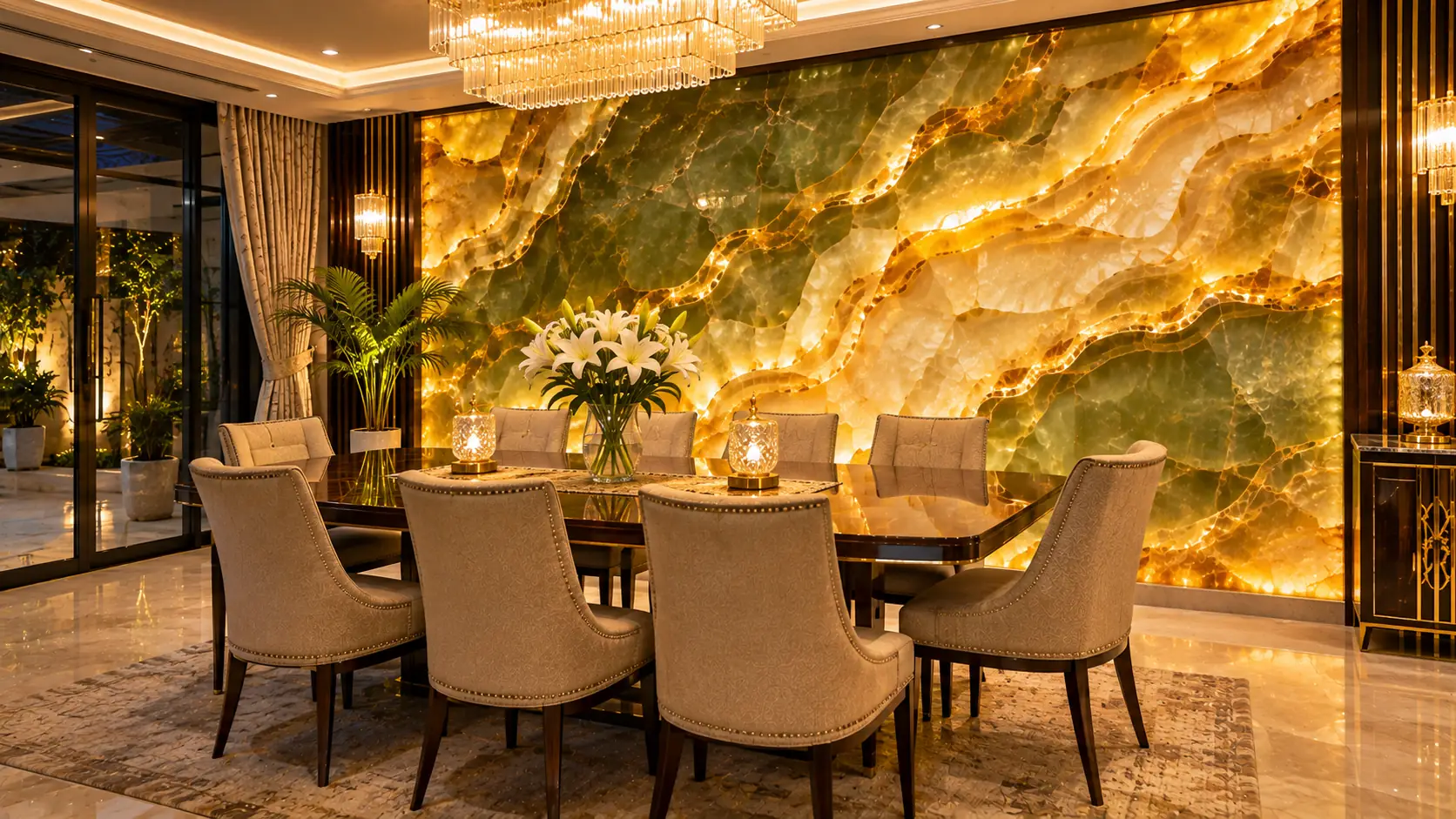
A lit panel is the signature use, and in Pakistani houses it usually lands in one of five places: behind the dining table, on the drawing-room wall facing the entrance, as a TV wall in the lounge, in a stairwell niche, or as a headboard panel in the main bedroom. All five are vertical, out of reach of daily wear, and seen from a few steps away, which is exactly where onyx is happiest.
How a lit panel is built, in brief
- Thin, backed panels. Panels are cut around 18 mm and mesh-backed so they stay strong while still letting light through.
- An even light source. An LED sheet or dense strip grid sits behind a diffuser, with a cavity of roughly 40 to 60 mm to the back of the stone so no strip shows as a bright line.
- Bookmatched slabs. Sequential slabs from one block are mirrored so the bands open like a butterfly across the joint.
- Heat and access. Drivers sit outside the light box with an access panel, because a sealed box gets hot in a Lahore or Multan summer.
- No cement bed. Panels go onto a frame with clips and white adhesive; every ridge of grey mortar would show as a shadow.
That is the outline only. The step-by-step build, with slab selection, cavity depth and the mistakes that ruin a wall, is in our backlit Pak onyx feature wall guide.
Sizing the panel to the room
Bigger is not better here. A panel about the width of the dining table or the sofa, framed by plaster or a darker marble, looks deliberate and keeps the cost sensible. A whole wall of lit stone in a 12 ft room can feel like standing next to a lightbox. For a stairwell or a passage, a narrow vertical niche of one or two panels gives the glow without the expense. Put the panel on a dimmer: full brightness is for guests, while a low setting in the evening makes the banding look like amber or jade rather than a sign board.
Plan the wiring with the electrician before plaster, and agree what happens during load-shedding. A panel wired to the UPS circuit stays lit when the grid goes; one wired to the mains simply goes dark, which is fine, but the choice should be made on purpose. An LED sheet draws little power, so a dimmed panel is a reasonable UPS load in most houses.
Vanities and powder rooms
The powder room is where onyx makes the most sense for most budgets. A guest washroom gets light use, the area is small, and visitors see it up close. A vanity top with a short splash uses only about 6 to 12 square feet, so even near the top of the price range the stone costs less than many imported fittings in the same room.
Making a vanity top last
- Choose a guest washroom, not the family bathroom. Daily toothpaste, hair oil, perfume and acidic cleaners will mark the top in a busy family bathroom far sooner.
- Use a vessel or undermount basin with a sealed rim. Water sitting around a basin is what dulls the polish first. Our guide to marble sinks and wash basins covers basin types and cut-outs.
- Ask for a slightly thicker top or a laminated edge. The workshop can cut vanity tops thicker than lit panels, or build up the front edge, so the top feels solid and resists chipping.
- Light it from below or behind. A strip under the vanity front or behind a translucent splash turns the top into a soft lamp at night.
- Keep a tray for bottles. Perfume, nail polish remover and hair oil are the usual stain culprits; a small brass or wooden tray solves it.
A full bath surround is also possible if the onyx stays out of direct splash, for example as a lit panel at the head of the tub. Shower walls that get soaked twice a day, and above all shower floors, are not a good use. For the family bathroom, our bathroom vanities page and the guide to choosing marble for a bathroom vanity cover harder-wearing stones.
Bar fronts, reception counters and serving islands
A counter front is a vertical surface, so it suits onyx even in a busy space. In homes, this usually means the front of a coffee or juice bar in the lounge, a serving counter between dining room and kitchen, or the front panel of an island. Lit from inside the cabinet, a Honey Onyx front glows warm and pairs naturally with brass, walnut and dark timber.
- Front panel in onyx, top in something harder. The front is admired; the top is used. A top in Jet Black, Black & Gold or Ziarat White takes cups, keys and elbows better.
- Protect the bottom edge. Shoes and mop buckets hit the lower edge. A recessed plinth or a strip of harder marble at the base keeps the onyx out of harm's way.
- Leave access to the lights. The cabinet behind a lit front needs a removable panel for the drivers.
- A serving island is fine, a prep island is not. If the island only ever holds dishes at a dawat, onyx can work as the top too. If anyone chops onions or squeezes lemons on it, choose another stone.
If you are planning an island, our kitchen islands page shows the stones that work as a full working top, and Black & Gold at PKR 1,400 to 2,800 per square foot gives a bold look on the top at about half the onyx rate.
Tabletops, side tables and furniture
Onyx tabletops are a classic in Pakistani drawing rooms: a round side table, a coffee table or a console top in green onyx, often on a brass or wooden base. The stone looks wonderful when lamp light catches the bands. The risk is that tables are touched constantly, with cups, glasses, keys and the odd spilled glass of juice.
Rules for onyx tables
- Use it for occasional tables, not the dining table. A side table or console sees a fraction of the use of a dining table, where hot dishes, curry and lemon are daily events.
- Consider a glass top. A thin clear glass sheet on small spacers protects the polish from rings and scratches and still lets the colour show. Indicative cost is modest compared with the stone, but ask your glass shop for a quote.
- Use coasters, always. Tea, cola and fruit juice are all mildly acidic and leave dull rings on polished onyx.
- Keep a solid base under the whole top. Small slabs and natural fissures mean a top should be fully supported or framed, not balanced on a single pedestal with a big overhang.
- Lit tables are possible. A small cube or drum table with an LED inside makes a striking lamp-table, provided the heat can escape.
For dining tables in general, including which stones survive daily meals, see our marble table design guide.
Fireplace surrounds and TV walls
Fireplace surrounds are one of the applications we list for all three onyx colours, and in Islamabad, Peshawar and Lahore winters a fireplace wall is often the focal point of the drawing room. Onyx works well as the surround panels and the wall above, especially lit from behind on a TV wall that doubles as the fireplace wall.
The caution is heat. Onyx is resin-backed, and resin does not like sustained high temperature. Keep onyx panels out of direct contact with the flame and the firebox opening; use a harder stone or a metal trim for the hearth and the inner frame, and keep a gap between a gas heater and the stone. A wood fire throws more heat and soot than a gas fire, so treat onyx as the outer surround only. Our marble fireplace design guide explains clearances, hearth stones and layouts in more detail, and the fireplace surrounds page lists the stones we cut for this work.
Prayer rooms, mihrab panels and decorative pieces
Onyx has long been used in mosques and shrines across the region for mihrab panels, lattice (jaali) screens, lamp shades and inlay, because light passing through it gives a calm, warm glow. The same idea works at home in a dedicated prayer room or a prayer corner: a lit onyx panel set into the qibla wall, framed in white marble, marks the direction without any extra decoration. For the prayer hall floor itself, see our guide to mosque flooring.
- Mihrab-shaped panel. An arched panel can be cut from one slab or bookmatched from two. Arches and curves are workshop time, so they are quoted separately from the stone.
- Lit jaali screen. Thin onyx behind a carved timber or metal screen gives the pattern a glow without carving the stone itself.
- Calligraphy. Calligraphy is best done in an inlay of darker stone or in metal fixed on top, rather than cut into a thin, mesh-backed panel.
- Masjid projects. For a mosque or a community prayer hall, the same rules apply on a larger scale: keep onyx on walls and the mihrab, and use a hard-wearing marble or granite on floors and steps where people walk.
Lamps, bowls and offcut mosaic
Carved onyx lamps, vases, bowls, ashtrays and chess sets are a familiar part of Pakistani handicraft shops. These are made by carving workshops rather than slab yards; our own work is slabs, panels and offcut mosaic. Offcuts from panel jobs are cut into strips, small tiles and mosaic for a lit niche, a band around a mirror, a shelf back or a small inlay in a marble floor, which is the budget route to the look.
Where should onyx not be used?
Onyx should not be used on floors, stair treads, kitchen prep counters, shower floors or sunlit outdoor walls. This is the question we are asked most: can I put onyx on the floor? Our advice is no, not as a walking surface. Feet carry grit, and grit under a shoe is sandpaper on a Mohs 3 stone. A dropped steel pot or a dragged chair chips a fissured slab, and daily pocha with an ordinary floor cleaner etches the polish within weeks. Stair treads add impact and edge wear, which is worse again.
| Works well | Use with care | Avoid |
|---|---|---|
| Backlit walls, niches, headboards | Guest-washroom vanity tops | Floors, stair treads and landings |
| Bar and counter fronts | Occasional tables with coasters or glass | Kitchen prep counters beside the hob |
| Fireplace outer surrounds | Serving islands that never see a knife | Shower floors and wet benches |
| Prayer-room and mihrab panels | Small floor inlays away from walkways | Outdoor or west-facing sunlit walls |
The one floor exception is a small inlay: a medallion or a strip of onyx set into a marble floor in a corner nobody walks across, or under a glass panel in an entrance. Even then, expect to re-polish it more often than the marble around it. For kitchens, the kitchen countertops page lists the stones that handle heat, oil and lemon, and our marble floor design guide covers floor stones by room.
Sunlight and outdoor walls
Strong sunlight can fade the colour of onyx and yellow the resin behind it over time, and the stone has no business on an outside wall exposed to rain, dust storms and a Karachi sea breeze full of salt. Keep it indoors and away from a west-facing window that bakes the wall every afternoon. If a panel must sit near a window, a UV-filtering film on the glass helps.
Which onyx colour should you choose?
Choose Honey Onyx for warm wood-and-brass rooms, Pak Green Onyx for formal drawing rooms and prayer panels, and Snow White Onyx for the brightest backlit glow. We stock three Chaghi colours. They behave the same way in fabrication and care; the choice is about colour, how much light passes through, and budget.
| Stone | Look | Light | PKR / sq ft | Best uses |
|---|---|---|---|---|
| Honey Onyx | Amber to caramel bands | Glows warm | 2,200 – 4,800 | Bar fronts, vanities, dining walls with brass and walnut |
| Pak Green Onyx | Jade-green banding | Deep green glow | 2,400 – 5,200 | Drawing-room walls, side tables, prayer-room panels |
| Snow White Onyx | Milky white, faint grey ghosting | Highest, even soft white | 2,600 – 5,600 | Bath surrounds, headboards, colour-changing LED walls |
See current lots and slab photos on Honey Onyx, Pak Green Onyx and Snow White Onyx. Slab sizes are small: about 78 x 48 inches for Pak Green, 72 x 48 for Honey and 72 x 44 for Snow White, so a panel wider than about four feet needs a joint, and that joint should be planned as a bookmatch.
Matching the colour to the room
- Warm interiors with wood, brass and beige marble such as Verona suit Honey Onyx.
- Formal drawing rooms with white marble floors and dark furniture suit Pak Green Onyx, which reads as traditional and rich.
- Modern, pale interiors and bathrooms suit Snow White Onyx, which also takes colour-changing LEDs best because its body is close to neutral.
- Framing stone matters. A Jet Black or Ziarat White frame around a lit panel sharpens its edges and hides the light-box trim.
Practical limits: thickness, backing, weight and lead time
Most onyx problems we are asked to fix are not stone problems but planning problems. These are the limits to design around.
- Thickness. Lit panels are cut around 18 mm, which balances strength and light. Thicker stone passes less light; thinner stone is fragile. Vanity and table tops can be cut slightly thicker or built up at the edge.
- Backing is normal. The mesh and resin on the back are standard practice, not a defect. A resin-filled slab is stronger and safer to cut, and the backing disappears once fitted.
- Fissures show when lit. Fine filled lines along the bands are part of the stone. Open cracks across the bands, or dark resin patches, are reasons to choose a different slab, so do a torch test at the yard.
- Weight and fixing. Wall panels go on a frame or a sound wall with mechanical clips plus white adhesive. Never hang a tall panel on cement dabs alone.
- Handling. Slabs travel flat on padded frames and are carried by two people on a board, not on the shoulder like marble.
- Lead time. Allow about two to three weeks from slab selection to fitting, because filling, backing, cutting and dry-fitting the light box all take time.
- Buy the whole job at once. Banding changes quickly through a block, and a panel added six months later will not match.
What it costs, briefly
At our current ranges, a 12 sq ft guest vanity in Honey Onyx comes to roughly PKR 26,400 to 57,600 fitted, and a 4 x 7 ft lit dining-wall panel in Pak Green Onyx (28 sq ft) to roughly PKR 67,200 to 145,600 installed, before lighting. Backlighting adds an indicative PKR 600 to 1,200 per square foot of lit panel for the light box, diffuser and frame, plus the electrician. Grades, slab-by-slab pricing and more worked examples are in our onyx marble price guide, and the cost estimator does the arithmetic for your own sizes.
Ask for onyx to be priced per slab as well as per square foot. Because slabs are small and irregular, the usable area after trimming can be noticeably less than the gross size.
Caring for onyx at home
Onyx is not hard to look after, but it is less forgiving than marble. A few habits keep a polished panel or top looking new.
- Seal on installation and about every six months on tops and vanities; lit wall panels that are never touched need it less often. Our guide on how to seal marble in Pakistan explains the water-drop test, which works the same way on onyx.
- Dust with a soft, dry microfibre cloth. Fine Pakistani dust is abrasive; wiping it across the polish with a rough duster leaves fine scratches.
- Clean with a [pH-neutral cleaner](/glossary/ph-neutral-cleaner) only. No vinegar, lemon, glass cleaner with ammonia, bleach, tile acid or scouring powder.
- Wipe spills at once. Tea, juice, perfume and cosmetics can etch or stain within minutes.
- Use trays, coasters and felt pads under anything that sits on a top.
- Check the light box once a year. Dust inside the cavity dims the glow, and a failing driver flickers before it dies.
- Call a polisher for etch marks. Light dull spots on a top can be hand-polished; do not try abrasive pads yourself on a thin panel.
Tell the cleaning staff which surfaces are onyx. Most etching we see comes from a well-meaning wipe with the same acidic cleaner used on the bathroom tiles.
Plan your onyx feature with us
Send us the wall or top size, a photo of the room and how the surface will be used through our free quote form. We will suggest the colour, thickness and backing, check which lots can be bookmatched, and quote the installed rate, with the light box, cut-outs and any seams itemised. To judge colour and translucency in your own light first, order a sample, or browse every colour on our onyx slabs page.
Written by
The Captivating Marble Design Team
Fabricators, templaters and stone designers
We template, cut and install natural stone every day and write about what we learn — pricing, layouts, care and the mistakes we help clients avoid.
Book a free design consultation