Marble Inlay Design: Medallions, Borders, Methods and Costs in Pakistan
Floor medallions, patti and Dighin borders, waterjet vs hand inlay, colour pairings from Pakistani stones, placement, cost and lead time. Get a free quote.
Captivating Marble Design Team · · 14 min read
Key takeaways
- Inlay sets shaped pieces of contrasting stone flush into a marble field; borders, medallions and floral panels are the three main forms in Pakistani homes.
- Our Design Patti border strips cost PKR 300–700 per sq ft installed and carved Dighin Border PKR 320–740, as of November 2026.
- A 4 ft medallion covers about 12.6 sq ft; a 6 ft one about 28.3 sq ft, more than double the stone and cutting.
- Straight-line geometric inlay can be hand-cut; curves, florals and calligraphy are normally machine-cut by waterjet or CNC from a digital drawing.
- Use two or three colours with strong contrast, keep the field plain, and place inlay where it is seen but not walked on constantly.
The short answer
A marble inlay design is a pattern made by cutting shaped pieces of contrasting stone and setting them flush into a marble field. In Pakistani homes it takes three forms: border strips such as Design Patti (PKR 300–700 per sq ft installed at our November 2026 ranges), carved Dighin borders (PKR 320–740), and custom medallions quoted from a drawing.
Inlay is the traditional way to give a plain floor a focal point without changing the main stone. A narrow border frames a room like a rug, a medallion marks the centre of an entrance hall or the spot under a chandelier, and a floral or geometric panel can turn a table top or a wall niche into a feature. This guide explains the methods, from hand-cut strips to machine-cut medallions and the old pietra dura craft, which of our stones combine well, where inlay belongs and where it does not, and how the cost and lead time build up.
How we priced this: stone rates in this post are our current catalogue quote ranges per square foot as of November 2026, and they are installed prices covering stone, cutting, a standard finish and fitting in our service area. Custom medallion and floral inlay work is priced from the drawing; the cutting and assembly figures quoted below are indicative market ranges, not our rate card. Confirm any final figure against a written quotation.
What counts as inlay, and how is it different from a pattern?
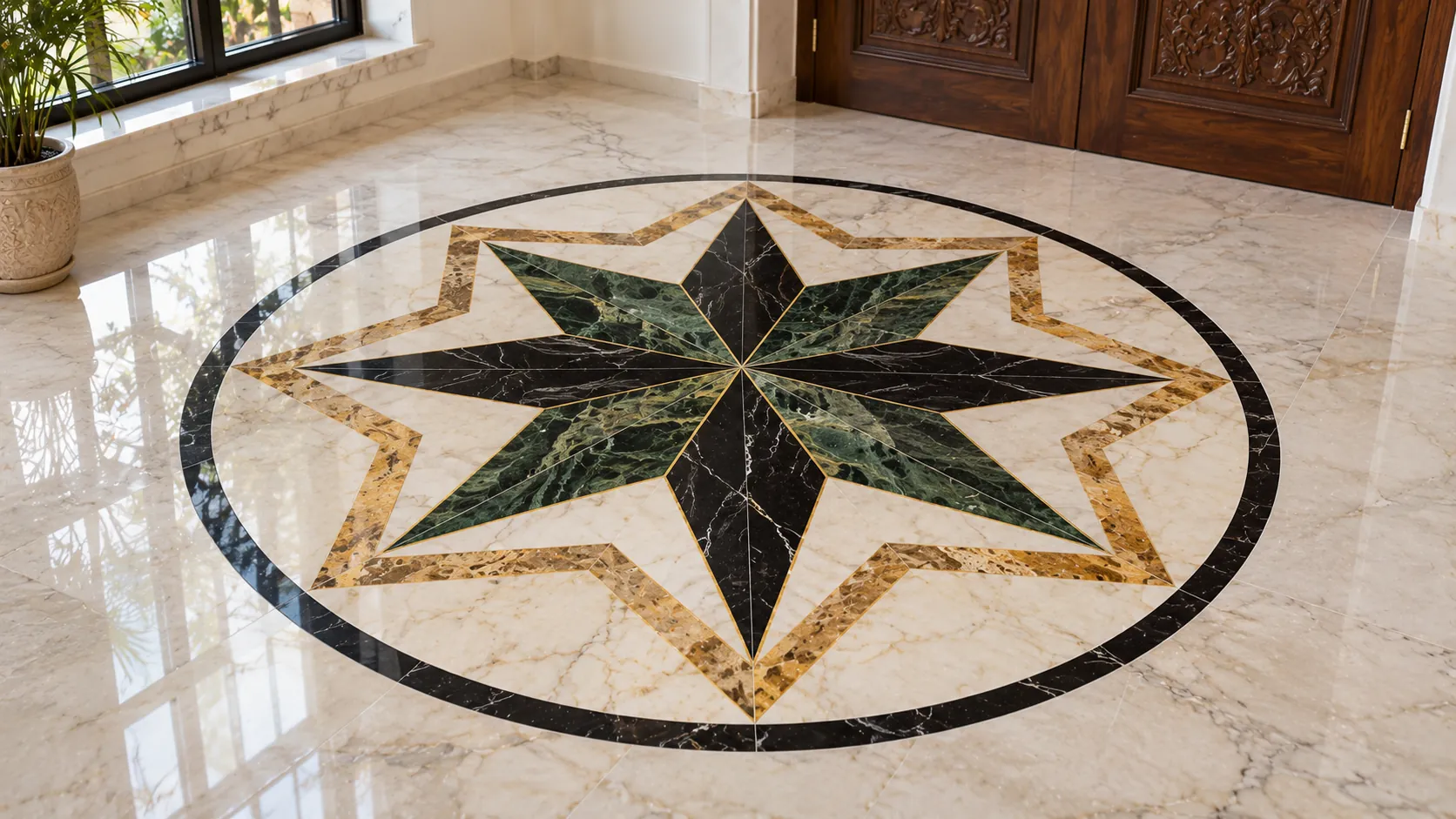
Inlay means the contrasting stone is cut to shape and set into the surrounding stone so the surface stays level, rather than laid as separate tiles in a pattern. A chequerboard of black and white squares is a laying pattern; a black eight-point star set into a white floor, with the white cut away around every point, is inlay. The difference matters because inlay needs precise cutting of both the insert and the field around it, which is where the cost and the skill sit.
| Type | What it is | Typical use |
|---|---|---|
| Line border | One or two straight strips of a darker stone, 2–4 in wide | Around a room, a short distance in from the skirting |
| Patti border | Pre-assembled decorative strips in a repeat: diamonds, rope, Greek key, floral | Room borders, corridor edges, stair landings |
| Carved (Dighin) border | A hand-cut course with a profile that stands slightly proud of the floor | Formal drawing rooms, entrance halls, around a medallion |
| Medallion | A circular, square or star-shaped design, usually 3–6 ft across | Entrance halls, under a dome or chandelier, stair landings |
| Floral or calligraphic panel | Fine curved pieces forming flowers, vines or lettering | Wall panels, table tops, niches, prayer-room walls |
| Pietra dura (parchin kari) | Very small hand-shaped pieces of hard and semi-precious stone set into marble | Heritage work, table tops, decorative panels |
Inlay is part of Lahore's own building history. The pietra dura work on the Taj Mahal is the best-known example of the Mughal craft known locally as parchin kari, and the same tradition appears on Jahangir's tomb at Shahdara on the edge of Lahore. Modern home inlay is far simpler, but it follows the same idea: a plain, light field with a few strong colours set into it.
Waterjet, CNC or hand inlay: which method should you choose?
Choose hand-cut inlay for straight-line geometry and borders, and machine cutting (waterjet or CNC) for curves, florals, calligraphy and anything that must repeat exactly. The method follows the drawing, not the other way round.
| Method | Best for | Strengths | Limits |
|---|---|---|---|
| Hand-cut on a saw | Stars, squares, diamonds, straight borders | Lower cost on simple shapes; any stone thickness | Curves and fine points are slow and less exact |
| Ready-made patti strips | Room and corridor borders | Arrive assembled; set like long tiles; least site labour | Fixed repeats unless a custom strip is cut from a drawing |
| Hand-carved (Dighin) | Raised borders and frames | Light catches the profile; traditional look | Manual work; extra days on long runs; careful polishing needed |
| Waterjet | Curves, florals, logos, calligraphy | Cuts insert and field from the same digital file, so pieces fit tightly | Needs a clean digital drawing; priced per design |
| CNC router | Recesses, engraved lines, shallow inlay | Repeatable; good for grooves and routed outlines | Small inside corners are rounded by the tool |
| Pietra dura | Fine heritage-style panels | Exceptional detail and depth of colour | Specialist craft; slow and costly |
Our Lahore workshop makes Design Patti and Dighin Border in-house and cuts centre medallions from offcuts of Fancy, Black & Gold and Ziarat. For a custom curved or floral design, the quote will state how it is to be cut. Our catalogue does not include semi-precious hardstones, so treat pietra dura here as a reference for what the craft can do, not a product we sell.
What makes a machine-cut medallion fit well
- A clean vector drawing at full size, with every colour region closed. A photograph from the internet is a starting point, not a cutting file.
- No needle points. Very thin points and slivers under about half an inch wide snap during cutting or in the floor. Round or thicken them on the drawing.
- Enough contrast. Two stones that look different in a sample box can merge from standing height. Lay the samples on the floor and look from six feet away.
- Dry assembly before delivery. Ask to see the medallion laid out at the workshop, or a photograph of it assembled, before it is packed.
Design styles that suit Pakistani homes
Most inlay in Pakistani houses falls into one of five styles. Picking the style first makes every later choice, from stones to cutting method, much easier.
- Geometric star or compass. Eight, twelve or sixteen points inside a ring, usually in black and one colour on a white field. It is the most common entrance-hall medallion, it suits both traditional and modern rooms, and because it is all straight lines it can be hand-cut.
- Islamic geometric. Interlocking stars and polygons drawn from the jaali and tile work of Mughal and Central Asian buildings. It needs precise cutting and looks best in two tones, so the pattern reads clearly from across the room.
- Mughal floral. Vines, leaves and five-petal flowers in red, green and gold stones on white, echoing parchin kari. It is the most expensive style because almost every piece is curved, and it is best kept to panels, borders and table tops rather than large floor areas.
- Modern minimal. A single brass-coloured or black line, a thin ring, or an offset rectangle set into a large-format floor. It costs least, ages well and lets a premium field stone do the talking.
- Monograms and calligraphy. Family initials at the entrance, or a verse in a prayer room or on a wall panel. Lettering must be drawn by a calligrapher and machine-cut from a clean file; keep sacred text off the floor and place it on a wall.
Whatever the style, look at the design at full size before approving it. A pattern that looks delicate on a phone screen can look busy at 5 ft across, and a thin line that seems bold on paper can vanish once the floor is polished. Many workshops will print the drawing at full scale or chalk it onto the floor; ask for that before cutting begins.
Colour combinations from Pakistani stones
The rule that works almost every time is one light field and two or three inlay colours with a clear step in tone. Too many colours, or colours that are close in value, read as a blur once the floor is polished. The pairings below use stones from our own catalogue with their current installed quote ranges.
| Field | Inlay colours | Effect |
|---|---|---|
| Ziarat White (850–1,600) | Jet Black (1,100–2,000) + Black & Gold (1,400–2,800) | Classic, formal; the gold vein lifts a black star |
| Ziarat White | Green Fancy (780–1,450) + Jet Black | Traditional Punjabi drawing-room look |
| Verona Plain (600–1,100) | Tropical (650–1,200) + Indus Gold (700–1,300) | Warm, low-contrast; suits wood and brass |
| Tavera Light (520–980) | Royal Fancy (820–1,550) or Commando Fancy (740–1,380) | Multicoloured medallion on a value field |
| Sunny Grey (560–1,000) | Superline Grey (620–1,150) + Jet Black | Modern, tonal; geometric designs only |
| Ziarat White | Strawberry (850–1,550) or Red & White (700–1,300) + Green Fancy | Floral work with red petals and green leaves |
The Fancy family is the workhorse of Pakistani inlay. Green Fancy gives the deep bottle green of leaves and borders, Royal Fancy brings green, gold, red and grey in one stone, and their busy figure hides light wear. Our Fancy collection shows all three grades side by side. Black & Gold is the stone for the eye-catching centre of a star or rosette, and plain Jet Black is the safest outline colour on any light field.
Onyx as an accent
Honey Onyx (PKR 2,200–4,800) and the other onyx stones glow beautifully in a medallion centre, but onyx is soft, fissured and slippery when wet. Use it only as a small accent away from the main walking line, or in wall and table inlay. Our guide to onyx uses in Pakistani homes covers where it is safe.
Where to use inlay, and where not to
Inlay works best where people stop and look, and worst where they walk the same line every day. A medallion in a busy passage wears unevenly, gathers grit in its joints and is crossed so often that nobody notices it.
Good places
- Entrance halls and lobbies. The first thing a guest sees; a medallion centred on the door or under the light fitting sets the tone for the house.
- Under a dome, skylight or chandelier. The design repeats the shape above it, and furniture is unlikely to cover it.
- Drawing and dining rooms. A border set 12 to 24 inches from the wall frames the room and hides walls that are not quite square.
- Stair landings. The one place on a staircase where pattern belongs; our stair design guide shows how to keep the steps plain around it.
- Walls, niches and table tops. Floral and calligraphic panels are safest off the floor; see our table design guide for inlaid tops and the fireplace guide for hearth and surround panels.
Places to avoid
- Kitchens and bathrooms. Water, oil and haldi find every joint, and acid cleaners etch the softer inlay stones first.
- Car porches and outdoor paving. Sun, dragged loads and grit open joints; granite or Chips Dana patterns suit these areas better.
- Under a rug or a sofa. Measure the furniture plan first. A medallion half hidden under a dining table wastes most of its cost.
- Small rooms. A 5 ft medallion in a 10 x 12 ft bedroom crowds the floor. Keep inlay to a slim border or leave the floor plain.
For room-by-room layouts beyond inlay, our floor layouts and borders guide covers straight, diagonal and framed floors, and our design ideas guide covers walls, kitchens and staircases across the whole house.
Sizing a medallion
A useful rule is to keep the medallion to roughly one third of the shorter side of the room or hall, and to leave at least 3 feet of plain floor between it and any wall or doorway so it reads as the centre, not as a crowded corner.
| Diameter | Area | Suits a room or hall about |
|---|---|---|
| 3 ft | 7.1 sq ft | 10 x 12 ft lobby, stair landing |
| 4 ft | 12.6 sq ft | 12 x 14 ft entrance hall |
| 5 ft | 19.6 sq ft | 15 x 18 ft drawing room |
| 6 ft | 28.3 sq ft | 18 ft and wider halls, double-height lobbies |
How much does a marble inlay design cost?
Border inlay is affordable; custom medallions are not cheap. Ready-made borders cost PKR 300–740 per sq ft installed at our November 2026 ranges, while a custom medallion is priced from its drawing because the cutting and assembly can cost several times more than the stone itself.
Borders, per running foot
Borders are priced per square foot of finished strip and converted to running feet once the width is fixed: running feet × width in inches ÷ 12 = square feet.
| Border | PKR / sq ft | 2-in strip | 4-in strip | 6-in strip |
|---|---|---|---|---|
| Design Patti | 300 – 700 | 50 – 117 | 100 – 233 | 150 – 350 |
| Dighin Border | 320 – 740 | 53 – 123 | 107 – 247 | 160 – 370 |
| Jet Black line border | 1,100 – 2,000 | 183 – 333 | 367 – 667 | 550 – 1,000 |
| Step | Figure |
|---|---|
| Border rectangle | 11 x 15 ft |
| Running feet | (11 + 15) × 2 = 52 running ft |
| 4-in Design Patti | 52 × 4 ÷ 12 = 17.3 sq ft, about 19 sq ft with 10% wastage |
| Installed cost, Design Patti | About PKR 5,700 – 13,300 |
| 6-in Dighin Border | 52 × 6 ÷ 12 = 26 sq ft, about 28.6 sq ft with wastage |
| Installed cost, Dighin Border | About PKR 9,150 – 21,160 |
Medallions: stone plus cutting and assembly
A medallion has two cost parts. The first is the stone area, which you can estimate at our installed rates for the stones in the design. The second is cutting, fitting and assembling every piece, which depends on the number of pieces, curves and colours, and is priced from the drawing.
| Diameter | Area | Mostly Ziarat White (850–1,600) | Mostly Black & Gold (1,400–2,800) |
|---|---|---|---|
| 3 ft | 7.1 sq ft | PKR 6,000 – 11,300 | PKR 9,900 – 19,800 |
| 4 ft | 12.6 sq ft | PKR 10,700 – 20,100 | PKR 17,600 – 35,200 |
| 5 ft | 19.6 sq ft | PKR 16,700 – 31,400 | PKR 27,500 – 55,000 |
| 6 ft | 28.3 sq ft | PKR 24,000 – 45,200 | PKR 39,600 – 79,200 |
As an indicative market guide only, custom medallion and floral inlay often works out at 3 to 6 times the field stone rate per square foot of design once cutting and assembly are included. On a 4 ft medallion in Ziarat White and black stones, that suggests something in the region of PKR 32,000 to 120,000, with simple geometric stars at the lower end and dense florals at the top. These are not our rates; the written quote for your drawing is the figure to rely on.
What pushes the price up
- Piece count and curves. A 16-point star with a ring has far fewer cuts than a vine of leaves and petals.
- Number of colours. Each extra stone is another slab to buy into and another set of cuts.
- Expensive inserts. Black & Gold and onyx cost more than the field; use them for small centres.
- Site work. The field has to be cut to receive the medallion, then the whole floor ground and polished together.
Our stone cost estimator gives an installed figure for the field stone; add the border and medallion lines from the tables above to see the full budget.
Lead time, fitting and polishing
Plain marble jobs typically run 5 to 10 days from yard stock to fitted, and the Fancy stones 7 to 14 days. Dighin Border is cut by hand, so allow extra days for anything over about a hundred running feet.
A custom medallion adds design approval, cutting and dry assembly; as an indicative guide, allow two to four weeks from an approved drawing, and order it with the field stone so the two are cut from the same lot and finished together.
On site
- Mark the centre lines of the room or hall, measured from the door and the light fitting, not just from the walls.
- Set the medallion first, level and square, then lay the field outward from it and cut the field stone tight around it.
- Lay borders after the field is set out, keeping them parallel to the longest wall.
- Grind and polish the whole floor together (ragrai) so the inlay and field finish dead level. Tell the polishing team where a carved Dighin border is, so its raised profile is not ground flat.
- Seal after polishing, paying attention to the softer stones and the joints.
Cover a finished medallion with hardboard while other trades are still working. A dropped tool or a dragged ladder chips a medallion point far more easily than a plain field, and replacing one piece means recutting it from the same stone.
Care for inlaid floors
- Sweep grit daily. Grit lodged in joints scratches softer inlay stones first.
- Mop with a pH-neutral stone cleaner. Acid and vinegar etch the calcite stones at different speeds, which leaves the design looking patchy.
- Wring the pocha well. Standing water lines up along the joints and leaves rings on onyx and dark stones.
- Seal yearly and after every re-polish; our guide to polished, honed and leathered finishes explains which finish suits each room.
- Re-polish the floor and inlay together; our marble polishing guide covers the process and timing.
Plan your inlay with us
Send us the room size, the furniture plan, a photo or sketch of the design you like and the stones you are considering. We will suggest a size and colour combination, reserve the field and inlay stones from one lot, and send a free written quote. To check contrast before committing, order samples of the field and inlay stones and lay them together on the floor in daylight.
Written by
The Captivating Marble Design Team
Fabricators, templaters and stone designers
We template, cut and install natural stone every day and write about what we learn — pricing, layouts, care and the mistakes we help clients avoid.
Book a free design consultation