TV Wall Marble Design: Book-Matched Slabs, Niches, Wiring and Costs in Pakistan
Book-matched slabs, fluted panels, niches, console shelves, hidden cables and backlit onyx for lounge TV walls, with sizes and PKR costs. Get a free quote.
Captivating Marble Design Team · · 21 min read
Key takeaways
- A 10 x 9 ft marble TV wall needs about 104 sq ft of stone with 15% wastage for book-matching and cut-outs.
- At our November 2026 installed quote ranges, that wall costs about PKR 58,000–104,000 in Sunny Grey and PKR 146,000–291,000 in Black & Gold.
- Two sequential 96 x 60 in slabs stood on end and book-matched cover a wall 10 ft wide and 8 ft high.
- Lay conduits, sockets and TV bracket backing before any slab is cut; a cut-out in the wrong place cannot be moved on a book-matched wall.
- A honed or soft finish reduces glare around the screen; high polish reflects windows and ceiling lights straight back at the sofa.
The short answer
Good TV wall marble design means one stone, book-matched or framed, fixed as 18–20 mm panels with its conduits, sockets and bracket backing planned before any slab is cut. A 10 x 9 ft lounge wall needs about 104 sq ft of stone, which costs roughly PKR 58,000–104,000 in Sunny Grey and PKR 146,000–291,000 in Black & Gold, installed, as of November 2026.
The TV wall has become the most requested stone feature in new Pakistani houses because it gives a large visual return on a small area: a lounge floor might be 300 sq ft, the feature wall a third of that. This guide covers the layouts that work (book-match, framed panel, strips and fluting, niches and floating consoles), which stones to choose, how big the wall should be for your screen, how to hide every cable, when backlit onyx makes sense, and a cost method you can check yourself. For a whole-house view of where stone goes, our marble design ideas guide covers every room.
How we priced this: stone figures are our current catalogue quote ranges per square foot as of November 2026. They are fabricated and installed prices in our service area, covering stone, cutting, a standard edge and polish, fixing and sealing. Socket and cable cut-outs, mitred returns, niche linings and freight outside our fitting cities are itemised on the quote. Labour-only and light-box figures are indicative market ranges, marked as such. Confirm the final figure against a written quotation.
Which layout suits your lounge?
The layout depends on the width of the wall, the strength of the stone's veining and your budget: a full-height book-match for a wide wall and a dramatic stone, a framed panel for a narrow wall or a tight budget, and strips or fluting for a modern room with a calm stone. Decide the layout first, because it sets how many slabs you buy and where every joint falls.
Full-height book-match
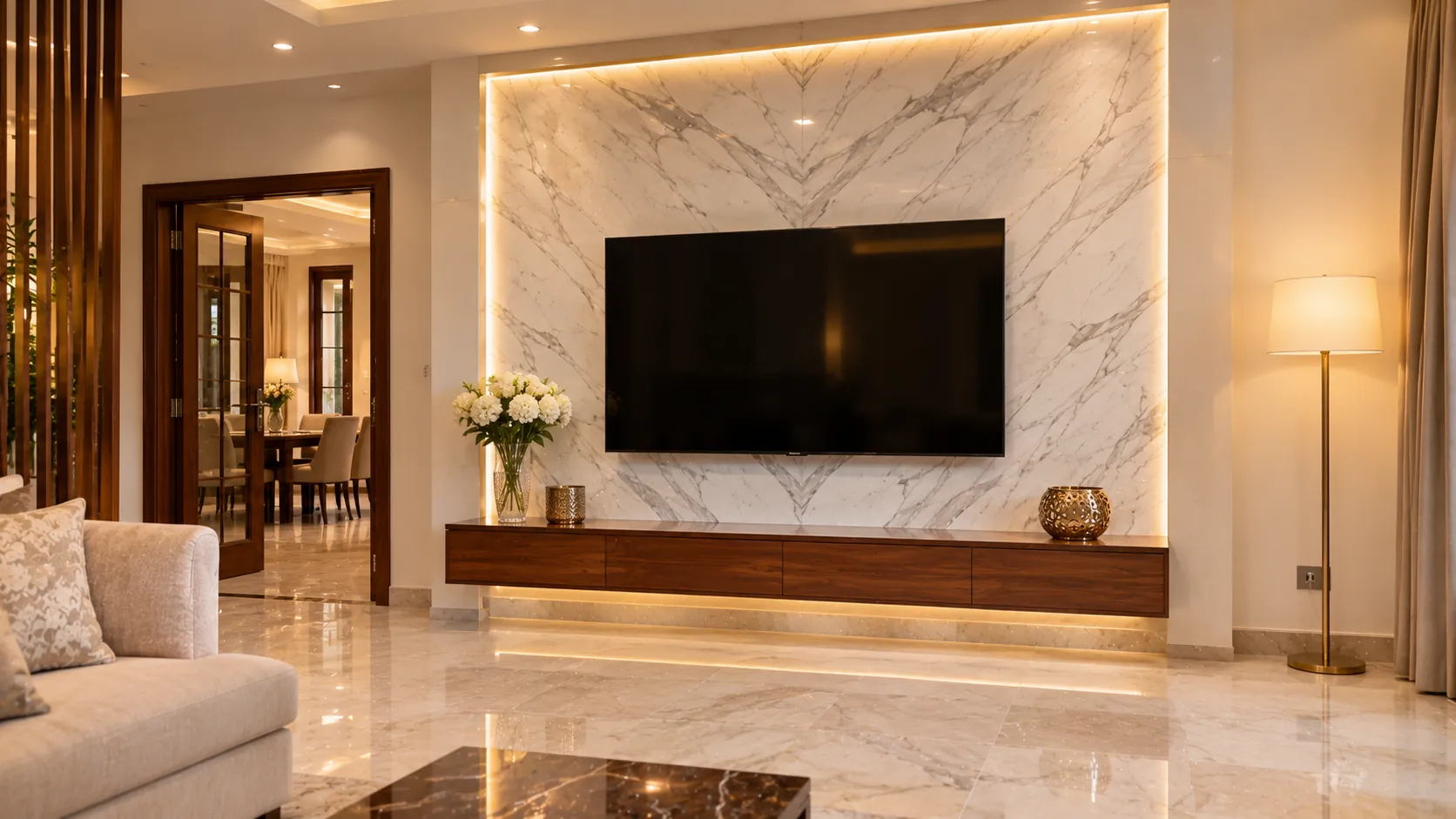
Book-matching means taking two slabs cut one after the other from the same block and opening them like the pages of a book, so the veins mirror around a centre line. Behind a TV, that centre line runs straight down the middle of the screen, and the pattern fans out on both sides like a butterfly. It is the most striking layout and suits stones with clear movement: Tiger Verona, Black & Gold, Black & White, Zebrano and vein-cut Badal. It needs sequential slabs, so the whole wall must be reserved from one block at once.
Framed panel
A stone panel roughly the width of the TV unit, with wood, paint, wallpaper or fluted MDF on either side. It uses less stone, fits more easily between an AC unit, a window and a door, and lets you spend on a better stone for a smaller area. A 6 ft wide panel in Ziarat White can cost less than a full 10 ft wall in a mid-range grey.
Vertical strips and fluting
Strips 12 to 24 inches wide run floor to ceiling with a 3–5 mm shadow gap between them. This suits linear stones such as Superline Grey, avoids the cost of sequential slabs, and hides small differences between pieces because each strip reads on its own. Fluting, a series of shallow grooves routed into the stone face, gives a ribbed, modern texture that catches side light from a window or a cove.
Fluting is extra machine work on top of the per-square-foot rate and is not suitable for every stone; heavily fissured or resin-filled slabs can chip along the grooves. Ask for it to be quoted separately, with a sample groove on your chosen stone, before you commit. A cheaper way to get a similar rhythm is plain strips with shadow gaps, which any fitter can cut.
Stone frame with a contrast centre
A light field stone across the wall with a darker panel directly behind the screen, for example Ziarat White with a Jet Black or Galaxy Black centre. A black panel behind a black screen makes the TV almost disappear when it is off, which many families prefer to a large dark rectangle on a white wall. Inlaid brass or steel strips at the joint between the two stones sharpen the line; our marble inlay design guide explains how metal and stone inlays are cut.
| Layout | Best for | Stone use | Watch out for |
|---|---|---|---|
| Full-height book-match | Wide walls, bold veining | Highest: sequential slabs, about 15% wastage | Every cut-out must be planned before cutting |
| Framed panel | Narrow walls, tighter budgets | Low: one or two slabs | Join between stone and frame material must be neat |
| Vertical strips | Modern rooms, linear stones | Medium: offcuts usable | Shadow gaps must be perfectly even |
| Fluted panels | Textured, minimal rooms | Medium, plus machining | Not every stone takes grooves; quoted separately |
| Contrast centre | Hiding the screen when off | Medium: two stones | Two lots to match, plus a clean joint detail |
How big should the stone wall be for your TV?
Make the stone at least 12 to 18 inches wider than the screen on each side, and run it to the ceiling or to a deliberate line such as a bulkhead, so the TV sits inside the stone rather than hanging off its edge. Measure the screen, not the diagonal; a "65-inch" TV is 65 inches corner to corner but only about 57 inches wide.
| TV size (diagonal) | Screen width | Screen height | Minimum stone panel width |
|---|---|---|---|
| 55 in | About 48 in (4 ft) | About 27 in | 6 ft – 7 ft |
| 65 in | About 57 in (4 ft 9 in) | About 32 in | 6 ft 9 in – 7 ft 9 in |
| 75 in | About 65 in (5 ft 5 in) | About 37 in | 7 ft 5 in – 8 ft 5 in |
| 85 in | About 74 in (6 ft 2 in) | About 42 in | 8 ft 2 in – 9 ft 2 in |
Mounting height and viewing distance
As a rule of thumb, the centre of the screen should sit near seated eye level, roughly 40 to 44 inches from the finished floor, which is lower than most people mount a TV in a Pakistani lounge. For a 4K set, a common guideline is to sit about one to one and a half times the screen diagonal away. Settle both before the electrician chases the wall, because they fix where the sockets and the bracket go, and those fix where the slab joints must not fall.
Working with slab sizes
Slab size decides whether the wall has a horizontal joint. Most of our marbles come in slabs about 96 x 60 inches (8 x 5 ft). Stood on end, two book-matched slabs cover a wall 10 ft wide and 8 ft high with only one vertical joint, down the centre behind the TV. A 9 or 10 ft ceiling then needs either a horizontal joint, best placed just above the console or at the top of the screen where it disappears, or a stone with a longer slab.
| Stone | Slab size | Full-height without a horizontal joint? |
|---|---|---|
| Sunny Grey, Verona Plain, Ziarat White, Badal | 96 x 60 | Up to 8 ft |
| Tiger Verona, Superline Grey, Black & White | 102 x 64 | Up to 8 ft 6 in |
| Black & Gold, Galaxy Black (granite) | 108 x 66 | Up to 9 ft |
| Honey Onyx | 72 x 48 | No; used as panels |
Slab sizes vary from block to block, so confirm the actual slabs at the yard before the drawing is finalised. If a full-height piece matters to you, say so at the start and the slabs can be chosen for length.
Choosing the stone: marble, granite or onyx
A TV wall is vertical and rarely touched, so it is the one place where soft, dramatic or expensive stones are safe. Nobody cuts limes on it, and it does not take foot traffic. The choice is about looks, light and how the stone sits with the floor.
| Stone | PKR / sq ft | Look on a wall | Works with |
|---|---|---|---|
| Sunny Grey | 560 – 1,000 | Soft grey clouds, calm | White or cream floors, walnut joinery |
| Verona Plain | 600 – 1,100 | Warm beige, quiet movement | Brass, cream sofas, traditional rooms |
| Superline Grey | 620 – 1,150 | Straight linear grey lines | Strip layouts, modern rooms |
| Dawezai Badal Travertine | 640 – 1,180 | Vein-cut grey lines on off-white | Honed finishes, warm lighting |
| Tiger Verona | 750 – 1,350 | Bold brown and gold veining | Book-matching, plain floors |
| Ziarat White | 850 – 1,600 | Clean white, faint grey veins | Contrast centres, framed panels |
| Galaxy Black (granite) | 900 – 1,700 | Black with fine gold sparkle | Contrast centres; screen blends in |
| Black & Gold | 1,400 – 2,800 | Black with bold gold veins | One statement wall, quiet surroundings |
| Honey Onyx | 2,200 – 4,800 | Amber bands, glows when lit | Backlit centre panel only |
Marble
Marble is the default because it comes in the widest range of veining and colour, takes a high polish or a soft hone, and is easy to cut around sockets and niches. For a family lounge, a calm grey or beige that matches or sits close to the floor makes the room feel larger; a bold stone like Tiger Verona or Black & Gold is better in a drawing room where the wall is the reason the room exists. Browse the Sunny Grey collection or the full flooring and wall tile range to compare colours. For tiled walls in other rooms, see our wall tile ideas.
Granite
Granite is harder than any wall needs, but it earns its place on a TV wall in two cases: a black centre panel behind the screen, and a wall in a commercial lounge or reception where cleaners use harsher products. Galaxy Black is the usual choice because its fine sparkle reads as texture rather than pattern, and it does not compete with the picture on the screen.
Onyx
Onyx is translucent, so a thin panel lit from behind glows from within. On a TV wall it is best as a centre panel or a pair of side panels rather than the whole wall, because it costs three to five times as much as most marbles per square foot and the lit area should frame the screen, not sit behind it, where the glow fights the picture. Light boxes, cavity depths and LED choice are covered in detail in our backlit onyx feature walls guide; the summary is below.
Finish: polished or honed?
A mirror polish shows the depth of the veining best, but it reflects windows, chandeliers and ceiling spotlights straight back at the sofa, often right around the screen. A honed (matt) or lightly polished finish reduces that glare and hides fingerprints from children reaching for the remote shelf. A common compromise is a honed field with the console and niche linings polished. Our guide to polished vs honed marble compares the finishes room by room.
Niches, floating consoles and shelves
Niches and a floating console turn a flat stone wall into a piece of furniture, and they are where most of the workmanship shows. Each one adds mitred returns and cut edges, so plan them on the drawing and expect them as separate items on the quote.
Recessed niches
A niche is a recess in the wall, lined with stone on its back, sides, top and bottom, used for décor, a set-top box or a soundbar. The returns (the sides and top) should be mitred to the face so no raw edge shows, and the niche bottom is often polished even when the face is honed.
- Check the wall thickness first. Many internal partitions in Pakistani houses are a single brick (about 4.5 inches) thick. Cutting a 6-inch-deep niche into that weakens the wall and can break through to the next room. On thin walls, build the niche outward with a block or framed false wall instead.
- Get a structural opinion for load-bearing walls. Never chase a deep niche into a wall that carries a beam or slab without an engineer's approval.
- Light it from the top or the side. A warm LED strip in an aluminium channel set into the niche head grazes light down the stone. Run its wire before the lining goes in.
- Keep niches clear of the screen. A lit niche right beside the TV distracts the eye; leave at least a foot of plain stone between them.
Floating consoles and stone shelves
A wall-hung console under the TV, or a slim floating stone shelf, keeps the floor clear for sweeping and pocha and hides the wiring. There are two ways to build one:
- A timber or MDF wall-hung unit with a stone top. The carcass hangs on a steel rail or heavy brackets fixed into the masonry, and the stone sits on top. It gives drawers or flaps for set-top boxes and routers, with ventilation holes.
- A solid stone shelf on hidden steel brackets. Steel rods or a flat bar are anchored deep into the wall and the stone slides over them. A 2 cm slab with a laminated edge looks 4 cm or thicker from the front without the weight of solid thick stone.
Typical console heights are 12 to 18 inches above the floor, with a depth of 14 to 18 inches, enough for a soundbar and a receiver. Ask your fitter how the brackets are anchored and what load they are rated for; a stone shelf that sags or rotates off the wall is dangerous, and children will climb on it.
How do you hide TV cables in a marble wall?
Hide TV cables by chasing PVC conduits into the wall before the stone goes on, running from a recessed power and data box behind the screen down to the console, with a draw wire left inside for future cables. Once slabs are fixed, a missed conduit means drilling through finished stone or running visible trunking, which ruins the wall.
What to plan with the electrician
- Mark the TV size, its centre height and the bracket position on the plastered wall in pencil, full size.
- Place a double socket and a data/HDMI back box behind the screen, inside the bracket footprint so the TV hides them.
- Run at least one 1.5 to 2 inch PVC conduit from that box down to the console, so HDMI plugs can be pulled through without cutting them off.
- Add sockets for the console: router, set-top box, soundbar and a spare. One more socket costs very little now and a lot later.
- Run separate conduits for any wall speakers, niche LEDs and an onyx light-box driver.
- Photograph the wall with a tape measure in shot before plastering over, so every conduit can be found later.
Cut-outs in the stone
Socket and cable openings are cut in the workshop with diamond core bits and saws from a template, not knocked out on site. On a book-matched wall, a wrong cut-out cannot be fixed by swapping the slab, because the replacement will not match. Give the fabricator a dimensioned drawing that shows every box, then check the template against the actual back boxes after the electrician has finished. Keep cut-outs at least 2 to 3 inches away from slab edges and joints; a thin bridge of stone between a cut-out and an edge is the most common place for a crack.
Fixing the TV bracket through stone
The TV bracket must be anchored into the masonry behind the stone, never into the stone alone. The usual method is to core-drill clean holes through the panel and set the bolts into the wall with sleeves or spacers, so tightening the bracket clamps against the wall rather than crushing the stone. Agree the bracket model before the slabs are cut so its holes can be drilled in the workshop, or leave a plain zone behind the screen where the panel can be drilled on site with a diamond bit. An articulating (swing-arm) bracket puts much more leverage on its fixings than a flat one; tell your fitter which type you have chosen.
Keep AC units, their drain pipes and the AC socket off the stone wall where possible. An AC drain pipe chased behind marble and left to drip will stain the stone from behind and is almost impossible to reach later.
How is a stone TV wall fixed?
Large panels are fixed with a polymer-modified stone adhesive across the whole back plus stainless steel clips or pins into the wall, so the adhesive is never the only thing holding the stone up. Wall panels are cut from 18–20 mm stone, which weighs roughly 5 kg per square foot, so a 10 x 9 ft wall carries around 450 kg. Our marble thickness guide explains why 18 mm is the usual choice for vertical work.
- Prepare the wall. Stone goes on sand-cement plaster or bare masonry, never on gypsum (plaster of Paris) finish, putty or paint; scrape those back first. The wall must be dry, sound and plumb.
- Use white adhesive under light stone. Grey cement can shadow through white and cream marble. Back-butter every panel so there are no hollow spots.
- Add mechanical restraint for full-height slabs and anything above head height: stainless clips or dowel pins into the masonry at the top edge, or a steel sub-frame on a weak or hollow wall.
- Set out from the centre line. On a book-match, the centre joint behind the TV is the reference; everything else is measured from it, not from a wall that may be out of plumb.
- Keep joints tight at 1–2 mm and fill them with colour-matched epoxy so the book-match reads as one surface.
- Seal after fixing. Light marbles and travertine should be sealed once the adhesive has cured; our guide to sealing marble in Pakistan explains products and timing.
Fixing methods for exterior walls and heavier cladding are different again and are covered in our stone wall cladding guide. Indoors, the sequence on site is: electrics and conduits, plaster, cure, stone wall, floor polishing, then the TV and console. If the floor will be ground and polished (ragrai) after the wall goes up, protect the bottom edge of the wall panels from the machine.
Lead time
Allow time for slab selection, a dimensioned drawing, workshop cutting and a dry lay of the book-match on the workshop floor before it is loaded. Our stone installation page sets out the steps from template to fitting, and onyx panels need longer because of resin filling and backing.
Backlit onyx on a TV wall
Backlit onyx is a translucent stone panel set in front of an even LED light source, so its bands glow. On a TV wall it works best as a vertical panel on one or both sides of the screen, or as a band above the console, rather than directly behind the TV: a bright panel behind a dark screen strains the eyes in a dim room, and the TV bracket would have to pass through the light box.
- Pick the colour for the room. Honey Onyx glows warm amber and suits wood and brass; Snow White Onyx glows an even soft white and shows colour-changing LEDs best; Pak Green Onyx gives deep jade banding.
- Build a light box, not a strip behind a panel. An LED sheet or dense strip grid behind a diffuser, with a cavity of roughly 40–60 mm, avoids bright lines through the stone.
- Keep the driver accessible behind a service panel, outside the cavity, so a failed driver does not mean taking stone off the wall.
- Put the lit panel on a dimmer so it can be a soft background during a film and a feature when guests arrive.
| Item | Honey Onyx | Snow White Onyx |
|---|---|---|
| Onyx installed, 32 sq ft (our quote range) | 70,400 – 153,600 | 83,200 – 179,200 |
| Light box, diffuser and frame (indicative) | 19,200 – 38,400 | 19,200 – 38,400 |
The light-box line is an indicative market range and the electrician comes on top. Full build details, heat management and the mistakes that ruin a lit wall are in our backlit Pak onyx guide.
How much does a marble TV wall cost?
A marble TV wall costs the wall area plus wastage, multiplied by the installed rate per square foot, plus itemised extras. For a 10 x 9 ft wall, that comes to about PKR 58,000–104,000 in Sunny Grey and PKR 146,000–291,000 in Black & Gold at our November 2026 quote ranges. The method below lets you check any quote.
- Measure the stone area: width x height in feet. Deduct only large openings such as a door; do not deduct the TV area, because the stone runs behind the screen.
- Add about 15% for a book-matched wall, 10% for a framed panel or strips. Book-matching trims slabs to line up the veins, so it wastes more.
- Multiply by the installed rate per square foot of your chosen stone.
- Add niches, mitred returns, a floating console and the cut-outs, which are itemised.
- Add any onyx light box, the electrician, and freight if you are outside our fitting cities.
| Stone | PKR / sq ft | Stone wall, installed |
|---|---|---|
| Sunny Grey | 560 – 1,000 | 58,240 – 104,000 |
| Verona Plain | 600 – 1,100 | 62,400 – 114,400 |
| Dawezai Badal Travertine | 640 – 1,180 | 66,560 – 122,720 |
| Tiger Verona | 750 – 1,350 | 78,000 – 140,400 |
| Ziarat White | 850 – 1,600 | 88,400 – 166,400 |
| Galaxy Black (granite) | 900 – 1,700 | 93,600 – 176,800 |
| Black & Gold | 1,400 – 2,800 | 145,600 – 291,200 |
A framed 6 ft wide panel at the same 9 ft height (about 60 sq ft with 10% wastage) cuts these figures by about 40%, which is why it is the usual choice when the budget is tight but the stone is not negotiable. Our cost estimator runs the same arithmetic for any of our stones once you enter the area.
If you buy stone only and hire your own fitter
Our ranges above already include cutting and fixing, so do not add labour to them. Buyers who purchase stone only and hire their own mason will see indicative market labour of roughly PKR 80–200 per sq ft for adhesive-fixed indoor wall panels, with mechanical clips, niches and mitres extra. Those are not our rates, and they vary by city and contractor; slab-only pricing is quoted separately on request.
Where the money goes, and where to save
- Spend on the stone, save on the area. A framed panel in a better stone usually looks richer than a full wall in a cheap one.
- Keep niches to one or two. Each niche adds five lined faces, mitres and lighting.
- Choose a slab length that avoids a horizontal joint if the ceiling allows it; it saves fitting time and looks better.
- Use offcuts for the console top and niche linings, cut from the same slabs so the colour matches.
Mistakes we see on stone TV walls
- Cutting slabs before the electrician has finished, so a socket lands on a slab joint or a cut-out misses its back box.
- Mounting the TV too high, at 5 ft or more, because it "looks better on the stone". It is uncomfortable to watch for more than a few minutes.
- Buying slabs from two blocks for a book-match, so the veins do not mirror and the colour shifts across the centre joint.
- Bolting the TV bracket into the stone instead of the masonry behind it.
- High polish opposite a window, which turns the wall into a mirror around the screen every afternoon.
- A dark wall in a dim room, with no wash of light; Black & Gold and Galaxy Black need a cove or grazing light to show their veins and sparkle.
- Forgetting the floor junction. Run the floor first or leave a clean shadow gap; a wall panel cut to follow an uneven floor shows every dip. Our marble skirting guide covers the floor-to-wall detail.
- Fixing large panels on cement dabs alone. They can let go in the first humid monsoon or after a knock.
If a fireplace shares the wall with the TV, as it often does in Islamabad, Peshawar and Murree, the heat clearances and hearth stone change the design; our marble fireplace design guide covers that combination. For a vein-cut grey with a warm off-white base, see the TV wall layouts in our Badal marble guide.
Caring for a stone TV wall
A TV wall needs little care because it is vertical and rarely touched, but Pakistani dust settles on every ledge within days. Dust the console, niche bottoms and the top of the TV weekly with a dry microfibre cloth, and wipe the stone with a damp cloth and a pH-neutral stone cleaner when needed. Never spray glass cleaner, bleach sprays or polish onto the wall; they streak, strip the sealer and can etch polished marble. Clean onyx even more gently, with a soft cloth and neutral cleaner only. Fingerprints on a polished panel at child height come off with a damp cloth; on honed stone they barely show.
Plan your TV wall with us
Send us the wall width and height, the ceiling height, the TV size and a photo of the room with the sockets and AC marked. We will suggest a layout and stone, reserve sequential slabs for a book-match, and send a free written quote with niches, cut-outs and any onyx light box itemised. If you are torn between two stones, order samples and hold them against your floor and sofa in your own light, or book our design service for help with the drawing.
Written by
The Captivating Marble Design Team
Fabricators, templaters and stone designers
We template, cut and install natural stone every day and write about what we learn — pricing, layouts, care and the mistakes we help clients avoid.
Book a free design consultation