Badal Marble Design Guide: Floors, Walls, Finishes and Care
Cross-cut clouds or vein-cut lines? Badal marble design ideas for floors, porches, TV walls and fireplaces, with finishes, pairings and care. Get a free quote.
Captivating Marble Design Team · · Updated · 15 min read
Key takeaways
- Badal is a grey-clouded travertine from Dawezai, Mohmand, Khyber Pakhtunkhwa, sold in Pakistani yards as badal marble or badal pathar.
- Our November 2026 quote range for Dawezai Badal Travertine is PKR 640–1,180 per sq ft; filled and honed floor tile sits at the bottom of that band.
- Cross-cut Badal shows soft grey clouds for floors and bathrooms; vein-cut Badal shows straight lines for TV walls and fireplaces.
- Unfilled Badal absorbs about 1–2% water and filled Badal under 0.5%, so filled and honed is the standard for indoor floors.
- Seal Badal once a year indoors and twice a year outdoors; stock grades usually take 5–10 days from order.
The short answer
Good badal marble design starts with the cut. Badal is a grey-clouded travertine from Dawezai, Mohmand, at PKR 640 to 1,180 per square foot. Cross-cut, it shows soft grey clouds over a warm off-white body that suit floors, porches and bathrooms. Vein-cut, it shows calm straight lines that suit TV walls, fireplaces and tall feature walls.
The cut is the one decision most buyers never hear about. Cloud-cut tiles give a relaxed, natural surface with no direction; vein-cut slabs give a quiet, linear texture that looks deliberate on a wall.
Badal (badal pathar at the yard) is strictly a travertine, not a true marble, so the finish matters as much as the cut. Filled and honed is the standard for interior floors and bathrooms, brushed or tumbled for verandahs and courtyards, and polished only for walls and small indoor surfaces. This guide walks through layouts for floors, ideas for walls, finishes, colour pairings, a budget worked example, a yard checklist and how to look after it in Pakistani dust, heat and monsoon rain.
The stone rate in this guide is our current quote range per square foot (November 2026) for Dawezai Badal Travertine, fabricated and installed in our service area. Labour figures are indicative market ranges that apply only if you buy stone alone and hire your own mistri. Confirm every number against a written quotation.
What Badal is, and why the cut changes everything
Badal means cloud in Urdu, and the name is literal. The stone comes from the Dawezai belt in Mohmand district, Khyber Pakhtunkhwa, where mineral springs laid it down in layers. Blocks are trucked down and gauged into tiles and slabs in Lahore. Because it formed at springs rather than under heat and pressure, it carries natural pores that run in fine lines through the body. The yards call it marble because almost every polished calcium stone is sold as sang-e-marmar, but in practice it behaves like a softer, more textured stone than Ziarat White or Sunny Grey. Our travertine guide covers the geology in more detail.
Cross-cut: the cloud look
Sawn against the bedding, a block opens up into irregular grey patches, some soft and smoky, some darker and more defined. No two tiles repeat, and the pattern has no direction, so you can turn pieces any way on the floor to balance light and dark areas. This is the cut most people picture when they hear the name, and it hides dust and footprints very well.
Vein-cut: the linear look
Sawn along the bedding plane, the same stone shows straight horizontal bands in grey and off-white, like fine sedimentary strata. It looks far more architectural and is what designers ask for on fireplace cladding, double-height walls and minimalist bathrooms. Vein-cut pieces have a direction, so they must be laid out and numbered before fixing or the lines will wander.
| Variety | What it looks like | Best used for |
|---|---|---|
| Dawezai Badal (filled and honed) | Grey cloud over off-white, smooth matte face | Interior floors, bathrooms, vanity tops |
| Badal Vein-Cut | Straight grey and off-white lines | Fireplace cladding, TV walls, feature walls |
| Badal Brushed | Textured, slightly grippy face | Verandahs, porches, wet areas |
| Badal Tumbled | Softened edges and an aged surface | Courtyards, pool surrounds, garden paths |
You can see slab photographs of each on our Badal collection page. Tiles and slabs come in 18 mm, 20 mm and 30 mm thicknesses, and most of the stone leaves the yard as 12 x 24 inch tile for floors.
Floor layouts that suit a clouded stone
A clouded floor already has plenty of movement, so the layout should stay simple. Busy patterns on top of a busy stone usually end up looking patchy. These are the layouts that work best with it in Pakistani homes. For the full catalogue of floor patterns, borders and inlays across every stone, see our marble floor design guide.
Straight lay in 12 x 24 tile
The simplest and most forgiving. Lay the long side across the room, parallel to the longest wall or the main window, so joints read as quiet horizontal lines. With cross-cut tile, spread the darker pieces evenly across the room in a dry lay before fixing; otherwise the mistri tends to use tiles in the order they come out of the crate, and you get a dark corner.
Brick bond or one-third offset
Offsetting each row by a third of a tile breaks up the grid and suits long corridors and lounges. Avoid a half offset on 24 inch tiles if they have any bow, because the high middle of one tile will meet the low end of the next and show lippage.
Versailles and mixed-module patterns
Mixed sizes in a repeating module are the classic travertine floor around the world and suit tumbled or brushed Badal in a courtyard, roof terrace or farmhouse verandah. Indoors it works best in large rooms; in a small Lahore bedroom it can feel restless.
Borders and contrast strips
A narrow dark border tightens a grey-and-cream floor nicely. A 3 to 4 inch strip of Jet Black or a band of Design Patti inlay around the room edge or at a doorway threshold frames the clouds without fighting them. Keep any border plainer than the field; a carved Dighin Border belongs with a quieter main floor.
Skirting and stairs
Cut skirting from the same lot so the colour matches, and keep the top edge simply eased; our marble skirting guide covers heights and profiles. On stairs, honed treads are safer than polished ones, and a vein-cut riser under a cloud-cut tread is a neat detail. For heavy-traffic stairs, see the options in our stair marble design guide.
Order 10% extra for a straight lay and around 15% for offsets, diagonals and mixed modules. Keep a few spare tiles from the same lot in the store room for future repairs.
Wall ideas: feature walls, fireplaces and porches
Walls are where this stone often looks its best. It has presence without noise, so it works as a backdrop rather than a showpiece, and it pairs easily with wood, iron and plaster. Our stone wall cladding guide covers fixing methods for every stone; the ideas below are specific to Badal.
TV and lounge feature walls
Vein-cut slabs run horizontally across a TV wall make a lounge feel wider, and the soft grey hides the cable chase and the TV bracket better than a bright white. Keep the lines continuous by numbering slabs in sequence and setting them out on the floor before fixing. A slim recessed LED strip at the top or side grazes the surface and brings out the texture of the filled pores in the evening.
Fireplace and gas heater surrounds
Vein-cut cladding on a chimney breast is one of the most requested Badal jobs in Islamabad and the northern cities, where a fireplace or gas heater is the centre of the winter lounge. A honed finish looks calm and modern; a slim hearth in the same stone or in a darker contrast finishes it off. Ideas for mantels and hearths are in our marble fireplace design guide.
Porch and entrance walls
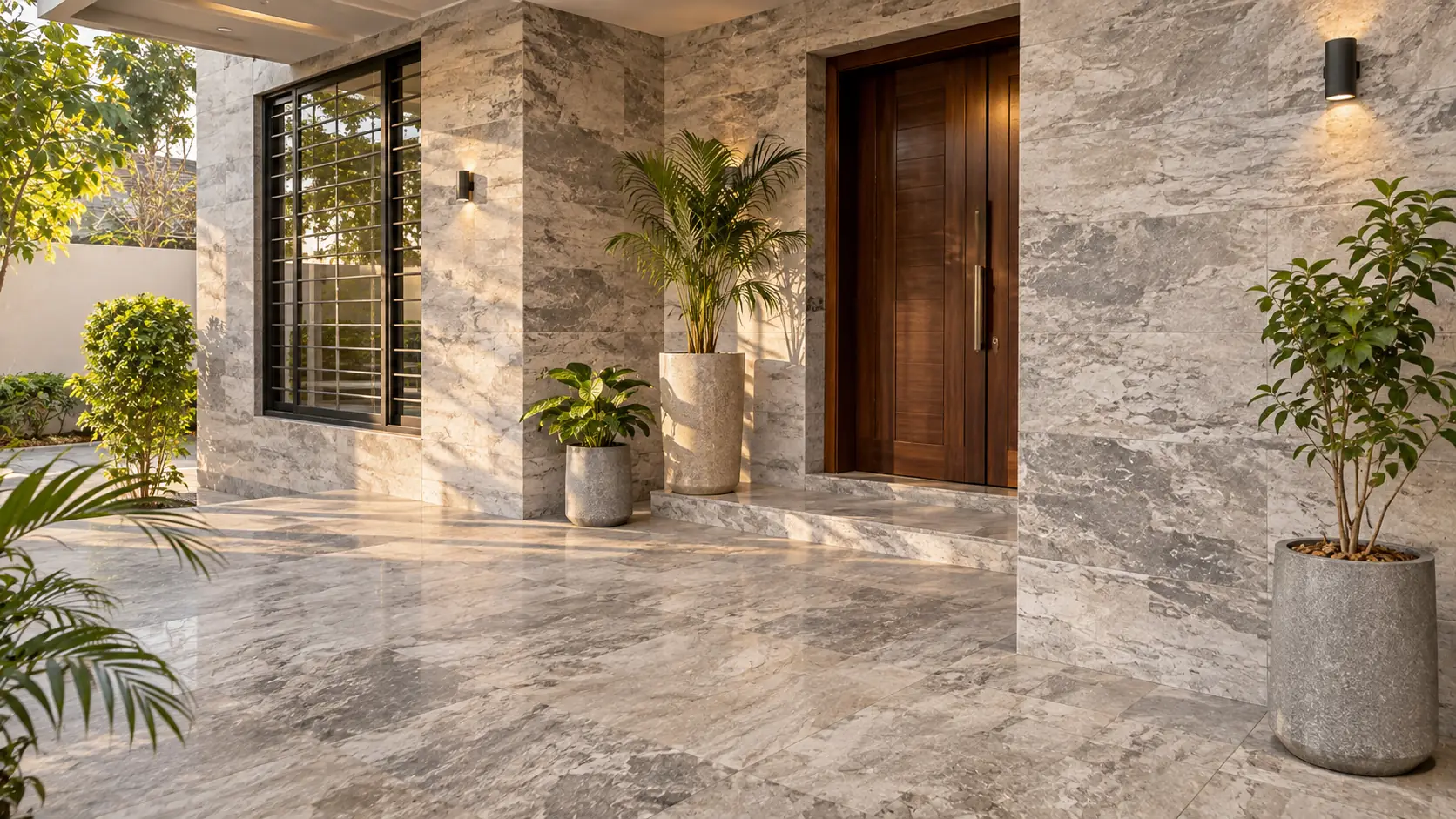
A clad entrance wall around the main gate or front door is a classic Pakistani use. On an exterior wall, choose filled and honed or brushed stone, seal it before and after grouting, and keep it under a canopy or chajja where possible, because open pores on an exposed wall collect dust and water. Above head height, ask your contractor for mechanical fixings in addition to adhesive.
Bathrooms and shower walls
Filled and honed tile makes a warm, spa-like bathroom that feels softer than polished grey marble. Run the same tile on the floor and up one or all walls, or keep the clouded tile on the floor with vein-cut pieces behind the vanity. Seal before and after grouting, squeegee shower walls after use, and avoid acid or chlorine cleaners.
Staircase walls and double-height voids
A tall stair wall in vein-cut stone turns a dull void into the feature of the house. Plan the joint lines on a drawing first, keep horizontal joints level with landings, and use the same lot for the whole height so the grey does not shift between floors.
Badal marble design ideas, room by room
Use this table as a starting point. The cut, finish and pairing suggestions come from the jobs our clients ask for most often, and the pairings follow the materials that sit well with this stone.
| Space | Cut | Finish | Pair it with |
|---|---|---|---|
| Lounge or TV wall | Vein-cut slab | Honed | Walnut or pale oak joinery, warm LED strip |
| Fireplace surround | Vein-cut slab | Honed or polished | Blackened steel insert, slim dark hearth |
| Bedroom floor | Cross-cut tile | Filled and honed | Off-white walls, rattan and linen |
| Bathroom floor and walls | Cross-cut floor, vein-cut walls | Filled and honed | Matte black taps, pale oak vanity |
| Porch and entrance wall | Either | Filled and honed or brushed | Black iron gate and lights, planters |
| Verandah or roof terrace | Cross-cut tile | Brushed or tumbled | Lime plaster, terracotta pots |
| Courtyard or pool surround | Cross-cut paving | Tumbled, unfilled | Grass joints, brick edging |
Colours and materials that suit it
- Blackened steel and iron. Window frames, stair rails and fire inserts in dark metal sharpen the soft grey.
- Pale oak and rattan. Light wood keeps the room warm and relaxed; dark polished wood can look heavy against it.
- Off-white lime plaster. A textured, chalky wall next to honed stone is the classic Mediterranean pairing.
- Matte black taps and fittings. Cleaner than chrome against a honed surface, and they hide hard-water spots.
What to avoid
- A second busy stone in the same view, such as a Fancy or a strongly veined marble right next to the clouds.
- Cool blue-white tube lights, which flatten the warm off-white body and make the grey look dirty. Warm white (3000K) suits it better.
- Polished Badal on a floor that gets wet; it loses the grip that makes this stone so practical.
Which Badal finish should you choose?
Choose filled and honed for indoor floors and bathrooms, brushed or tumbled for verandahs, porches and courtyards, and polished only for walls and small indoor surfaces. Finish decides how the stone looks, how it feels underfoot and how much work it is to keep clean. The pores are either resin-filled at the factory for a smooth surface that mops clean, or left open and grouted full on site for a rustic texture. Filled and honed is what most of our Lahore clients choose for interior floors.
| Finish | Look and feel | Grip when wet | Where it suits |
|---|---|---|---|
| Filled and honed | Smooth matte, colour slightly softened | Good | Interior floors, bathrooms, vanity tops, walls |
| Polished | Light sheen, deeper grey | Poor | Indoor walls, fireplace cladding, small tops |
| Brushed | Gently textured, soft to touch | Very good | Verandahs, porches, shower floors |
| Tumbled | Rounded edges, aged look | Very good | Courtyards, pool surrounds, garden paths |
Filled or unfilled?
On our catalogue spec sheet, unfilled stone absorbs around 1 to 2% water and filled stone under 0.5%. That difference is why filled tile is the right choice for anything indoors that gets mopped daily. Unfilled or tumbled tile suits outdoor areas where the open texture adds grip and the look is meant to be rustic; it is grouted full on site and needs sealing more often.
Heat and monsoon
Outdoors, this pale stone stays noticeably cooler underfoot than dark granite through a Lahore or Multan June, and a brushed or tumbled face grips well in monsoon rain. That makes it a good fit for roof terraces and pool surrounds where barefoot comfort matters.
Is Badal better than grey marble?
Badal is better where you want texture, a matte natural look and grip on wet floors; a grey marble such as Sunny Grey is better for a smooth, polished floor at a slightly lower rate. If you are deciding between Badal and a grey marble, the table puts them side by side on our current quote ranges. Our grey marble guide goes into each of these in depth.
| Stone | Type and origin | Look | PKR / sq ft |
|---|---|---|---|
| Denso | Marble, Mohmand | Tight-grained grey with a faint green cast | 450 – 820 |
| Sunny Grey | Marble, Ziarat | Warm light grey, soft cloud | 560 – 1,000 |
| Superline Grey | Marble, Mohmand | Mid-grey with straight pale lines | 620 – 1,150 |
| Dawezai Badal | Travertine, Mohmand | Grey cloud drift with fine linear pitting | 640 – 1,180 |
| Nagar Parkar Grey | Granite, Sindh | Salt-and-pepper grey and white | 650 – 1,200 |
- Choose Badal when you want texture, a warm undertone, a matte natural look and better grip on wet floors.
- Choose Sunny Grey when you want a smoother, polished marble floor right through the house at a lower rate. If a lighter tone appeals, compare Sunny Grey or Sunny White.
- Choose Superline Grey when you want straight lines but with a polished marble shine rather than a travertine texture.
- Choose Nagar Parkar Grey granite for kitchen worktops and car porches that see oil, heat and heavy wear.
Planning quantities and budget
Our current quote range for Dawezai Badal is PKR 640 to 1,180 per square foot, cut, finished and fitted in our service area. Standard filled and honed floor tile sits at the bottom of that band and vein-cut slabs at the top, with thickness, finish and the amount of cutting deciding where your job lands. Current stock and grades are listed on the product page.
| Job | Area incl. wastage | Estimated installed cost (PKR) |
|---|---|---|
| Bathroom floor, 8 x 6 ft | About 53 sq ft (10%) | 33,920 – 62,540 |
| Fireplace cladding wall, 6 x 9 ft | About 62 sq ft (15%) | 39,680 – 73,160 |
| Vein-cut TV wall, 10 x 9 ft | About 104 sq ft (15%) | 66,560 – 122,720 |
| Porch floor, 20 x 12 ft | About 264 sq ft (10%) | 168,960 – 311,520 |
| Lounge floor, 20 x 15 ft | About 330 sq ft (10%) | 211,200 – 389,400 |
Put your own room sizes into the stone cost estimator: length times width in feet, plus wastage, times the rate.
If you buy the stone only
Our range already includes fitting; cut-outs, mitres, book-matching and freight outside our fitting cities are itemised on the quote. If you buy stone only and hire your own mistri, budget labour separately. As an indicative market range only, floor laying is often quoted around PKR 60 to 150 per sq ft, and wall cladding costs more because of drilling, clamps and setting-out. Add adhesive, grout, sealer and transport, and get each line in writing.
Lead time on stock grades is typically 5 to 10 days from order. For cities outside Lahore, add transit time and make sure the tiles are crated, because loose stacks chip at the edges on the road.
Buying checklist at the yard
- Decide the cut first. Tell the yard whether you want cloud (cross-cut) or lines (vein-cut). Mixing the two by accident is the most common Badal mistake.
- See the whole lot. Colour shifts from block to block. For any floor bigger than one room, hold the full quantity from a single lot, plus spares.
- Check the fill. On filled tile, the resin should sit flush and match the stone colour. Large unfilled holes, cracked fill or a glossy plastic look are signs of a poor grade.
- Check thickness and flatness. Lay three tiles face to face and look for bowing. Ask for 20 mm or 30 mm on exterior walls and heavy-use floors.
- Wet a sample. Water shows you how the colour will look after sealing and how quickly an unsealed piece absorbs.
- Take a sample home. Look at it under your own lights at night and in daylight before you commit. You can order samples from us.
- Get the rate itemised. Stone, wastage, cutting, finishing, transport and fitting should each be a separate line.
Installation details that protect the look
- Dry lay first. Spread the tiles out, balance the dark and light pieces, and number vein-cut slabs in sequence.
- Use white stone adhesive. Grey cement can shadow through a pale, porous stone. Use a full bed of adhesive, not dabs, so there are no hollow spots that crack later. Our guide to stone tile adhesives compares the types.
- Seal before grouting. A coat of penetrating sealer before grouting stops grout pigment soaking into the pores; seal again once the grout has cured.
- Match the grout. A warm grey or off-white grout disappears into the clouds. Keep joints tight on interior floors.
- Plan movement joints. On large porches and terraces exposed to sun, leave movement joints at the perimeter and at regular intervals so the floor does not tent in summer.
- Protect the floor. Cover the finished floor with board or thick sheet while other trades finish, because paint, cement slurry and acid-based cleaners left by workers etch the surface.
Our installation process page shows how we measure, cut and fit, if you would rather we handle the job from end to end.
Care in Pakistani dust, heat and hard water
Badal is calcium-based, so the rules are the same as for marble, with a little more attention to sealing because of the pores.
- Daily pocha with a neutral cleaner. Sweep or vacuum grit first, then mop with clean water and a pH-neutral stone cleaner. Skip phenyl, bleach, vinegar and acidic tile cleaners, which dull the surface over time.
- Seal on schedule. Re-seal once a year indoors and twice a year outdoors. A simple test: drip water on the surface; if it darkens within a few minutes, it is time.
- Deal with oil quickly. Cooking oil, ghee and the drip from a parked motorcycle or generator are the real stain risks. Put a mat under anything that drips and clean spills the same day.
- Refill open pores. If a pore opens up on a filled floor, it can be filled with colour-matched grout or resin in minutes.
- Watch hard water. In bathrooms, squeegee walls and wipe vanity tops dry to stop white mineral spots building up.
For step-by-step sealing, see how to seal marble in Pakistan; the same products and methods work on this stone. If an old floor has lost its finish, our marble polishing guide explains re-honing.
Get a quote or see the stone
Send us the rooms or walls you are planning, rough sizes and whether you prefer the cloud or the linear look, and we will send a free itemised quote. If you are still deciding on a badal marble design for a porch or TV wall, browse the Badal collection for cut and finish photographs, or order samples and see them in your own light first.
Written by
The Captivating Marble Design Team
Fabricators, templaters and stone designers
We template, cut and install natural stone every day and write about what we learn — pricing, layouts, care and the mistakes we help clients avoid.
Book a free design consultation