Marble Fireplace Design in Pakistan: Styles, Safe Stones and PKR Costs
Fireplace styles for Pakistani homes, the stones that handle heat, gas heater safety, clearances and PKR cost per surround. Plan your fireplace with us today.
Captivating Marble Design Team · · Updated · 18 min read
Key takeaways
- A complete fabricated and fitted stone fireplace surround costs PKR 60,000 to PKR 450,000 in our current quotes (November 2026).
- Marble frames the fire but never lines the firebox; the inside of a wood-burning firebox is lined with firebrick laid in refractory mortar.
- Khyber Black granite (PKR 850–1,600 per sq ft) is the hardest-wearing choice for the hearth and frame of a real wood fire.
- Onyx and heavily resin-filled slabs belong only on electric or decorative fireplaces, away from gas and wood heat.
- Cladding is 18 mm stone fixed with stainless clips plus adhesive on masonry or cement board; hearths and shelves are 30 mm.
The short answer
A good marble fireplace design in Pakistan matches the stone to the heat source: dark marble or granite beside a wood or gas fire, any stone (onyx included) around an electric insert. The four styles that work are the classic mantel, the modern slab frame, floor-to-ceiling cladding and the TV-and-fireplace wall. A fitted surround costs PKR 60,000 to 450,000.
Whatever the style, two rules do not change: line the firebox with firebrick, never marble, and fix the cladding with stainless clips on masonry or cement board rather than mortar alone. How the fire is actually used decides the rest, whether that is a real wood fire in Murree or Quetta, a gas heater in a Lahore drawing room or a decorative electric insert in Karachi.
On cost, the range above is our current quote range (November 2026) for a complete surround, fabricated and fitted, and it moves with size, stone and carving. A plain three-piece frame in Ziarat White or Dawezai Badal travertine sits near the bottom of that range; a book-matched Black & Gold chimney breast with a carved shelf sits near the top. The sections below explain each style, which stones cope with heat, how the surround is built, the safety distances to respect and how to keep soot and heat stains off the stone.
How fireplaces are really used in Pakistani homes
Before choosing a stone, be honest about the heat source. The same drawing in a design magazine can mean three very different things on site, and each one puts a different load on the surround.
Wood or coal fires in the north
In Murree, Nathia Gali, Abbottabad, Swat and parts of Quetta and Islamabad, many houses still burn wood (lakri) all winter. These need a proper chimney, a firebrick-lined firebox and a deep hearth. The surround sees real radiant heat, sparks and soot, so stone choice and clearances matter most here.
Gas heaters in a fireplace niche
In Lahore, Rawalpindi, Faisalabad and Peshawar the "fireplace" is usually a niche with a Sui gas or LPG heater standing in it: radiant clay or ceramic plates, or a gas log set behind a glass front. Many of these heaters are flueless, so combustion gases and moisture go straight into the room. The stone above the opening takes a hot, rising plume, and when gas pressure drops in the coldest weeks the flame turns lazy and yellow and leaves brown streaks on the header.
Decorative and electric fireplaces
In Karachi and in apartments everywhere, the fireplace is often purely decorative or holds an electric insert with an LED flame effect. Heat is minimal, so any stone in our range will do, including onyx and soft fancy marbles. This is where you can be boldest with colour and veining.
Plan for change. Winter gas supply is unreliable in many areas, and families often switch from Sui gas to LPG or electric within a few years. Size the opening for a standard insert, bring the gas line to an accessible isolation valve outside the firebox, and leave a power socket at the side of the niche so the stone never has to be broken open later.
Marble fireplace design styles that work
Most fireplaces we fabricate fall into four families. Each one can be built from the stones on our fireplace surrounds page, in a normal Lahore workshop, with a careful fitter.
1. The classic mantel (three-piece surround)
Two jambs (the legs either side of the opening), a header across the top and a mantel shelf, standing on a raised or flush hearth. It suits traditional drawing rooms, kothi-style houses with high ceilings and anyone who wants a place for frames and a clock. The shelf can be a plain slab with a bullnose edge, a moulded "ogee" profile or a hand-carved piece with corbels and rope mouldings from a carving shop. Carving reads best in a pale, evenly coloured stone such as Ziarat White or Verona; strong veining fights with the carved detail.
2. The modern slab frame
A flat, flush frame of polished or honed stone around the opening, usually 6 to 12 inches wide, with no shelf or a thin floating one. It is the cleanest look for a contemporary lounge and the cheapest to build. A crisp Jet Black frame around a glass-fronted gas fire is a combination that never dates. Mitre the corners so the edge shows one continuous colour rather than a cut end.
3. Floor-to-ceiling cladding and book-matching
The whole chimney breast is clad in stone, from the hearth to the ceiling. Two sequential slabs from the same block are opened like a book so the veins mirror each other across the centre line. In a double-height lounge this is the most dramatic thing stone can do. It needs bold, flowing stones: Black & Gold, Tiger Verona, Zebrano or Royal Fancy. Book-matching only works if the slabs are cut in sequence and kept together, so reserve them at the yard and approve the layout on photographs before cutting.
4. The TV-and-fireplace wall
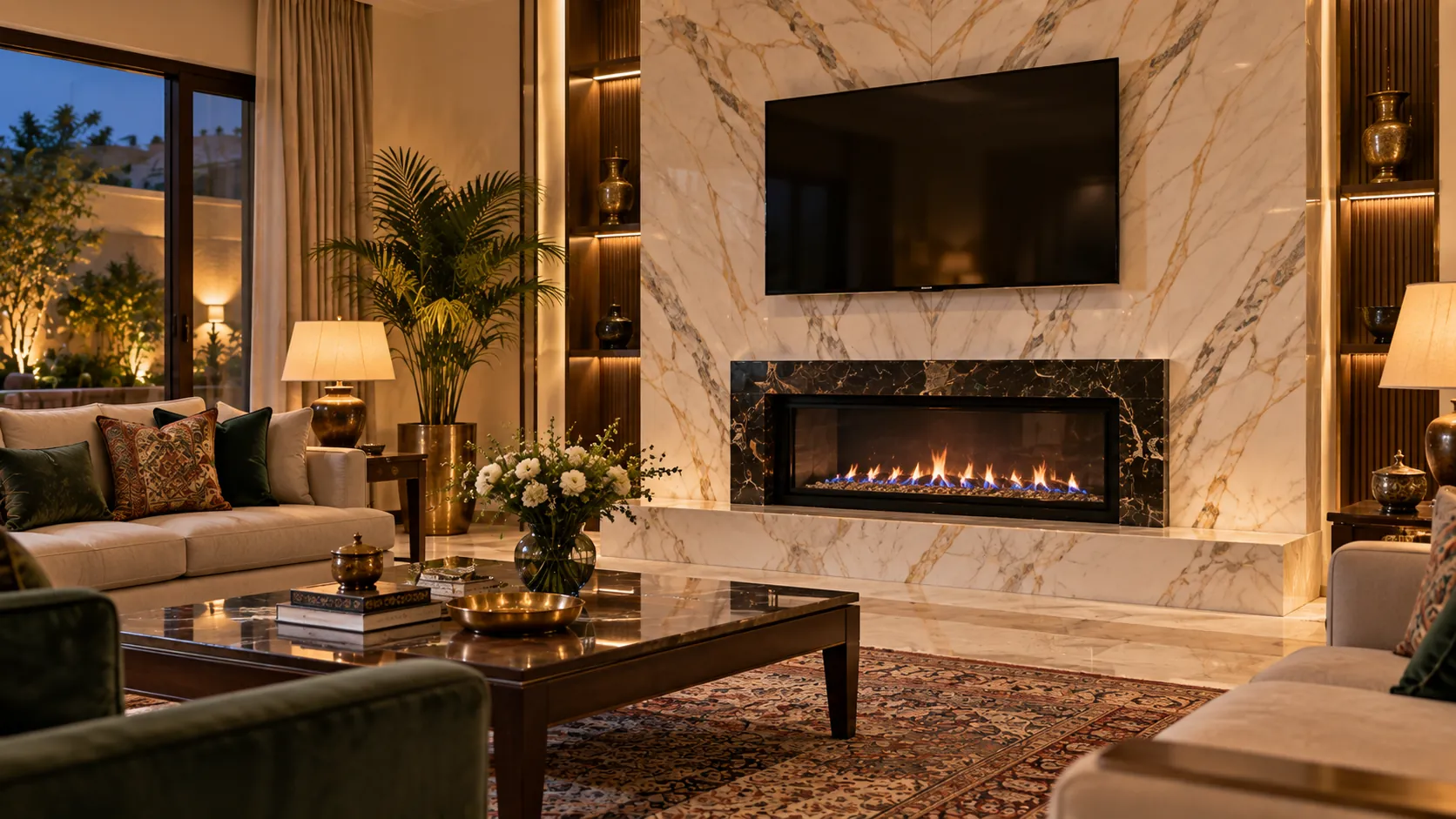
The commonest request in new Pakistani houses: a full feature wall with the fire low down, the television above or beside it, and floating shelves or a recessed niche. The stone is the backdrop, so a calm stone such as Perlino, Sunny Grey White or vein-cut Dawezai Badal travertine often works better than a loud one that competes with the screen. The design detail that matters most is heat: see the section on clearances before you hang a TV directly over a gas fire. Our marble design ideas guide covers TV walls without a fireplace.
Smaller details that lift any style
- A contrasting slip: a thin strip of black stone (2 to 3 inches) between the opening and a white surround frames the fire and hides heat marks.
- Raised hearth: a 6 to 12 inch high hearth doubles as seating and keeps rugs and children further from the flame.
- Hidden lighting: a warm LED strip under a floating shelf, with the driver kept well away from the opening.
Which stone is best for a fireplace?
For a real wood fire, granite such as Khyber Black is best next to the opening; for gas heaters a dark marble like Jet Black or Black & Gold hides heat marks; and for electric inserts any stone works, onyx included. Stone has framed fires for centuries, but not every slab in a yard is suitable for the hottest zone. The risk is rarely melting or burning. It is thermal shock (one part of a slab heating faster than the rest and cracking), resin in the slab softening or yellowing, and staining from soot and heat.
Marble is mostly calcite. It tolerates the warmth a surround normally sees, but it will crack if a wood fire sits hard against it, and it should never form the inside of a firebox. Granite is a silicate stone and copes better with heat, though very high, direct heat can still spall it. Travertine behaves like marble, but its holes are usually filled with resin or cement, and resin fill near the opening can darken. Onyx is the most sensitive: it is softer, more brittle, and almost always backed with resin and fibreglass mesh.
| Stone | Type and origin | PKR per sq ft | Next to the opening | Cladding above and around |
|---|---|---|---|---|
| Ziarat White | Marble, Ziarat | 850–1,600 | Yes, with a gap; shows soot | Excellent, carves well |
| Jet Black | Marble, Chaghi | 1,100–2,000 | Yes; hides heat marks | Excellent frames and slips |
| Black & Gold | Marble, Chaghi | 1,400–2,800 | Yes, check for resin repairs | Excellent, book-matches |
| Tiger Verona | Marble, Chaghi | 750–1,350 | Yes | Excellent, bold banding |
| Green Fancy | Marble, Mohmand | 780–1,450 | Yes, check for resin repairs | Good for period rooms |
| Dawezai Badal Travertine | Travertine, Mohmand | 640–1,180 | Better with a black slip | Excellent, vein-cut is calm |
| Khyber Black Granite | Granite, Nowshera | 850–1,600 | Best choice for wood fires | Good, plain look |
| Balochistan Red Granite | Granite, Chaghi | 780–1,450 | Good | Good for rustic rooms |
| Pak Green Onyx | Onyx, Chaghi | 2,400–5,200 | No | Only away from heat or on electric fires |
| Honey Onyx | Onyx, Chaghi | 2,200–4,800 | No | Only away from heat or on electric fires |
Stones and slabs to keep away from the opening
- Onyx and backlit panels: brittle, resin-backed and wired with LEDs. Use them as the outer cladding of an electric or decorative fireplace, not the frame of a wood or gas fire. Our onyx price guide explains how these slabs are reinforced.
- Heavily resin-repaired slabs: many fancy marbles are face-filled with epoxy at the factory. Near a gas heater the resin can haze, yellow or lift. Ask the yard which slabs are treated and use them higher up the wall.
- Thin tiles stuck on gypsum board: gypsum and plywood behind the stone are the weak link, not the stone. Use cement board or masonry.
- Very pale stone on the header of a flueless gas heater: it will brown within a season or two. Put a dark slip or a projecting shelf there instead.
Gas heaters and fireplaces: what to plan before the stone
Most fireplaces in Punjab and KP will hold a gas heater for at least part of their life. The stone is the easy part; the gas, air and heat around it decide whether the installation is safe and whether the surround stays clean.
- Ventilation first. A flueless heater burns the air in the room and releases carbon monoxide if it is faulty or starved of air. Keep a permanent vent, fit a carbon monoxide alarm and never sleep in a closed room with a gas heater running.
- Use a flued or balanced-flue unit if you can. A heater with a proper flue or chimney takes fumes and moisture outside, and the stone above it stays far cleaner.
- Gas fitting by a qualified fitter. Copper or approved hose, an isolation valve outside the firebox, and a leak test with soapy water before the stone goes on. The stone fitter should not be the gas fitter.
- Read the heater manual. The manufacturer states the minimum distances to combustible materials, shelves and the ceiling. Those figures override any general rule in this article.
- Plan the opening around the heater, not the other way round. Measure the actual unit you will buy, add the side gap it needs, and cut the stone to that.
Soot is a warning sign. A clean gas flame is mostly blue. If the header blackens quickly, the burner is dirty, the gas pressure is low or the room lacks air. Get the heater serviced before you blame the marble.
How a stone fireplace is built
A surround that lasts is a layered construction, and each layer has a job. The same principles apply whether the stone is a slim frame or a full wall; our marble installation guide covers the general fitting sequence in more detail.
The firebox lining
For a real fire, the inside of the box is lined with firebrick (refractory brick) laid in fireclay or refractory mortar. Marble, granite and normal cement mortar do not belong inside the firebox: they crack and spall under direct flame. A gas heater sits in a lined or metal-cased niche; follow its manual for what the niche must be made of.
The hearth
The hearth is the non-combustible floor in front of and under the fire. It sits on a concrete base, never on a timber floor or a raised wooden platform, and is finished in 30 mm stone with a mitred or bullnosed front edge. Granite or a dark marble is the practical choice for wood fires, because embers and ash land on it every day.
Backing and fixing
Cladding is usually 18 to 20 mm stone. It is bonded with a heat-stable cement-based tile adhesive onto masonry or cement board, and every large panel is also held with stainless steel clips or pins anchored into the wall. Adhesive alone, or a thick sand-cement bed (the old "masala" method), can let a heavy panel creep or drop as the wall heats and cools over winter. Shelves and header pieces carry their weight on steel angles or dowels, not on the adhesive.
Movement joints
Leave a small gap, typically 3 to 5 mm, between the stone and any metal firebox, insert or heater frame, and fill it with high-temperature silicone or leave it open as the insert maker specifies. Metal expands far more than stone. Without that gap the frame pushes on the stone every evening and eventually cracks a corner.
Carved mantels, mitred hearths and book-matched panels should be dry-fitted in the workshop, numbered and photographed before they leave, because nothing can be recut on site.
How far should wood and a TV be from a fireplace?
As a common international reference, keep wooden trim at least 6 inches from a wood-burning opening and extend the hearth at least 16 inches in front of it; a TV goes only where the heat stays comfortable to the hand. Pakistan does not have a widely enforced residential fireplace code, so architects and fitters usually borrow from international practice and the appliance manual. The figures below are common international reference points, not legal requirements here. Where your heater or insert manual gives a different figure, follow the manual.
| Element | Typical reference figure | Why it matters |
|---|---|---|
| Hearth in front of opening (opening under 6 sq ft) | At least 16 in (about 400 mm) | Catches embers and rolling logs |
| Hearth to each side (opening under 6 sq ft) | At least 8 in (about 200 mm) | Protects floor and rug edges |
| Hearth for larger openings | At least 20 in front, 12 in each side | Bigger fire, more radiant heat |
| Wooden trim or panelling | None within 6 in of the opening | Wood chars long before stone is affected |
| Wooden mantel shelf above | Higher the further it projects | A deep shelf traps rising heat |
TV above the fireplace
Televisions and their wall brackets do not like heat. Over a wood fire or a flueless gas heater, a screen directly above the opening is a poor idea unless a deep stone shelf deflects the plume and the TV maker confirms the temperature is acceptable. A simple check: run the fire for an hour and hold your hand where the bottom edge of the TV will be. If it is uncomfortable to keep it there, the TV should go higher, further back or to one side. Electric inserts largely remove this problem. If you are planning a marble TV wall beside the fireplace, settle the screen position before any stone is cut.
Keep curtains, wooden TV units, LED drivers and cable bundles out of the hot zone, rugs off the hearth, and a spark guard in front of any open wood fire.
How much does a marble fireplace cost in Pakistan?
A complete marble fireplace surround costs PKR 60,000 to PKR 450,000 fabricated and fitted at our current quote ranges (November 2026); worked from our per-square-foot ranges, which are also installed prices, a design runs from about PKR 19,000 for a small travertine frame to over PKR 300,000 for a Black & Gold feature wall. Yards quote stone per square foot; fabricators quote fireplaces per piece or per job. To compare, first estimate how much stone your design needs. The areas below are typical, not measured jobs, and include the hearth.
| Design | Approx. stone area | Dawezai Badal (640–1,180) | Ziarat White (850–1,600) | Jet Black (1,100–2,000) | Black & Gold (1,400–2,800) |
|---|---|---|---|---|---|
| Classic three-piece surround with shelf and hearth | 30 sq ft | PKR 19,200–35,400 | PKR 25,500–48,000 | PKR 33,000–60,000 | PKR 42,000–84,000 |
| Floor-to-ceiling chimney breast, 6 ft wide | 60 sq ft | PKR 38,400–70,800 | PKR 51,000–96,000 | PKR 66,000–120,000 | PKR 84,000–168,000 |
| TV-and-fireplace wall, 12 x 10 ft | 110 sq ft | PKR 70,400–129,800 | PKR 93,500–176,000 | PKR 121,000–220,000 | PKR 154,000–308,000 |
That PKR 60,000–450,000 surround range is the one listed on our fireplace surrounds page. Book-matched walls and carved mantels sit in the upper half because they need sequential slabs, more wastage and much more workshop time.
Our ranges include cutting, a standard edge, polishing and fitting with clips and adhesive in our service area. Mitres, book-matching, carving and freight outside our fitting cities are itemised on the quote, and so is scaffolding for double-height walls.
Market rates if you buy stone only
| Item | How it is usually quoted | Indicative market range |
|---|---|---|
| Cutting, polishing and simple edges (stone-only buyers) | Per sq ft | PKR 150–400 |
| Mitred edges on frames and hearths | Per running ft | PKR 150–350 |
| Hand-carved mantel shelf and corbels | Per piece, from a drawing | Quoted separately; varies widely with depth of carving |
| Cladding fitting with clips and adhesive (stone-only buyers) | Per sq ft | PKR 150–350 |
| Firebrick lining of a wood firebox | Per firebox | PKR 15,000–40,000 |
| Scaffolding for double-height walls | Per job | Depends on height and duration |
These are indicative market ranges seen in the Punjab trade, not our rate card; the cutting and fitting rows apply only when you buy stone only and hire your own fabricator. They move with electricity, diesel and labour costs. The cost estimator gives a first installed figure, and a free quote itemises the extras.
How to avoid being overcharged
- Ask for stone and labour as separate lines, with the stone named and the thickness stated (18 mm cladding, 30 mm hearth and shelf).
- Ask whether the quote includes clips, backer board, firebrick and scaffolding, or whether these appear later as "extras".
- For book-matching, confirm the slab numbers you approved are the ones that arrive.
- Get carving priced from a drawing or photograph, with the depth of carving agreed.
Buying checklist: choosing slabs and a fabricator
A fireplace is seen from every seat in the room, so slab selection matters more than on a floor. Take this list to the yard or ask for these photos if you are buying from another city.
- See the full slab, wet, in daylight. Wetting shows the true colour and reveals hairline cracks.
- Check the back. Mesh and resin on the back are normal for onyx and some fancy marbles; heavy resin on the face means keep that slab away from the heat.
- Look for natural fissures across narrow pieces. A jamb only 8 inches wide with a crack running across it will snap in handling.
- Reserve sequential slabs for any book-matched design, and photograph their numbers.
- Match lots if the fireplace stone also appears on the floor or a kitchen counter; buy both from the same block.
- Order a sample of the exact stone and finish and hold it next to your paint, sofa and curtains. Samples cost PKR 500 each and the charge is credited on your order.
- Ask how the fabricator fixes cladding and what goes behind the stone. "Masala and patience" is not an answer for a 10 ft wall.
- Confirm the lead time: around two weeks for a plain slab surround and three to five weeks for carved work in our workshop.
If you are also cladding other walls in the same room, our stone wall cladding guide covers formats, fixing and weight.
Care: soot, heat staining and sealing
A stone fireplace needs little care if you seal it and keep on top of soot. Neglect it for a winter and the header may need a professional clean.
Sealing
Seal light marble and travertine after fitting with a penetrating (impregnating) sealer, especially the hearth and the first foot around the opening, then reseal every one to two years. Sealing slows soot and ash from sinking into the pores; it does not make the stone heat-proof. Our guide on how to seal marble in Pakistan explains the water-drop test and which sealers to avoid.
Weekly and seasonal cleaning
- Dust the surround and hearth with a dry microfibre cloth; wipe with warm water and a few drops of pH-neutral stone cleaner.
- Lift light soot with a soft cloth and a neutral cleaner, wiping upwards from the clean area into the dirty one.
- Never use vinegar, lemon, bathroom cleaners or acid-based "marble shiners". They etch calcite stone instantly.
- Do not scrub with steel wool or scouring powder; both scratch the polish.
- Sweep ash from the hearth when cold. Hot ash on a damp hearth can mark it.
Heavy soot and heat stains
Deep brown or black staining above a gas heater usually responds to a poultice: a paste of an absorbent powder and a stone-safe cleaner left on the stain under plastic for 24 to 48 hours, then lifted off. Repeat if needed. Yellowing that comes from resin in the slab, rather than soot on it, will not come out; the only cure is re-honing and polishing or replacing that piece.
Start your fireplace
Send us a photo of the wall, its width and ceiling height, the heater or insert you plan to use and a picture of a style you like. We will suggest two or three stones, mark where the joints and clearances fall and return a written quote that states the installed price and itemises mitres, carving and freight. If you are deciding between a white and a dark frame, order samples of both and look at them by lamp light, the way you will see the fireplace on a winter evening.
Written by
The Captivating Marble Design Team
Fabricators, templaters and stone designers
We template, cut and install natural stone every day and write about what we learn — pricing, layouts, care and the mistakes we help clients avoid.
Book a free design consultation