Front Elevation Stone Design for Pakistani Houses: Stones, Styles and Costs
Granite from PKR 650 and Gadap stone from PKR 260 per sq ft installed: front elevation styles, fixing and costs for 5 marla to 1 kanal houses. Get a free quote.
Captivating Marble Design Team · · 16 min read
Key takeaways
- Granite is the safest stone for an exposed Pakistani house front: sun does not fade it, rain does not etch it and its water absorption is negligible.
- Most elevations put stone on 20 to 40 per cent of the façade: plinth, porch columns, door surround and one feature panel.
- Granite for a house front costs PKR 650–1,700 per sq ft installed on our November 2026 quote ranges; Gadap limestone costs PKR 260–520.
- A worked 10 marla example of about 275 sq ft costs roughly PKR 178,750–330,000 in Nagar Parkar Grey granite, before mechanical fixing and scaffolding.
- Choose honed, brushed or leathered finishes outdoors; polished stone glares in sun and shows every dust streak and water mark.
The short answer
Good front elevation stone design in Pakistan uses dense granite or a honed, sealed stone on 20 to 40 per cent of the façade: a plinth, porch columns, the main door surround and one feature panel. Installed granite costs PKR 650–1,700 per sq ft on our November 2026 quote ranges; Gadap limestone costs PKR 260–520.
A house front is the hardest job a stone can be given. It bakes in 45°C June sun, takes horizontal monsoon rain, collects dust after every aandhi and sits a few inches above soil full of salts. Some of our stones handle that for decades; others look superb on the day of fitting and patchy within two summers. This guide covers where stone belongs on an elevation, which stones to choose, the popular Pakistani styles and how to get the proportions right, a short summary of fixing, costs for three plot sizes and how to keep the façade clean.
How we priced this: stone rates are our current catalogue quote ranges per square foot as of November 2026. They are installed prices covering the stone, cutting, a standard edge and adhesive fixing in our service area. Mechanical anchors for panels at height, scaffolding, mitres and freight outside our fitting cities are itemised on the quote. Any market figure for those extras is indicative only. Confirm the final figure against a written quotation.
Where does stone go on a house front?
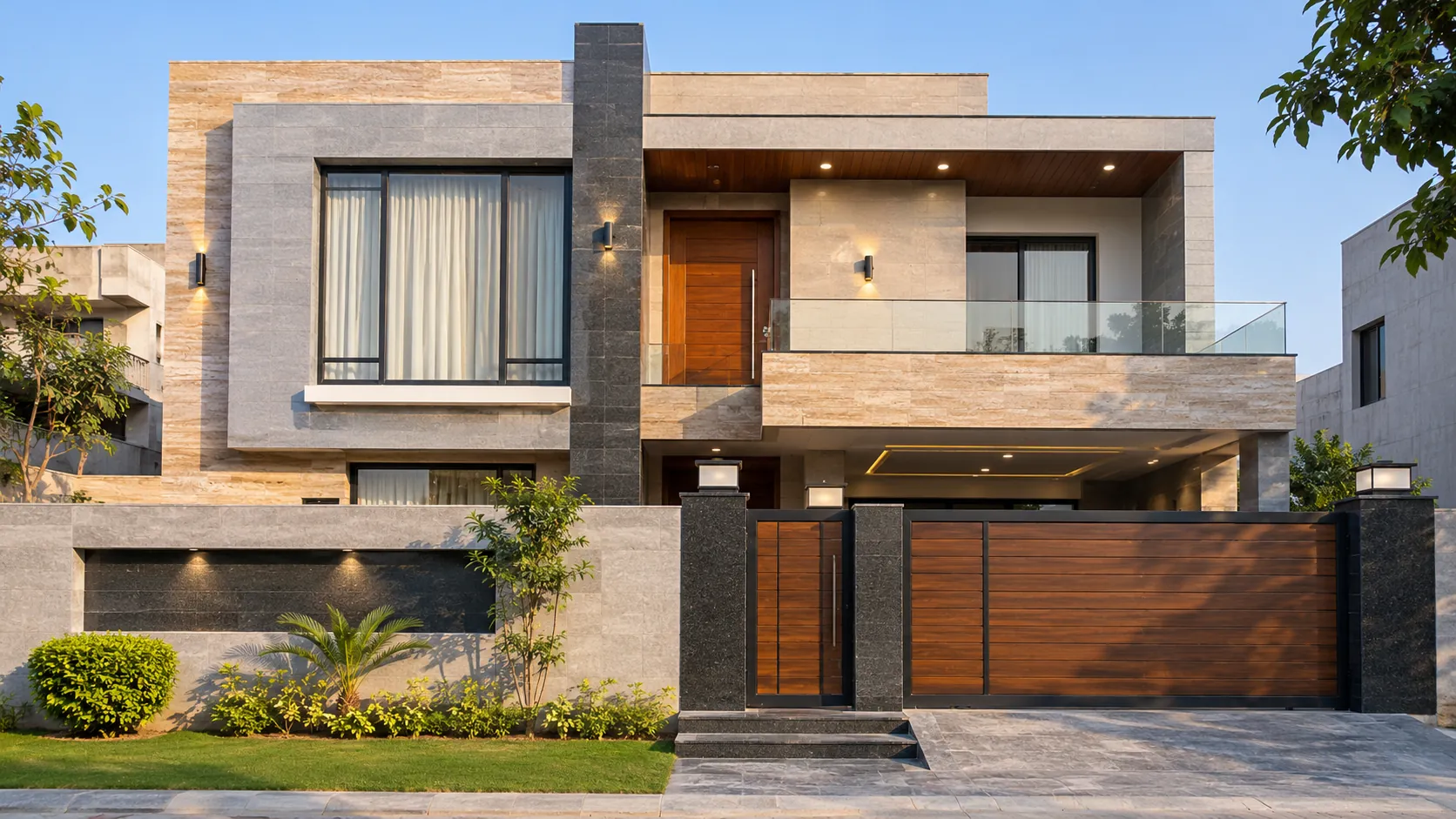
Stone goes where the façade takes the most punishment or needs the most emphasis: the plinth at the base, the porch columns, the main door surround, window frames and sills, one feature panel, and the gate pillars on the boundary wall. Very few well-designed houses clad the whole front. Plaster, paint, glass, metal and timber fill the rest, and the stone reads as a deliberate frame rather than a blanket.
| Zone | Typical size | Best stone | Finish |
|---|---|---|---|
| Plinth (base band) | 1.5–3 ft high along the frontage | Dense granite: Nagar Parkar Grey, Galaxy Black, Khyber Black | Honed, brushed or leathered |
| Porch columns | Full height, all four faces, mitred corners | Granite or New Tavera under a deep porch roof | Honed or brushed |
| Main door surround | 8–14 in wide band around the frame, or a full-height panel | Contrast granite, or Gadap for a warm modern look | Honed or leathered |
| Window frames and sills | 4–8 in bands; sills with a drip groove | Granite sills; same stone as the door frame | Honed; sill tops may be polished |
| Feature panel | One vertical or horizontal block, 40–120 sq ft | Granite, Gadap, Badal travertine, Commando Fancy (sheltered) | Honed or brushed |
| Gate pillars and boundary wall | Pillars 1.5–2 ft square; wall plinth 1–2 ft | Granite, or Gadap under a projecting coping | Brushed or honed |
| Parapet and copings | Top of walls and pillars | Granite with a drip edge | Honed |
The plinth matters more than people expect. It is the band that gets splashed by rain bouncing off the porch floor, wiped with a wet pocha, hit by car doors and soaked by garden water. A dense granite plinth protects the plaster above it and frames the whole house, and it is the one piece of exterior stone we would add even to the simplest elevation. For the porch floor and front steps, see our guide to black granite stairs, which covers treads, nosings and grip.
Which stones survive sun, rain and dust on a façade?
Granite survives all three best, followed by dense marbles and travertine in honed or brushed finishes under a roof or deep overhang; soft, light or polished marbles belong indoors. Pakistani granite is UV-stable, holds its colour in full sun and absorbs almost no water, so monsoon rain and freezing nights in the north do not harm it. Marble, limestone and travertine are calcium stones: acid rain, bird droppings and acidic cleaners slowly etch them, and they drink more water.
The four exterior stresses
- Sun and heat. A west- or south-facing front in Lahore, Multan or Faisalabad heats far above air temperature by late afternoon. Dark stones run hotter than greys and creams, and thin polished marble on a sunny wall can slowly lose strength and bow. Granite does not.
- Monsoon rain. Rain rarely harms good stone; water trapped behind it does. Stone with low porosity and fully filled joints keeps water out of the wall.
- Dust and smog. Smooth honed or brushed faces rinse clean. Deep textures and polished faces both show grime: one holds it, the other shows every streak.
- Ground salts. Brackish groundwater rises into the base of walls and leaves white bloom on the stone. Dense granite at the plinth, a damp-proof course and a sealer on any porous stone keep it at bay.
| Stone | PKR / sq ft | Finishes we offer | Exposure |
|---|---|---|---|
| Gadap Stone (limestone) | 260–520 | Honed, brushed | Sheltered or sealed walls; keep off the ground |
| Denso (grey marble) | 450–820 | Polished, honed, brushed | Honed or brushed, partly sheltered |
| New Tavera (beige marble) | 580–1,050 | Polished, honed | Under a porch roof or deep overhang |
| Dawezai Badal Travertine | 640–1,180 | Honed, brushed | Filled and sealed, sheltered panels |
| Tropical (brown marble) | 650–1,200 | Polished, honed, leathered | Leathered, partly exposed |
| Nagar Parkar Grey (granite) | 650–1,200 | Polished, honed, brushed, leathered | Fully exposed, plinths included |
| Nagar Parkar Pink (granite) | 700–1,300 | Polished, honed, brushed | Fully exposed; holds colour in full sun |
| Swat White (granite) | 720–1,350 | Polished, honed, leathered | Fully exposed; stays cooler in sun |
| Commando Fancy (green marble) | 740–1,380 | Polished, honed | Courtyard and sheltered feature walls, sealed |
| Balochistan Red (granite) | 780–1,450 | Polished, honed, brushed | Fully exposed; colour holds in sun and rain |
| Khyber Black (granite) | 850–1,600 | Polished, honed, leathered | Exposed; runs hot, best on plinths and frames |
| Galaxy Black (granite) | 900–1,700 | Polished, honed, leathered, brushed | Exposed; brushed or leathered outside |
| Ziarat White (marble) | 850–1,600 | Polished, honed | Not recommended outside: polish dulls, stains show |
Every granite above is compared by colour, grain and price in our granite colours guide, and Gadap and other limestones are covered in the limestone price guide. Onyx, Tiger Verona and the polished whites are lovely stones, but they are interior stones; save them for the drawing-room wall.
Finish matters as much as the stone
Polished stone on a sunny façade throws glare at the street, shows every water spot after rain and loses its shine to grit within a few seasons. A brushed finish or a honed or leathered one gives a soft, even surface that hides dust, reads well under evening uplighting and keeps its look for years. The colour reads slightly lighter and softer than a polished sample, so judge it from a honed or brushed piece, not a glossy chip.
Popular elevation styles in Pakistan and the stone each needs
Most new houses in DHA, Bahria Town and the newer societies of Lahore, Islamabad and Karachi follow one of a handful of styles. Each has a stone that suits it and a way of using it.
1. Modern box (contemporary)
Flat roofs, deep frames around windows, white or off-white plaster, black window sections and timber or WPC louvres. Stone appears as one or two strong blocks: a full-height grey granite panel beside the door, a dark plinth, and perhaps a frame around the upper balcony. Nagar Parkar Grey or Galaxy Black in a honed or leathered finish suits it best, laid in large rectangular pieces with tight, straight joints. Keep the stone count low; the style depends on contrast between a few large surfaces.
2. Spanish and Mediterranean
Arched openings, clay roof tiles on sloping eaves, textured cream plaster and wrought-iron grilles. Warm, matt stones work here: Gadap in a brushed finish for the plinth and gate pillars, Dawezai Badal Travertine for sheltered arch surrounds, and New Tavera for porch columns under the roof. Avoid black granite, which fights the warm palette, and avoid polished anything.
3. Classic and colonial
Symmetrical fronts with columns, cornices, moulded window heads and a central porch. Stone goes on the columns, the plinth and the door surround, often in beige or cream to match the plaster mouldings. New Tavera or Verona-toned stone under the porch roof, with granite on the plinth and steps, keeps the classic look while putting the hard stone where the wear is.
4. Mughal and heritage
Red and cream façades inspired by Lahore's Mughal buildings: pointed arches, jharokas, chhatris and inlaid bands. Balochistan Red granite takes the place of red sandstone on plinths, arch surrounds and columns, with cream Gadap or beige marble bands and Design Patti-style inlay under the porch. The red holds its colour in sun and monsoon rain, which red sandstone and painted plaster do not always do.
5. Monochrome black and white
White plaster with black granite door and window frames around every opening, a black plinth and black gate pillars. It photographs beautifully, but black granite on a west-facing wall becomes very hot, and white plaster shows rain streaks below every frame. Use Khyber Black or Galaxy Black in a leathered or honed finish, give every sill and frame top a drip groove, and consider Nagar Parkar Grey on the sunniest face.
6. Rustic and farmhouse
Rough split-face or ledge panels, exposed brick and heavy timber, popular on farmhouses and boundary walls. We do not supply split-face panels; our brushed Gadap, brushed Badal travertine or leathered Tropical give a textured but flat face that is easier to fix and clean. For the rough look itself, the Chakwal stone guide explains the market options.
Design rules that make an elevation look right
- Limit the stone to 20–40 per cent of the façade. More than that and the front looks heavy and costs more without looking better. One feature panel plus a plinth and frames is usually enough.
- Use no more than two stones. One main stone and one accent. Three stones on one front almost always look busy, especially with a patterned gate.
- Follow the building's lines. Panels should start and stop at floor levels, window heads and slab edges, not halfway across a window.
- Go vertical on narrow plots. On a 25 ft 5 marla frontage a full-height vertical panel makes the house look taller; horizontal bands make it look squat.
- Go horizontal on wide plots. On a 50 ft kanal frontage long horizontal bands and a continuous plinth tie the wings of the house together.
- Match the stone to fixed colours. Hold samples against the window sections, gate paint, roof tiles and timber before choosing; the stone has to live with all of them.
- Plan the joints. Large pieces with tight, regular joints look modern; random small pieces look cheap. Decide the piece size on the drawing, not on site.
- Light it. Narrow-beam uplighters at the foot of a granite panel or porch column show off a brushed or leathered texture at night. Plan the conduits before fixing.
Choosing colours by plaster and gate
| Plaster / paint | Main stone | Accent | Suits |
|---|---|---|---|
| White or off-white | Nagar Parkar Grey (honed) | Galaxy Black plinth | Modern box, black window sections |
| White | Khyber Black or Galaxy Black frames | None | Monochrome; north- or east-facing fronts |
| Cream or sand | Gadap Stone (brushed) | Tropical or New Tavera | Spanish, Mediterranean |
| Cream | Balochistan Red granite | Gadap bands | Mughal and heritage |
| Light grey | Swat White granite | Khyber Black plinth | Contemporary with timber louvres |
| Beige | New Tavera under the porch | Nagar Parkar Pink plinth | Classic and colonial |
Want more combinations for inside the house as well? Our marble design ideas guide carries the same colour logic through floors, stairs and feature walls.
Details that stop rain stains
Every horizontal stone surface needs a way to throw water clear of the wall. Window sills, frame tops and copings should project slightly and carry a drip groove cut on the underside; without one, rain runs back under the stone and leaves dark streaks down the plaster below. Sills should slope outwards. Joints on top surfaces should be filled, never left open. These details cost almost nothing when the stone is cut in the workshop and are impossible to add once it is fixed.
How is elevation stone fixed?
Stone at low level on a sound, plastered wall is fixed with a polymer-modified stone adhesive; panels at height, and large or heavy pieces anywhere outside, need stainless-steel mechanical restraint as well. Our installed rates include standard adhesive fixing; mechanical anchors and scaffolding are itemised. The full comparison of adhesive, mortar-and-wire and mechanical methods, with weights and failure modes, is in our stone wall cladding guide. The points that matter most for a house front are:
- Restrain anything above about 10 ft. Porch panels, upper-floor frames and parapet stone that could fall onto a car or a person should be mechanically held, whatever the glue is rated for.
- Use thicker stone for anchors. Our stone comes in 2 cm and 3 cm; 3 cm is the usual choice where pins or clamps go into the panel edges.
- Fix to sand-cement plaster or masonry, never to paint, putty or gypsum finish.
- Leave movement joints at corners, at changes from brick to concrete column and at intervals across large panels, filled with a flexible sealant.
- Keep the bottom course off the soil and above a damp-proof course, so groundwater is not drawn into the stone.
- Use a white adhesive under light stone such as Gadap, Swat White or New Tavera, so grey cement does not shadow through.
Safety first: ask who designed the fixing for any stone above head height and who is responsible if a panel moves. A falling stone from a porch is a serious accident, not a repair job.
Our stone installation page explains what our own teams handle and how site measurement, cutting and fitting are scheduled.
How much does a stone house front cost?
A stone house front costs the installed rate per square foot multiplied by the stone area plus about 10 per cent wastage, with mechanical fixing and scaffolding added for anything high. The biggest variable is not the stone but how much of the façade you cover, so measure the zones first and price second.
Three worked examples
The layouts below are typical examples we have assumed for illustration, not measured houses. Your areas will differ; use them to see how the cost moves with plot size and stone.
- 5 marla, 25 ft frontage, double storey (about 150 sq ft): a 2 ft plinth along 20 ft of wall, two gate pillars, and one 3 ft wide vertical feature strip to roof level. With 10% wastage: 165 sq ft.
- 10 marla, 35 ft frontage (about 250 sq ft): a 2 ft plinth, two porch columns, a main door surround and a 6 x 12 ft feature panel. With wastage: 275 sq ft.
- 1 kanal, 50 ft frontage (about 490 sq ft): a 2.5 ft plinth, four porch columns, two feature panels and two large gate pillars. With wastage: 540 sq ft.
| Stone (PKR / sq ft) | 5 marla, 165 sq ft | 10 marla, 275 sq ft | 1 kanal, 540 sq ft |
|---|---|---|---|
| Gadap Stone (260–520) | 42,900–85,800 | 71,500–143,000 | 140,400–280,800 |
| Nagar Parkar Grey (650–1,200) | 107,250–198,000 | 178,750–330,000 | 351,000–648,000 |
| Balochistan Red (780–1,450) | 128,700–239,250 | 214,500–398,750 | 421,200–783,000 |
| Galaxy Black (900–1,700) | 148,500–280,500 | 247,500–467,500 | 486,000–918,000 |
A popular way to keep the budget down is to mix: dense granite only on the plinth and gate pillars, where the wear is, and Gadap or New Tavera on the sheltered feature panel and door surround. On the 10 marla example, a granite plinth and pillars with a Gadap feature panel can come in well below an all-granite front without looking cheaper from the street.
Lines that sit on top
| Line | When it applies | Indicative cost |
|---|---|---|
| Mechanical fixing | Panels above about 10 ft, large or heavy pieces | PKR 350–900 / sq ft |
| Mitred corners | Porch columns, pillars, frames | PKR 50–150 / running ft |
| Scaffolding | Work above about 8 ft | Per job or per day |
| Freight | Outside our fitting cities | Quoted per load |
Run your own areas through the cost estimator, or send us the elevation drawing and we will measure every zone and send a priced layout.
Keeping a stone façade clean through dust and monsoon
- Rinse, do not scrub. After a dust storm, a low-pressure hose and a soft brush with a pH-neutral cleaner bring granite and honed stone back. High-pressure jets drive water into joints and can pit softer stones.
- Never use acid. Tile acid, teezab or vinegar etch marble, limestone and travertine permanently and dull granite polish. Building contractors often reach for acid to clean cement splashes after fitting; forbid it in writing.
- Seal the porous stones. Gadap and travertine need a penetrating sealer on install and every year outside; dense granite needs little or none. Our guide to sealing stone explains the water-drop test.
- Brush off white bloom dry. Efflorescence after the first monsoon is salt from cement and bricks. Brush it off dry and let the wall dry out; it fades as the wall cures.
- Check joints and copings before each monsoon. A cracked joint or open coping lets water behind the stone, which is how panels loosen.
- Clean bird droppings promptly on calcium stones; they are acidic and leave etched marks under parapets and sills.
Mistakes to avoid on a house front
- Polished white marble outside. It loses its shine, stains with rain run-off and yellows behind cement mortar. Keep it indoors.
- Stone down to the soil. Ground contact wicks salts and water into the stone; stop the stone on a damp-proof course above finished ground.
- No drip grooves. Every sill, frame top and coping without one leaves streaks on the wall below.
- Too many stones. Two is the limit for most fronts.
- Adhesive alone at height. Anything above about 10 ft needs mechanical restraint.
- Choosing from a polished chip. Outside you will use honed, brushed or leathered; choose from that finish.
- Ordering in batches. A second order months later may come from a different block. Order the whole elevation from one lot.
- Forgetting lights, bells and nameplates. Conduits, the bell push and the nameplate fixing should be planned before the stone goes on, not drilled through it afterwards.
Get a priced layout for your elevation
Send us the front elevation drawing or a few photos with the plot frontage, the style you want and the zones you plan to finish in stone. We will suggest one main stone and one accent, mark each zone with its area and finish, and send a free written quote that states the installed rate and itemises mechanical fixing, mitres and freight. Before you decide, order samples in the honed or brushed finish and look at them against your plaster colour in morning and evening light. Every exterior-grade stone we stock is in our granite range and our flooring and wall tile range.
Written by
The Captivating Marble Design Team
Fabricators, templaters and stone designers
We template, cut and install natural stone every day and write about what we learn — pricing, layouts, care and the mistakes we help clients avoid.
Book a free design consultation