Stair Marble Design in Pakistan: Ideas, Stones and PKR Costs
Stair ideas for Pakistani homes: the right marble or black granite, safe nosings, anti-slip grooves and PKR cost per step. Plan your staircase with us today.
Captivating Marble Design Team · · Updated · 16 min read
Key takeaways
- A 4 ft wide marble step (12 inch tread, 7 inch riser) uses about 6.4 sq ft of stone.
- One such step costs about PKR 3,300–10,200 installed in the common floor stones at our November 2026 quote ranges, up to 12,800 in Jet Black.
- A 10 marla house flight of about 17 steps with one landing needs roughly 150–170 sq ft of stone including wastage.
- Honed treads with two or three anti-slip grooves behind the nosing give far better grip than a mirror polish.
- Granite (Mohs 6–7) suits outdoor and entrance steps; marble (Mohs 3–4) suits indoor stairs and can be re-polished.
What makes a good marble staircase?
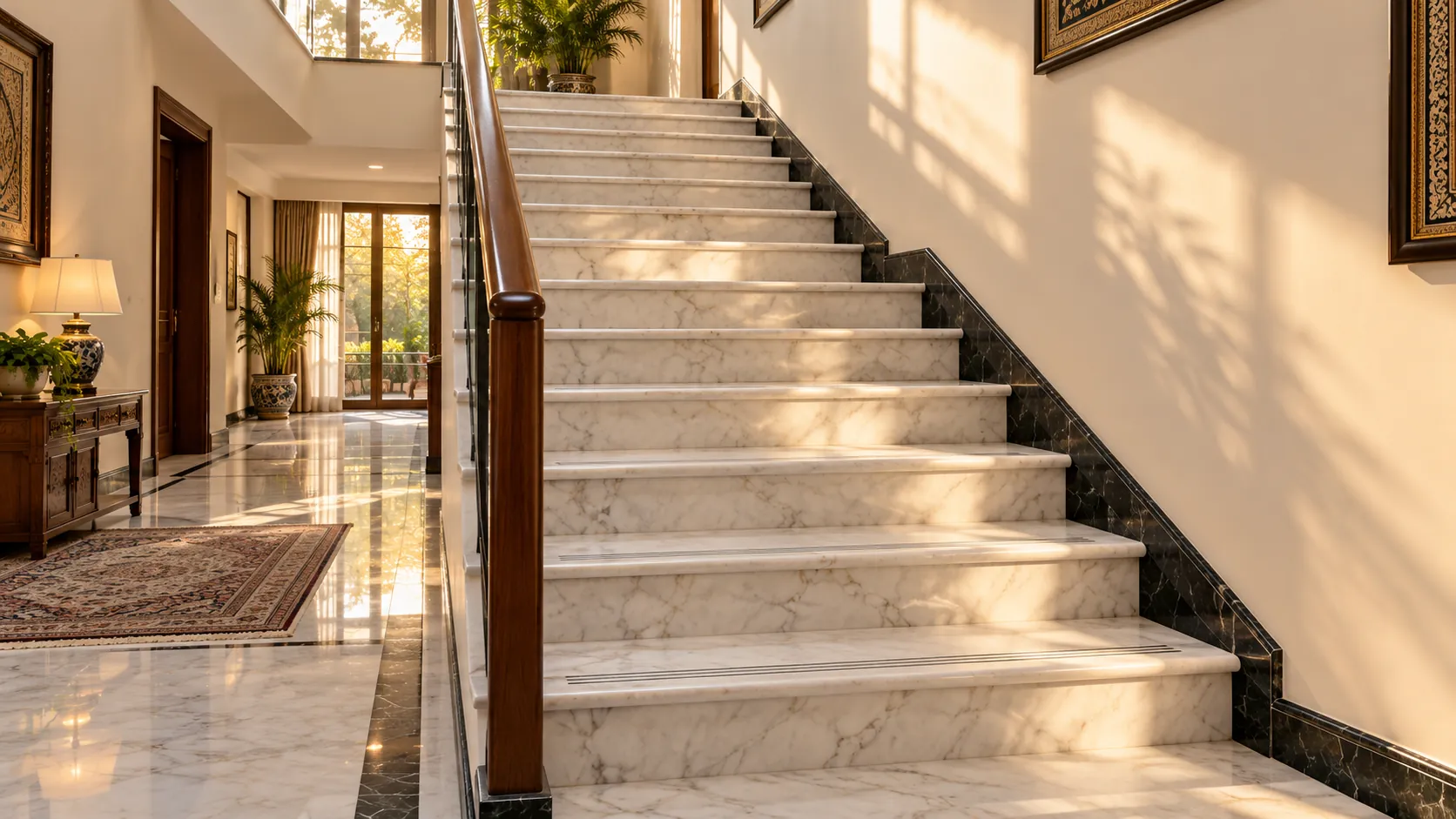
A good stair marble design in Pakistan uses one-piece treads and matching risers cut from one block, a honed tread finish with anti-slip grooves, and a thick, rounded nosing. Indoors, Ziarat White, Sunny Grey or Verona Plain work well; a 4 ft wide step costs about PKR 3,300–10,200 installed at our current quote ranges.
Outdoors, on porch and garage steps, granite is the safer stone. The step figure above (tread plus riser, about 6.4 sq ft, as of November 2026) runs from Tavera Light to Ziarat White; nosing, grooves and stair-specific work are itemised on top. A full flight in a 10 marla house usually needs 150 to 170 sq ft once the landing, skirting and wastage are counted. The rest of this guide explains each choice, shows the arithmetic and lists what to check at the yard so you are not overcharged.
Why stairs are harder on stone than floors
A floor spreads foot traffic over a large area. A staircase concentrates it on a strip about 6 inches deep at the front of every tread, and every footstep pivots and grinds on that strip. That is why stairs dull, chip and lose their polish years before the floor they lead off.
Marble is mostly calcite, which sits at about 3 on the Mohs hardness scale. Sand and dust carried in on shoes contain quartz at 7, so every gritty sole acts like fine sandpaper. In Lahore, Multan or Karachi in the dry months, when a fine film of dust settles on everything by evening, the front edge of an indoor marble stair takes a constant scrub. Granite is a silicate stone at roughly 6 to 7, which is why it shrugs off the same grit.
The second difference is impact. Stairs get knocks from furniture being moved, a gas cylinder dragged up to the roof, a child's cycle bumped down. A thin, sharp nosing is the first thing to chip. The fix is not a harder marble but a better edge: thicker, rounded and supported by the riser below it.
Rule of thumb: choose the stone for colour, then design the edge and finish for wear. A well detailed Sunny Grey stair will outlast a badly detailed Ziarat Supreme one.
Anatomy of a marble staircase
Fitters, contractors and yard staff use a handful of terms. Knowing them makes quotes far easier to compare.
- Tread (paira or step): the horizontal piece you stand on. Normally 10 to 12 inches deep in Pakistani houses, plus the nosing projection.
- Riser: the vertical piece between treads, usually 6 to 7 inches high. Risers take almost no wear, so they can be a cheaper or contrasting stone.
- Nosing: the front edge of the tread, projecting about 3/4 inch to 1 inch past the riser. This is where design, safety and durability meet.
- Landing (platform): the flat area where a flight turns. It is laid like a small floor and often carries a border or inlay.
- Stair skirting: the strip along the wall, either cut in a stepped "zigzag" profile that follows each step or as a straight slanted band.
- Patti (border): a contrasting strip, either inset near the nosing or running along the edge of the landing.
Ask your fitter whether the quote treats each tread as one piece (a single length of slab across the full width) or as tiles joined in the middle. One-piece treads cost more in stone because they need longer slab offcuts, but they look far better and never open a joint underfoot.
Stair marble design ideas for Pakistani homes
These are the layouts we see working, year after year, in Pakistani houses from 5 marla to 2 kanal. Each one is buildable from stones in our range with a normal workshop and a careful fitter.
1. One-piece tread and matching riser
The classic: tread and riser in the same stone, cut from the same block, veins running the same direction. It suits any house and is the easiest to maintain. In white it brightens a dark stair core; in Verona Plain it feels warm and hides dust between cleans.
2. Two-tone: light treads, dark risers
Ziarat White or Medium White treads with Jet Black or black granite risers. The dark risers frame each step, make the edge easier to see in poor light and hide shoe scuffs, which always land on the riser first. It is also a quiet way to save money, because the riser can be a lower grade than the tread.
3. Contrasting anti-slip strip near the nosing
Two or three shallow grooves cut about 1 to 1.5 inches back from the edge, sometimes filled with a contrasting strip of black or brown stone. It reads as a design line rather than a safety feature and gives real grip. A Design Patti border on the landing ties it together.
4. Thick nosing (double nosing)
A second strip of stone is glued under the front edge so a 2cm tread looks 4cm thick from the front. It makes the stair look substantial, protects the edge from chipping and hides the mortar bed. The joint must be colour matched and polished, or it shows as a dark line.
5. Floating (cantilever) steps
Treads that appear to come out of the wall with no riser. The stone is only the finish: the structure is a steel or RCC cantilever designed by an engineer, with the stone bonded on top and wrapped at the front. Use 3cm stone or a laminated edge, and never ask marble to span on its own.
6. LED strip under the nosing
A small recess under each tread with a warm LED strip lights the step below. It is beautiful at night and genuinely safer for elderly parents. Plan the wiring before the risers go in, and keep the driver accessible for load-shedding surges.
7. Inlay or border on the landing
The landing is the one place on a staircase where pattern belongs. A simple border, a corner motif or a small medallion makes the turn feel deliberate. Keep the steps themselves plain, because patterned treads make it hard to judge where the edge is.
8. Curved and spiral stairs
Wedge-shaped treads are cut individually from a template of each step. Expect higher wastage (often 20 to 30 per cent) and a longer workshop time, and choose a stone with soft or no veining so the pattern does not jump around the curve.
If you want to coordinate the stair with the floor it leads off, our guide to marble floor designs in Pakistan covers borders and layouts that carry through to a landing.
Which stone is best for stairs: marble or granite?
Marble is best for indoor stairs and granite for outdoor or heavy-traffic steps. Indoors, almost any of the floor marbles in our flooring and wall tile range can go on a staircase, provided it is not one of the very soft or open-textured stones. Outdoors, on porch steps, garage ramps and roof stairs that take rain and sun, granite is the better choice.
Indoor marbles that work well
- [Ziarat White](/products/ziarat-white) (Ziarat, Balochistan): the default premium white. Bright, takes a good polish, shows dust and scuffs more than a grey.
- Sunny Grey (Ziarat, Balochistan): the practical choice for a busy family stair. The grey ground hides wear and dust.
- Verona Plain (Chaghi, Balochistan): warm beige that pairs with wooden handrails.
- Medium White and Tavera Light: budget options that still look clean. Check for pitting on Tavera before buying.
- Jet Black and Black & Gold (Chaghi, Balochistan): strong risers, skirting and landing borders. On treads, polished black shows every footprint and dust film.
Granite for outdoor and heavy-traffic stairs
Khyber Black Granite from Nowshera and Galaxy Black from Karachi are the usual picks for entrance steps. Granite does not etch with rain or bird droppings, stands up to the grit of a driveway and handles summer heat without fading. Ask for a leathered or honed finish on treads: polished granite is just as slippery as polished marble when wet. Our black granite stairs guide covers granite steps in detail.
Is it really granite? Some "black granite" in the market is black marble or a dyed stone. Three quick yard tests: a steel key drawn across the back should not scratch real granite; a drop of vinegar on an offcut should not fizz or dull it; and a cloth wiped with nail polish remover (acetone) should come away clean, not grey.
When marble is the wrong choice
Marble is not always the right answer, and it is better to hear that before you buy:
- Exposed outdoor steps: rain, sun and grit will dull marble quickly. Use granite.
- Commercial stairs in shops, clinics or plazas: footfall is far higher than a house. Granite or a heavy-duty porcelain will last longer. Our guide to stone for commercial projects covers shops and plazas.
- Very tight budgets: porcelain stair tiles with a matching nosing cost less. They chip at the edge and cannot be re-polished, but they are a fair stopgap.
- Unsound structure: if the concrete steps are cracked or uneven, fix that first. Stone magnifies every flaw underneath it.
For a deeper side-by-side on hardness, staining and price, see our marble vs granite comparison.
Marble or tiles on stairs?
Stone treads outlast porcelain stair tiles on a staircase that has to look good for decades. A 2 cm marble or granite tread runs in one piece across a 4 ft step with a solid, rounded nosing, and a worn tread can be honed and polished again. A tiled step is cheaper to buy and needs no sealing, but it relies on a separate nosing piece, often has a joint across the tread, and a chipped tile edge cannot be repaired. Our marble and tile comparison covers the same trade-off for whole floors.
| Marble | Granite | Porcelain stair tile | |
|---|---|---|---|
| One-piece tread across 4 ft | Yes, cut from a slab | Yes, cut from a slab | Only with a long-format tile; otherwise a joint on the tread |
| Nosing | Solid and rounded, cut from the tread itself (or doubled to read 4 cm) | Solid; eased or half-round | Separate nosing tile or a metal or PVC strip |
| Edge chipping | Chips if thin and square; a rounded nosing resists it | The most chip-resistant of the three | A chipped edge shows the body and cannot be repaired |
| After years of wear | Honed and re-polished on site | Re-polished with heavier machine work | Replace the tile, if a match is still available |
| Grip options | Honed finish plus 2–3 grooves | Leathered or brushed finish plus grooves | Textured or anti-skid tile; check the rating on the box |
| Installed PKR per 4 ft step | About 3,300–10,200 in the common floor stones; up to 12,800 in Jet Black | About 4,200–10,900, Nagar Parkar Grey to Galaxy Black | Not sold by us; get a local quote |
A mixed design is common and sensible: stone treads and nosings, where all the wear happens, with porcelain tile, paint or a cheaper stone on the risers, which take almost no traffic. Keep the riser a shade darker than the tread so each edge reads clearly at night. That keeps the stone budget where it earns its cost.
Stairs marble price in Pakistan: what a step really costs
One 4 ft wide marble step, cut, polished and fitted, costs about PKR 3,300 to PKR 10,200 in the common floor stones at our current quote ranges (November 2026), from Tavera Light to Ziarat White; Jet Black runs up to about PKR 12,800 and Black & Gold more. Our rates are installed prices per square foot; yards quote bare stone per square foot, and stair fitters often quote labour per step or per running foot. To compare, convert everything to a cost per step. The table uses a common step size: 4 ft wide, a 12 inch tread and a 7 inch riser, which is about 6.4 sq ft of finished stone per step.
| Stone | Type and origin | PKR per sq ft | PKR per step (approx.) | Best use on a stair |
|---|---|---|---|---|
| Ziarat White | Marble, Ziarat | 850–1,600 | 5,400–10,200 | Indoor treads and risers |
| Medium White | Marble, Ziarat | 550–950 | 3,500–6,100 | Budget white treads |
| Sunny Grey | Marble, Ziarat | 560–1,000 | 3,600–6,400 | Busy family stairs |
| Verona Plain | Marble, Chaghi | 600–1,100 | 3,800–7,000 | Warm interiors |
| Tavera Light | Marble, Khuzdar | 520–980 | 3,300–6,300 | Budget beige |
| Jet Black | Marble, Chaghi | 1,100–2,000 | 7,000–12,800 | Risers, skirting, borders |
| Black & Gold | Marble, Chaghi | 1,400–2,800 | 9,000–17,900 | Landing feature, risers |
| Khyber Black Granite | Granite, Nowshera | 850–1,600 | 5,400–10,200 | Entrance and outdoor steps |
| Galaxy Black | Granite, Karachi | 900–1,700 | 5,800–10,900 | Entrance steps, landings |
| Nagar Parkar Grey | Granite, Nagar Parkar | 650–1,200 | 4,200–7,700 | Outdoor and roof stairs |
Online rate lists often show stair rates that look far lower. Those are usually yard rates for unselected commercial-grade stock, sometimes thinner, quoted before cutting, nosing, grooves and fitting, so part of the gap with our installed rates is labour. Compare like with like: same grade, same thickness, same scope.
If you buy stone only and hire your own fitter
| Item | How it is usually quoted | Indicative market range |
|---|---|---|
| Cutting, polishing and a simple edge | Per sq ft | PKR 150–400 |
| Bullnose or half-round nosing polish | Per running ft | PKR 100–250 |
| Double nosing (laminated strip) | Per running ft | PKR 250–600 |
| Anti-slip grooves (2–3 lines) | Per running ft | PKR 60–150 |
| Fitting labour, tread and riser | Per step | PKR 700–1,800 |
| Cement, sand or tile adhesive | Per job | Depends on bed and area |
Those figures are indicative market ranges seen in the Punjab trade, not our rate card. They apply only if you buy slab or stone only and hire your own fabricator and fitter; our installed rates already cover cutting, polishing, a standard nosing and fitting, and our quote itemises double nosings, grooves and freight. Market labour rates move with diesel, electricity and wage costs, so ask for each line in writing. Our cost estimator gives a first installed figure for your own sizes.
Working out quantities for a whole staircase
Here is a worked example for a typical 10 marla double-storey house, one flight from ground to first floor with a single landing. The same method for floors is in our guide to working out marble quantities.
- Treads: 17 treads × 4 ft wide × 1 ft deep = 68 sq ft.
- Risers: 18 risers × 4 ft × 0.6 ft = about 43 sq ft.
- Landing: 4 ft × 8 ft = 32 sq ft.
- Skirting: roughly 25 running ft at 4 inches high = about 8 sq ft (more with a stepped zigzag profile).
- Subtotal: about 151 sq ft.
- Wastage: 10 per cent on a straight flight with plain stone, 15 per cent with one-piece treads or veining you want matched. At 10 per cent that is about 165 sq ft. Slab lengths decide how many one-piece treads each slab yields.
At 165 sq ft, the installed staircase comes to about PKR 92,000–165,000 in Sunny Grey, PKR 140,000–264,000 in Ziarat White or Khyber Black Granite, and PKR 99,000–182,000 in Verona Plain, at our current ranges. A second flight to the roof roughly doubles it; many owners use a cheaper grey on the roof flight and keep the premium stone where guests see it.
Measure the real riser heights before ordering. In older houses the first and last risers are often a different height from the rest because the floor levels changed. A fitter who cuts every riser to one size will leave a gap or a lip.
Safety: nosings, finish and grip
Marble stairs are safe when the treads are honed, grooved and given a rounded nosing. Marble on stairs has a reputation for being slippery, and polished marble with wet socks or a damp mop really is. The answer is to design for grip from the start rather than to stick on rubber strips later. Our anti-slip marble guide covers finishes and grooves in more detail.
- Finish: a honed finish on treads gives far better grip than a mirror polish, while risers and skirting can stay polished. Outdoors, choose leathered or brushed granite.
- Grooves: two or three grooves, 4–5 mm wide and about 3 mm deep, cut just behind the nosing. They are almost invisible from a standing position.
- Nosing profile: a bullnose edge or eased half-round is kinder to shins and heels than a square edge, and chips less.
- Consistent risers: every riser in a flight should be the same height to within a few millimetres. A single odd step is the most common cause of trips.
- Visual contrast: a darker riser or strip at the edge helps anyone with weak eyesight judge the step, especially at night during load-shedding.
- Handrail and lighting: neither is stone, but both belong in the plan. Put a light switch at the top and bottom of every flight.
How stairs are fitted, and what to watch on site
Most Pakistani stairs are built as an RCC waist slab with brick or concrete steps on top, then finished in stone. The usual order is risers first, then treads, so each tread sits on top of the riser and its nosing projects past it.
- The fitter checks the concrete steps for level and consistent height and builds up any low step with mortar.
- Risers are fixed with mortar or adhesive, set back so the tread nosing will project evenly.
- Treads are laid on a full bed (a solid cement-sand masala or a thick adhesive bed), back-buttered, and tapped down to level with a slight fall forward so mop water does not pool at the back.
- Each tread is tap-tested. A hollow, "khokla" sound means an air pocket that will crack under a heel. It must be lifted and re-laid there and then.
- Joints are filled with colour-matched grout or epoxy, then the nosings and any grooves are given their final polish.
- The stair is closed for 24 to 48 hours. If it is the only way upstairs, fit alternate steps first and the rest the next day.
Summer heat dries a mortar bed too fast and monsoon humidity slows it down, so good fitters adjust the water and curing. Ragrai (in-situ grinding) is common on floors but awkward on steps, so most stair pieces come from the workshop already polished, with only the edges finished on site. Our step-by-step guide to marble installation in Pakistan covers measuring, transport and fitting day in more detail.
Buying checklist: inspecting stair stone at the yard
Stairs need long, consistent pieces, so inspect the actual lot rather than a display sample.
- Tell the yard the full quantity (treads, risers, landing, skirting) so all of it can come from one block.
- Check slab length: a one-piece 4 ft tread needs offcuts at least 4 ft 2 in long after trimming.
- Wet a corner with water to see the polished colour, and look at it in daylight, not under shed lights.
- Look for hairline cracks, especially ones filled with resin. Avoid them on treads and nosings; they can go on risers.
- Check thickness with a tape at several points. A "2cm" slab that varies from 17 to 22 mm will give an uneven nosing.
- Ask how many treads per running foot of slab they are assuming, and what wastage percentage is in the quote.
- Get the finish (honed or polished), nosing profile, groove count and fitting scope written on the quote.
- Keep two spare treads from the same lot. Replacing a chipped step in five years is easy with a match and almost impossible without one.
The easiest way to compare colours at home, against your handrail and wall paint, is with stone samples before you go to the yard.
Caring for a marble staircase
Stair care is mostly about dust. Sweep or vacuum daily in the dry season, then damp-mop with a pH-neutral cleaner. Keep acid cleaners, toilet cleaners and lemon-based products away from marble: they etch the polish and leave dull patches exactly where people walk.
- Seal treads after fitting and re-test every 6 to 12 months; full instructions are in our guide to sealing marble in Pakistan.
- Put a coir or rubber-backed mat at the bottom of an outdoor flight to catch grit before it reaches the stone.
- Re-polish worn nosings with a professional diamond pad rather than chemical crystallisers, which can leave a slippery film.
- Wipe spills of tea, oil or paan straight away; marble is porous and stains set quickly in heat.
When the treads have dulled across the whole flight, a professional re-polish brings them back; our marble polishing guide explains the process and indicative rates. Stair skirting is covered in our marble skirting guide.
Plan your staircase with us
Whatever stair marble design you settle on, the details decide how it wears. Send us the number of steps, the width, the riser height and a photo of the stair core, and we will suggest two or three stones and a nosing detail that suits your house and budget. Order samples to see the colours in your own light, then request a quote with the full quantity so we can reserve one block for treads, risers, landing and skirting.
Written by
The Captivating Marble Design Team
Fabricators, templaters and stone designers
We template, cut and install natural stone every day and write about what we learn — pricing, layouts, care and the mistakes we help clients avoid.
Book a free design consultation