Marble vs Tiles in Pakistan: An Honest Guide for Floors and Walls
Marble, porcelain, ceramic or chips? Durability, summer coolness, slip, upkeep and 20-year cost for Pakistani homes, room by room. Get a free quote today.
Captivating Marble Design Team · · Updated · 16 min read
Key takeaways
- Natural marble floors cost PKR 450–1,600 per sq ft installed in our current quotes; porcelain material runs about PKR 350–1,000+ and ceramic PKR 120–450 (indicative).
- Marble can be ground and re-polished in place many times; worn or chipped porcelain and ceramic tiles can only be replaced.
- Porcelain absorbs no more than 0.5 per cent water and does not etch; polished marble etches from lemon, vinegar and acid tile cleaners.
- Marble floor tiles are usually 16–20 mm thick, roughly twice a porcelain tile, so they hold summer coolness longer.
- For a 300 sq ft room, good porcelain usually stays cheaper than mid-range marble even over 20 years; marble buys renewability, not a lower total.
The short answer
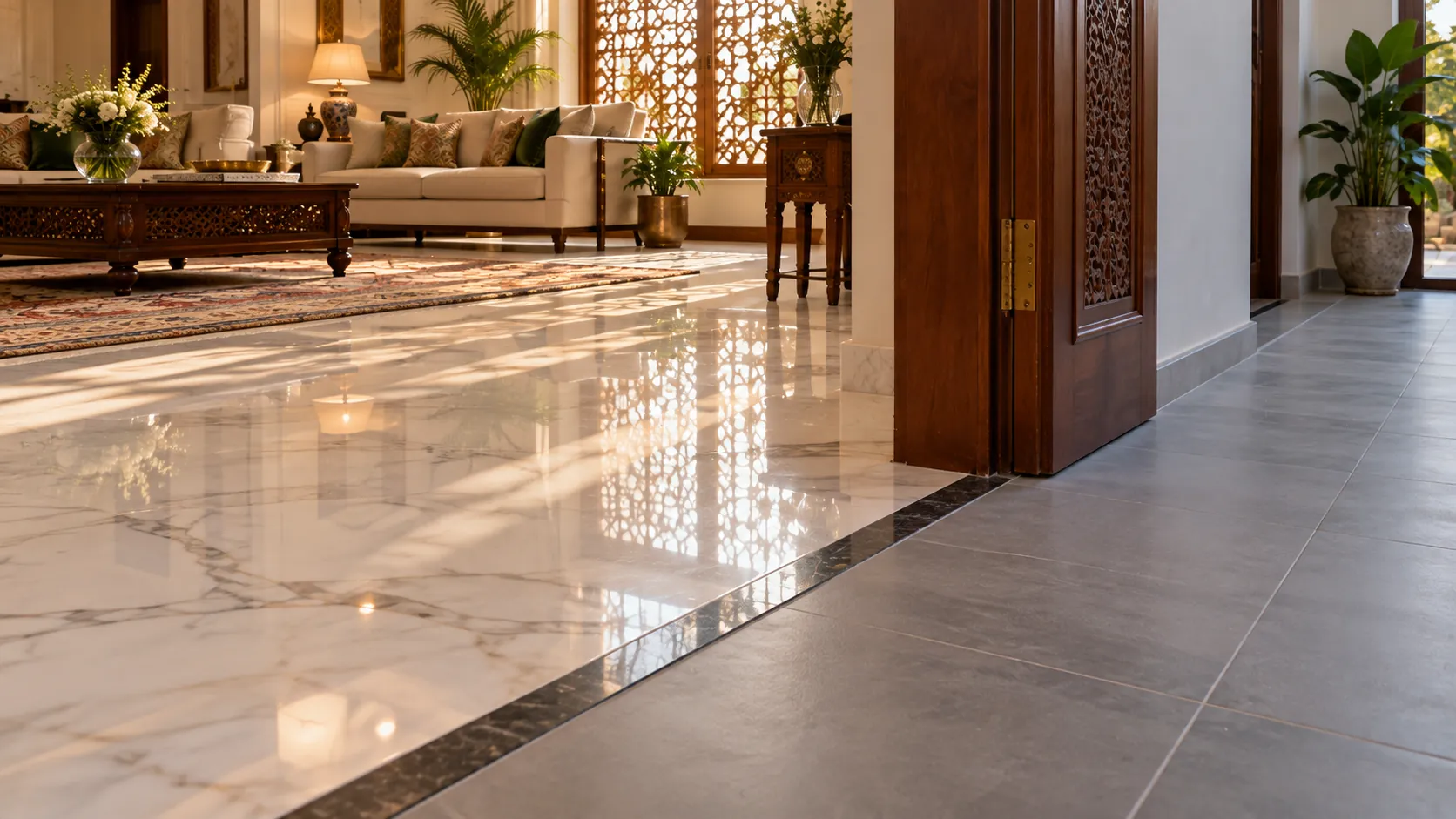
Marble vs tiles in Pakistan comes down to one trade-off: marble (PKR 450–1,600 per sq ft) costs more and needs polishing and sealing every few years, but it can be renewed for decades; porcelain and ceramic cost less and need almost no care, but worn tiles must be replaced. Marble suits drawing rooms and stairs; porcelain suits kitchens, bathrooms and rentals. For marble on its own, see the pros and cons of marble flooring; for seamless resin floors, see epoxy compared with marble.
This guide compares the four floors Pakistani families actually choose between: quarried marble, porcelain tile, ceramic tile and marble chips (terrazzo). It covers durability, how each feels in a Multan June and a Quetta January, slipperiness, maintenance, lifespan, the real cost over twenty years, installation and a room-by-room recommendation. For per-stone rates, sizes and fitting lines, see our separate marble tiles price list; this page is about which material to choose in the first place.
What you are really comparing
Most articles treat "tiles" as one product. They are not, and the differences between them matter as much as the difference from stone.
Natural marble (sang-e-marmar)
A metamorphic rock made mostly of calcite, quarried in blocks in Balochistan (Ziarat, Chaghi, Khuzdar) and Khyber Pakhtunkhwa (Mohmand, Nowshera, Tippi), then sawn into slabs and tiles in yards around Karachi, Lahore, Peshawar and Islamabad. The colour and veining run right through the thickness, usually 16–20 mm for floors. That full-depth body is what allows it to be ground down and polished again years later.
Porcelain tile
Fine clay and feldspar pressed hard and fired at very high temperature until the body is almost glass-like. By international definition porcelain absorbs no more than 0.5 per cent water by weight, which is why it shrugs off stains. In Pakistani shops it is sold as glazed porcelain, polished glazed vitrified tile (often called PGVT or "double glaze"), and full-body or "through-body" porcelain, where the colour runs through the tile. Most marble-look porcelain is glazed: the veining is a printed image on the surface, typically on an 8–10 mm tile.
Ceramic tile
A softer, more porous red or white clay body with a glaze on top, fired at lower temperatures. It is the cheapest hard floor and the standard bathroom wall tile across Pakistan. The glaze is hard but thin; once it chips, the clay body shows through in a different colour.
Marble chips (terrazzo, chips dana)
Crushed marble aggregate set in cement, either poured in place between brass or glass divider strips and ground flat on site, or supplied as pre-cast chips tiles. It is not quarried marble and has no veining, but it behaves like marble in use: it can be ground and polished again, and it etches from acids. Our Chips Dana is the budget stone floor in our range, and the terrazzo and chips flooring guide explains how it is laid and ground.
Side-by-side comparison
The table below summarises how the four options behave on a typical Pakistani floor. Marble and chips costs are our current quote ranges, installed in our service area; porcelain and ceramic are indicative market material rates only, before laying.
| Natural marble | Porcelain tile | Ceramic tile | Chips (terrazzo) | |
|---|---|---|---|---|
| Cost / sq ft | PKR 450–1,600 installed (our quotes) | About PKR 350–1,000+ material (indicative) | About PKR 120–450 material (indicative) | PKR 180–420 installed (our quotes) |
| Typical floor thickness | 16–20 mm | 8–12 mm | 7–9 mm | 16–20 mm tile or poured |
| Scratch resistance | Moderate (calcite, about 3 on Mohs) | High | Glaze high, but chips | Moderate to good |
| Acid (lemon, vinegar, cleaners) | Etches | Unaffected | Glaze unaffected | Etches |
| Stain resistance | Good once sealed | Excellent | Good on glaze; grout stains | Good once sealed |
| Feel underfoot in summer | Coolest, holds coolness longest | Cool | Cool | Cool |
| Can be re-polished | Yes, many times | No | No | Yes |
| Repair a damaged spot | Grind, fill and polish in place | Replace the tile | Replace the tile | Patch, grind and polish |
| Look after 20 years | Renewable to near-new | As laid, minus wear | Often worn or dated | Renewable |
Notice that neither side wins every row. Porcelain beats marble on scratches, acids and stains. Marble beats porcelain on renewal and repair. That is the whole decision in miniature, and the rest of this guide is about which rows matter most in your house.
Durability: scratches, etching, chipping and cracks
Scratches from dust and grit
Pakistani dust is mostly fine sand, and quartz sand is harder than calcite. Walked across a marble floor, it slowly dulls the polish along traffic lanes: the doorway, the path to the kitchen, the area in front of the sofa. Porcelain is far harder and hides this kind of wear much longer. The difference is that a dull marble lane can be brought back by a polisher in a day, while a scuffed glazed porcelain surface stays scuffed.
Etching from acids
Calcite reacts with acid. Lemon juice, vinegar, imli, tomato, many fizzy drinks and almost every "tile cleaner" sold in bazaars leave a dull, slightly rough mark on polished marble called etching. Sealer does not stop it; sealer slows stains, not chemistry. Porcelain and ceramic glazes do not etch at all. This single fact is why we steer people away from polished marble on kitchen floors where food is prepared at floor level, and toward honed finishes where marble is used.
Chipping and cracks
Drop a heavy steel pateela on ceramic and the glaze may chip, exposing the clay body. Porcelain is tougher but, because it is thin and brittle, it can crack if the adhesive bed has hollow spots. Marble is thicker and more forgiving of impact, though it can crack over a void in a mortar bed too. In all four cases the bed matters more than the material: a full, solid bed with no hollows prevents most cracks.
A cracked porcelain tile needs a matching replacement. Tile designs are discontinued every few seasons, so keep at least one full box of spares. Marble needs spares too, from the same lot, because natural stone varies block to block.
Is marble cooler than tiles in summer?
Yes, slightly: a 16–20 mm marble floor has more thermal mass than an 8–10 mm porcelain tile, so it stays cool for longer through a hot afternoon. Ask an older relative why they chose marble and "it stays thanda in summer" is usually the first answer. It is true, with some nuance.
- Summer: all hard floors feel cool to bare feet because they draw heat away from the skin. Stone is denser and roughly twice as thick as a porcelain tile, so it has more thermal mass and stays cool for longer through the afternoon. The difference against porcelain is real but modest; against vinyl, laminate or wood it is large. Our guide to how stone floors behave in summer covers colour, finish and sun.
- Winter: the same property makes marble feel cold in Islamabad, Peshawar, Quetta and the north from December to February. Tiles are cold too. Rugs in bedrooms and lounges solve it in practice; underfloor heating is rare in Pakistani homes but works well under stone if you plan for it.
- Sun-exposed porches and roofs: colour matters more than material. Dark porcelain or black stone in direct sun becomes too hot to walk on barefoot. Light, honed or brushed stone and light matt tiles stay usable.
- Humidity: in Karachi and through the monsoon, polished surfaces of both materials can feel damp and show condensation on very humid days. Honed finishes hide this better.
If coolness is your main reason for choosing marble, a mid-tone stone such as Sunny Grey or a cream such as Tavera Light gives you the thermal benefit without the high-maintenance look of a pure white.
Is marble more slippery than tiles?
Not inherently: slipperiness depends on the finish, so polished marble and high-gloss porcelain are both slippery when wet, while honed marble and matt anti-skid tiles grip well. A mirror-polished floor looks impressive in a drawing room and dangerous in a bathroom. This applies equally to polished marble and to high-gloss PGVT porcelain: both are slippery when wet, and wet floors are common in Pakistani homes, from wudu areas and washing in the verandah to daily pocha (wet mopping).
- Polished finish: fine for dry living areas. Avoid it in bathrooms, wudu spaces, kitchen floors, outdoor steps and anywhere an elderly parent walks at night.
- Honed finish: marble ground to a smooth matt surface. Noticeably better grip, hides scratches and etching, and still easy to clean. A good default for kitchens and stairs.
- Brushed or rough finishes: textured stone for porches, driveways and wet outdoor areas.
- Matt and anti-skid tiles: porcelain is sold with slip ratings for bathrooms and outdoor use. Ask the shop for the rating printed on the box, not just "anti-skid" in conversation.
As a rough indicative guide, many tile importers label bathroom-grade porcelain around R10 on the German ramp test and outdoor or ramp-grade around R11. Natural stone is rarely labelled this way in Pakistan, so judge it by finish: honed or brushed, never polished, for wet areas. Stair edges deserve extra care; the stair marble guide covers anti-slip grooves on nosings.
Maintenance: ragrai, polishing, sealing and grout
This is where the two families differ most, and where many disappointed owners went wrong: they bought marble expecting tile-level upkeep, or tiles expecting a floor that could be renewed.
Living with a marble floor
- Daily: dry-sweep or dust-mop to remove grit, then a damp mop with a pH-neutral cleaner. Plain water is fine most days.
- Never: acid tile cleaners, bleach-heavy phenyl mixes, vinegar or lemon "home remedies". One wash with the wrong cleaner can dull an entire floor.
- Yearly: re-apply an impregnating sealer once the floor has been tested with water drops. The sealing guide explains the test and timing.
- Every few years: light polishing of traffic lanes, or a full ragrai (grinding) and polish when the floor looks tired or uneven. The marble polishing guide compares diamond and chemical polishing and what each costs.
Living with porcelain or ceramic
- Daily: sweep and mop with almost any cleaner. Tiles tolerate acids, so stubborn marks are easy.
- The weak point is grout. Cement grout is porous and darkens in traffic lanes and kitchens. It needs scrubbing, and in bathrooms periodic re-grouting or an epoxy grout from the start.
- No renewal. Worn glaze, scratched gloss and chipped edges cannot be polished back. When the floor looks tired, the choice is to live with it or replace it.
Masons often wash every new floor with acid to remove cement haze, because that is standard on ceramic. On marble or chips it etches the whole surface. Tell your contractor in writing: no acid on stone, ever.
Is marble more expensive than tiles over 20 years?
Usually yes: in the worked example below, a Sunny Grey marble room costs about PKR 234,000–474,000 over twenty years against PKR 142,500–399,000 for porcelain, though marble ends that period freshly polished rather than worn. Comparing only the per-square-foot rate on the day of purchase gives the wrong answer. Here is one 20 × 15 ft room (300 sq ft, with 10 per cent wastage on materials) costed over twenty years. Marble and chips rates are our current quote ranges for Sunny Grey and Chips Dana, which are installed prices covering the bed, laying, grinding and polishing; everything else is an indicative market range to show the shape of the decision, not a quotation.
| Item | Sunny Grey marble | Porcelain | Ceramic | Chips Dana |
|---|---|---|---|---|
| Material, or installed stone at our rates (330 sq ft) | 184,800–330,000 | 115,500–330,000 | 39,600–148,500 | 59,400–138,600 |
| Bed, laying and grout | Included in our rate | 24,000–60,000 | 21,000–54,000 | Included in our rate |
| First grind, polish and seal | Included in our rate | Not needed | Not needed | Included in our rate |
| Day-one total | 184,800–330,000 | 139,500–390,000 | 60,600–202,500 | 59,400–138,600 |
| Upkeep over 20 years | Re-polish and seal ×3: 49,500–144,000 | Grout cleaning, a few spare tiles: 3,000–9,000 | Likely one full re-tile incl. break-out: 66,600–217,500 | Re-polish and seal ×3: 49,500–144,000 |
| 20-year total | 234,300–474,000 | 142,500–399,000 | 127,200–420,000 | 108,900–282,600 |
| Floor at year 20 | Freshly polished, same stone | Original tile, visible wear | Second tile floor, ageing | Freshly polished |
The honest reading: good porcelain is usually cheaper than mid-range marble even over twenty years, and cheap ceramic only looks cheap until it has to be replaced in a busy room. What marble buys is not a lower total; it is a floor that looks new again after every polish, never goes out of production and never needs to be broken out. If you are building a house to live in for decades, that is often worth the difference. If you are building to rent or sell within five years, it often is not.
Run your own rooms and stones through the stone cost estimator, which applies wastage for you.
Lifespan
A well-laid marble or chips floor lasts as long as the building; many older houses in Pakistani cities still have their original chips or marble floors, re-ground several times over the years. Porcelain is long-lived too if the bed is sound, but its surface wears once, permanently. Ceramic in a busy room generally shows wear first, which is why we assume one replacement in the table.
Resale and rental
Pakistani property listings routinely mention "marble flooring" as a selling point, and buyers in the bungalow and kothi market expect it in drawing rooms. We cannot put a rupee figure on that and would not trust anyone who does. For rental flats, landlords generally prefer porcelain: tenants will not seal floors or avoid acid cleaners, and a damaged tile is cheap to swap.
Installation: what changes on site
- Bed: marble is traditionally laid on a sand-cement mortar bed that absorbs an uneven slab, then ground flat. Calibrated stone and porcelain go on tile adhesive over a level screed with thinner joints.
- Weight: a 20 mm marble tile weighs roughly 5 kg per sq ft, a 10 mm porcelain tile about half that, before the bed. On upper storeys and old roofs, the thick mortar bed adds far more than the stone itself, so ask your engineer if the slab is marginal.
- Laying over an old floor: porcelain can often be laid with adhesive straight over a sound old floor, saving demolition, dust and door-height problems. Marble on mortar usually means breaking out the old floor first.
- Finishing: tiles are finished when grouted. Stone needs ragrai and polishing after the bed cures, which adds days, water and machine noise, and needs steady power, so plan around load-shedding with a generator.
- Time: a tiled room can be usable within days. A marble floor laid on mortar, cured, ground and polished typically takes one to two weeks per area, longer in monsoon humidity.
- Skill: a good tile mistri and a good marble mistri are different trades. Ask to see a floor each has finished, and check lippage with a straight edge.
Our stone installation service handles cutting, laying, grinding and polishing as one job, so there is one party responsible for the finished floor.
Room-by-room recommendations
| Area | Best choice | Why | Also fine |
|---|---|---|---|
| Drawing and dining room | Polished marble | Formal look, low wet use, renewable | Large-format porcelain |
| Lounge and TV room | Marble, polished or honed | Cool in summer; traffic lanes re-polish easily | Porcelain, chips |
| Bedrooms | Marble or porcelain | Rugs cover much of it; either works | Ceramic on a budget |
| Kitchen floor | Matt porcelain | Acid spills, oil, dropped utensils | Honed mid-tone marble |
| Bathrooms | Anti-skid porcelain | Wet, soap, acid cleaners | Honed marble with good sealing |
| Bathroom walls | Ceramic or porcelain | Cheap, water-resistant, easy to clean | Marble on a feature wall |
| Stairs | Marble, honed treads | Thick, durable, renewable nosings | Chips, granite |
| Passages and entrances | Mid-tone marble or chips | Hides dust, takes heavy traffic | Full-body porcelain |
| Porch, verandah, driveway | Brushed stone or outdoor porcelain | Grip and heat in sun | Chips, light granite |
| Roof and servant quarters | Chips or ceramic | Lowest cost per sq ft | Gadap stone |
Many families mix: marble through the main rooms and stairs, porcelain in kitchens and bathrooms, chips on the roof. That split puts each material where its strengths matter. For layouts, borders and colour combinations in the marble rooms, see the marble floor design guide.
Walls
On walls the durability argument largely disappears, because nobody walks on them. Ceramic is the sensible bathroom wall, porcelain the practical kitchen backsplash, and marble is chosen for feature walls, TV walls, staircases and dado panels where its depth and veining are the point. Marble on a shower wall works if it is honed, sealed and cleaned only with pH-neutral products.
When tiles genuinely win
We sell stone, and we still recommend tiles in these cases:
- Rental property, where tenants will mop with whatever cleaner is cheapest.
- Kitchen floors in homes that cook heavily, with tomato, lemon and oil on the floor daily.
- Bathrooms and wudu areas where you want zero maintenance and a certified anti-skid surface.
- Renovating over an existing floor where breaking out would mean weeks of dust and raising door frames.
- A very uniform, modern look, such as large grey or concrete-effect slabs with no variation. Natural stone cannot promise that.
- Tight budgets with a deadline: ceramic and value porcelain are faster to lay and need no grinding.
- Upper floors on weak roofs, where the lighter, thinner build-up of adhesive-laid tile helps.
Equally, marble-look porcelain is not marble. It copies the pattern but repeats every few tiles, and it cannot be re-polished. If what you want is the real feel and the ability to renew, buy real stone; if you want the look without the care, buy good porcelain and be happy with it.
How to choose: a decision checklist
- How long will you live there? Ten years or more favours stone. Under five favours tiles.
- Who will clean it? If you cannot control the cleaners used, choose porcelain, or honed marble with written cleaning rules.
- Wet or dry room? Wet rooms lean to anti-skid porcelain; dry living rooms lean to marble.
- Budget for upkeep, not just purchase. Set aside a re-polish every few years for stone.
- Check the subfloor. New construction suits a mortar bed; renovation over a sound floor suits adhesive-laid tile.
- See it wet and in daylight. Ask for marble samples and wet them; ask the tile shop for a full tile, not a cut corner.
- Read the box or the quote. For tiles: porcelain or ceramic, glazed or full-body, slip rating, batch and shade codes. For stone: name, grade, thickness, finish and lot number.
- Order spares. 3–5 per cent extra of either, from the same lot or batch.
If the checklist points to stone, browse our flooring and wall tile range; mid-tones such as Verona Plain and Sunny Grey are the most forgiving with dust and daily life.
Get advice for your own floor
The right answer depends on your rooms, how the house is used and your budget, and there is no shame in a house that is half stone and half tile. Send your plan or room sizes through the free quote form and we will price the rooms where marble makes sense and tell you plainly where tiles would serve you better. To see stone in your own light first, order samples of two or three floor stones (PKR 500 each, credited against your order) and put them next to the tile you are considering.
Whichever way your own marble vs tiles decision goes, the floor will only be as good as the bed under it and the care after it. Get both right and either material will serve you well.
Written by
The Captivating Marble Design Team
Fabricators, templaters and stone designers
We template, cut and install natural stone every day and write about what we learn — pricing, layouts, care and the mistakes we help clients avoid.
Book a free design consultation