Marble Tiles Price in Pakistan 2026: Rates per Sq Ft, Sizes and Fitting Costs
Marble tiles cost PKR 450–1,600 per sq ft laid and polished (Nov 2026): rates for 20 floor stones, sizes, thickness, wastage and a room budget. Get a quote.
Captivating Marble Design Team · · Updated · 13 min read
Key takeaways
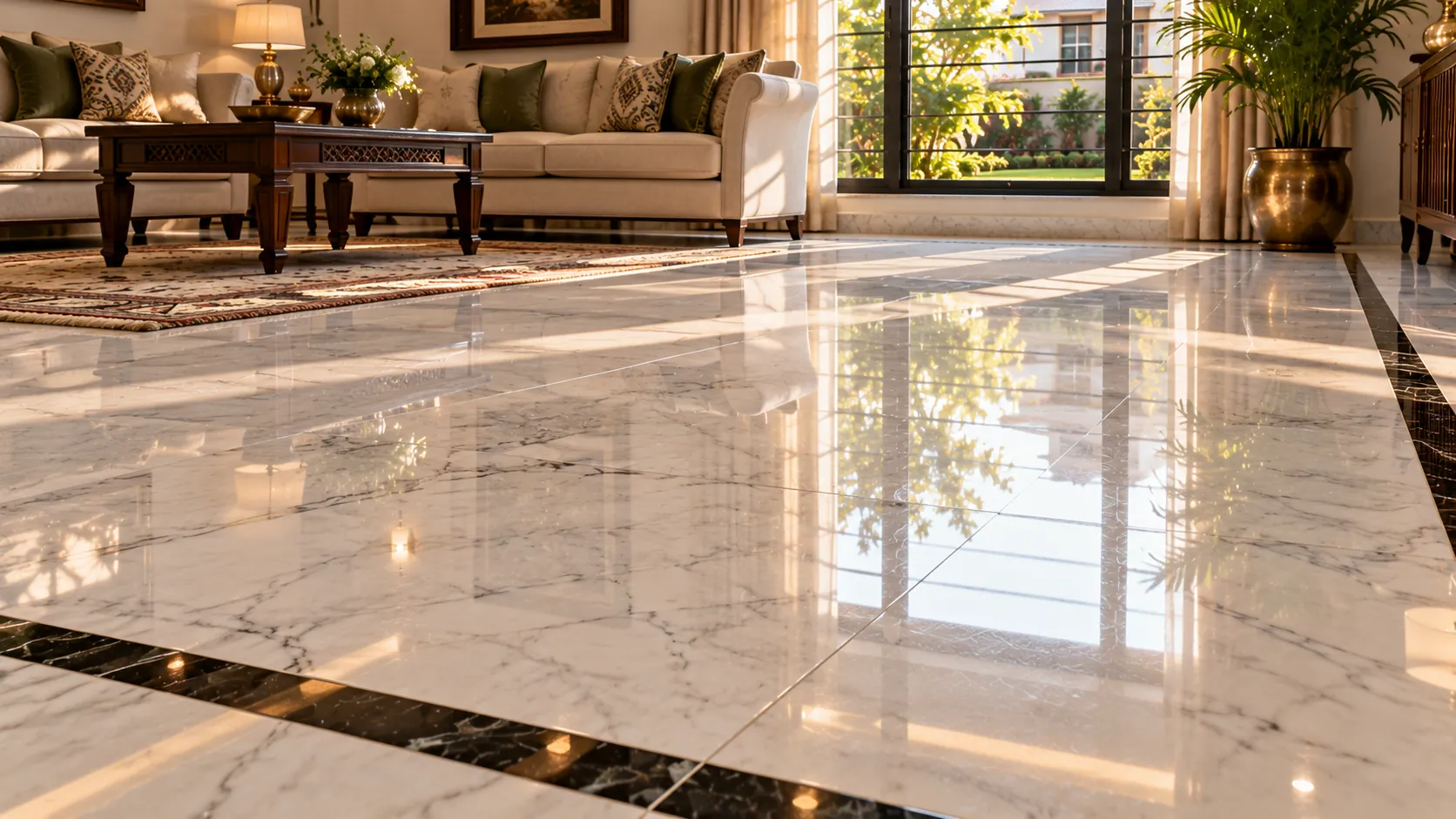
- Marble floor tile costs PKR 450–1,600 per sq ft laid and polished on our November 2026 quotes, from China White and Denso up to Ziarat White.
- Most Pakistani homes choose Tavera Light, Sunny Grey or Verona Plain in the PKR 520–1,100 per sq ft band.
- Chips Dana terrazzo (PKR 180–420) and Gadap limestone (PKR 260–520) are the lowest-cost stone floors we quote.
- Order 10% extra for a straight lay, 15% for diagonal and 20% or more for borders and patterns.
- A 20 × 15 ft room needs about 330 sq ft of tile with 10% wastage, or PKR 184,800–330,000 installed in Sunny Grey.
How much do marble tiles cost per square foot?
The marble tiles price in Pakistan is PKR 450–1,600 per sq ft laid and polished on our November 2026 quotes: from China White and Denso at the value end to Ziarat White at the top. Most homes choose Tavera Light, Sunny Grey or Verona Plain in the PKR 520–1,100 band. Chips Dana terrazzo starts at PKR 180 and Gadap limestone at PKR 260.
The exact figure depends on grade, tile size, thickness and how much cutting and finishing the job needs. Below is every floor-suitable stone we quote, followed by what a "marble tile" actually is in the Pakistani trade, why the same stone can carry three different rates, the full list of costs that sit around the tile, and a worked budget for a real room. If you are comparing marble with porcelain or chips, that comparison is here too.
| Stone | Colour | Origin | PKR / sq ft |
|---|---|---|---|
| Chips Dana (terrazzo) | Multicolour chips | Lahore, Punjab | 180–420 |
| Gadap Stone (limestone) | Beige | Gadap, Karachi, Sindh | 260–520 |
| China White | White | Chiniot, Punjab | 450–800 |
| Denso | Grey | Mohmand, KP | 450–820 |
| Dawezai Basaf | White | Mohmand, KP | 480–880 |
| Pampo White | White | Mohmand, KP | 500–900 |
| Tavera Light | Cream | Khuzdar, Balochistan | 520–980 |
| Medium White | White | Ziarat, Balochistan | 550–950 |
| Sunny Grey | Grey | Ziarat, Balochistan | 560–1,000 |
| New Tavera | Cream | Khuzdar, Balochistan | 580–1,050 |
| Sunny Grey White | Grey-white | Ziarat, Balochistan | 600–1,080 |
| Verona Plain | Beige | Chaghi, Balochistan | 600–1,100 |
| Superline Grey | Grey | Mohmand, KP | 620–1,150 |
| Dawezai Badal Travertine | Grey | Mohmand, KP | 640–1,180 |
| Tropical | Brown | Mohmand, KP | 650–1,200 |
| Tippi Flower | Multicolour | Tippi, KP | 680–1,250 |
| Indus Gold | Gold | Nowshera, KP | 700–1,300 |
| Tiger Verona | Beige | Chaghi, Balochistan | 750–1,350 |
| Ziarat White | White | Ziarat, Balochistan | 850–1,600 |
| Jet Black | Black | Chaghi, Balochistan | 1,100–2,000 |
Jet Black sits above the whole-floor band: it is mostly cut for borders, stair risers and skirting rather than laid across a room. Borders are priced separately: Design Patti at PKR 300–700 and Dighin Border at PKR 320–740 per sq ft. Every stone links through to its page from our flooring and wall tile range, and the wider marble price guide covers slabs, onyx and granite.
How we priced this: the stone rates are our own current quote bands from the product catalogue, as of November 2026, and match each product page. They are installed prices, covering cutting, laying and polishing in our service area. Separate labour, porcelain and yard-tile figures elsewhere on this page are indicative market ranges, labelled as such.
What counts as a marble tile in Pakistan
In the Pakistani trade, "tile" simply means stone cut to a repeatable floor or wall format, as opposed to a full slab (roughly 7 to 9 ft long) sold for kitchen tops and islands. How that tile was cut matters as much as which quarry it came from.
Gang-saw tiles and block-cutter tiles
Large yards saw whole blocks into slabs on a gang saw, a frame of many parallel blades, and then cross-cut those slabs into tiles. The result is consistent thickness and the option of large formats. Smaller units run cut-to-width blocks through a block cutter that produces strips and small tiles directly. Block-cutter tiles are cheaper and perfectly usable, but thickness and squareness vary more, which means more on-site grinding (ragrai) to level the floor afterwards.
Common sizes
- 12 × 12 inch and 12 × 24 inch: the everyday formats for rooms, passages and stairs. Easy to handle, low wastage in small rooms.
- 24 × 24 inch: the popular drawing-room size. Fewer joints, a more expensive look, slightly higher wastage at the walls.
- Cut-to-size and large format (2 × 4 ft and up): cut from slabs for lounges and lobbies. Fewest joints, highest material and handling cost.
- Random lengths (patti): 12-inch-wide strips of random length, a traditional low-cost format laid in running bond.
- Borders and inlays: narrow strips of contrasting stone (patti), plus medallions cut from offcuts.
Thickness
Interior floor and wall tile is usually cut at 16–20 mm, with 25 mm for steps and driveways; our catalogue slabs come in 2 cm and 3 cm. You will also see thin 10–12 mm tile sold cheaply in many markets. It is fine on walls, but on a floor it is more likely to crack over a hollow spot and leaves less stone for future re-grinding. Compare rates only between tiles of the same thickness.
Why does the same stone have three different tile rates?
Grade, size, thickness, finish and what the rate includes explain almost every gap. Ask three yards for Tavera or Ziarat tile and you will get three prices; usually they are quoting different products under the same name, which is why online tile rates look so inconsistent.
- Grade. Yards sort tiles into first selection, second and commercial grade. First selection has even colour and few spots or fissures; commercial grade is what is left.
- Size. Large formats need large defect-free areas of the block, so they cost more per square foot than 12-inch tile from the same stone.
- Thickness and calibration. Calibrated tiles are ground to an even thickness at the factory, lay flat on adhesive and need less site grinding. Uncalibrated tile is cheaper to buy and costlier to level.
- Finish. Factory-polished, honed or brushed. Rough-cut tile meant to be ground and polished after laying is the cheapest to buy, with the polishing cost moved to site.
- What the rate includes. A bare yard rate excludes transport, cutting to room sizes, laying, grinding and polishing. A complete quote includes some or all of them.
Online rate lists often show floor tile from under PKR 100 to around PKR 350 per sq ft. Those are indicative bare yard rates for the cheapest grades and formats, loaded at the gate. They are useful as a floor for negotiation but are not comparable with an installed, polished quotation.
Every cost around the tile
Most families in Pakistan buy a stone floor one of two ways: supply-only from a yard with their own mistri doing the work, or a complete quotation from a supplier who manages cutting, fitting and finishing. Either way, these are the lines that make up the real total. Our quote ranges are complete-job prices that already cover cutting, the bed, laying and polishing in our service area; the labour figures below apply only when you buy supply only and hire your own mistri.
| Line | What it covers | Indicative cost |
|---|---|---|
| Stone | Tiles in your chosen grade, size and thickness | Yard supply rate (our ranges above are installed) |
| Wastage | Cuts at walls, breakage, pattern alignment | 10% straight lay; 15% diagonal; 20%+ patterned |
| Transport and unloading | Truck from yard; carrying upstairs by hand | Per load or per trip, quoted by city |
| Bed: mortar or adhesive | Sand-cement bed or tile adhesive, plus grout | PKR 30–80 / sq ft in materials |
| Laying labour | Mistri and helper, levelling and joints | PKR 60–150 / sq ft |
| Grinding (ragrai) and polishing | Levelling lippage, then polishing on site | PKR 40–120 / sq ft |
| Skirting | 4-inch strips around the room | Per running ft or in sq ft at the tile rate |
| Sealing | Impregnating sealer after polishing | PKR 15–40 / sq ft |
The two lines most often missed are skirting and on-site polishing. Skirting around a 20 × 15 ft room is 70 running feet, about 23 sq ft of extra stone at 4 inches high. Site polishing is unavoidable with rough or uncalibrated tile and still advisable with factory-polished tile after the grout cures.
Ask for each line in writing, with the square footage used. If the quote is a single figure per square foot, ask exactly which of these lines it covers.
Supply only, or a complete job?
Supply only looks cheaper on paper, and it can be, if you already have a mistri you trust and the time to supervise. The risk sits with you: if the tiles arrive short, a shade off or uneven in thickness, the argument is between the yard and the mason while your floor waits. A complete quotation costs more per square foot because it carries that risk, along with cutting, levelling and the final polish. For a single room either route works; for a whole house built to a deadline, one party responsible for stone and finish usually saves money in the end. Our ranges are complete-job prices; supply-only pricing is quoted separately on request.
Transport deserves its own line. Within one city it is usually a flat charge per trip; between cities it depends on the load, the distance and the season. Heavy stone carried up two or three flights of stairs by hand is also charged, so mention it when you ask for a price.
A worked budget for a 20 × 15 ft drawing room
A 20 × 15 ft room is 300 sq ft. Laid straight with 10 per cent wastage you buy 330 sq ft; laid on the diagonal with 15 per cent, about 345. Here is the installed cost for 330 sq ft at our quote ranges. Our room quantity guide shows the method for any room shape.
| Stone | PKR / sq ft | Total for 330 sq ft (PKR) |
|---|---|---|
| Chips Dana | 180–420 | 59,400–138,600 |
| China White | 450–800 | 148,500–264,000 |
| Tavera Light | 520–980 | 171,600–323,400 |
| Sunny Grey | 560–1,000 | 184,800–330,000 |
| Verona Plain | 600–1,100 | 198,000–363,000 |
| Ziarat White | 850–1,600 | 280,500–528,000 |
Add skirting (about 23 sq ft at the same rate) and, if you choose one, a border. A 6-inch Design Patti band set 12 inches in from the walls runs roughly 62 feet, or 31 sq ft, at PKR 300–700. These totals are laid and polished, with freight outside our fitting cities itemised, so check which labour lines any other quote covers before comparing.
To try other rooms or stones, our stone cost estimator applies the wastage and multiplies it out for you.
Marble tiles compared with porcelain, ceramic and chips
Marble is not always the right floor. Here is how it compares with the other common choices, honestly.
| Natural marble tile | Porcelain tile | Ceramic tile | Chips (terrazzo) | |
|---|---|---|---|---|
| Cost / sq ft | PKR 450–1,600 | About PKR 350–1,000+ | About PKR 120–450 | PKR 180–420 |
| Feel in summer | Coolest underfoot | Cool | Cool | Cool |
| Scratch and acid | Scratches and etches | Very resistant | Glaze can chip | Etches; hard-wearing |
| Can be re-polished | Yes, many times | No | No | Yes |
| Repair a damaged piece | Grind and polish, or replace | Replace only | Replace only | Patch and polish |
| Uniform look | Natural variation | Very uniform | Very uniform | Uniform pattern |
| Lifespan with care | Decades | Long | Medium | Decades |
The deciding factor for most Pakistani homes is renewal. A marble floor that looks tired after fifteen years can be ground, polished and sealed to look close to new, while a worn porcelain floor has to be broken out. Against that, porcelain resists acids and stains better and is more uniform, which suits rentals and kitchens where nobody wants to think about maintenance. The full trade-off is in our marble vs tiles guide.
Chips flooring as the budget alternative
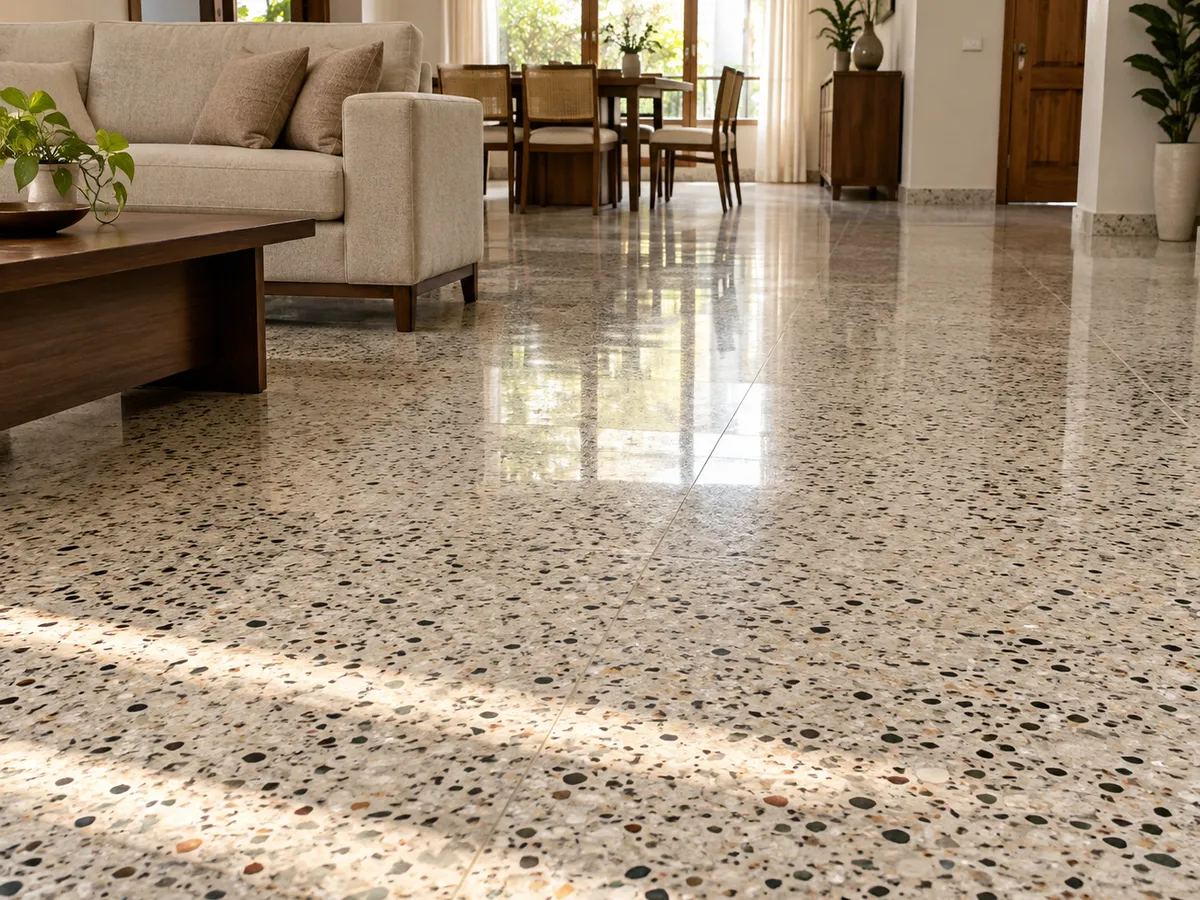
Chips (chips dana) is marble aggregate set in cement, either poured and ground in place or supplied as pre-cast tiles. It is the traditional low-cost option for passages, stairs, roofs and commercial floors, and at PKR 180–420 per sq ft on our quotes it costs a fraction of slab-cut stone. It is not quarried marble, so it lacks veining, but it is hard-wearing and can be re-ground just like marble. See the terrazzo and chips flooring guide for mixes and patterns.
Which marble tile is best for each room?
- Drawing and dining rooms: 24 × 24 inch or larger in Ziarat White, Verona Plain or Sunny Grey White, polished, often with a patti border. This is where it pays to buy first selection.
- Bedrooms and lounges: Tavera Light, Sunny Grey or Medium White in 12 × 24 or 24 × 24. Value grades work well because furniture and rugs cover much of the floor.
- Passages and stairs: hard-wearing, mid-tone stone that hides dust: Sunny Grey, Verona Plain, Tavera or Chips Dana. Use honed treads and a 25 mm thickness; see the stair marble guide for nosing and riser details.
- Kitchens: honed rather than polished, and mid-tones that hide spills. Remember that marble etches from lemon and vinegar, so wipe spills promptly.
- Bathrooms: honed or brushed for grip, with sealed joints. Gadap Stone and travertine need thorough sealing in wet areas.
- Porches, driveways and verandahs: 25 mm honed or brushed stone, light in colour so it stays cooler in sun. Avoid polished finishes and dark stone outside.
For layouts, borders and colour combinations, the marble floor design guide shows the patterns that work in Pakistani homes.
How to measure and order the right quantity
- Measure each room separately and multiply length by width in feet. Add bays, landings and door thresholds individually.
- Add wastage: 10 per cent for a straight lay in a rectangular room, 15 per cent for diagonal or many corners, 20 per cent or more for patterns and borders.
- Add skirting: perimeter in feet × skirting height in feet (4 inches is 0.33 ft), minus door openings.
- Add 3–5 per cent as spares and store them. Natural stone changes block to block, so a matching replacement in five years is not guaranteed.
- Order the whole house at once, from one lot. Ordering room by room means each delivery may come from a different block and a different shade.
We hold a whole floor from one lot and send photographs of the crates before loading. Tell us the full scope up front and we will reserve the spares from the same lot.
A buying checklist for the yard
Take a tape measure, a straight edge or spirit level, and a bottle of water. Go in daylight; tube lights flatter stone.
- Open several crates, not only the top tile. Check that colour and veining are consistent through the lot.
- Lay four tiles together on a flat floor. Corners should meet without steps and edges should be straight; that tells you how much grinding the floor will need.
- Measure thickness at all four corners of a few tiles. Variations of more than a millimetre or two mean an uncalibrated tile.
- Check squareness by measuring both diagonals; they should match.
- Wet a tile. It shows the true colour and any hidden fissures or resin fills. Spots that darken quickly reveal a porous stone that will need careful sealing.
- Look at the reflection of a straight line, such as a door frame, in a polished tile. A wavy reflection means uneven polishing.
- Tap tiles lightly with a knuckle or coin. A dull note can indicate a crack.
- Get it in writing: stone name, grade, size, thickness, finish, square footage and the lot or crate numbers.
If you cannot get to a yard, order samples of two or three stones first and look at them in your own room at different times of day before deciding.
Laying, grinding and sealing a marble tile floor
Fitting quality decides how the floor looks far more than the last fifty rupees on the tile rate.
Mortar bed or adhesive
The traditional Pakistani method lays tiles on a sand-cement bed, which takes up an uneven base and suits uncalibrated tile, followed by grinding to flatten the joints. Calibrated tiles can go down on tile adhesive over a level screed, with thinner joints and much less grinding. Either way, the bed must be full: hollow spots under a tile are where cracks start.
Ragrai and polishing
Once the bed has set, the floor is ground with progressively finer abrasives to remove lippage and then polished. Wait for the bed to cure first; in monsoon humidity this takes longer. Grinding machines need steady power, so plan around load-shedding with a generator or a working schedule agreed with the contractor. The marble polishing guide explains the difference between diamond and chemical polishing and what each should cost.
Sealing and daily care
Seal after the final polish, once the floor is fully dry, and again about once a year. Sweep grit daily, mop with a pH-neutral cleaner and keep acid-based tile cleaners out of the house. Our sealing guide covers the water test and timing for Pakistani heat and dust.
Never wash a new marble floor with the acid cleaners masons use on ceramic tile. One wash can etch the entire polished surface and you will be paying for a second round of polishing.
Get a firm rate for your floor
Every figure here is a starting point. A firm number needs your room sizes, the stone and grade, the format and whether you want supply only or a complete job. Send a floor plan or measurements through the free quote form and we will return a written quotation that states the installed rate and wastage and itemises freight; supply-only pricing is available too.
Considering a dark border or a black feature floor? Our black marble pricing guide explains why dark stone sits in a higher band. We supply marble tiles in Pakistan from our Lahore yard to the cities on our delivery list.
Written by
The Captivating Marble Design Team
Fabricators, templaters and stone designers
We template, cut and install natural stone every day and write about what we learn — pricing, layouts, care and the mistakes we help clients avoid.
Book a free design consultation