Marble vs Wooden Flooring in Pakistan: Heat, Damp, Termites, Upkeep and Cost
Summer heat, monsoon damp, termites, scratches, pocha mopping and lifespan: how stone and timber floors compare in Pakistani homes. Get a free quote.
Captivating Marble Design Team · · 13 min read
Key takeaways
- Marble suits most Pakistani ground floors, kitchens, baths and lounges because water, wet mopping and termites do not harm it.
- Wood feels warmer underfoot because it conducts heat roughly ten times more slowly than stone, which helps in northern winters.
- Solid and engineered wood can be sanded a limited number of times; marble can be ground and re-polished on site again and again.
- Common floor marbles cost PKR 450–1,600 per sq ft installed at our November 2026 quote ranges; wood prices vary widely by board type.
- A practical mix is stone downstairs and in wet rooms, with engineered wood or rugs in upstairs bedrooms, joined at a level threshold.
The short answer
In the marble vs wooden flooring decision, stone is the safer choice for most Pakistani homes: it shrugs off heat, monsoon damp, wet mopping and termites, and it can be re-polished for decades. Wood wins on warmth and softness underfoot, so it makes sense in upstairs bedrooms in colder cities, kept well away from water.
Plenty of families now ask about timber because it looks warm in photographs and feels softer to walk on. That is a fair question, but Pakistani houses put floors through things that European and North American wood floors rarely face: months of heat, a monsoon, ground-floor damp, daily pocha with a wet cloth, dust that acts like sandpaper and, in many areas, termites. This guide compares the two on each of those points, then covers lifespan, cost, which rooms suit which floor, and how to combine them.
How we priced this: stone rates are our current catalogue quote ranges per square foot as of November 2026. They are installed prices in our service area and include cutting, a standard polished finish, fitting and sealing on fitting day. Freight outside our fitting cities, borders and special finishes are itemised on the quote. We do not sell or fit wooden flooring, so we give no wood prices here; get itemised quotes from flooring suppliers.
What counts as a wooden floor?
Before comparing, be clear about which product you are being offered, because shops use the word "wooden" for four quite different things.
| Product | What it is | Can it be refinished? | Water tolerance |
|---|---|---|---|
| Solid hardwood | Planks cut from one piece of timber, usually nailed or glued down | Yes, sanded several times over its life | Low; swells and cups when wet |
| Engineered wood | A real-wood top layer bonded to plywood or another core | Yes, a few times, depending on the top-layer thickness | Better than solid, still low |
| Laminate | A printed photograph of wood on a fibreboard core, under a clear wear layer | No; damaged boards are replaced | Low; the core swells at joints |
| Vinyl or SPC "wood-look" | Plastic or stone-plastic composite planks printed to look like wood | No | High, but it is not wood |
Laminate and vinyl are the cheapest ways to get a wood look, and they are what many "wooden floor" quotes in Pakistan actually contain. They are not natural materials and cannot be renewed; when the wear layer goes, the floor is replaced. Solid and engineered boards are the real comparison with natural stone, so most of this guide is about them.
Side-by-side comparison for Pakistani homes
| Factor | Marble | Solid or engineered wood |
|---|---|---|
| Summer comfort | Feels cool to bare feet; holds coolness in shaded rooms | Feels close to room temperature; no cooling effect |
| Winter comfort | Feels cold in northern cities from December to February | Feels warmer and softer underfoot |
| Water and wet mopping | Unaffected by water; seal light stones | Swells, cups or stains if left wet |
| Termites | Not food for termites | At risk unless treated and kept dry |
| Scratches and dents | Scratched by grit; does not dent | Scratched by grit and dented by heels and furniture |
| Acids (lemon, vinegar, tile acid) | Etched; needs neutral cleaners | Finish damaged by harsh cleaners |
| Renewal | Ground and re-polished on site many times | Sanded a limited number of times; laminate never |
| Sound | Hard and echoing without rugs | Quieter, but hollow-sounding if floating |
| Installed cost | PKR 450–1,600 per sq ft at our ranges | Varies widely; get itemised quotes |
Neither floor is better at everything. The question is which weaknesses your house can live with. In most Pakistani homes, the weaknesses of wood (water, termites, denting) show up in daily life, while the weaknesses of stone (cold in winter, hardness, etching) are easier to manage with rugs, slippers and the right cleaner.
Heat, cold and comfort underfoot
The difference in feel comes from how fast each material pulls heat out of your skin. Stone conducts heat roughly ten times faster than wood, so on a hot afternoon a shaded marble floor draws warmth away from bare feet and feels cool, while a wood floor feels close to the temperature of the room. In a Lahore or Multan June, that is a real advantage for stone.
The same property works the other way in winter. In Islamabad, Peshawar, Quetta and the northern areas, a stone floor feels cold from December to February, and wood feels noticeably kinder. That is the strongest argument for timber in Pakistan, and it applies mainly to bedrooms used in winter. A thick rug, carpet or slippers solves most of it on a stone floor, and underfloor heating works well under stone because the stone spreads the warmth evenly, though it is still uncommon in Pakistani homes.
Our companion guide on how marble floors behave in summer heat and winter cold goes deeper into ground floors, upper storeys, sun-lit rooms and humid cities. For hard floors compared with porcelain and ceramic, see marble vs tiles.
Softness and fatigue
Wood has a little give and stone has none. If someone stands for hours in a room, or you have small children who fall often, wood or a large rug is gentler. On stone, a honed finish is less slippery than a high polish, and Tavera Light honed is noted in our catalogue as a comfortable barefoot floor. Our guide to polished, honed and leathered marble explains how each finish feels and grips.
Damp, monsoon, leaks and termites
Water is where the two floors part company. Marble is laid in a cement-sand bed, and water on its surface does no harm beyond a possible stain on light, absorbent stone if it is not sealed. Wood is a natural sponge: it takes up moisture from the air, from the slab below and from spills, and it swells, cups and gaps as it does.
Ground floors and rising damp
Many Pakistani ground floors sit on a slab that stays slightly damp, especially in older houses, low-lying plots and anywhere the damp-proof course has failed. A wood floor on a damp slab needs a moisture barrier and a slab dry enough for the manufacturer to warrant it, or the boards will cup within a season. Stone tolerates the same slab without complaint.
Monsoon humidity
Through July and August, humidity in Lahore, Sialkot, Karachi and much of Punjab climbs for weeks. Wood floors expand in that weather and shrink again in the dry months, so fitters leave expansion gaps around the walls hidden under skirting. If those gaps are missed, the floor can buckle. Stone moves very little with humidity, although a polished ground floor can show condensation on very humid days, which our floor cleaning guide covers.
Leaks and bathrooms
One burst pipe, an overflowing washing machine or a leaking AC drain can ruin a wood floor in an afternoon. Never put timber in bathrooms, wudu areas, kitchens or laundry rooms. Marble is at home in all of them, with a honed finish for grip.
Termites
Termites (deemak) are common in many Pakistani cities and attack wooden door frames, cupboards and skirting every year. A wooden floor gives them a large, hidden food source. If you choose timber, treat the slab and the walls before fitting, choose treated boards, keep the floor dry and inspect regularly. Stone is not food for termites, which is one less thing to worry about.
Scratches, dents, stains and etching
Dust in Pakistani cities is full of fine sand, and both floors are scratched by it. Marble sits at about 3 on the Mohs hardness scale, so grit dulls the polish along busy routes over time. Wood finishes scratch just as readily, and wood also dents: a dropped steel glass, a stiletto heel or the leg of a heavy sofa can leave a permanent mark.
| What happens | Marble | Wood |
|---|---|---|
| Grit from shoes | Dulls polish on traffic routes; re-polished on site | Scratches the lacquer; sanded and refinished |
| Dropped utensil | May chip an edge; small repairs with resin | Dents the board |
| Dragged furniture | Scratches; felt pads prevent it | Scratches and gouges; felt pads prevent it |
| Lemon, vinegar, imli | Etches a dull spot on polished stone | Usually fine if wiped quickly |
| Oil, haldi, tea | Can stain light stone; poultice lifts most stains | Stains bare or worn finishes |
| Water left standing | No damage; may mark unsealed light stone | Swelling and dark water marks |
| Direct sun through windows | Colour stays stable | Fades or darkens unevenly over time |
Etching is the main weakness of marble: acids eat into polished calcite and leave dull spots that cleaning will not remove. A honed finish hides etching far better than a high polish, and spills in the kitchen and dining area should be wiped promptly. Stains on light stone are prevented by sealing at fitting and once a year after, and most can be drawn out with a poultice. Our guide on how to remove stains from marble covers each stain type.
Cleaning: pocha against dry mopping
Most Pakistani households clean floors with a pocha, a damp cloth pushed by hand or on a stick, often every day. Stone is built for that routine. Wood is not: manufacturers of solid and engineered boards generally tell owners to sweep or vacuum and use only a well-wrung, barely damp mop, never a wet one. If your house help mops with a bucket of water, a wood floor will not last the way the brochure suggests.
- Marble: dust-mop or sweep grit away first, then damp mop with clean water or a pH-neutral cleaner. No acid, no bleach on polished stone, no vinegar.
- Wood: dry-mop or vacuum daily, use the cleaner the board maker specifies, wipe spills at once and keep the floor out of the wet-mopping routine.
- Both: put mats at outside doors, felt pads under furniture and take shoes off indoors where you can. Less grit means fewer scratches on either floor.
Our care guide has a printable routine for stone floors that you can hand to whoever cleans the house.
Lifespan and renewal: ragrai against sanding
Both natural floors can be renewed, but stone has far more to give. A marble floor tile is usually 16–20 mm thick, and machine grinding and re-polishing on site, known as ragrai, removes only a very thin layer each time. That is why marble floors laid decades ago in Pakistani homes are still being re-polished today, and why our marble polishing guide treats re-polishing as routine maintenance rather than repair.
Solid wood can be sanded back and refinished several times before the boards get too thin near the tongue-and-groove joint. Engineered wood can only be sanded as far as its real-wood top layer allows; thin top layers may take one light sanding or none. Laminate and vinyl cannot be renewed at all. Ask any wood supplier for the top-layer thickness in writing and how many sandings they expect it to take.
| Floor | How it is renewed | What limits it |
|---|---|---|
| Marble | Grinding, honing or re-polishing on site | Overall thickness, which is rarely the limit in a home |
| Solid wood | Sanding and new lacquer or oil | Board thickness above the joint |
| Engineered wood | Light sanding and refinishing | Thickness of the real-wood top layer |
| Laminate, vinyl | Replacement of damaged boards | Cannot be refinished |
Chips and cracks in stone are also repairable in place. Our crack and chip repair guide explains resin fills and when a piece should be replaced.
What each floor costs
As of November 2026, the marbles most often used for house floors cost PKR 450–1,600 per sq ft installed at our quote ranges, from China White at the low end to Ziarat White at the top. Calm, mid-priced floor stones such as Sunny Grey and Verona Plain sit at PKR 560–1,100.
| Stone | PKR / sq ft | Room total, PKR |
|---|---|---|
| China White | 450 – 800 | 90,000 – 160,000 |
| Dawezai Basaf | 480 – 880 | 96,000 – 176,000 |
| Tavera Light | 520 – 980 | 104,000 – 196,000 |
| Sunny Grey | 560 – 1,000 | 112,000 – 200,000 |
| Verona Plain | 600 – 1,100 | 120,000 – 220,000 |
| Tropical | 650 – 1,200 | 130,000 – 240,000 |
| Ziarat White | 850 – 1,600 | 170,000 – 320,000 |
Wood flooring prices in Pakistan vary far more than stone, because the product ranges from printed laminate to imported solid hardwood. When you compare quotes, make sure each one includes the same things:
- Board type (solid, engineered or laminate), species, total thickness and real-wood top-layer thickness.
- Underlay and moisture barrier, and whether the slab will be moisture-tested before fitting.
- Skirting, threshold and transition strips, and any levelling of the slab.
- Termite treatment, if any, and who is responsible for it.
- Fitting labour, finish (lacquer or oil) and the written warranty, including what voids it (usually water).
Over the life of a house, the cheaper upfront option is not always the cheaper floor. A laminate floor replaced after water damage, or a solid floor sanded every few years, adds cost that a stone floor re-polished every several years may not. Our house flooring cost guide works out whole-house stone budgets by marla, and the cost estimator prices any of our stones for your own measurements.
Which floor for which room
| Room | Better choice | Why |
|---|---|---|
| Entrance, lounge, drawing room | Marble | Grit, guests, wet mopping; can be re-polished |
| Kitchen | Marble (honed) or granite | Water, oil and dropped utensils |
| Bathrooms and wudu areas | Marble (honed) | Constant water; timber is unsuitable |
| Stairs | Marble or granite | Heavy wear on nosings; easy to clean |
| Ground-floor bedrooms | Marble, with rugs | Slab damp and termites put wood at risk |
| Upstairs bedrooms, colder cities | Engineered wood, or marble with large rugs | Warmth underfoot in winter |
| Study or home office | Either | Low traffic, little water |
| Verandah, porch, roof | Brushed stone or granite | Sun and rain rule out wood |
For lounges and drawing rooms, see our marble floor design guide for patterns, borders and stone choices. For outdoor areas, the outdoor stone flooring guide covers finishes that grip in rain.
Getting a warm, wood-like look in stone
If what you love about timber is its warmth and colour rather than its feel, several Pakistani stones get you most of the way without the water and termite worries.
- [Zebrano](/products/zebrano) (PKR 900–1,650): tight cream and chocolate stripes that our catalogue says read like timber grain from across a room. Run the stripe along the length of a room for a plank-like effect.
- [Tropical](/products/tropical) (PKR 650–1,200): a warm brown with tan drift that sits naturally beside terracotta, cane and unfinished timber, and hides traffic marks in corridors.
- [Dawezai Basaf](/products/dawezai-basaf) (PKR 480–880): a creamy white-beige with soft banding, an easy partner for wooden doors and beige furnishing. Seal it on fitting.
- [Verona Plain](/products/verona-plain) (PKR 600–1,100): a flat honey-beige whose polish gives a warm glow under low lighting.
- Honed finishes: honing takes away the cold glassy look of a high polish and leaves a soft, matte surface that feels warmer to the eye.
Cutting stone into long, narrow planks rather than squares also gives a timber-style layout. Ask for the plank size when you request a quote, because long pieces need a flat slab and careful bedding. You can see every warm-toned stone in our marble range and in the flooring and wall tile section, and order samples to hold against your wooden doors and furniture before you decide.
Combining marble and wood in one house
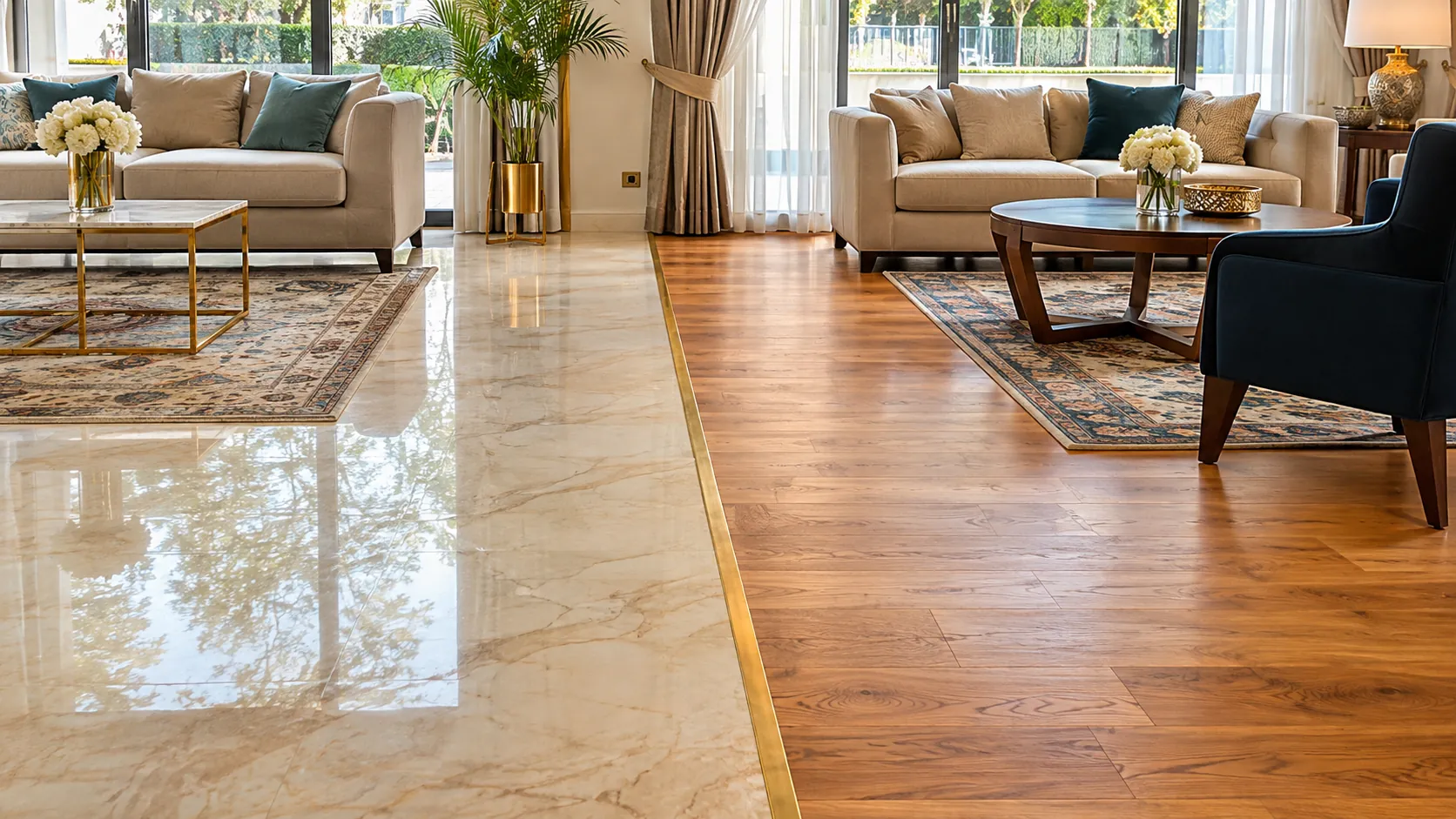
Many families end up with both: stone in the public rooms, kitchen, bathrooms and stairs, and wood or carpet in one or two upstairs bedrooms. That works well if the junction is planned before the floors go down.
- Set the finished levels first. Stone in a mortar bed and wood on underlay have different build-ups. Agree the finished floor level for every room so the two meet flush, without a trip step.
- Put the joint under the door. The neatest change of floor sits on the centre line of the closed door, covered by a threshold strip of brass, stone or wood.
- Lay stone first. Stone is a wet trade with mortar, grinding and polishing slurry. Fit wood last, after plaster, paint and stone polishing are finished and the house has dried out.
- Leave the expansion gap. The wood fitter needs a gap at walls and at the stone threshold, hidden by skirting or a strip.
- Match the skirting. Stone skirting on the stone side and timber skirting on the wood side looks deliberate; see our marble skirting guide.
Our stone installation page explains how our crews set levels, bed the stone and polish it, and our installation process guide walks through each day on site.
How to decide
Ask four questions about each room. Will it get wet, from mopping, bathing, cooking or rain? Is it on a ground floor or an area where termites are known? Will it take grit and heavy traffic? Is it a bedroom used mainly in a cold winter? If the answer to any of the first three is yes, stone is the better floor. If only the last applies, wood or a large rug is reasonable.
For the stone rooms, choose a calm, forgiving marble such as Sunny Grey or Verona Plain if you want a floor that is easy to live with, or a warm stone from the list above if you want the feel of timber. Our types of marble guide introduces every family, and the glossary entry on price per square foot explains what an installed rate includes. Send your room sizes for a free itemised quote.
Written by
The Captivating Marble Design Team
Fabricators, templaters and stone designers
We template, cut and install natural stone every day and write about what we learn — pricing, layouts, care and the mistakes we help clients avoid.
Book a free design consultation