Marble Slabs vs Tiles: Which Format Suits Floors, Walls, Stairs and Counters?
Full slabs or cut tiles? Compare joints, veining, wastage, lippage, grinding, handling and cost for floors, walls, stairs and counters. Get a free quote.
Captivating Marble Design Team · · 13 min read
Key takeaways
- A slab is a full sawn sheet 7 to 9 ft long; a tile is stone cut to a set size, such as 24 x 24 inches.
- Slabs suit kitchen tops, vanities, feature walls and stair treads, where long unbroken pieces and continuous veining matter.
- Tiles suit most floors: they waste less stone, cost less to handle and carry up stairs, and stock sizes load from Lahore in 3 to 5 days.
- A 96 x 60 inch slab at 20 mm weighs about 200 kg, against about 20 kg for a 24 x 24 inch tile of the same thickness.
- Our November 2026 quote ranges are per sq ft fitted in either format; size, grade and wastage decide where a quote lands within the range.
The short answer
Marble slabs vs tiles comes down to joints, wastage and handling. A slab is a full sawn sheet, about 7 to 9 ft long, used for counters, vanities, feature walls and stair treads where veining should run unbroken. Tiles, usually 12 x 12 to 24 x 24 inches, suit most floors: less wastage, easier carrying and quicker supply.
Most Pakistani houses use both: tiles or cut-to-size pieces on the floors, slabs on the kitchen top, the vanities and perhaps one feature wall. The right answer depends on the room, the stone, the stairs the pieces must be carried up and how much you care about joints. This guide defines each format, compares them side by side, works through the cost on a real room and ends with a job-by-job recommendation. If you are weighing natural stone against porcelain or ceramic rather than one stone format against another, read our guide to marble vs ceramic and porcelain instead.
How we priced this: stone rates are our current catalogue quote ranges per square foot as of November 2026. They are fabricated and installed prices in our service area, covering stone, cutting, a standard edge, a standard polish, fitting and sealing on fitting day, in either format. Cut-outs, seams and freight outside our fitting cities are itemised; slab-only rates are quoted separately. Wastage figures are indicative.
What is the difference between a marble slab and a marble tile?
A slab is a full sheet sawn from a block and polished on one face; a tile is stone cut down to a small, repeatable size. Both can come from the same block and carry the same grade, finish and price range; the difference is the size of each piece and therefore how it is cut, moved and laid.
- Slab: a sheet sawn on a gang saw, polished, and stored upright on A-frames in the yard. In our catalogue slabs run from 84 x 54 inches (China White, Denso) to 108 x 66 inches (Ziarat Supreme, Black & Gold, Galaxy Black), in 2 cm and 3 cm thicknesses.
- Tile: stone cut to a standard format, either cross-cut from slabs or produced directly by a block cutter. Our floor and wall tile comes in 12 x 12, 12 x 24 and 24 x 24 inches, at 16–20 mm for interiors and 25 mm for steps and driveways.
- Cut-to-size or large format: pieces cut from slabs to fit a particular room or wall, often 2 x 4 ft or larger. This sits between the two: tile-like handling, slab-like look.
- Strips and borders: narrow patti strips for borders, skirting and inlays, such as our Design Patti.
| Format | Typical size | Thickness | Main uses |
|---|---|---|---|
| Standard tile | 12 x 12, 12 x 24 in | 16–20 mm | Bedrooms, passages, bathrooms, verandahs |
| Large tile | 24 x 24 in | 16–20 mm | Drawing and dining rooms, lounges |
| Cut-to-size, large format | 2 x 4 ft and up | 18–20 mm | Lobbies, open-plan lounges, wall cladding |
| Full slab | 7–9 ft x 4.5–5.5 ft | 2 cm or 3 cm | Kitchen tops, islands, vanities, feature walls, treads |
| Strip or border | 2–6 in wide, random length | 2 cm | Floor borders, skirting, inlays |
Thickness is a separate choice from format, and our marble thickness guide explains which thickness each job needs and what gauging means. The glossary page on 2 cm vs 3 cm gives the short version.
Side-by-side comparison
| Factor | Slabs and large cut-to-size | Tiles (12 to 24 in) |
|---|---|---|
| Look | Continuous veining, few joints; reads as one surface | A grid of joints; veining breaks at every edge |
| Joints | Few seams, planned on a slab layout | Many joints, every 1 or 2 ft |
| Wastage | Higher: offcuts at every wall and opening, more when veins are matched | Lower: about 5–8% on a straight lay |
| Lippage risk | Lower on gauged stone, but a single bow shows across a large piece | Higher with ungauged tile; more edges to align |
| Grinding (ragrai) | Less needed with few joints | Usually needed on mortar-bed floors to flatten joints |
| Handling | Heavy; needs a crew, A-frames and clear access | One or two people can carry a crate up stairs |
| Breakage in transit | Long pieces crack on bad roads unless crated well | Low; a broken tile is cheap to replace |
| Repair | A cracked large piece is costly to match | Swap one tile from your spare stock |
| Supply | Cut to your drawing after measurement | Stock sizes load from Lahore in 3–5 days |
| Where in our range | Towards the upper end: larger defect-free areas, more cutting | Towards the lower end of the same stone's range |
The pattern is consistent: slabs buy you a seamless look at the cost of weight, wastage and care in handling; tiles buy you economy and convenience at the cost of joints.
Which looks better on a floor?
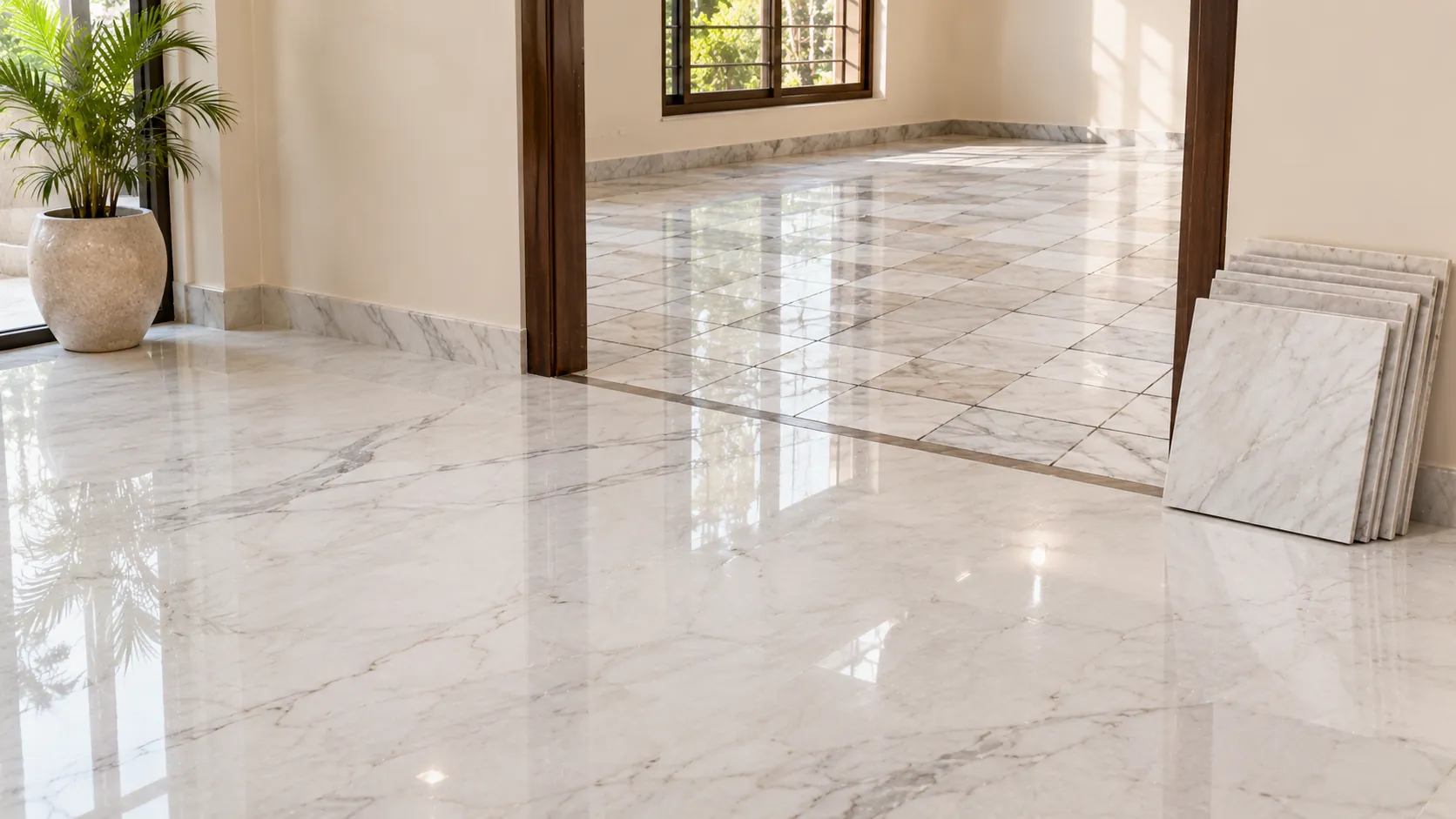
Large pieces look more expensive in a big room, while tiles look perfectly right in bedrooms, passages and anywhere furniture breaks up the floor. The eye reads joints as a pattern. In a 25 ft drawing room, a 12-inch grid becomes busy; 24-inch tiles or 2 x 4 ft cut-to-size pieces calm it down. In a 12 x 12 ft bedroom with a bed, wardrobe and rug, the joints barely register.
Veining and movement
Plain or softly clouded stones such as Verona Plain and Tavera Light look much the same in either format, because there is little veining to break. Strongly veined stones are different: Tiger Verona, Black & Gold or Zebrano cut into 12-inch tiles can look chopped up, with veins stopping and starting at every joint. Those stones show their character in large pieces laid in sequence, where the veins flow from one piece to the next or are book-matched as mirror pairs.
Joints and grout
On a traditional Pakistani floor, joints are kept tight and filled with colour-matched grout or polishing slurry, then ground and polished so they nearly disappear. Done well, even a 24-inch tile floor reads as one sheet from standing height. Done badly, with wide grey joints and lippage, every joint shows. So joint quality matters as much as tile size, and a well-laid tile floor beats a badly laid slab floor every time.
For layout ideas, such as borders, diagonal lays and medallions, see our marble floor design guide.
Wastage, lippage and grinding
These three practical issues decide more of the final cost and finish than the format itself.
Wastage
Wastage is stone you pay for that ends up as offcuts. With tiles on a straight lay, cuts happen only at the walls, and about 5–8% is normal. Diagonal and bordered layouts push that to 10–15%. Large cut-to-size pieces waste more, because each piece is cut from a slab to a specific size and the remainder of that slab may be too small to use elsewhere in the house. Matching veins across pieces wastes more again, since the cutter must choose which part of each slab to use.
As an indicative range, cut-to-size floors from slabs run at about 10–20% wastage, depending on room shape and how many pieces can be nested on each slab. A good workshop reduces this by planning skirting, sills and stair risers from the offcuts.
Lippage
Lippage is a step between the edges of two neighbouring pieces. Tiles have more edges, so more chances of lippage, especially if they are ungauged and vary by a few millimetres in thickness. A single large piece has fewer edges, but if it is bowed, the whole piece rocks or sounds hollow, and the step at its edge is longer. Gauged stone, a flat screed and a full bed under every piece prevent most of it in either format.
Grinding and polishing on site
Most marble floors laid on a sand-cement bed are ground flat after laying, the process the trade calls ragrai, and then polished. That evens out lippage and closes joints, and it is how a tile floor achieves its one-sheet look. It also means the factory polish on a tile does not survive: the floor is re-polished on site anyway. Cut-to-size pieces on adhesive over a level screed need much less grinding. Our marble polishing guide covers what the process involves and how often a floor needs it.
Does a slab floor cost more than a tile floor?
Usually yes, by a modest amount: large pieces need bigger defect-free areas of the block, more cutting and more wastage, so a quote for the same stone lands higher in its range. The stone, the grade and the thickness still move the price more than the format does.
| Stone | PKR / sq ft | Notes |
|---|---|---|
| Tavera Light | 520 – 980 | Value cream floor for a whole house |
| Sunny Grey | 560 – 1,000 | Soft grey; hides dust and footprints |
| Verona Plain | 600 – 1,100 | Warm beige for drawing and dining rooms |
| Dawezai Badal Travertine | 640 – 1,180 | Mostly supplied as 12 x 24 tile; vein-cut slabs at the top of the range |
| Ziarat White | 850 – 1,600 | Large, consistent blocks; fewer seams on long runs |
Worked example: a 20 x 15 ft drawing room
The room is 300 sq ft. To show the effect of wastage alone, both columns below use the same rate range for Verona Plain; in practice a large-format quote would also sit nearer the top of the range.
| Item | 24 x 24 in tiles, straight lay | Cut-to-size from slabs |
|---|---|---|
| Wastage allowance | 7% | 15% |
| Stone to order | 321 sq ft | 345 sq ft |
| Installed cost | PKR 192,600 – 353,100 | PKR 207,000 – 379,500 |
| Difference from wastage alone | - | About PKR 14,400 – 26,400 more |
Skirting, a border and the stairs come on top in both cases. Our whole-house flooring cost guide works these out for 5, 7 and 10 marla houses, and the stone cost estimator gives an installed figure for any stone once you know the area. For tile rates by stone, size and thickness, and why one stone can carry three different rates, see our guide to tile rates per square foot.
Handling in Pakistani houses
Weight and access decide more jobs than buyers expect. Stone weighs about 5 kg per sq ft at 20 mm, so a single 96 x 60 inch slab (40 sq ft) weighs about 200 kg, while a 24 x 24 inch tile (4 sq ft) weighs about 20 kg.
| Piece | Area | Weight | Who can carry it |
|---|---|---|---|
| 12 x 12 in tile | 1 sq ft | about 5 kg | One person, several at a time |
| 24 x 24 in tile | 4 sq ft | about 20 kg | One person |
| 2 x 4 ft cut-to-size | 8 sq ft | about 40 kg | Two people |
| Kitchen top run, 10 ft x 2 ft | 20 sq ft | about 100 kg | Three or four people, kept on edge |
| 96 x 60 in slab | 40 sq ft | about 200 kg | A crew with a trolley or A-frame |
- Narrow streets. In older parts of Lahore, Rawalpindi and Karachi, a truck may not reach the door, so every piece is carried from the main road. Tiles in crates travel easily; a full slab may need cutting before it can be carried in.
- Stairs and flats. Every piece for an upper floor is carried up by hand. A 4 ft piece has to turn on a landing, so measure stairwells and lift doors before ordering large format for a first or second floor.
- Breakage. Long, thin pieces crack when carried flat or knocked on a door frame. Slabs travel on edge, and the longer the piece the more careful the crew must be.
- Summer and monsoon. Adhesive and mortar dry fast in June heat, which makes large pieces harder to bed fully; work early in the day. In the monsoon, keep crates covered so stone does not sit wet and stain from below.
In Lahore, Islamabad and Rawalpindi our own crew measures and fits. Elsewhere we crate slabs or finished pieces on A-frames and send them by road, with freight itemised on the quote.
Which format for each job?
Floors mostly suit tiles or cut-to-size pieces; counters, vanities and treads need slab. Walls can go either way.
| Job | Best format | Why |
|---|---|---|
| Bedrooms, passages, upper floors | Tile, 12 x 24 or 24 x 24 in | Low wastage, easy carrying; furniture hides joints |
| Drawing room, lounge, lobby | 24 x 24 in tile or cut-to-size | Fewer joints in a large open floor |
| Bathroom floor | Tile, honed | Joints and a honed finish improve grip; easy to fall to the drain |
| Shower and bathroom walls | Large cut-to-size panels or slab | Fewer grout lines to clean and stain |
| Feature or TV wall | Slab, sequential or book-matched | The veining is the design |
| Kitchen top and island | Slab | Joints over cabinets crack and collect dirt; tiles are not suitable |
| Vanity top | Slab | One piece around the basin cut-out |
| Stair treads and risers | Slab cut to tread size | A tread should be a single piece across its width |
| Verandah, courtyard, porch | Tile, honed or brushed | Grip, easy replacement, movement joints |
| Skirting, sills, borders | Strips cut from slab or offcuts | Uses offcuts from the floor lot |
Kitchens and vanities
This is the one place where there is no real choice. A kitchen top made of tiles has a joint every foot, and each joint collects oil and haldi, cracks over the cabinet frame and breaks the edge. Kitchen and vanity tops are cut from full slabs, with any seam placed away from the sink and hob on a slab layout agreed before cutting. Our kitchen countertops page and kitchen marble design guide cover stones and edges.
Stairs
Each tread should be one piece across its width, which in practice means cutting treads from slabs or from large tiles at least as long as the step. Two short tiles on one tread leave a joint that is stepped on hundreds of times a day. Our stair marble design guide covers tread and riser sizes, nosings and grip.
Walls and cladding
Interior walls can take either format. Large panels give a clean, hotel look with few joints; tiles are lighter and easier to fix without mechanical clamps. Exterior and high-level cladding needs mechanical fixing whatever the size. Our guide to stone wall cladding explains fixings, and our shower walls page covers wet areas.
When does each format make sense?
Choose slabs or large cut-to-size pieces when:
- The surface is a counter, vanity, tread, sill or feature wall.
- The stone is strongly veined and you want the veins to flow.
- The room is large and open, and joints would read as a busy grid.
- Access is good: a ground floor, a wide gate, a lift or a straight staircase.
- The budget allows for higher wastage and careful handling.
Choose tiles when:
- The surface is a floor in a bedroom, passage, bathroom or verandah.
- The stone is plain or softly clouded, so joints hide easily.
- Pieces must be carried up narrow stairs or through a narrow gali.
- You want spares on hand for future repairs.
- Speed matters: stock sizes can load from Lahore in days.
Whatever the format, order the whole quantity from one lot. Tiles and slabs from different blocks can differ in tone, and the difference is most visible where a tile floor meets a slab threshold or stair. Our guide to marble grades and quality checks explains how to inspect a lot before you pay.
Get a format recommendation for your house
Send us your plan with room sizes, the floor level of each room and a note on stair and gate widths, and we will suggest a format for each area and quote it in one place, from the flooring and wall tile range to slab counters. Order samples of the stones you are considering, then request a free written quote that states the format, thickness, finish and lot for every line.
Written by
The Captivating Marble Design Team
Fabricators, templaters and stone designers
We template, cut and install natural stone every day and write about what we learn — pricing, layouts, care and the mistakes we help clients avoid.
Book a free design consultation