Kitchen Marble Design in Pakistan: Slabs, Prices and Ideas
Marble kitchen tops for desi cooking: which slab to pick, PKR per sq ft and per running foot, layout sizes and care that works. Plan your kitchen with us.
Captivating Marble Design Team · · Updated · 15 min read
Key takeaways
- Ziarat White kitchen tops cost PKR 850–1,600 per sq ft and Verona Plain PKR 600–1,100 at our November 2026 quote ranges.
- A typical 10 ft + 8 ft L-shaped kitchen needs about 44 sq ft of stone, including a 4 inch upstand and 15% wastage.
- One running foot of counter at 2 ft depth equals 2 sq ft of stone, so per-running-foot rates are roughly double.
- Marble (Mohs 3–4) etches with lemon and imli; a honed finish hides etch marks and a yearly seal slows oil and haldi stains.
- Heavy daily frying suits black granite on the working run, with marble kept for the island or backsplash.
Which marble is best for a Pakistani kitchen?
The best kitchen marble design in Pakistan uses a dense, light stone such as Ziarat White (PKR 850–1,600 per sq ft) or Verona Plain (PKR 600–1,100), honed rather than mirror-polished and sealed every year. If you fry daily or cook outdoors, put black granite on the working run and keep marble for the island or backsplash.
A honed finish matters because lemon and tomato marks barely show on it, and a yearly seal gives you time to wipe oil and haldi. At our current quote ranges (November 2026), a typical L-shaped kitchen (about 44 sq ft including a small upstand and wastage) comes to roughly PKR 26,000 to PKR 92,000 fabricated and fitted, depending on the slab you choose. Sink and hob cut-outs, seams and freight outside our fitting cities are itemised separately. This guide covers how each stone behaves, the layouts that work, how rates are quoted per square foot and per running foot, and a checklist for the yard.
What desi cooking does to a marble top
Most marble-in-the-kitchen advice is written for European kitchens. A Pakistani kitchen is harder on stone: daily tarka in hot oil, haldi and chilli, lemon squeezed over salad, imli and tomato chutneys, a heavy patila slid across the counter, and hard water drying on the sink edge. Understanding what is actually happening helps you choose and care for the stone.
Etching (acid)
Marble is calcite (calcium carbonate). Acids such as lemon, vinegar, imli, tomato, cola and many bathroom cleaners react with it and dissolve a thin layer of the polish, leaving a dull, slightly rough patch. That is etching, and sealer does not prevent it: sealer slows stains, not acid. On a honed finish an etch mark is hard to see; on a mirror polish it shows from across the room.
Staining (oil and haldi)
Marble is porous, so oil and turmeric can soak in and leave a dark or yellow patch. A good penetrating sealer gives you time to wipe up. Haldi on a white stone often fades with sunlight and a poultice, but oil stains need a proper poultice to draw them out.
Heat, scratches and impact
Marble tolerates a warm pan far better than laminate or acrylic, but a pressure cooker or tawa straight off a high flame can cause a heat mark or, rarely, a crack in a thin section near a cut-out. At about 3 on the Mohs scale it scratches with sand, steel pot bases and ceramic rings. Granite, at about 6 to 7, does not. A dropped cast-iron karahi can chip a marble edge, which is why a rounded edge profile is worth the small extra cost.
The honest trade-off: marble in a kitchen will collect a gentle patina of etch marks over the years. Many owners like that lived-in look. If you want a counter that looks the same in ten years as on day one, choose granite for the working runs.
Kitchen marble design ideas for Pakistani homes
These layouts suit the way Pakistani families cook and entertain, from a compact 5 marla kitchen to a 1 kanal house with a separate cooking area. For ventilation and the wider room plan, see our kitchen design guide.
1. White top, warm wood cabinets
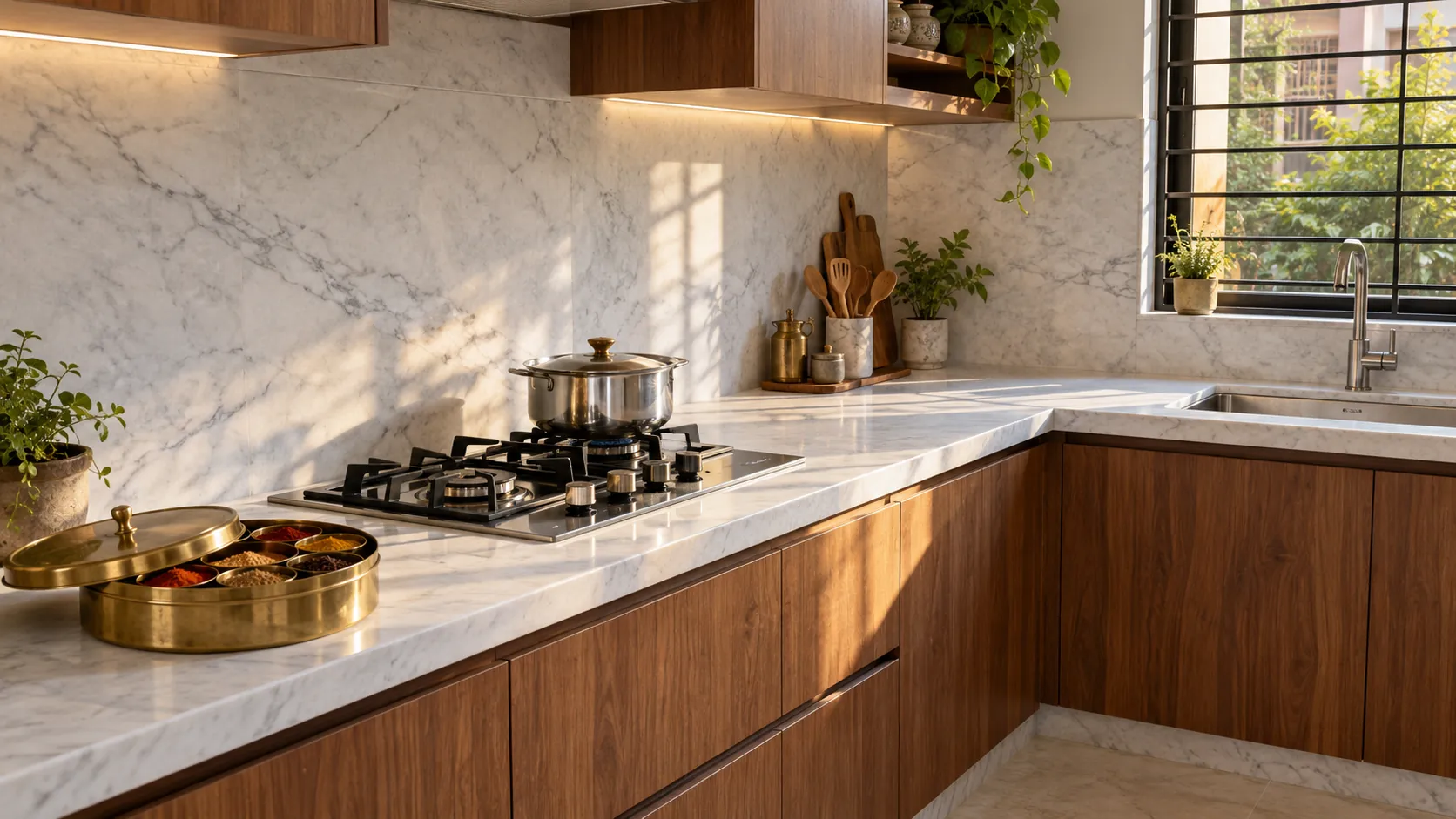
Ziarat White or Ziarat Supreme on the counters with walnut or oak-finish cabinets. It is the most requested look, it brightens a kitchen with one small window, and a honed finish keeps it practical.
2. Quiet cream: Perlino or Verona with handleless cabinets
Perlino Crystal Plain and Verona Plain have soft, even grounds that hide crumbs and haldi between cleans. Paired with matt beige or grey handleless shutters, the kitchen feels calm and expensive without looking busy.
3. Full-height marble backsplash
Instead of tiles behind the hob, the counter stone runs up to the wall cabinets, ideally cut from the same block. No grout lines means nothing to trap tarka splatter. Use a slightly lower-grade piece of the same stone if budget is tight, since the splash takes almost no wear. Our backsplash guide covers backsplash heights, joints and sockets.
4. Marble island, granite working run
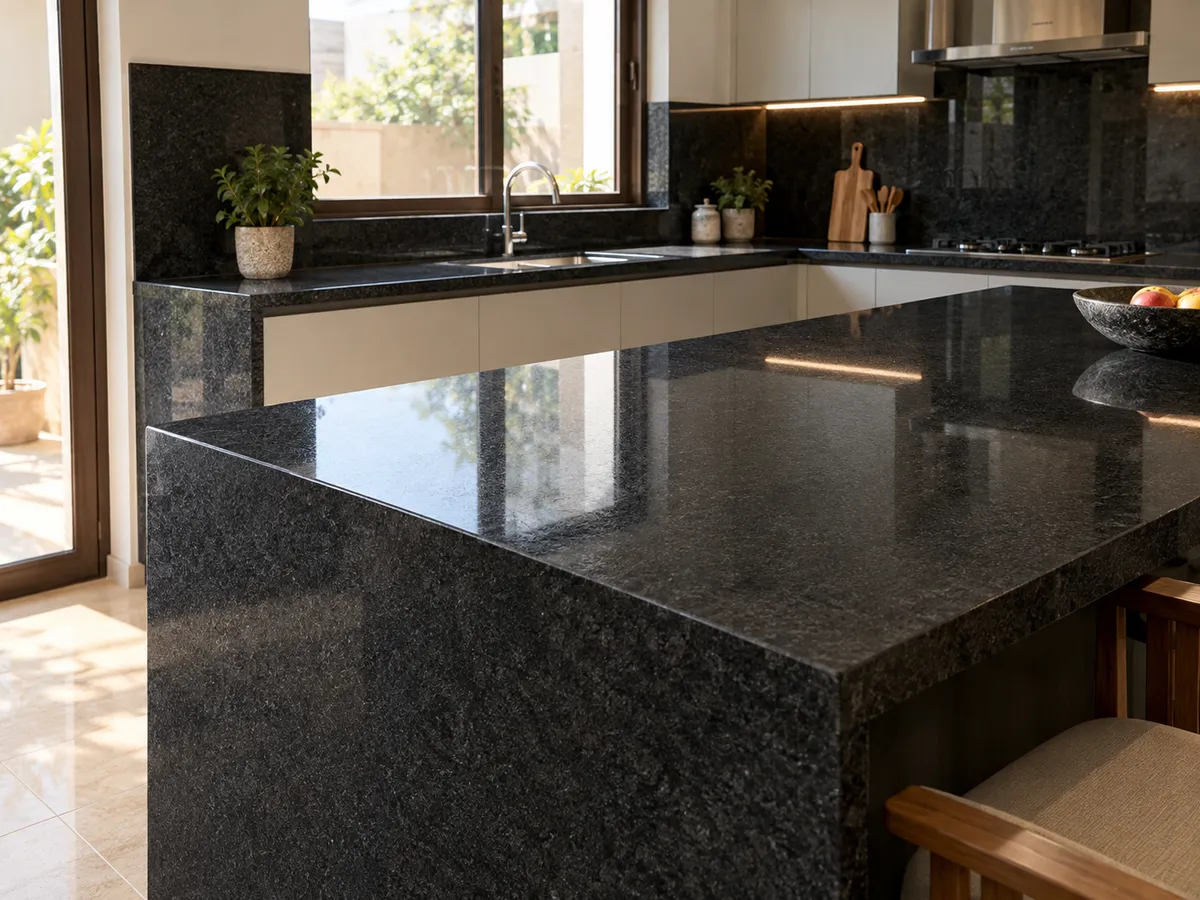
The most practical split for heavy cooks: black granite along the hob and sink wall, where the oil and acid are, and a showpiece marble island for serving, homework and chai. Our waterfall island guide explains how the folded end is cut and what it adds to the quote.
5. Dramatic black: Jet Black or Black & Gold
A black marble island or a Black & Gold splash makes a strong statement against white cabinets. Be aware that polished black marble shows every water spot, fingerprint and etch mark, so it is better on an island or splash than on the sink run.
6. Thick-edge look on a 2cm slab
A strip glued under the front edge (a laminated edge) makes a 2cm counter read as 4cm. It looks substantial, protects the edge and costs less than a full 3cm slab across the whole kitchen.
7. Marble shelves and a breakfast ledge
Open marble shelves for masala jars, a pantry shelf, or a narrow breakfast ledge are a good use of offcuts from the main job. They match exactly and cost far less than ordering new stone later.
Whichever kitchen marble design you choose, keep pattern for the island or splash and choose a calmer stone for the working counter. Busy veining on a working run hides spills, which sounds useful until a stain has had a day to set.
How do you choose a kitchen marble slab?
Choose a dense, tight-grained slab in 2cm or 3cm, with a honed finish and an eased edge, cut from one block for the whole kitchen. Not every marble that looks good in a showroom belongs on a worktop. Stick to the denser, tighter-grained stones in our kitchen countertops range and avoid the very open, pitted or heavily resin-filled ones.
Colour and pattern
- Whites (Ziarat White, Ziarat Supreme, Perlino Crystal Plain): brightest look; etch marks are least visible on honed white. See how Perlino compares with Botticino if you want a warmer white.
- Beiges (Verona Plain, New Tavera): warm and forgiving; good with wooden cabinets and brass fittings.
- Greys (Superline Grey): linear grey veining; hides everyday marks well.
- Blacks (Jet Black, Black & Gold): dramatic; best on islands and splashes rather than the sink run.
Still deciding between the two most popular choices? We compared them in detail in Ziarat White or Verona Plain for kitchens. If a black kitchen is the plan, our black marble kitchen guide covers what shows on dark stone.
Thickness: 2cm or 3cm
Most Pakistani kitchens use 2cm marble fully supported on a masonry or plywood base, often with a laminated front edge. 3cm is stiffer and better for islands with an overhang, long spans between supports and areas around large sink cut-outs. 3cm stone costs more and weighs about 50 per cent more, so check the cabinet base can carry it.
Finish
Choose honed for the working counters: it hides etching and gives a soft satin look. Keep polished for islands and splashes if you want shine. A honed finish is slightly more open, so seal it well.
Edge profile
An eased or half-bullnose edge is the most practical: it chips less than a sharp square edge and is kinder to hips and children's heads. Ogee and other decorative profiles look traditional but trap grease in the grooves.
Kitchen marble price in Pakistan per sq ft and per running foot
Yards price stone per square foot of finished surface. Many fitters and kitchen companies quote counters per running foot, which usually means one foot of length at standard counter depth. At a 2 ft depth, one running foot is 2 sq ft of stone, so a per-running-foot rate is roughly double the per-sq-ft rate. Always ask which unit a quote is in.
| Stone | Type and origin | PKR per sq ft | PKR per running ft at 2 ft depth | Best kitchen use |
|---|---|---|---|---|
| Ziarat White | Marble, Ziarat | 850–1,600 | 1,700–3,200 | Counters, islands, splashes |
| Ziarat Supreme | Marble, Ziarat | 1,100–2,100 | 2,200–4,200 | Premium counters and islands |
| Perlino Crystal Plain | Marble, Chaghi | 900–1,700 | 1,800–3,400 | Calm cream counters |
| Verona Plain | Marble, Chaghi | 600–1,100 | 1,200–2,200 | Warm counters on a budget |
| New Tavera | Marble, Khuzdar | 580–1,050 | 1,160–2,100 | Budget beige counters |
| Superline Grey | Marble, Mohmand | 620–1,150 | 1,240–2,300 | Grey counters and splashes |
| Jet Black | Marble, Chaghi | 1,100–2,000 | 2,200–4,000 | Islands, splashes |
| Black & Gold | Marble, Chaghi | 1,400–2,800 | 2,800–5,600 | Feature islands |
| Khyber Black Granite | Granite, Nowshera | 850–1,600 | 1,700–3,200 | Heavy-cooking runs |
| Galaxy Black | Granite, Karachi | 900–1,700 | 1,800–3,400 | Heavy-cooking runs |
| Swat White Granite | Granite, Swat | 720–1,350 | 1,440–2,700 | Light granite counters |
| Nagar Parkar Grey | Granite, Nagar Parkar | 650–1,200 | 1,300–2,400 | Outdoor and back kitchens |
You will see much lower kitchen marble slab prices in Pakistan on online rate lists. They are usually yard rates for unselected commercial stock, sometimes thinner, quoted before any cutting or fitting, while our ranges are installed prices, so part of the gap is labour. A fair comparison needs the same stone grade, thickness, finish and scope on both quotes.
A worked example: L-shaped kitchen
- Counters: 10 ft run + 8 ft run, 2 ft deep. The corner square is counted once: (10 × 2) + (6 × 2) = 32 sq ft.
- Upstand: a 4 inch stone upstand along 18 ft of wall = about 6 sq ft.
- Subtotal: 38 sq ft.
- Wastage: about 15 per cent for cut-outs and vein matching, so plan for roughly 44 sq ft.
At 44 sq ft, the installed counters come to about PKR 26,400–48,400 in Verona Plain, PKR 37,400–70,400 in Ziarat White or Khyber Black Granite, and PKR 48,400–92,400 in Ziarat Supreme. A full-height backsplash adds roughly another 30 sq ft for the same kitchen. To run your own counter lengths, edge and finish, use the marble price calculator.
What our range covers, and costs if you buy slab only
Our quote ranges already include cutting, a standard edge, the finish and fitting in our service area. Sink and hob cut-outs, laminated or mitred edges, seams and freight outside our fitting cities are itemised on the quote. Slab-only pricing is available on request.
| Item | How it is usually quoted | Indicative market range |
|---|---|---|
| Cutting, polishing and a simple edge | Per sq ft | PKR 150–400 |
| Laminated (thick-look) edge | Per running ft | PKR 250–600 |
| Undermount sink cut-out, polished | Each | PKR 2,500–6,000 |
| Hob cut-out | Each | PKR 1,500–4,000 |
| Fitting labour | Per running ft or per day | Varies by city and access |
| Sealing on handover | Per job | Often included; ask |
These are indicative market ranges from the Punjab trade, not our rate card, and apply only when you buy slab only and hire your own fabricator and fitter. The kitchen shelf marble price in Pakistan (open shelves, pantry shelves, a breakfast ledge) follows the same per-sq-ft logic, plus a small charge for polishing all visible edges.
Marble, granite or quartz: an honest comparison
Marble is not the only stone for a kitchen, and for some households it is not the best. Here is how the common options compare for Pakistani cooking.
| Material | Acid (lemon, imli) | Oil and haldi stains | Heat | Scratches | Repairable | Best for |
|---|---|---|---|---|---|---|
| Marble | Etches | Stains if unsealed | Good | Scratches | Yes, can be re-honed | Look and feel; islands, light cooking |
| Granite | Resists | Low risk once sealed | Very good | Resists | Chips can be filled | Heavy daily cooking |
| Engineered quartz | Resists | Very low risk | Can scorch or discolour | Resists | Hard to repair | Low maintenance; imported, costlier |
| Porcelain slab | Resists | Very low risk | Very good | Resists | Chips are hard to fix | Modern look; needs skilled fitting |
| Laminate / acrylic | Resists | Low risk | Poor | Scratches | No | Tight budgets, rentals |
For the full picture on the two natural stones, read our marble vs granite comparison; for granite worktops specifically, see granite kitchen countertops. Quartz and porcelain are imported or factory-made and we do not quote them here; our quartz vs marble guide compares them, and a supplier should give you a like-for-like price including cut-outs.
Layout and measurement details that matter
Most kitchen stone problems in Pakistan start with measurements taken too early or with no thought for the slab. A few rules prevent them.
- Counter height: usually 34 to 36 inches. Taller families sometimes go higher; whoever cooks most should stand at a sample height first. Our kitchen platform height guide has sizes for shorter and taller cooks.
- Depth: 24 to 25 inches, with about 1 inch of overhang past the cabinet doors so drips fall clear of the shutters.
- Island overhang: up to about 10 to 12 inches for stools on 3cm stone without extra support; more needs steel brackets.
- Joints: a typical slab is shorter than most L-shaped runs, so there will be at least one seam. Agree where it goes. Never put it through a sink or hob cut-out. Check slab sizes before you finalise the layout.
- Cut-outs: keep at least 3 to 4 inches of stone between a cut-out and the front edge or a joint, and ask for rounded inside corners on every cut-out.
- Measure last: measure only after cabinets are fixed and levelled and the sink and hob are on site.
Plan the hob position with ventilation in mind. A chimney hood that actually extracts to the outside does more to protect the stone from greasy film than any sealer.
Buying checklist for the slab yard
Take a photo of your cabinets and a cabinet shutter sample, and work through this list with the actual slabs in front of you.
- Ask for every piece of the kitchen (counters, upstand, splash, shelves) from one block, and see all the slabs together.
- Wet a corner to preview the polished colour, and look at it in daylight.
- Check the back and edges for cracks, especially resin-filled ones near where a sink cut-out will go.
- Measure thickness at several points; uneven slabs make uneven joints.
- Do the water test on an offcut: if a drop darkens the stone within a minute, it is porous and needs thorough sealing.
- Do the lemon test on an offcut (not the slab): you will see exactly how this stone etches and decide whether you can live with it.
- Confirm in writing: stone name and grade, thickness, finish, edge, number of cut-outs, upstand or splash, wastage, transport, fitting and sealing.
- Ask to keep the offcuts. They make perfect shelves, a chopping-board stand or a future repair.
To compare colours at home before going to the yard, order stone samples and look at them next to your cabinets under your own kitchen light.
Installation: what happens on fitting day
Kitchen tops are cut in the workshop from a template or careful site measurements: sink and hob cut-outs, edge profiles and any laminated edge are all done there. On site, the fitters dry-lay each piece, check level, then bed it on adhesive or silicone over the base. Joints are filled with colour-matched epoxy and polished flush.
A normal kitchen is fitted in a day. Keep the sink unplumbed and heavy pots off the counter for about 24 hours while the adhesive and epoxy cure. In summer, fitters work early to avoid the heat; during load-shedding, check they have a generator or UPS for the cutting and polishing tools. Our guide to marble installation in Pakistan walks through each step from yard selection to the first month.
A care routine for a desi kitchen
Marble care in a working Pakistani kitchen is a habit, not a chore. The routine that keeps it looking good:
- Daily: wipe with warm water and a few drops of pH-neutral dish soap. Dry the area around the sink to avoid hard-water rings.
- As you cook: keep a small tray or trivet for oil bottles, lemon halves, masala tins and the tawa. Wipe haldi and oil immediately.
- Never use: vinegar, lemon, bleach-based or bathroom acid cleaners, or scouring powder on the stone.
- Yearly: do the water test; if drops darken the stone, re-seal. Our guide to sealing marble in Pakistan explains the products and method.
- When it dulls: a professional can re-hone or re-polish the surface on site, removing years of etch marks.
When should you not use marble in a kitchen?
Skip marble on the working counters when the kitchen will not get a care routine or takes heavy, acidic cooking every day. In those cases:
- You fry and cook with acid daily and want a spotless look: choose granite for the working runs.
- Outdoor or back kitchens (dirty kitchens): sun, rain and heavy pots will wear marble fast; granite is the right stone.
- Rentals and offices: tenants and staff rarely follow a care routine; granite or a factory surface is easier.
- Very long single runs with no joint allowed: natural slabs have size limits, so a large-format porcelain slab may suit better.
Plan your kitchen with us
Send us a simple sketch of your kitchen with the counter lengths, the sink and hob positions and a photo of your cabinets. We will suggest two or three slabs that suit how you cook, with the stone quantity and options for edges and splashes. Start with samples so you can see the colours in your own light, then request a quote so we can reserve the slabs from one block.
Written by
The Captivating Marble Design Team
Fabricators, templaters and stone designers
We template, cut and install natural stone every day and write about what we learn — pricing, layouts, care and the mistakes we help clients avoid.
Book a free design consultation