The Waterfall Island Guide: Cost and Stone Choice
Our waterfall island guide: how the mitred leg is built, which Pakistani stones wrap a corner best and what it adds to the cost. Read it before you order.
Captivating Marble Design Team · · Updated · 7 min read
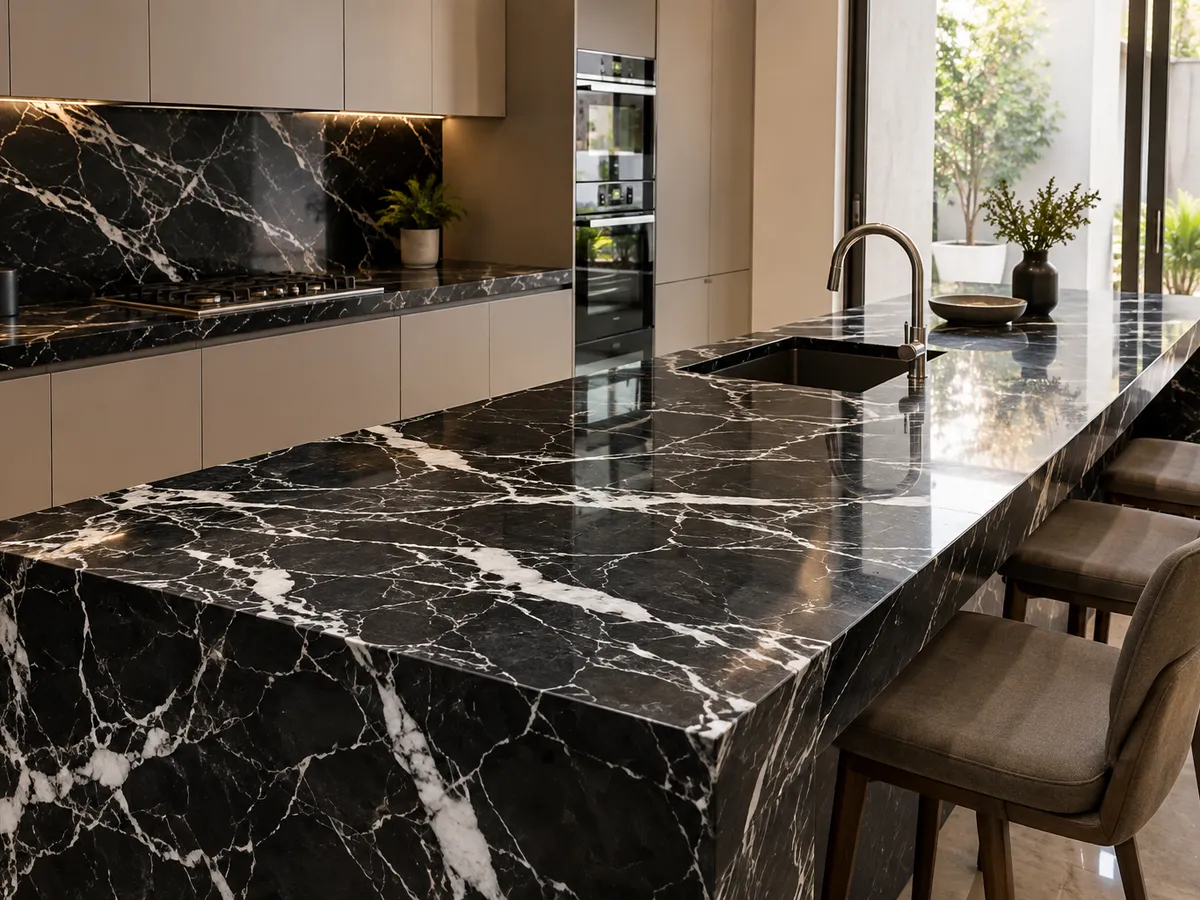
Key takeaways
- A waterfall edge turns an island top 90 degrees down to the floor at one or both ends, joined with a 45-degree mitre.
- In our catalogue a waterfall end adds roughly PKR 35,000–90,000 per end over a standard edge, depending on stone and height.
- The leg must be cut from the slab section next to the top, in sequence, for the veining to carry over the corner.
- Strongly veined stones such as Black & Gold, Zebrano and Tiger Verona show the fold best.
- Allow 2–4 weeks for an island with waterfall ends; every mitre is dry-assembled in the workshop first.
The short answer
A waterfall island is a kitchen island whose stone top turns ninety degrees at one or both ends and runs down to the floor, joined at a 45-degree mitre so the veining appears to fold over the corner. In our catalogue each waterfall end adds roughly PKR 35,000–90,000 over a standard edge, depending on the stone and the height of the leg.
Done well, the vein appears to continue over the edge and down the leg. Done badly, you see a dark glue line and a pattern that jumps. The difference is entirely in the cutting and the layout, so it is worth understanding before you order.
Stone rates in this post are our current quote ranges per square foot from our catalogue (November 2026), fabricated and installed in our service area. Every island is quoted in writing, with the waterfall ends as separate lines.
What the detail actually is
Instead of stopping at the end of the island, the top turns and runs down to the floor, or part way, on one or both ends. The corner is a mitred edge: both pieces are cut at 45 degrees, glued with colour-matched epoxy and polished so the two faces read as one folded piece of stone. We mitre the ends from 20 mm stone, book-matched to the top.
The leg also does a job: it carries the end of the top to the floor, hides the cabinet carcass and protects the end panel from kicks and wet mops. The waterfall island glossary entry has a one-line definition.
Cutting the leg from the right place
For the pattern to carry over, the leg must be cut from the slab immediately adjacent to the top, in sequence, and set the right way up. With sequential slabs a good workshop can also bookmatch the two ends so the island is symmetrical.
Ask to see the layout marked on numbered slab photographs before any cutting starts, and approve the vein direction there. Once a piece is cut, the sequence is gone.
Which stones are best for a waterfall island?
Stones with strong, directional veining are best, because the fold is only worth paying for when the eye can follow a pattern around the corner. Quieter whites also work, because their soft veining hides a small mismatch. Busy multicolours only work when the slabs are properly bookmatched.
| Stone | Origin | Figure | Our quote range | Typical slab |
|---|---|---|---|---|
| Black & Gold | Chaghi, Balochistan | Forking gold and white veins on black | 1,400–2,800 | About 108 x 66 in |
| Black & White | Chaghi, Balochistan | Strong black-and-white contrast | 900–1,700 | About 102 x 64 in |
| Zebrano | Chaghi, Balochistan | Clean linear banding | 900–1,650 | About 102 x 64 in |
| Tiger Verona | Chaghi, Balochistan | Warm tawny stripes | 750–1,350 | About 102 x 64 in |
| Ziarat Supreme | Ziarat, Balochistan | Clean white, soft veining | 1,100–2,100 | About 108 x 66 in |
| Perlino Crystal Plain | Chaghi, Balochistan | Crystalline white, little pattern | 900–1,700 | About 108 x 66 in |
| Jet Black | Chaghi, Balochistan | Solid black, no veins to align | 1,100–2,000 | About 96 x 60 in |
Choosing between the two dramatic blacks? Our comparison of Black and Gold vs Black Zebra marble sets them side by side.
How much does a waterfall end add to the cost?
A waterfall end adds roughly PKR 35,000–90,000 per end over a standard edge in our catalogue, on top of the island top itself; complete island tops run about PKR 85,000–450,000 fabricated and fitted. The extra comes from two things.
- Stone. A full-height leg on a 3.5 ft deep island about 3 ft high is roughly 10.5 sq ft of finished stone per end, more once the matched cut wastes part of the slab.
- Workshop labour. Precision mitring, dry assembly and polishing the joint, quoted per running foot of mitre.
| Stone | Top only (28 sq ft) | Top + two legs (49 sq ft) |
|---|---|---|
| Tiger Verona | 21,000–37,800 | 36,750–66,150 |
| Ziarat White | 23,800–44,800 | 41,650–78,400 |
| Ziarat Supreme | 30,800–58,800 | 53,900–102,900 |
| Black & Gold | 39,200–78,400 | 68,600–137,200 |
The rule of thumb: price the island top, then add the leg area and a mitre charge for each end, and ask for each end as a separate line. Browse finished options on our kitchen island tops page, or run your own size through the cost estimator.
Support, overhang and length
Most Pakistani blocks yield slabs up to about 9 ft, so an island top up to that length can usually be one piece; beyond it, a joint is placed under the hob or at a natural break in the figure. For a breakfast bar, 20 mm stone can overhang about 250 mm unsupported, or about 380 mm with flat steel let into the unit top so nothing shows under the counter.
The leg should stand on the finished floor, fixed back to the base unit, so the mitre carries no load. Ask for a very slight ease on the mitred corner: a razor-sharp arris chips at the first knock.
Five questions for your fabricator
- Will the leg come from the adjacent slab, in sequence?
- Will you dry-assemble the mitre in the workshop before it comes to site?
- What colour will the joint line be?
- How is the leg supported at the floor and fixed to the base?
- What happens to the offcut? Can it become the splashback?
Any workshop that answers those five clearly can build this detail. One that cannot should be building you a standard edge instead. For the wider kitchen around the island, see our kitchen marble design guide, and when you are ready, request a free quote with your island drawing.
Written by
The Captivating Marble Design Team
Fabricators, templaters and stone designers
We template, cut and install natural stone every day and write about what we learn — pricing, layouts, care and the mistakes we help clients avoid.
Book a free design consultation