Black and Gold vs Black Zebra Marble: Looks, Prices and Best Uses
Gold veins or white stripes? Pattern, PKR rates per sq ft, layout, finishes and where each black stone works in a Pakistani home, compared. Get a free quote.
Captivating Marble Design Team · · Updated · 15 min read
Key takeaways
- Black & Gold is a near-black marble from Chaghi, Balochistan, with forking gold, bronze and white veins; it costs PKR 1,400–2,800 per sq ft on our November 2026 quotes.
- Black Zebra is a yard trade name for black stone with parallel white lines, mostly sold as floor tile and borders rather than slabs.
- Black & Gold is rated about Mohs 3–4 with about 0.2% absorption; on a worktop it should be resealed about every six months.
- Use Black & Gold for one statement surface such as an island, fireplace or TV wall; use Black Zebra for borders, corridor runners and stair risers.
- Black & White from Chaghi, at PKR 900–1,700 per sq ft, is the nearest slab look in our catalogue; we do not stock Black Zebra.
The short answer
Black and gold vs black zebra marble is a choice between a showpiece and a pattern. Black & Gold is a selected Chaghi, Balochistan slab with forking gold veins at PKR 1,400 to 2,800 per sq ft, made for one island, fireplace or feature wall. Black Zebra is a trade name for black tile with parallel white lines, used on borders and floors.
Black & Gold veins fork and pool across a near-black field, and only part of each block yields clean gold. Black Zebra is mostly sold as floor tile and border strips, and its online list rates are far lower because the format and selection are completely different.
Put simply: gold veining is for a showpiece, white stripes are for pattern and rhythm across a floor or a border. If you want a black-and-white look in a slab you can vein-match on a wall, our Black & White marble from Chaghi sits between the two at PKR 900 to 1,700. This guide compares both stones on look, origin, formats, price, layout, finish and care, then tells you which to pick for each room.
Rates for our own stones are our current quote ranges per square foot (November 2026), fabricated and installed in our service area. The Black Zebra figure is an indicative online list rate for basic floor tile, supply only, not our price. We do not stock a stone sold under the Black Zebra name. Confirm every number against a written quotation.
What each name actually means
Black & Gold
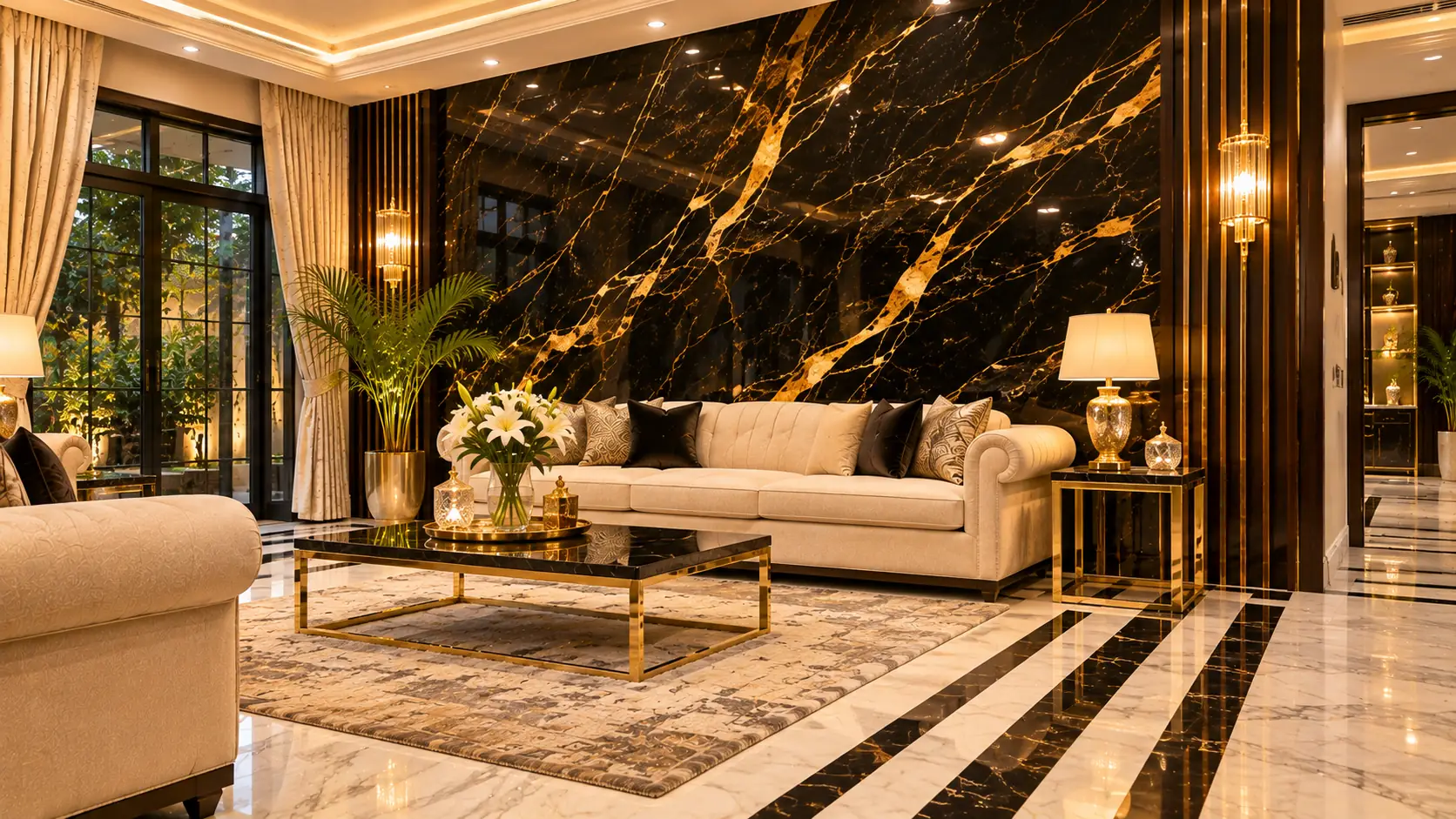
Black & Gold comes from Chaghi in Balochistan. The ground is deep black to charcoal, crossed by gold, copper and bronze veins with some white, and the veins fork and branch rather than run straight. In places they pool into wide gold flashes. Only part of each block carries clean gold on a genuinely black body; the rest is downgraded, which is why blocks are small, slabs per lot are limited and the price sits at the top of our marble range. It is the slab clients come to the yard specifically to see. Full specifications and current stock are on the Black & Gold product page.
Black Zebra (zebra black)
Zebra is not one quarry. In Pakistani yards it is a description of a pattern: alternating light and dark bands running side by side. Black Zebra, sometimes sold as Star Zebra, usually means a charcoal-to-black ground with straight or gently wavy white lines in parallel. It is mainly sold as machine-cut floor tile and border strips, with some slabs. Because the name describes the look rather than the source, lots from different sellers can differ in colour, line spacing and quality. Our zebra marble guide explains every zebra name in the trade, including Red Zebra and our own Zebrano.
Where we stand
We supply Black & Gold and its companion grade Black & White. We do not stock a stone sold as Black Zebra, so we cannot vouch for any particular lot. If you have seen Black Zebra and liked it, ask the seller for the quarry district, whether it is tile or slab, its thickness, and whether you can see the full lot you will receive. Then compare it with Black & White, the nearest look in our catalogue, and with Zebrano, our striped stone, which bands in cream and chocolate rather than black and white.
Black and Gold vs Black Zebra marble side by side
| Black & Gold | Black Zebra | |
|---|---|---|
| Ground colour | Near-black to deep charcoal | Charcoal to black |
| Pattern | Forking gold, bronze and white veins that pool into flashes | Parallel white lines, straight or gently wavy |
| Direction | No fixed direction; every slab differs | Strongly directional |
| Origin | Chaghi, Balochistan | Trade name; varies by seller |
| Usual format | Slabs, 18, 20 and 30 mm | Floor tile and borders, some slabs |
| Price, PKR / sq ft | 1,400 – 2,800 (our current quote range) | About 140 – 170 for basic floor tile (indicative online list rate) |
| Best use | Island, fireplace, feature wall, powder-room vanity | Floor borders, corridors, lobby floors, stair risers |
| Effect in a room | Luxury and warmth; one focal point | Graphic rhythm and movement |
| Main risk | Cost and limited matching slabs | Inconsistent lots; dye or wax on very dark tile |
The two are not really rivals on price or format. Black & Gold is a slab you plan a room around. Black Zebra is a pattern you use to give a floor or a border some energy. The real decision is usually about the look you want and how much area you are covering.
Pattern and layout: veins versus stripes
How a stone is laid out matters as much as which stone you buy, and the two patterns need opposite approaches.
Laying out Black & Gold
- Book-match where it counts. Two sequential slabs opened like a book turn the forking veins into a mirrored pattern that reads as deliberate design. It needs consecutive slabs from one block and more wastage, but on an island face or a fireplace it doubles the effect. Our bookmatching guide explains how to select the slabs.
- Place the gold flashes deliberately. Because the veining is irregular, decide where the strongest gold lands before the saw touches the slab: the centre of a fireplace, the front of an island, the wall facing the door.
- Approve on photographs. We number every slab, photograph it in daylight and map your pieces onto it so you approve joint positions before cutting.
- Order from one block. Gold tone varies between blocks, from brassy yellow to coppery bronze. Mixing blocks in one view looks patchy.
Laying out Black Zebra
- Decide the direction first. Stripes run lengthways down a corridor make it look longer; run across a room, they make it look wider. On a wall, vertical lines add height.
- Line up the stripes at every joint. Dry lay the tiles and check that lines meet across joints, or the pattern looks broken. This takes time and more wastage, typically 15% rather than 10%.
- Use it in measured doses. A border, a threshold strip or a corridor runner usually looks better than a full room, where parallel stripes can feel restless.
- Keep the grout dark. A black or charcoal epoxy grout keeps joints from interrupting the lines.
For floor patterns, borders and inlay layouts with either stone, our marble floor design guide has worked examples.
Why does Black & Gold cost so much more than Black Zebra?
Black & Gold costs more because it is a selected slab from small, low-yield blocks, while Black Zebra is usually basic machine-cut floor tile sold off the pile. The table puts our quote ranges for black stones next to the indicative online list rate for Black Zebra floor tile.
| Stone | Look | Source of figure | PKR / sq ft |
|---|---|---|---|
| Black Zebra / Star Zebra, floor tile | Black with white lines | Indicative online list rate | 140 – 170 |
| Black & White | Charcoal with broad, irregular white veins | Our current quote range | 900 – 1,700 |
| Zebrano | Cream with tight chocolate bands | Our current quote range | 900 – 1,650 |
| Jet Black | Near-uniform solid black | Our current quote range | 1,100 – 2,000 |
| Black & Gold | Black with gold and bronze veins | Our current quote range | 1,400 – 2,800 |
Why a PKR 150 tile and a PKR 1,400 slab are not comparable
Online list rates are yard prices for standard machine-cut floor tile sold off the pile, usually before grinding and polishing, cutting, edges, wastage, transport and fitting, and the grade can change between truckloads. Our ranges cover slabs selected from tagged lots, cut, finished and fitted in our service area, so part of the gap is labour, with the final figure depending on thickness, finish and how much cutting and edge work the job needs. Black & Gold also carries the cost of yield: you are paying for the selected part of the block, not the whole block. Our black marble price guide breaks down every black stone in more detail.
Worked costs (installed)
| Job | Area incl. wastage | Black & Gold (PKR) | Black & White (PKR) |
|---|---|---|---|
| Powder-room vanity top with upstand | About 15 sq ft | 21,000 – 42,000 | 13,500 – 25,500 |
| Fireplace surround and hearth | About 30 sq ft | 42,000 – 84,000 | 27,000 – 51,000 |
| Island 8 x 3 ft with two waterfall ends | About 50 sq ft | 70,000 – 140,000 | 45,000 – 85,000 |
| Book-matched TV wall, 10 x 9 ft | About 104 sq ft (15%) | 145,600 – 291,200 | 93,600 – 176,800 |
At the indicative Black Zebra list rate, a 20 x 15 ft lounge floor of about 330 sq ft with wastage would come to roughly PKR 46,200 to 56,100 for basic tile, before polishing, transport and fitting. Run your own sizes through the stone cost estimator.
Our figures include fitting; sink cut-outs, waterfall mitres, book-matching and freight outside our fitting cities are itemised on the quote. If you buy stone only and hire your own mistri, budget labour separately. As an indicative market range only, floor laying is often quoted around PKR 60 to 150 per sq ft; stripe-matched floors and book-matched walls cost more because of setting-out and extra care. Add adhesive, grout, sealer and transport.
Where should you use Black & Gold or Black Zebra?
Use Black & Gold on one vertical or raised statement surface, such as an island, fireplace, TV wall or powder-room vanity, and Black Zebra on floors as borders, runners, thresholds and stair risers.
| Surface | Black & Gold | Black Zebra |
|---|---|---|
| Kitchen island | Excellent; the classic use | Not usual; tile format and joints |
| Fireplace surround | Excellent, ideally book-matched | Possible as a slim border or frame |
| TV or feature wall | Excellent as a single statement wall | Works with vertical lines in a modern room |
| Powder-room vanity | Excellent, and offcuts keep the cost down | Rarely used |
| Drawing-room floor | Too costly and dark for a full floor | Good as a border or inlay band |
| Corridor or lobby floor | As an inlay medallion only | Good as a runner or border |
| Stair risers | Too costly for most | Good with a lighter tread |
| Kitchen worktop | Possible with care; honed is easier to live with | Not recommended |
Kitchens
Black & Gold is dense, with absorption of about 0.2% on our spec sheet, and it is on our list for islands and worktops. It is still a calcite stone, though, at about Mohs 3 to 4, so lemon, imli and vinegar etch it and steel utensils can scratch it. Many clients put Black & Gold on the island only and run a quieter worktop around the walls. For a hard-working desi kitchen, a black granite such as Galaxy Black (PKR 900 to 1,700) or Khyber Black Granite (PKR 850 to 1,600) takes heat and acids far better. Our black marble kitchen guide covers this in depth.
Fireplaces and feature walls
This is where Black & Gold earns its price. A book-matched pair around a fireplace or behind a TV becomes the focal point of a drawing room. Ideas for mantels, hearths and surrounds are in our marble fireplace design guide.
Floors, borders and stairs
Stripes come into their own on floors. A Black Zebra band around the edge of a white or beige floor, or a runner down a long corridor, adds movement without the cost of a full dark floor. A full black floor of any kind shows dust and footprints quickly in Pakistani cities, so most homes keep black to borders, inlays and stair risers. For stair details, see our black granite stairs guide.
Design pairings and using them together
What suits Black & Gold
- Unlacquered brass and antique gold. Taps, handles and light fittings pick up the veining.
- Walnut and fumed oak. Warm dark timber deepens the luxury feel.
- Warm white or bone units. They let the slab carry the room and stop the kitchen feeling heavy.
- A quiet white partner. Ziarat White perimeter worktops with a Black & Gold island is a well-tried combination.
What suits Black Zebra
- Plain white or pale grey fields. Stripes need calm around them.
- Chrome, steel and matte black fittings. Cooler metals suit the graphic black and white.
- Simple modern furniture. Pattern on the floor, plain shapes above it.
Can you use both in one room?
It can be done, but carefully. Gold veins are warm and organic; white stripes are cool and graphic. Put them side by side at full strength and they compete. If you want both, keep Black & Gold on one vertical surface, such as a fireplace or feature wall, and use the stripes only as a slim floor border well away from it, with plain floor in between. Brass fittings will pull the room towards the gold; chrome will pull it towards the stripes. Choose one metal and stick to it. If the stripes start to feel like too much, Black & White or solid Jet Black are calmer partners for Black & Gold.
Finish, sealing and care on dark stone
| Finish | Effect on Black & Gold | Effect on Black Zebra | Upkeep |
|---|---|---|---|
| Polished | Deepest black, gold veins at their brightest | Strongest contrast between lines and ground | Shows fingerprints, water spots and fine scratches |
| Honed | Softer charcoal, veins more muted | Lines softer, ground looks greyer | Hides marks; needs good sealing against oil |
| Brushed | Textured, matte, more rustic | Rarely offered on tile | Good grip, hides wear |
- Seal on schedule. On a worktop, re-seal Black & Gold about every six months; on walls and vanities, once a year is usually enough.
- Clean with a pH-neutral cleaner. Daily pocha with clean water and a neutral stone cleaner. Avoid vinegar, lemon, phenyl and acidic bathroom cleaners, which leave dull etch marks that show clearly on black.
- Use a microfibre cloth. It stops streaks on polished black. Wipe vanity tops dry to prevent hard-water spots.
- Watch for dye and wax. Very dark, cheap tile is sometimes dyed or waxed to look blacker. Wipe the back or an edge with a cloth dampened with acetone or nail polish remover; if colour comes off, the black is not natural.
For step-by-step sealing, see how to seal marble in Pakistan.
Yard checklist for black slabs and striped tile
- See the actual slabs or the full lot. Never buy Black & Gold from a photograph; gold tone and vein placement vary block to block. For Black Zebra, look at a whole crate, not one sample.
- Check for fissures. Look along the veins and stripes for open cracks. Resin-filled hairlines are normal; open cracks across a slab are not.
- Look at the back. Fibreglass mesh on the back of thin or fissured slabs is fine if it is declared; ask whether it is included in the rate.
- Check line spacing on zebra tile. Stripe width and spacing should be consistent across the crate, or the floor will look patchy.
- Wet the surface. Water shows the true colour after sealing and reveals fill and wax.
- Get the rate in writing. Stone, wastage, cutting, edges, book-matching, transport and fitting should each be a separate line.
Lead time on Black & Gold is typically 7 to 14 days from slab approval, longer for book-matched work. You can order samples of our black stones to see them in your own light first.
Which should you choose?
- Choose Black & Gold for one dramatic surface, such as an island, fireplace, TV wall or powder-room vanity, when you want warmth and luxury and the budget allows it.
- Choose Black Zebra for floor borders, corridor runners, thresholds and stair risers when you want graphic pattern at a low material cost, and you can inspect the full lot.
- Choose Black & White when you want black-and-white contrast in a slab that can be book-matched on a wall or used on an island, at a lower rate than Black & Gold.
- Choose Jet Black when you want a solid black void rather than a pattern, for skirting, risers, splashbacks or borders.
- Choose a black granite for a busy kitchen worktop or an exterior step that has to survive heat, acids and heavy wear.
Browse the Black & Gold collection for slab photographs and grades, including Gold Vein Black and Copper Vein Black, and the Jet Black collection for solid blacks.
Get a quote or see the stone
Tell us the surface, rough sizes and whether you lean towards gold veins or black-and-white contrast, and we will send a free itemised quote with slab photographs from the current lot. If you are unsure, we can lay out your island or wall on photographs of the actual slabs before anything is cut.
Written by
The Captivating Marble Design Team
Fabricators, templaters and stone designers
We template, cut and install natural stone every day and write about what we learn — pricing, layouts, care and the mistakes we help clients avoid.
Book a free design consultation