Zebra Marble in Pakistan: Black Zebra, Zebrano, Prices and Where It Works
Black Zebra, Star Zebra, Red Zebra and Zebrano compared: what each is, PKR rates per sq ft, layout tips and care for striped stone. Get a free quote.
Captivating Marble Design Team · · Updated · 15 min read
Key takeaways
- Zebra is a Pakistani trade name for any strongly striped marble, not a single quarry or stone.
- Zebrano, our cream-and-chocolate striped marble from Chaghi, Balochistan, costs PKR 900–1,650 per sq ft as of November 2026.
- Online rate lists show basic Zebra floor tile at about PKR 80–100 and Star Zebra at PKR 140–170 per sq ft, before cutting, polishing and fitting.
- A Zebrano slab measures about 102 × 64 inches, a little over 45 sq ft; two side by side cover a 10.5 × 8.5 ft TV wall.
- Book-matched striped walls need about 15% wastage, against 10% for a plain straight lay.
What is Zebra stone, and what does it cost?
Zebra marble is a Pakistani trade name for any marble with strong parallel stripes, not one quarry: Black Zebra and Star Zebra (black with white lines), Red Zebra, and cream-and-brown Zebrano. We supply Zebrano from Chaghi, Balochistan, at PKR 900–1,650 per sq ft on our November 2026 quotes. Basic striped floor tile appears on online rate lists for far less.
This guide covers what each name usually means, how the stripes form and why that matters for strength, what the rates per square foot really include, where striped stone looks its best and where it fails, how to lay it so the bands line up, a yard checklist and how to care for it in Pakistani heat, dust and hard water.
How we priced this: Zebrano rates are our own current quote range per square foot from the product catalogue, fabricated and installed in our service area, as of November 2026. Every other figure in this post, including online list rates for other "Zebra" names and labour, is an indicative market range only. Confirm the final rate against a written quotation.
What "Zebra" means at a Pakistani stone yard
Ask for "zebra" in Lahore, Karachi or Peshawar and you may be shown three or four quite different stones. Names in the trade grow out of what a stone looks like, not where it was quarried, so the same label can sit on material from different districts, and a different label can sit on stone from the same seam. Treat the name as a description of the pattern, then judge the actual slab.
| Trade name | What you usually see | Typical format | Notes |
|---|---|---|---|
| Zebra (plain) | Alternating dark and light bands, often grey-brown | Machine-cut floor tile | The cheapest grade on rate lists; quality varies widely |
| Black Zebra / Star Zebra | Charcoal to black ground with straight white lines | Tile and some slabs | High contrast; check for dye and wax on very dark lots |
| Red Zebra | Red or brick-red streaks with white veins | Tile, borders, small slabs | Bold; best kept to small areas and borders |
| Zebrano | Cream ground with tight chocolate-brown parallel bands | Slabs, cut-to-size pieces, tile | Our stone, from Chaghi; reads like timber grain from a distance |
| Tiger Verona (near relative) | Warm beige with darker brown "tiger" bands | Slabs and tile | Some lots are close to zebra; stripe density varies by lot |
You will also see striped handicrafts, chess boards, bookends and bowls sold as "zebra" stone. That is the same family of banded material cut small, and it is often where people first meet the name. For floors and walls, ignore the label and ask three questions: where was the block quarried, is this tile or slab, and can I see the whole lot?
Is it real marble, and where do the stripes come from?
Most striped stone in Pakistani yards is a true marble or a dense crystalline limestone sold as marble (sang-e-marmar). Its parent rock was laid down in layers, and each layer trapped slightly different impurities: clay and iron oxides give brown, red and cream; carbon-rich material gives grey and black; purer calcite stays white. Heat and pressure later recrystallised the rock and often stretched and folded those layers, which is why the bands in a good slab look like flowing grain rather than ruled lines.
Why the bands matter for strength
A boundary between two bands is a natural plane of weakness. Many banded slabs carry fine fissures (dry seams) running along the stripes, and the dark bands are sometimes softer than the light ones. That is not a defect in itself; yards routinely fill fissures with resin and back thin slabs with fibreglass mesh. It does mean you should not cantilever a striped slab across a wide gap, and you should look closely along the bands for open cracks before you buy.
Hardness and acids
Like every calcite stone, striped marble sits at about 3 on the Mohs scale, so steel, sand and grit scratch it. Lemon, vinegar, tamarind, tomato and acidic bathroom cleaners etch it, leaving dull patches. The light bands show etching first because the dull mark contrasts with the polish around it. This is the same chemistry that governs every marble, explained in our guide to marble vs granite in Pakistan.
Zebrano: our striped stone from Chaghi
Zebrano is cut from a banded seam in the Chaghi district of Balochistan, the same belt that gives Black & Gold, Jet Black and the Verona beiges. It stripes cream and chocolate in tight, roughly parallel lines. Close up you see fine dark threads inside each brown band; from across a room it reads like the grain of a timber veneer, which is why interior designers often use it where they would otherwise use wood panelling but want something that will not warp in monsoon humidity.
- Origin: Chaghi, Balochistan.
- Colour: cream to light beige ground, chocolate to dark brown bands.
- Finishes: polished (strongest contrast) and honed (softer, more matte, hides etching better).
- Thickness: 2 cm and 3 cm.
- Slab size: the slabs we list measure about 102 x 64 inches, a little over 45 sq ft each; sizes vary from lot to lot.
- Best uses: feature and TV walls, headboard walls, lift lobbies, fireplace surrounds, backsplashes, vanity tops and floors in hallways.
- Our current quote range: PKR 900 to 1,650 per sq ft.
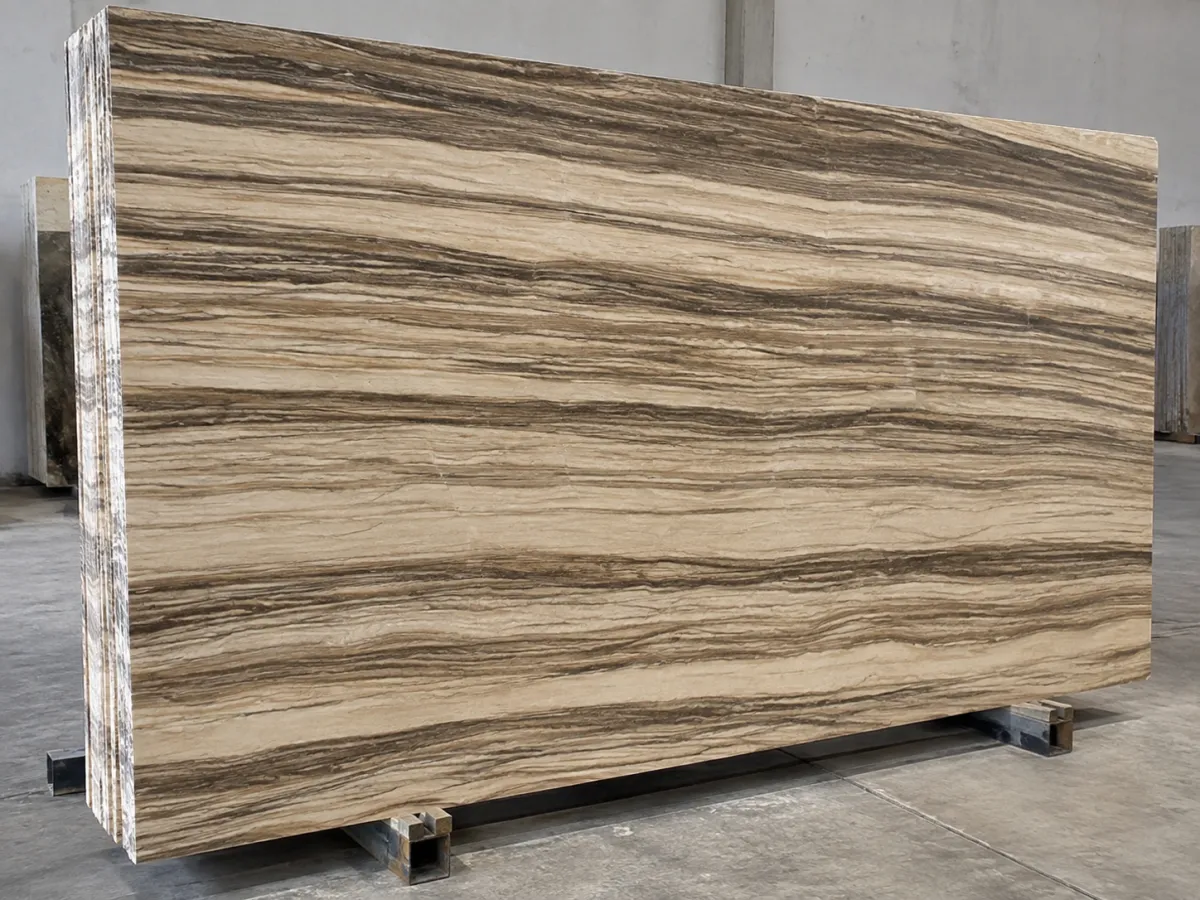
Because the pattern is so directional, Zebrano rewards planning more than almost any other Pakistani stone. The orientation, the order of slabs and the position of every joint should be settled on a drawing before the first cut, not on site.
Zebra marble price in Pakistan per sq ft
Prices for striped stone span a wide band because the names cover everything from entry-grade floor tile to selected slabs. The table puts our catalogue stones beside the indicative list rates published online for other zebra names.
| Stone | Look | Source of figure | PKR / sq ft |
|---|---|---|---|
| Zebra (plain), floor tile | Dark and light bands | Indicative online list rate | 80 – 100 |
| Star Zebra, floor tile | Black with white lines | Indicative online list rate | 140 – 170 |
| Red Zebra, floor tile | Red with white veins | Indicative online list rate | 220 – 280 |
| Superline Grey | Grey with straight pale lines | Our current quote range | 620 – 1,150 |
| Tiger Verona | Beige with brown tiger bands | Our current quote range | 750 – 1,350 |
| Zebrano | Cream with chocolate bands | Our current quote range | 900 – 1,650 |
| Black & White | Charcoal with broad white veins | Our current quote range | 900 – 1,700 |
Why a list rate of PKR 90 and a quote of PKR 900 are not the same thing
The low figures on online rate lists are yard prices for standard machine-cut floor tile, usually the thin, ungraded stock sold by the square foot off the pile. They normally leave out on-site grinding and polishing, cutting to size, edge work, wastage, transport and fitting, and the grade can change from one truckload to the next. Our quote range is an installed price for Zebrano in 2 cm and 3 cm, selected for an even, continuous stripe, cut, finished and fitted, with cut-outs, seams and freight itemised; the final figure depends on thickness, finish and the lot. Whenever you compare two rates, ask each seller to write down exactly what the rate includes.
What moves a striped-stone quote up or down
- Stripe quality. Even, unbroken bands with consistent spacing cost more; patchy lots with wandering bands are cheaper.
- Format. Stock tile is cheapest. Full slabs and cut-to-size pieces (steps, vanity tops, fireplace legs) carry yield loss and workshop time.
- Matching. Book-matching or vein-matching needs consecutive slabs from one block and more wastage, typically 15% or more rather than 10%.
- Thickness. 3 cm stone costs more than 2 cm and is heavier to fix on walls.
- Resin and mesh. Fissured lots need filling and backing; ask whether that is already done or extra.
- Finish and edges. Honing, mitred edges, bullnose and grooves are itemised separately in most quotes.
Worked installed costs at our Zebrano range
| Job | Area incl. wastage | Estimated installed cost (PKR) |
|---|---|---|
| Vanity top 5 x 2 ft with upstand | About 15 sq ft | 13,500 – 24,750 |
| Fireplace surround and hearth | About 30 sq ft | 27,000 – 49,500 |
| Book-matched TV wall, 10 x 9 ft | About 104 sq ft (15%) | 93,600 – 171,600 |
| Headboard wall, 12 x 9 ft | About 124 sq ft (15%) | 111,600 – 204,600 |
| Entrance lobby floor, 12 x 10 ft | About 132 sq ft (10%) | 118,800 – 217,800 |
Put your own sizes into our stone cost estimator: multiply length by width in feet, add the wastage for the layout you want and multiply by the rate.
If you buy stone only and hire your own mistri
Our rates already include cutting, finishing and fitting in our service area. If you buy stone only and hire your own mistri, budget labour separately. As an indicative market range only, floor laying is often quoted around PKR 60 to 150 per sq ft, and wall cladding with mechanical clamps costs more because of the drilling, fixing and extra care needed to keep the stripes aligned. Add white stone adhesive, grout or colour-matched epoxy for joints, sealer and transport. Get each line in writing before work starts.
Where does striped marble work best?
Striped marble works best on one feature surface per room: a TV wall, headboard wall, lift lobby, fireplace or vanity. Stripes are a strong statement, and that is the whole appeal of zebra marble. Used on one surface, they turn a plain room into a designed one; used on every surface, they make a room restless and hard to furnish. The rule of thumb in most good Pakistani interiors is one striped plane per room, with a quiet stone or plaster around it.
Where it shines
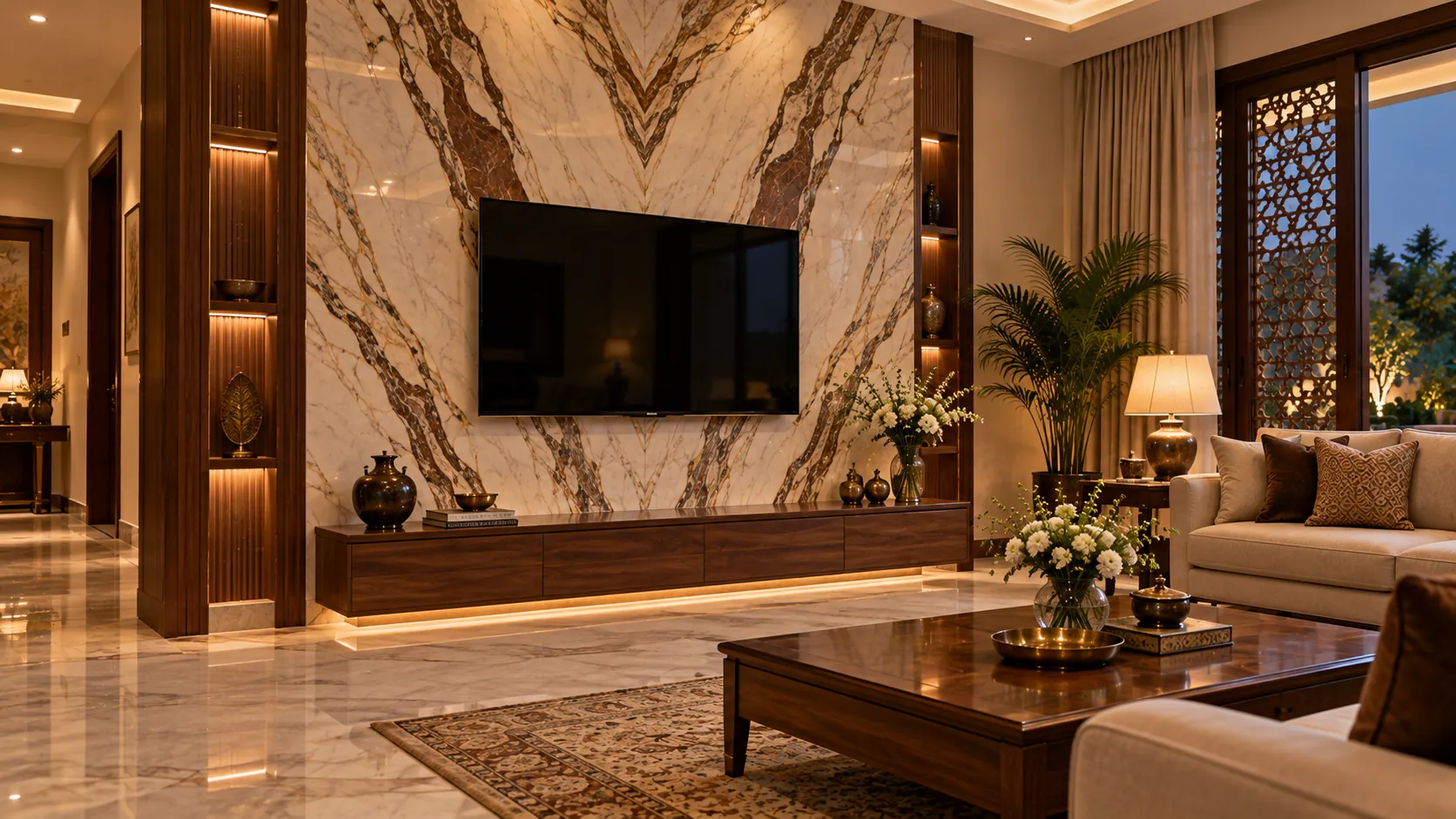
- TV and feature walls. The classic use. A book-matched pair behind a wall-mounted TV gives a focal point that suits both a drawing room and a TV lounge.
- Headboard walls. Horizontal bands behind a bed widen the wall and feel calm; vertical bands make a low bedroom ceiling look higher.
- Lift lobbies and entrance foyers. A small, high-impact area where the stone is seen up close and the cost stays contained.
- Fireplace surrounds. Banded stone frames a gas heater or electric fire beautifully; see our fireplace surround options.
- Vanity tops and powder rooms. A small slab, a big effect, and little exposure to cooking acids.
- Hallway floors. Bands laid along the length of a corridor lead the eye and make it feel longer.
Where to think twice
- Busy cooking counters. Desi cooking means lemon, tomato, imli and haldi on the worktop every day. Striped marble etches and the cream bands stain. Use it as a backsplash and choose granite for the work surface.
- Whole-house floors. Hundreds of square feet of stripes become tiring, and matching bands across rooms needs a lot of stone from one lot. Use it as an inlay or border instead.
- Outdoor and wet areas with a polished face. Polished marble is slippery when wet and loses its shine in sun and rain within a season or two.
- Narrow strips cut across the bands. Stair nosings or thin skirting cut across the grain can snap along a band line.
How do you lay striped stone so the bands line up?
Fix the stripe direction and matching pattern on a drawing, number the slabs in sawing order and dry-lay them before fixing. With plain stone, a sloppy layout costs you a few odd joints. With striped stone it ruins the job, because the eye follows every band and spots every break. Settle these points with the fabricator before cutting.
Decide the direction first
Vertical bands make a wall look taller and a room more formal. Horizontal bands make a wall look wider and calmer. On floors, run the bands along the longest dimension of the room or corridor; across a narrow room they chop it into strips. How the block was sawn also matters: sawn along the bedding the bands are straight and linear, sawn across it they become wavier and cloudier. Our glossary entry on vein-cut vs cross-cut shows the difference.
Choose a matching pattern
- Book-match. Two consecutive slabs opened like the pages of a book so the bands mirror around a centre line. The most dramatic option for a TV wall or a fireplace; see bookmatching.
- Vein-match (slip-match). Consecutive slabs placed side by side so each band continues across the joint. Calmer, and good for long walls.
- End-match. Slabs stacked so the pattern continues upwards across a horizontal joint; needed on walls taller than one slab.
- Random. Tiles laid with no matching. Cheapest and fastest, but the stripes will jump at every joint, which suits only small areas.
Number, dry-lay and photograph
- Ask the yard to keep slabs in sawing order and to number them on the back.
- Make a scaled drawing of the wall or floor and mark every joint, socket, switch box and TV bracket.
- Dry-lay the cut pieces on the yard floor or on site before fixing, and photograph the layout from a step-ladder.
- Only then fix the stone, starting from the centre line for a book-match.
As a guide, two of our Zebrano slabs side by side cover a panel roughly 10.5 ft wide and 8.5 ft high, which suits many TV walls. A taller wall needs end-matched pieces above or below. Our marble installation guide walks through measuring, templating and fitting day.
Plan electrical work before the stone is cut. Conduits, back boxes and the TV bracket position must be fixed in the wall first; a socket cut in the wrong place on a book-matched wall cannot be moved without replacing a slab.
Design pairings for Pakistani homes
Because the stone is busy, everything around it should be quiet. These pairings work well with the two main colourways.
| Element | Cream and brown (Zebrano, Tiger Verona) | Black and white (Black Zebra, Black & White) |
|---|---|---|
| Floor | Plain light beige or off-white marble, honed timber-look tile | Plain white or light grey marble |
| Walls around it | Warm white or sand plaster | Pure white or pale grey |
| Woodwork | Walnut, teak, dark oak | Black, charcoal or pale ash |
| Metals | Brushed brass, bronze | Chrome, black steel, polished nickel |
| Fabrics | Camel, rust, olive, ivory | Charcoal, white, one accent colour |
| Lighting | Warm 2,700–3,000 K strip light along the top edge | Neutral 3,000–4,000 K, wall washers |
Grazing light from a concealed strip at the top of a wall brings out the texture of the bands, especially on a honed face. Keep artwork off a striped wall; the stone is the art. For more ways to use pattern around the house, see our marble design ideas for Pakistani homes.
Buying checklist: inspecting striped slabs at the yard
Go to the yard in daylight, take a bottle of water, a soft cloth, a tape measure and your drawing, and check the following before you pay an advance.
- See the whole lot, not one sample. Stripe spacing and colour change across a block. Make sure every slab or crate you will use comes from the same lot.
- Wet the surface. Water shows the stripe contrast as it will look when polished and reveals hairline fissures along the bands.
- Run a fingernail along the bands. A fissure you can catch with a nail is open; ask whether it will be resin-filled and backed, and avoid it on a slab that must span a gap.
- Check the back. Mesh and resin on the back are normal for thin, fissured slabs. Patches of fresh filler on the face are not.
- Measure thickness at several points. A 2 cm slab should not vary by more than a millimetre or two along its length; uneven slabs show lippage on a wall.
- Test very dark stone for dye or wax. Rub an offcut edge with a cloth and a little acetone. Colour on the cloth suggests dye; a surface that turns grey once dry suggests oiling.
- Look at the polish under a tube light. Reflections should stay straight and sharp across both light and dark bands; wavy reflections mean poor grinding.
- Agree the orientation and matching in writing. Note which way the bands run, the slab numbers and the matching pattern on the quotation.
- Ask what the rate includes. Cutting, edges, resin, transport, fitting, sealing and wastage should each be written as included or extra.
If you cannot visit, order a sample first. A sample from our samples page costs PKR 500 and is credited against your order, and it lets you see the bands in your own room's light.
Installation and care in Pakistani conditions
Fixing
- Use a white stone adhesive rather than a grey sand-cement bed. Cream bands can shadow or pick up stains from a grey mortar bed.
- Back-butter every piece so there are no hollow spots; hollow spots crack along band lines under load.
- Use mechanical clamps on walls for slabs and large panels, especially at height and in lobbies, in addition to adhesive.
- Keep joints tight and colour-matched. A 1–2 mm joint filled with tinted epoxy disappears into a band; a wide grey grout line breaks the pattern.
- Polish on site last. For floors, grinding and polishing after laying (ragrai) levels the joints so the stripes flow across them.
Sealing and daily care
Seal with a penetrating (impregnating) sealer after fixing and reseal roughly once a year on floors and vanities, sooner in kitchens. A sealer slows staining from oil, haldi and chai; it does not stop acid etching. Our step-by-step guide to sealing marble in Pakistan covers products, timing and the water-drop test.
- Dust-mop daily; fine Pakistani dust acts like sandpaper on a polished face.
- Wash with plain water or a pH-neutral stone cleaner. Avoid vinegar, lemon, bleach and tile acids.
- Wipe hard-water drips on vanities before they dry into white rings.
- Put felt pads under furniture and doormats at every entrance.
- If a polished surface dulls, a professional re-polish restores it; honed finishes hide wear far longer.
Summer heat cures adhesive fast and monsoon humidity slows it. In June and July ask the fitter to work early in the day and keep fresh stone out of direct sun; in the rains, let walls dry before cladding and allow extra curing time before sealing.
Alternatives if stripes are not quite right
If you like the idea but not the strength of the pattern, or need something tougher, these are the stones people usually compare with a zebra-pattern wall or floor.
- Tiger Verona (PKR 750 – 1,350): the same warm family with softer, wider bands; easier to live with across a larger area.
- Superline Grey (PKR 620 – 1,150): straight pale lines on mid-grey from Mohmand; calm, modern and economical.
- Black & White (PKR 900 – 1,700): charcoal with broad, irregular white veins; the closest of our stones to a Black Zebra look, but more painterly than striped. Our Black & Gold vs Black Zebra comparison weighs the two dark options.
- Jet Black (PKR 1,100 – 2,000): a solid black that frames a striped panel well as a border, skirting or plinth.
- Granite for kitchens: if the stripes are for a cooking counter, a granite top with a striped backsplash gives you the look without the etching. Compare options in our black marble price guide, which also covers black granite.
Get a quote or see the stone
Send us your room sizes, a photo of the wall or floor and the direction you want the stripes to run, and we will come back with a free written quote that states the installed rate and wastage, with cut-outs, seams and freight itemised. If you are still choosing between Zebrano, Tiger Verona and a black-and-white stone, order samples first and look at them in your own light, morning and evening, before you commit to a full lot.
Warm striped stones sit in the brown family too; our brown marble guide compares Zebrano with Tropical and the other browns.
Written by
The Captivating Marble Design Team
Fabricators, templaters and stone designers
We template, cut and install natural stone every day and write about what we learn — pricing, layouts, care and the mistakes we help clients avoid.
Book a free design consultation