Marble Flooring Pros and Cons: An Honest Guide for Pakistani Homes
Marble floors stay cool, last decades and re-polish, but they etch, stain and get slippery when wet. Room-by-room advice and PKR costs. Get a free quote.
Captivating Marble Design Team · · 13 min read
Key takeaways
- Marble floors stay cool in summer, last for decades and can be machine-ground and re-polished on site instead of being replaced.
- The main drawbacks are etching from acids, scratching from grit, staining in light stones and a slippery surface when polished stone is wet.
- Use polished marble in dry living rooms and honed or brushed stone in bathrooms, kitchens and on stairs; use granite or travertine outdoors.
- At our November 2026 installed ranges a 300 sq ft lounge costs about PKR 1.4–2.6 lakh in China White and 2.7–5.1 lakh in Ziarat White, with 7% wastage.
- Most disadvantages are managed with the right finish, a sealer, entrance mats and a pH-neutral cleaner rather than by avoiding marble.
The short answer
The marble flooring pros and cons are easy to state: it is cool underfoot, lasts for decades, can be re-polished on site and is quarried in Pakistan, but it etches from acids, scratches more easily than granite, can stain in light colours and is slippery when polished and wet. For most living rooms, bedrooms and stairs, the advantages win.
That is why stone is still the default finish in so many Pakistani houses, from 5 marla homes to kanal bungalows. It is not the right answer everywhere, though. A wet bathroom, a busy kitchen or a sun-baked porch asks things of the floor that a polished white marble struggles with. This guide sets out each advantage and drawback honestly, explains who it suits, goes room by room, summarises how it compares with tiles, granite, quartz, travertine and wood, and gives an installed cost range so you can decide with real numbers.
How we priced this: stone rates are our current catalogue quote ranges per square foot as of November 2026. They are installed prices in our service area that include the stone, cutting, laying, a standard polished finish and sealing on fitting day. Freight outside our fitting cities, borders, inlays and special edge work are itemised on the quote. The room size in the cost example is our assumption, not a measurement of your house.
The advantages of a marble floor
The case for stone rests on comfort in a hot climate, a very long life and the fact that it can be renewed rather than ripped out. Here is each advantage in turn, with the practical detail behind it.
It stays cool in the hot months
Stone draws heat away from bare feet, so a shaded marble room feels noticeably cooler than one finished in carpet, vinyl or most tiles during a Lahore or Multan June. That is one of the main reasons Pakistani houses have been floored in it for generations. The effect is strongest in rooms that stay out of direct sun; a floor baking under a west-facing window will warm up like any other material. Our guide to marble flooring in summer heat explains which colours and finishes stay coolest.
It lasts for decades and can be renewed
A well-laid floor does not wear out in the way laminate or a printed tile does, because the colour and pattern run through the full thickness of the stone. When the surface dulls, scratches or picks up etch marks, a polishing crew grinds it back and brings the shine up again on site. A floor can be re-polished after twenty years and look close to new. That makes the long-term cost lower than the price per square foot on the day suggests. See marble polishing for how the process works and how often it is needed.
Damaged pieces can be repaired one by one
If a heavy object cracks a tile or chips a corner, the broken piece can be filled with a colour-matched resin or cut out and replaced without lifting the rest of the room, especially if you kept spares from the original lot. Our guide to marble crack and chip repair shows what can be filled and what needs replacing.
It looks better with age, not worse
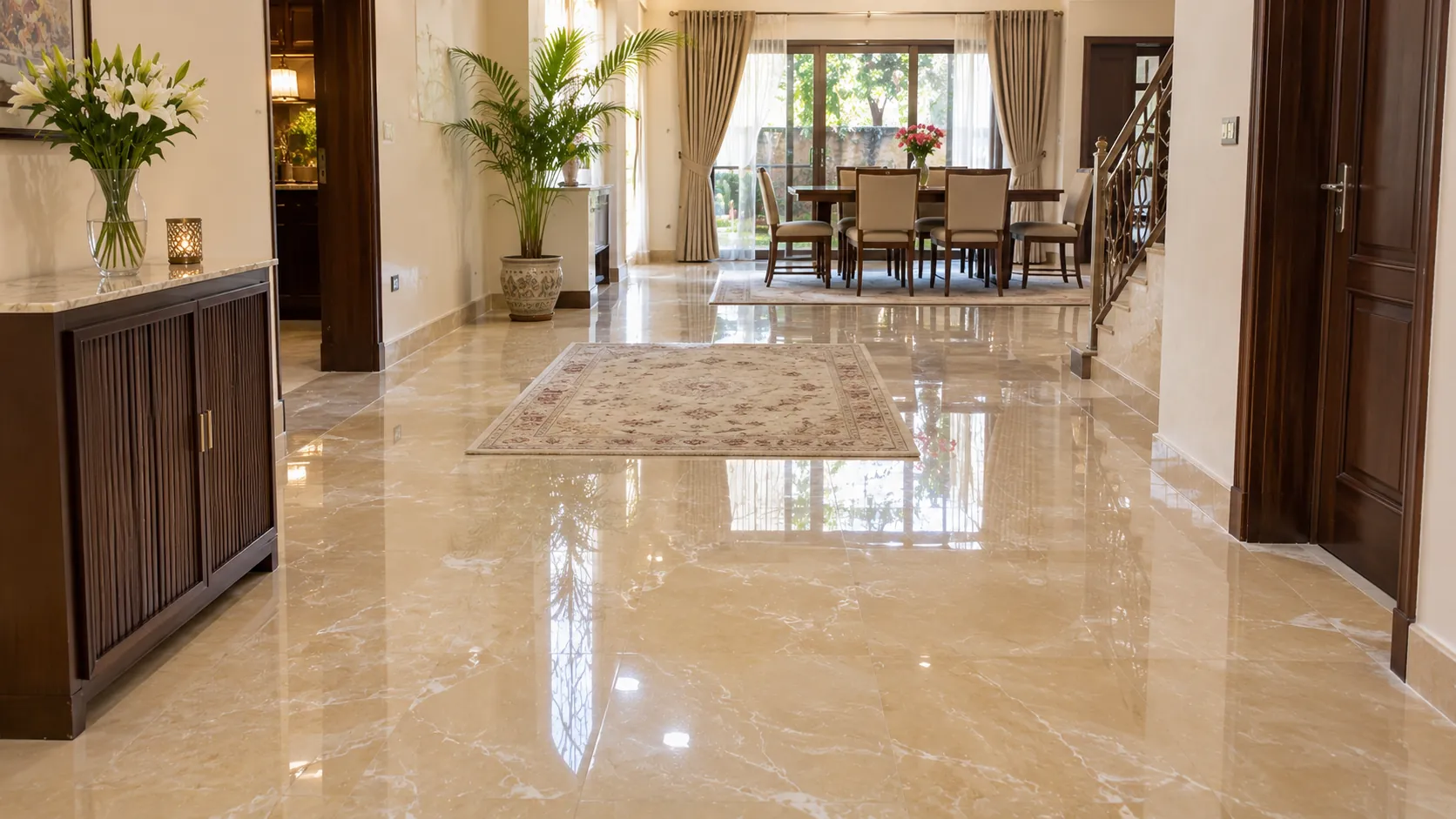
Natural veining, cloud and colour drift mean no two rooms are identical, and a polished floor reflects daylight deep into a house. A well-kept stone floor tends to read as a quality finish when a house is sold or rented, whereas a dated tile pattern can make a house look its age. Marble also takes borders, Design Patti strips and medallions, the traditional Punjabi floor detail, which very few other materials can.
It is local, varied and quick to supply
Pakistan quarries its own whites, creams, beiges, greys, browns and blacks, from Ziarat White and Tavera Light to Sunny Grey and Jet Black. Standard floor sizes of 12 × 12, 12 × 24 and 24 × 24 inches in 16–20 mm are stocked, and stock sizes load from Lahore in 3–5 days, so you are not waiting on an import container. Our floor and wall tile range lists every stone we cut for floors.
Daily cleaning is simple
A sealed stone floor needs a dry sweep or dust-mop to lift grit and a damp mop with a pH-neutral cleaner. It does not trap dust like carpet, and fine joints mean far less grout to scrub than a small-format ceramic. The care routine is in our guide to cleaning marble floors.
It works with underfloor heating
In Murree, Islamabad and other cold-winter areas, stone suits underfloor heating because it conducts and holds warmth well and spreads it evenly. Use a flexible adhesive and leave movement joints at the room edges.
The disadvantages of a marble floor
Every drawback below is real, and most of them come from the same fact: marble is a calcium-based stone of moderate hardness, about 3 to 4 on the Mohs scale against 6 to 7 for granite. Knowing what causes each problem is what lets you design around it.
Acids etch the surface
Lemon, vinegar, imli, tomato, cola and, above all, bathroom acid (teezab) react with the stone and leave a dull, slightly rough mark called an etch. It is not a stain that wipes away; it is a small area where the polish has been dissolved. A sealer slows stains but does not stop etching. On a floor this matters most in kitchens and bathrooms, and wherever someone mops with an acidic tile cleaner.
Grit scratches it
Sand and dust carried in on shoes act like sandpaper. Over months, a polished floor shows a duller path along the busiest routes: front door to lounge, kitchen to dining. Furniture dragged without felt pads leaves visible lines. Honed floors hide this far better than a mirror polish.
Light stones can stain
Marble has some porosity, so oil, haldi (turmeric), tea and rust from a metal pot can soak in if left. White and cream stones show it most. A good impregnating sealer, applied before grouting and refreshed about once a year on floors, gives you time to wipe a spill before it marks. Our guide to removing stains from marble covers the poultice method for marks that have already set in.
Polished stone is slippery when wet
This is the drawback that matters most for safety. A mirror polish is fine in a dry drawing room but treacherous in a bathroom, at an entrance in the monsoon, on stairs or on a verandah. The fix is a honed or brushed finish in those areas, which keeps the same stone but gives far better grip. Our guide to polished, honed and leathered marble explains how each finish behaves.
It is cold in winter and hard underfoot
The same property that keeps it cool in June makes it cold in January in the north. Rugs, socks and underfloor heating answer that. Stone is also unforgiving: a dropped glass or plate is far more likely to break than on wood or vinyl, and some people find long periods of standing on it tiring.
Colour varies between lots
Natural stone shifts shade from block to block. If a floor is bought in two separate purchases, or a repair piece comes from a different lot years later, the difference can show. Buy the whole quantity at once from one lot and keep a few spare pieces. Some whites can also turn yellowish over time from iron in the stone, moisture under it or the wrong sealer; see why white marble turns yellow.
It needs a good base and a skilled fitter
Stone is heavy and rigid. It needs a cured, level screed and a fitter who beds every piece fully, or you get hollow-sounding tiles, lippage between pieces and cracks later. Laying, grinding and polishing take longer than clicking down a laminate. Our installation process guide shows what good work involves.
It costs more than ceramic on the day
Even the economical whites cost more per square foot installed than ordinary ceramic tile. Over twenty years the gap narrows or reverses, because stone is re-polished rather than replaced, but the upfront figure is higher. The worked costs are further down this page.
Advantages and drawbacks side by side
The table puts each point next to the practical way to deal with it, which is where the real decision lies.
| Point | For or against | What it means in practice | How to manage it |
|---|---|---|---|
| Cool underfoot | For | Comfortable through long summers in shaded rooms | Choose lighter stones in sunny rooms |
| Long life, re-polishable | For | Floor is renewed on site, not replaced | Budget a re-polish every few years in busy areas |
| Repairable piece by piece | For | One cracked tile does not mean a new floor | Keep spares from the original lot |
| Local supply, wide range | For | Stock sizes load in days; dozens of colours | Choose from photographed lots or samples |
| Etching from acids | Against | Dull marks from lemon, vinegar and teezab | Honed finish in kitchens; neutral cleaner only |
| Scratches from grit | Against | Dull paths on busy routes | Entrance mats, felt pads, honed finish |
| Staining in light stones | Against | Oil, haldi and tea can soak in | Seal on install and about once a year |
| Slippery when polished and wet | Against | Risk in baths, entrances and stairs | Honed or brushed finish in wet areas |
| Cold in winter, hard underfoot | Against | Chilly in the north; breaks dropped glass | Rugs, underfloor heating |
| Shade varies between lots | Against | Mismatched repairs or extensions | Buy the full quantity from one lot |
Who a marble floor suits, and who it does not
Stone suits people who plan to stay in a house for many years, live in a hot climate and are willing to follow a simple cleaning routine. It is less suited to anyone who wants a floor they never have to think about, or who is finishing a property they will leave soon.
Good fit
- Owner-occupiers building or renovating a family home, who will benefit from a floor that can be renewed for decades.
- Houses in hot cities where a cool floor is a daily comfort for most of the year.
- Formal drawing and dining rooms where appearance matters and traffic is moderate.
- Stairs and landings, with honed treads and a rounded nosing.
- Buyers who want borders, inlays or a traditional patti design, which suit stone better than any tile.
Think twice
- Landlords fitting out short-term rentals, where tenants may use acid cleaners. An economical white such as China White or a hard grey such as Denso is the safer stone if you still want it.
- Very busy kitchens with a lot of lemon, tomato and oil on the floor, unless you choose a darker, honed stone and accept some etching.
- Homes with elderly relatives or small children in wet areas, where polished stone in a bathroom is a real slip risk. Use honed or brushed stone there.
- Outdoor areas in full sun and rain, where granite or travertine performs better.
- Very tight budgets, where Chips Dana terrazzo or Gadap Stone covers the same area for less.
Room by room: where marble works best
The best answer is often a mix: polished marble where the house is dry and on show, honed stone where it gets wet, and granite outside. The table gives a starting point for each room.
| Room | Is marble a good choice? | Finish | Stones to consider |
|---|---|---|---|
| Drawing and dining room | Excellent | Polished | Ziarat White (850–1,600), Verona Plain (600–1,100), Perlino Crystal Plain (900–1,700) |
| TV lounge and corridors | Very good | Polished or honed | Sunny Grey (560–1,000), Tavera Light (520–980), Verona Plain |
| Bedrooms | Very good | Polished | Tavera Light, Sunny Grey, China White (450–800) |
| Kitchen | Fair; etches | Honed | Sunny Grey, Denso (450–820), or granite |
| Bathroom | Good with care | Honed or brushed | Sunny Grey, Tavera Light, Verona Plain |
| Stairs | Very good | Honed treads, polished risers | Verona Plain, Sunny Grey, Ziarat White |
| Entrance and porch | Poor outdoors | Brushed | Nagar Parkar Grey (650–1,200), Galaxy Black (900–1,700) |
| Verandah, courtyard, roof | Poor; use other stone | Brushed or honed | Dawezai Badal travertine (640–1,180), granite |
Drawing rooms, dining rooms and bedrooms
These are where marble is at its best: dry, lightly used and on show. A polished white or beige reflects light and suits borders. Verona Plain is a calm honey-beige that hides dust between cleans, and Perlino Crystal Plain gives an almost seamless, vein-free white field. Our floor design guide has layouts and border ideas.
Kitchens
A kitchen floor takes spills of acid, oil and haldi every day. Marble can work if you accept some etching over time, choose a mid-tone or darker stone that hides marks, specify a honed finish and seal well. A tight-grained grey like Denso stays semi-matte even when polished, which helps. If you want no etching at all, a granite such as Nagar Parkar Grey is the low-maintenance choice.
Bathrooms
Marble bathroom floors are common and beautiful, but they need a honed or brushed finish for grip, good falls to the drain, sealed joints, and a cleaner without acid. Hard-water marks are removed with a neutral cleaner, not teezab. Our bathroom marble design guide covers floors, walls and vanity tops together.
Stairs
Stairs concentrate wear on the front few inches of each tread, so they need one-piece honed treads with a rounded, thick nosing and anti-slip grooves. Our stair marble design guide explains tread sizes and nosing profiles.
Porches, verandahs and roofs
Outdoors, rain, sun, car tyres and grit push marble beyond what it handles well. Brushed granite or honed travertine is the better choice. Our outdoor stone flooring guide compares the options.
How marble compares with the alternatives
Each comparison below has its own full guide; this is the one-line version so you can see where stone sits against everything else.
| Alternative | Where it beats marble | Where marble wins | Full comparison |
|---|---|---|---|
| Porcelain and ceramic tile | Lower upfront cost, almost no care, resists acids | Re-polishable, repairable, longer life, natural look | Marble vs tiles |
| Granite | Harder, scratch- and acid-resistant, better outdoors | More colours and veining, softer look, easier re-polish | Marble vs granite |
| Quartz | Stain and acid resistance, no sealing | Heat and sunlight tolerance, price, repairability | Quartz vs marble |
| Travertine | Grip and texture outdoors, warm earthy tone | Brighter, smoother, glossier indoor floor | Travertine vs marble |
| Wood and laminate | Warmer and softer underfoot in winter | Cool in summer, water-tolerant, termite-proof | Marble vs wooden flooring |
| Chips Dana terrazzo | Lower cost, seamless, easy repairs | Natural slab look, wider colour choice | Terrazzo and chips flooring |
A pattern emerges: marble is rarely the toughest or the cheapest option, but it is the one that combines a cool, natural floor with the ability to be renewed for decades. If your priority is zero maintenance, porcelain or granite will suit you better. If you want the look and the long life, stone remains hard to beat.
What a marble floor costs
As of November 2026 our installed quote ranges for common floor stones run from PKR 450–800 per sq ft for China White to PKR 850–1,600 for Ziarat White, with lower-cost options in Gadap Stone (PKR 260–520) and Chips Dana (PKR 180–420). The figure for a room is the area, plus wastage, multiplied by the rate.
| Stone | PKR / sq ft | Room total, PKR |
|---|---|---|
| China White | 450 – 800 | 144,450 – 256,800 |
| Tavera Light | 520 – 980 | 166,920 – 314,580 |
| Sunny Grey | 560 – 1,000 | 179,760 – 321,000 |
| Verona Plain | 600 – 1,100 | 192,600 – 353,100 |
| Ziarat White | 850 – 1,600 | 272,850 – 513,600 |
Skirting, stairs, borders and freight outside our fitting cities are extra lines. For a whole house, our guide to marble flooring cost for a house works out 5, 7 and 10 marla and 1 kanal totals. To work out the area of your own rooms, including L-shapes and wastage, see how to calculate marble for a room, or put your figures into our cost estimator. The glossary entry on price per square foot explains what a quoted rate should and should not include.
How to keep the drawbacks small
Most complaints about stone floors come from the wrong finish in the wrong room, a skipped sealer or the wrong cleaning product. These steps prevent nearly all of them.
- Match the finish to the room. Polished in dry living areas, honed or brushed in bathrooms, kitchens, entrances and on stair treads.
- Choose a forgiving stone for busy areas. Mid-tone greys and beiges such as Sunny Grey and Verona Plain hide dust, etches and small shade differences better than bright whites or black.
- Seal it properly. An impregnating sealer before grouting and about once a year after; see how to seal marble and the glossary entry on sealing.
- Stop the grit at the door. A mat outside and inside every entrance, and a daily dry sweep before mopping.
- Use a neutral cleaner only. No teezab, vinegar, lemon or bleach. Tell whoever cleans the house, because this is where most etching starts.
- Put felt pads on furniture and lift, never drag, heavy items.
- Buy from one lot and keep spares. Check the lot against photographs or samples before it is loaded; our guide to checking marble grades shows what to look for.
- Plan a re-polish of the busiest routes every few years rather than waiting until the whole floor is dull.
If you are still undecided between two stones, order samples and try lemon juice, oil and a scratch test on the back of each at home. When you are ready, send your room sizes for a free itemised quote with the installed rate, wastage and every extra line stated.
Written by
The Captivating Marble Design Team
Fabricators, templaters and stone designers
We template, cut and install natural stone every day and write about what we learn — pricing, layouts, care and the mistakes we help clients avoid.
Book a free design consultation