Quartz vs Marble in Pakistan: An Honest Guide for Kitchens
Engineered quartz or natural marble for a Pakistani kitchen? Heat, sunlight, haldi, lemon, seams, repairs and real PKR costs compared. Read before you buy.
Captivating Marble Design Team · · Updated · 18 min read
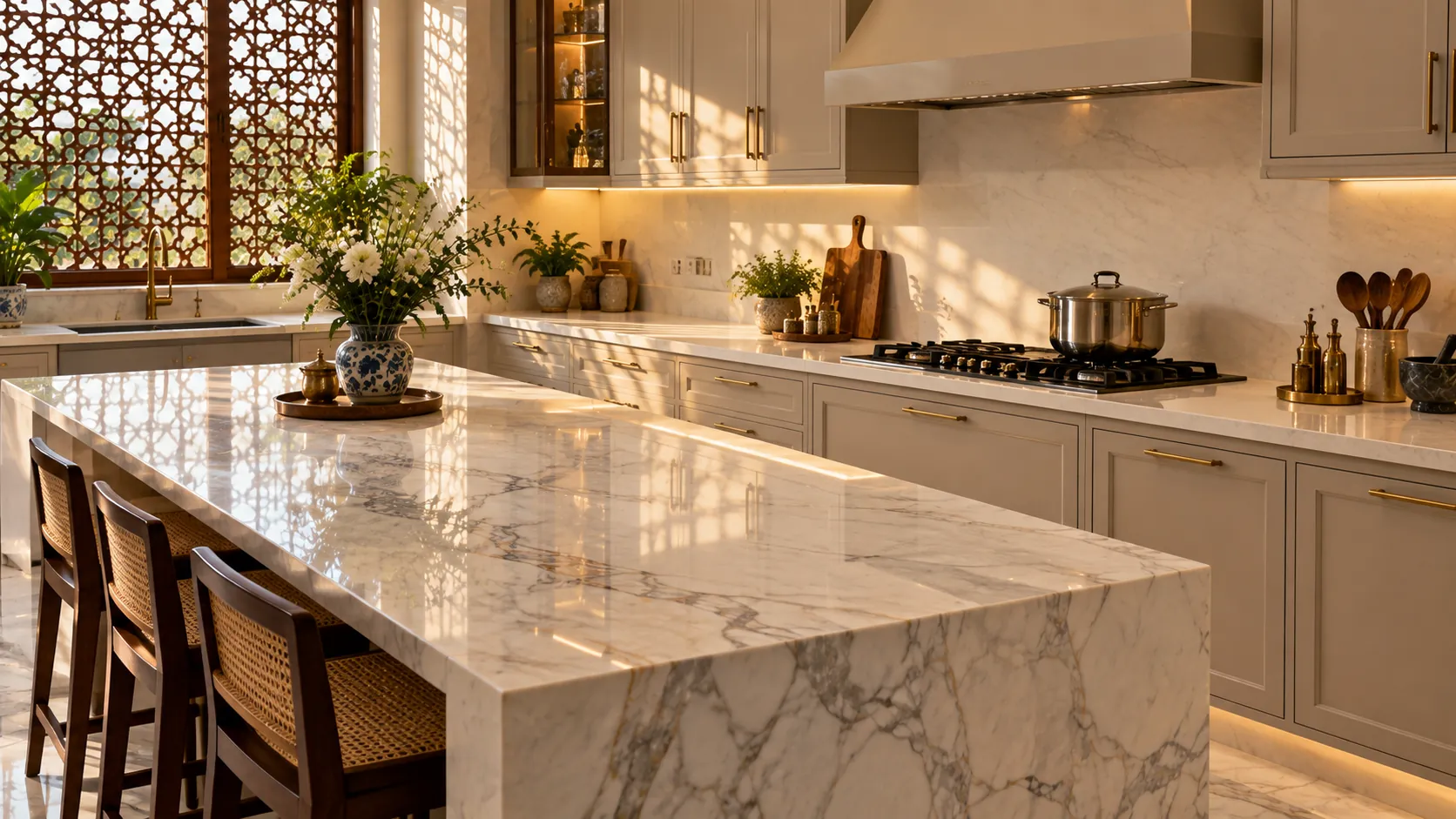
Key takeaways
- Engineered quartz is a factory slab of roughly nine-tenths crushed quartz bound with resin; marble is natural calcite stone, about 3 on the Mohs scale.
- Quartz does not etch or stain, but hot pans can scorch its resin and direct sun can yellow it; marble takes heat and sun but etches with lemon.
- Published quartz prices in Pakistan run roughly PKR 6,000–9,500 per sq ft, against PKR 600–2,100 for local kitchen marbles in our current quotes.
- Marble can be re-honed and re-polished in place many times; heat scorches and sun yellowing on quartz are usually permanent.
- Granite such as Galaxy Black (PKR 900–1,700 per sq ft) gives quartz-level acid and stain resistance and also takes heat and full sun.
The short answer for Pakistani kitchens
In the quartz vs marble decision, engineered quartz wins on stain and acid resistance and needs no sealing, while natural marble wins on heat, sunlight, repairability and price. In Pakistan, published quartz prices run roughly PKR 6,000–9,500 per sq ft against PKR 600–2,100 for local kitchen marbles. Choose quartz for low-effort cooking, marble or granite for sun, hot pans and re-polishing.
Put simply: if your kitchen sees daily tarka, lemon and achaar and you want a uniform look with minimal care, quartz is the lower-effort surface. If the counter gets direct sun or hot pans straight off the burner, or you want a surface that can be renewed in place, natural stone is the better buy.
Before going further, a disclosure: we supply and fit natural stone only. Marble, granite, onyx and travertine are what we sell. We do not sell engineered quartz or quartzite, so we have no reason to talk you out of either, and where quartz is the right answer for your kitchen this guide says so. All quartz and quartzite rupee figures here are indicative market ranges, not our prices.
If you are weighing the two natural stones against each other instead, our marble vs granite comparison covers that in detail.
What each material actually is
Most confusion here comes from names. In Urdu, "marble" (sang-e-marmar; see marble meaning in Urdu) covers almost any polished stone, and "quartz" is used loosely for anything white and glossy. These three are different products, and cast or resin artificial marble is something else again.
Engineered quartz: crushed stone held in resin
Engineered quartz is a factory-made slab. Ground natural quartz, roughly nine-tenths of the slab by weight, is mixed with a polymer resin binder and pigments, pressed under vacuum into a mould and cured. The quartz particles give it hardness; the resin gives it a sealed, non-porous body and lets the factory print in colour and veining. That resin is also where every weakness of quartz comes from: heat, sunlight and some harsh chemicals act on the binder, not the stone.
Marble: natural calcite stone
Marble is limestone recrystallised by heat and pressure deep underground. In Pakistan it comes mainly from Balochistan (Ziarat, Chaghi, Khuzdar) and Khyber Pakhtunkhwa (Mohmand, Nowshera). It is mostly calcite, about 3 on the Mohs hardness scale, slightly porous, and it reacts with acids. Nothing is added to it: the veining, colour and depth are what came out of the block, which is why no two slabs are identical.
Quartzite: the natural stone people confuse with quartz
Quartzite is a natural metamorphic rock: sandstone fused under heat and pressure until the quartz grains lock together. It is around 7 on the Mohs scale, takes heat and sun like granite, and often looks like marble with soft white and grey movement. It is not engineered quartz and it is not marble. Almost all of the quartzite you will see in Pakistani showrooms is imported, much of it from Brazil.
Trade-name trap: stones such as Perlino "Crystal" or "Crystal White" are marbles, not quartz. On the other side, some imported slabs sold as "soft quartzite" are actually marble or dolomite. Ask the seller to write the material type, not just the trade name, on the quote.
Quartz vs marble side by side
This is how the two compare on the things that actually go wrong in Pakistani kitchens. Quartzite and granite are included because they are the natural alternatives most buyers end up considering.
| Factor | Engineered quartz | Marble | Granite | Quartzite |
|---|---|---|---|---|
| What it is | Factory slab: quartz + resin + pigment | Natural calcite stone | Natural igneous stone | Natural fused sandstone |
| Hot degchi or tawa set down | Risk of scorch, yellow ring or crack | Tolerates it; sudden extreme heat can mark or crack | Tolerates it well | Tolerates it well |
| Direct sunlight / outdoors | Most lines fade or yellow; usually indoor-only | Colour stable; polish weathers outdoors | Excellent | Excellent |
| Lemon, imli, tomato, vinegar | No etching | Etches (dull marks) | No etching | No etching (true quartzite) |
| Haldi, oil, tea | Very low risk | Stains if unsealed | Low risk once sealed | Low risk once sealed |
| Sealing | Not needed | Every 6–12 months on worktops | Yearly on lighter colours | Yearly |
| Scratches | Resists | Scratches from steel and grit | Resists | Resists |
| Repair on site | Chips filled; burns and fading mostly permanent | Re-honed and re-polished in place | Chips filled; polishing is heavy work | Chips filled; polishing is heavy work |
| Look | Uniform, repeatable, printed veins | Unique veining and depth | Speckled crystal | Marble-like movement, glassy depth |
| Source for Pakistan | Imported | Local quarries | Local and imported | Imported |
The pattern: quartz is strongest against acids and stains and weakest against heat and light. Marble is the reverse, and that single trade-off decides most kitchens.
Can quartz handle heat and sunlight?
Not well: heat and UV are where engineered quartz is weakest, because both attack the resin binder rather than the stone particles, while marble and granite tolerate them.
Hot pans, tawas and pressure cookers
Pakistani cooking is hard on worktops. A degchi of salan comes off a high flame, a pressure cooker is lifted off the burner and set down still hissing, and a hot tawa often goes straight onto the counter when the roti is done. Natural stone formed under far higher temperatures than any stove produces, so marble and granite take this in their stride; the main risk with marble is a crack from very sudden, concentrated heat on a cold slab, which is rare.
Quartz is different. The resin binder softens and discolours with direct, prolonged heat, leaving a pale or yellowish ring, and a sharp temperature difference can crack the slab, often near a cut-out where it is narrowest. Quartz manufacturers' own care guides tell you to use a trivet every time. In a house where several people cook, or where a maasi or cook works fast during a dawat, assume someone will eventually forget.
If you choose quartz, keep a wooden board or steel stand permanently beside the hob, and never put the tandoor plate, a hot tawa or a pressure cooker directly on it. Treat this as non-negotiable, not occasional.
Sunlight, west windows and outdoor kitchens
UV light breaks down the resin in most engineered quartz over time. On a counter that gets hours of direct sun, the result is gradual yellowing or uneven fading, typically worst along the edge nearest the window. Most quartz manufacturers limit their warranty to indoor use away from direct sun; a few outdoor-rated lines exist, but check before you buy. In Pakistan this matters more than in cooler countries: a west-facing kitchen window in Lahore or Multan, a skylight over an open kitchen, a rooftop barbecue counter, or a lawn outdoor kitchen all put a worktop under very strong sun for much of the year.
Marble does not yellow in sunlight; its colour is in the mineral, not a binder. Polished marble outdoors does slowly lose its shine to rain and dust, which is why we recommend granite or a honed or brushed natural stone for anything under open sky. Our outdoor kitchen stones page covers the options that handle sun, rain and heat together.
Stains, etching and everyday desi cooking
This is where quartz earns its reputation. Because the resin seals every pore, oil, ghee, haldi and tea sit on the surface and wipe off. Acids do nothing to it. A lemon squeezed on the counter, imli chutney, tomato paste, vinegar or a spilled cola leave no mark.
Marble behaves very differently with the same ingredients, and it helps to separate the two problems:
- Staining is something soaking in: haldi, mustard oil, tea, achaar masala. A good impregnating sealer slows absorption enough that a spill wiped within a few minutes leaves nothing behind. Most stains that do set can be lifted with a poultice.
- Etching is a chemical reaction: acid dissolves a thin layer of calcite and leaves a dull mark, most visible on polished stone. Sealer does not stop it. Lemon, imli, tomato, yoghurt-based marinades and many bathroom and tile cleaners all etch marble.
- Honed marble shows etching far less than polished, because the surface is already matte. For a working kitchen in marble, a honed finish is the single best way to keep it looking even.
Quartz is not completely carefree. Strong alkaline cleaners such as oven cleaner, paint thinner, nail polish remover and undiluted bleach can dull or discolour the resin, and a permanent marker or hair dye left on light quartz can leave a shadow. Daily cleaning with warm water and a mild dish soap avoids all of this.
For marble, the routine that keeps it looking good is in our guide on how to seal marble in Pakistan's heat and dust, including the water test that tells you when it is due.
Seams, slab sizes and fitting
Engineered quartz comes in fixed factory sizes, typically around 3 metres long and 1.4 metres wide, with larger jumbo slabs from some makers. Because every slab of a colour is the same, a fabricator can plan seams anywhere and the colour on either side will match. On plain and speckled designs, a well-made seam filled with tinted epoxy is very hard to spot. On veined, marble-look quartz the printed veins rarely continue across a joint, and that interrupted vein is often more noticeable than a seam in natural marble.
Marble slab sizes depend on the block, so long, clean slabs of premium whites command higher rates. The advantage is that veins can be laid out deliberately: slabs cut in sequence from one block can be bookmatched or arranged so the movement flows across a seam. When you select marble, ask to see the slabs laid out side by side at the yard so you can agree where joints will fall before anything is cut.
Fitting and cut-outs
- Marble is lighter to work. A fitting team can trim an edge or adjust a hob cut-out on site with a hand grinder, which helps when Pakistani cabinet carcasses are not perfectly square.
- Quartz should be cut and finished in the workshop with water-fed tools. On-site corrections are slow, and dry cutting throws off a fine dust you do not want in your house (see below).
- Lead time for marble from local quarries is usually short. Quartz depends on whether the colour is in stock locally or on order from abroad, which can add weeks.
A health note on cutting engineered quartz
Engineered quartz contains far more crystalline silica than marble, which is mostly calcium carbonate. Dry-cutting or grinding it releases fine silica dust, and breathing that dust over time causes silicosis, an incurable lung disease. The risk is serious enough that Australia banned the use of engineered stone benchtops from 1 July 2024. For a homeowner the practical point is simple: insist that your quartz is cut wet in the fabricator's workshop, and do not let anyone dry-grind it inside the house.
Repair, ageing and resale perception
Think about how the counter will look in fifteen years, not on handover day.
Marble ages and can be renewed. Etch marks, light scratches and dullness are removed by grinding and re-polishing in place, the same ragrai and polishing work done on marble floors across the country. A tired worktop can be brought back close to new in a day, and this can be repeated many times over the life of the slab. Our marble polishing guide explains how it is done and what it costs.
Quartz ages more slowly but less forgivingly. It resists everyday wear for years, which is its strength. When damage does happen, the options are narrower: chips along an edge can be filled with colour-matched resin by a skilled fabricator, but a heat scorch, yellowing from sun or a crack across a cut-out is usually permanent short of replacing the section. Matching a replacement piece years later depends on the manufacturer still making that colour.
On resale, buyers and estate agents in Pakistan recognise natural marble names. "Ziarat White kitchen" or "granite tops" reads as a known quantity in a listing. Quartz is newer here and is seen as a premium, modern choice in upmarket kitchens, but recognition varies and many buyers cannot tell a good quartz from a cheap one. Condition matters more than type, which favours the material you will actually look after.
Is quartz more expensive than marble in Pakistan?
Yes, several times more: published finished prices for engineered quartz run roughly PKR 6,000–9,500 per sq ft, while our current installed quote ranges (November 2026) for local marble run PKR 600–2,100 and granite PKR 650–1,700. Natural stone and quartz are priced per square foot of finished surface, but published figures are hard to compare because some include fabrication, edges, cut-outs and fitting while others are the bare slab. The marble and granite rows below are our current quote ranges from the catalogue, fabricated and fitted in our service area, with cut-outs, seams and freight itemised. The quartz and quartzite rows are indicative market ranges only: we do not sell either, and you should get written quotes from suppliers who do.
| Material | Example | PKR per sq ft | Basis |
|---|---|---|---|
| Marble, mid-range white | Ziarat White | PKR 850 – 1,600 | Our current quote range |
| Marble, premium white | Ziarat Supreme | PKR 1,100 – 2,100 | Our current quote range |
| Marble, cream | Perlino Crystal Plain | PKR 900 – 1,700 | Our current quote range |
| Marble, beige | Verona Plain | PKR 600 – 1,100 | Our current quote range |
| Granite, black with flecks | Galaxy Black | PKR 900 – 1,700 | Our current quote range |
| Granite, grey | Nagar Parkar Grey | PKR 650 – 1,200 | Our current quote range |
| Engineered quartz | Imported, unbranded to branded | Roughly PKR 6,000 – 9,500 | Indicative market range; check what is included |
| Quartzite | Imported, mostly Brazilian | Top of the market | No reliable published rupee rates found |
On the published quartz countertop price in Pakistan, the clearest figure we found is a 2025 chart from a Pakistani fabricator listing quartz at roughly PKR 6,000 to 9,500 per sq ft. That chart does not say what the number includes, and its granite figures were also far above typical yard rates, so treat it as a sign of where finished, fitted quartz sits rather than a slab price. Even at the low end of that range, quartz comes out several times our quote ranges for local marble or granite in the table above.
We have not found reliable published rupee rates for quartzite. It is imported in small volumes, priced off the exchange rate with freight and duty on top, and generally sits at or above branded quartz. Ask for the slab, the origin and the full fitted price in writing.
Why quartz costs more here
- It is imported, so the rupee price follows the dollar and includes freight, duty and the importer's margin.
- Fabrication needs water-fed bridge saws and diamond tooling; fewer workshops do it, and they charge for it.
- Branded lines carry a brand premium and a warranty; unbranded slabs are cheaper but quality and resin content vary.
- Marble comes from local quarries in volume, so even the premium Ziarat grades stay well below imported surfaces.
For a quick estimate on the natural stone side, our cost estimator gives a low and high figure for any stone from your measurements. Always compare quotes on the same basis: total sq ft including wastage, thickness, edge profile, sink and hob cut-outs, transport and fitting.
Quartz vs granite and quartzite vs marble
Many people who start out comparing quartz with marble actually want the strengths of both. Two natural stones get closest.
Granite: the natural answer to "quartz without the weaknesses"
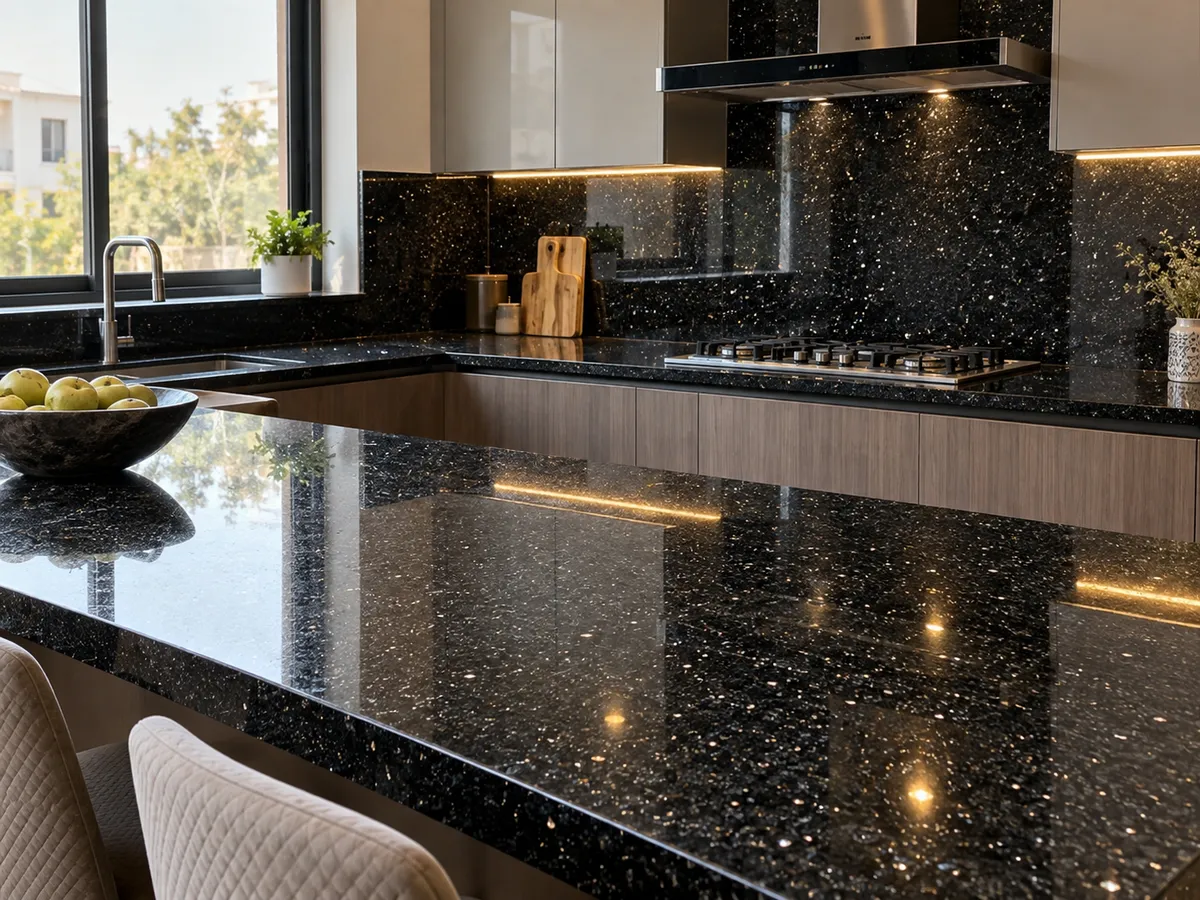
Granite does not etch, resists stains once sealed, takes a hot degchi and is happy in full sun. Against quartz it gives up only two things: it is not perfectly uniform, and lighter colours need sealing about once a year. Against those, it costs a fraction of quartz in Pakistan because the main colours are quarried here. For a kitchen that cooks heavily, Galaxy Black or Nagar Parkar Grey are hard to beat on value. If you want a light look, Swat White granite is the closest local stone to a white quartz.
Quartzite: the marble look with granite toughness
Quartzite appeals to people who love white marble but cook with lemon every day. True quartzite does not etch and handles heat and UV. The catch is cost, limited local stock and mislabelling: test any "quartzite" by trying to scratch a glass tile with a corner (real quartzite scratches glass, marble does not) and by putting a drop of lemon juice on a hidden spot for ten minutes. If it dulls, it is not quartzite.
A workable split many households choose is granite on the cooking run where heat and haldi live, and white marble on the island or a breakfast counter where it can be seen and enjoyed. Our kitchen countertop stones page shows the marbles and granites we fit for both roles.
Where each one wins, room by room
| Location | Best choice | Why |
|---|---|---|
| Main cooking run, heavy daily cooking | Granite, or quartz with strict trivet habits | Heat plus acids plus oil; marble needs honing and care here |
| Island or breakfast counter | Marble or quartz | Little direct heat; marble gives the look, quartz the low effort |
| Kitchen with strong direct sun | Marble, granite or quartzite | Most quartz yellows or fades under UV |
| Outdoor or rooftop barbecue | Granite (brushed or leathered) | Sun, rain, dust and open flame |
| Bathroom vanity | Marble or quartz | No heat; marble needs care with acidic cleaners |
| Floors and stairs | Marble or granite | Quartz slabs are not a practical or economical flooring choice here |
| Rental flat or office pantry | Granite or quartz | Users will not seal or baby the surface |
Quartz is the honest winner for a modern, heavily used indoor kitchen in a household that will reliably use trivets, wants a uniform colour, and does not mind the price. Marble wins for anyone who values natural veining, local supply and the ability to renew the surface, and who is willing to choose a honed finish and seal on schedule. Granite is the quiet default that covers most of quartz's strengths at a fraction of the cost.
Buying checklist before you pay a deposit
If you are buying quartz
- Ask for the brand and country of manufacture in writing, plus the product spec sheet. Unbranded slabs vary a lot in resin content and finish.
- Read the warranty for exclusions: heat damage, direct sunlight and outdoor use are commonly excluded.
- Check the slab face under a phone torch at a low angle for pits, resin pooling or colour patches before it is cut.
- Confirm the cutting is done wet in the workshop, and agree that no dry grinding happens inside your house.
- Get a fitted price covering edges, sink and hob cut-outs, backsplash, transport and installation, so it can be compared with a stone quote line by line.
If you are buying marble
- Choose the finish for the job: honed on cooking areas, polished where it is mostly seen.
- Wet a corner at the yard. If it darkens quickly, it is a thirsty stone and must be sealed before use.
- See the full slabs and approve where seams fall, especially on veined whites.
- Ask for all pieces from one block, so the island and worktops match.
- Make sure sealing at fitting is in the quote, and ask how often to repeat it.
Whatever you choose, test it at home. Put a sample next to your cabinet colour, squeeze lemon on one corner, leave a drop of haldi and oil overnight, and see how it looks in your own morning and evening light.
Get stone samples and a quote
If natural stone looks like the right fit after reading this, order stone samples of the marbles and granites on your shortlist. They are PKR 500 each, credited against your order, and they are the best way to run the lemon, haldi and sunlight tests yourself.
Then send us your kitchen layout and measurements through our free quote form. We reply with an installed rate covering the stone, cutting, standard edge and fitting, with cut-outs, seams and any transport itemised, so you can put it beside any quartz quote and compare them fairly. If quartz turns out to suit your household better, that comparison will show it clearly too.
Written by
The Captivating Marble Design Team
Fabricators, templaters and stone designers
We template, cut and install natural stone every day and write about what we learn — pricing, layouts, care and the mistakes we help clients avoid.
Book a free design consultation