Artificial Marble vs Natural Marble in Pakistan: Cost, Durability and Care
Cultured marble, engineered stone, porcelain and PVC sheets vs natural stone: cost, heat, etching, repairs and resale in Pakistan. Get a free quote.
Captivating Marble Design Team · · Updated · 18 min read
Key takeaways
- Man-made marble covers cultured (cast) marble, engineered marble, engineered quartz, acrylic solid surface, marble-look porcelain and PVC sheets.
- Natural marble is the only option that can be ground and re-polished many times; porcelain and PVC are replaced when damaged.
- Local natural marble is not automatically expensive: Medium White costs PKR 550–950 and Sunny Grey PKR 560–1,000 per sq ft on our November 2026 quotes.
- Natural marble rates about Mohs 3–4 and etches with lemon, vinegar and imli, so it should be sealed after fitting and resealed about once a year.
- Engineered marble is mostly crushed calcite, so it etches with lemon and vinegar just like natural marble.
The short answer
Artificial marble is any factory-made material designed to look like marble: cultured (cast) marble, engineered marble, engineered quartz, solid surface, marble-look porcelain and PVC sheets. Natural marble is quarried stone, such as Ziarat White from Balochistan at PKR 850 to 1,600 per sq ft, that tolerates heat and can be re-polished for decades.
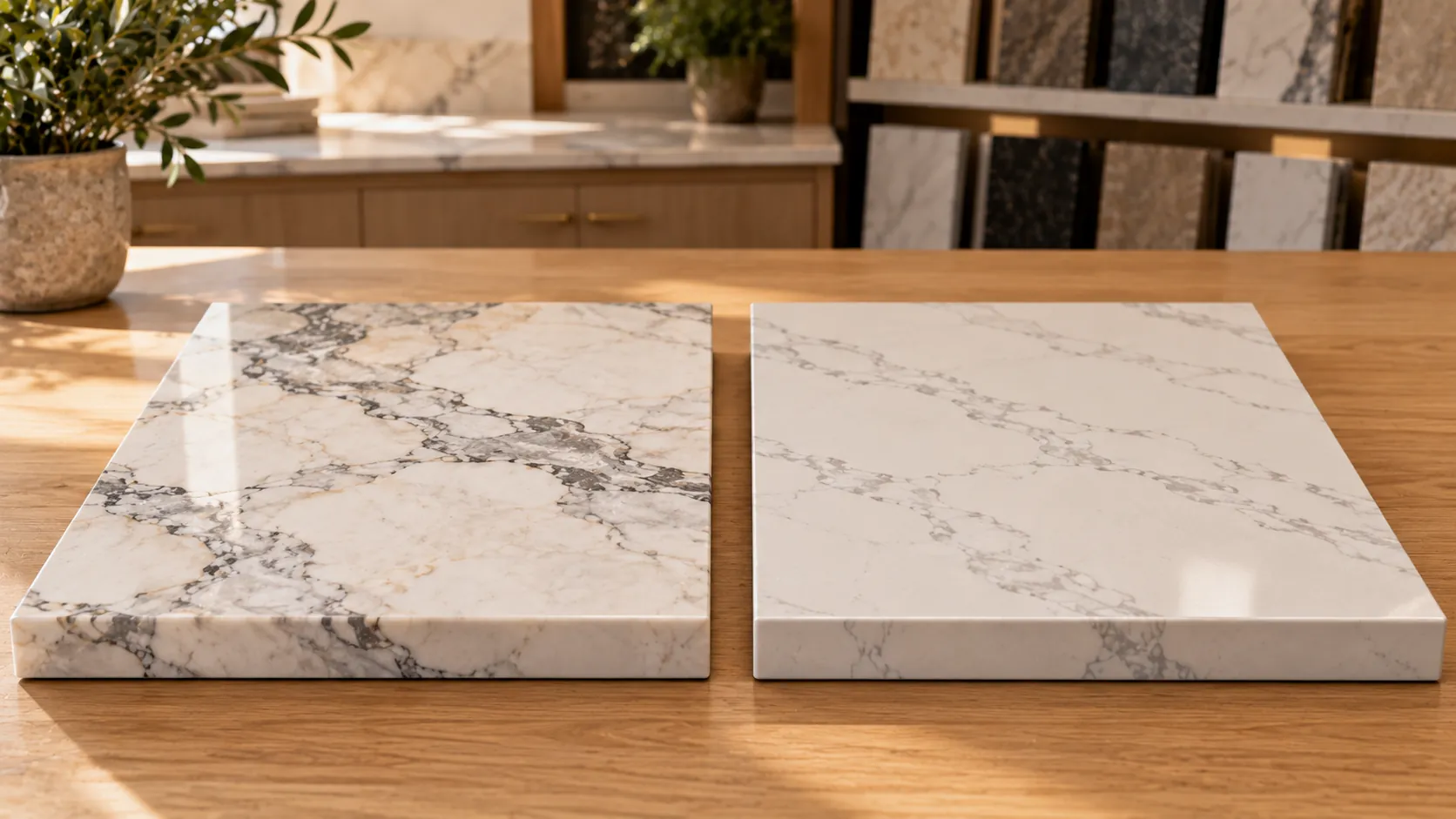
Because natural marble is cut from a quarry block, every slab is different and the colour runs right through it. Neither is better everywhere. Natural stone wins on heat tolerance, repairability, depth of colour and lifespan; it can be ground and re-polished many times over decades. Man-made products win on stain and acid resistance (except engineered marble), uniformity and, in the case of porcelain tiles and PVC sheets, a low entry price. In Pakistani conditions the deciding factors are usually heat from cooking, strong sun, hard water, how the surface will be repaired in ten years and what the budget really includes once fitting is added.
We sell natural stone only: marble, granite, onyx, travertine and Chips Dana marble-chip terrazzo. We do not sell any of the man-made products described here, and we have tried to describe them fairly. Natural-stone rates are our current quote ranges per square foot (November 2026), installed in our service area; every figure for a man-made product is an indicative market range only.
What is artificial marble made of?
It is made of resin, fired clay or plastic, usually combined with stone filler or a printed marble pattern. Shops and contractors use the same few words for very different products, so start by finding out which one you are actually being shown. The table sorts them by what they are made of, because that decides how each one behaves.
| Material | What it is made of | Common uses | Main weakness |
|---|---|---|---|
| Cultured (cast) marble | Crushed stone or calcium carbonate filler in polyester resin, cast in a mould, with a clear or tinted gelcoat on the surface | One-piece vanity tops with moulded basins, shower trays, window sills | Gelcoat scratches, dulls and can crack from heat |
| Engineered (agglomerate) marble | Natural marble chips and powder bound with resin, pressed into blocks and sawn into slabs or tiles | Floors and walls in commercial buildings, imported "uniform" beiges and whites | Still etches like marble, plus resin weaknesses |
| Engineered quartz | Ground quartz bound with resin and pigment, pressed into slabs | Kitchen worktops, vanity tops | Heat and UV act on the resin |
| Acrylic solid surface | Mineral filler in acrylic resin | Seamless counters with moulded sinks, reception desks | Soft, scratches and marks from hot pots |
| Porcelain and sintered slabs | Fired clay and minerals with a printed marble image on the face | Floors, walls, large-format cladding, some worktops | Pattern is only on the surface; chips cannot be re-polished |
| PVC or "UV marble" sheets | Plastic sheet with a printed pattern and a glossy cured coating | Wall panels, TV walls, shop interiors | Not for floors, heat or wet areas; scratches and dents |
One local material sits in between: Chips Dana, which is real marble chips set in a cement matrix, laid on site and ground flat. It is a manufactured surface made from natural stone, and it behaves like marble because it is marble. We supply it, and it is discussed further down.
How natural marble differs
Natural marble is a metamorphic rock made almost entirely of calcite crystals. The veining is the trace of impurities, clay, iron and carbon, that were folded and recrystallised under heat and pressure over geological time. That gives it four properties no factory product fully copies.
- Depth. Light travels a little way into the crystals before reflecting, which is why a polished white marble looks luminous rather than painted. Printed surfaces reflect from the top layer only.
- Through-colour. The pattern runs through the full thickness. An edge, a cut-out or a chipped corner shows the same stone, so it can be shaped, profiled and repaired.
- No repeats. Every block is different. Book-matched slabs from one block mirror each other; nothing else in the house will match them.
- Heat stability. There is no resin to soften. A hot pot can leave a mark or, with an extreme temperature shock, crack a stone, but marble will not scorch, melt or yellow.
The weaknesses are just as real. At about 3 to 4 on the Mohs scale, marble scratches under grit and steel. Acids from lemon, vinegar, imli, tomato and many bathroom cleaners cause etching, a dull patch where the polish has been dissolved. It is porous enough to take stains from oil and haldi unless sealed. Some Pakistani slabs also carry natural fissures that the yard fills with resin before polishing, which is normal on floors and walls but worth avoiding where water stands. Put simply, natural marble is a stone you maintain, not one you ignore.
Pakistan quarries a wide range of it. Our current list includes Ziarat White from Balochistan (PKR 850 – 1,600 per sq ft), Verona Plain from Chaghi (PKR 600 – 1,100), Sunny Grey from Ziarat (PKR 560 – 1,000) and Medium White (PKR 550 – 950). Browse the full range on our marble page.
Cultured and engineered marble
Cultured (cast) marble
Cultured marble is poured, not cut. Filler and polyester resin are mixed, coloured with swirls of pigment to imitate veining, and cast in a mould that has been sprayed with gelcoat. When it is demoulded, the gelcoat forms a smooth, glossy skin over the whole piece. Its big advantage is shape: a vanity top, its basin and its splashback can come out of the mould as one seamless piece with no joints to leak.
The gelcoat is also its limit. It is a thin plastic layer, so scouring powder and grit dull it, and a deep scratch cuts through to the filler beneath. Very hot water poured repeatedly into a cast basin, or a hot hair-straightener set on the counter, can cause fine crazing or cracks, often around the drain where the material is thinnest. Small damage can be patched with a gelcoat repair kit, but colour matching is hard and the repair usually shows. Over years, some gelcoats yellow, especially on light colours.
Engineered (agglomerate) marble
Engineered marble takes real marble, crushed into chips and powder, and binds it with a resin into large blocks that are sawn and polished like natural stone. Most of its weight is marble, which gives it a convincing look and a very even colour from tile to tile, popular for large commercial floors where uniformity matters more than character.
Because it is mostly calcite, it etches from acids exactly like natural marble. Because it contains resin, it also inherits resin's weaknesses: it is less tolerant of heat and direct sun than solid stone, and outdoors or under strong window light it can fade or yellow. It can be honed and re-polished, but the resin and chips wear at slightly different rates. For most Pakistani homes it offers the downsides of both materials with few extra benefits; a consistent natural stone such as Sunny Grey or Medium White usually gives a more even look at a lower cost.
Engineered quartz and solid surface
Engineered quartz replaces the marble chips with ground quartz, which is much harder, so it resists scratches, stains and acids far better. It is still bound with resin, so heat and sunlight are its weak points, and its cost in Pakistan runs several times that of local stone. We cover it in depth in our quartz vs marble guide. Acrylic solid surface is softer again: it scratches and marks easily, but it can be sanded back and joined almost invisibly, which is why it appears on reception desks and hospital counters more than in homes.
Cutting and grinding engineered quartz releases very fine crystalline silica dust, a known cause of the lung disease silicosis among fabrication workers. Australia banned the use of engineered stone from 1 July 2024 for this reason. If you choose quartz, ask whether your fabricator cuts with water and uses proper dust extraction and masks.
Porcelain, sintered slabs and PVC sheets
Marble-look porcelain tiles
Porcelain is fired at high temperature until it is dense and absorbs almost no water. The marble pattern is printed on the face by inkjet, then glazed or polished. It does not etch, barely stains and is not affected by heat or sunlight, which makes it a very practical floor for the price. The trade-offs are that the pattern sits on the surface only, a chip shows the different-coloured body underneath, and the same handful of printed faces repeat across a floor; once you spot the repeat you cannot unsee it. A worn or chipped porcelain tile is replaced, not repaired, and finding a matching batch a few years later is often impossible. Our marble vs tiles guide compares the two for floors room by room.
Large-format sintered or porcelain slabs
Large porcelain and sintered slabs are made the same way at much bigger sizes and are sold for walls, cladding and, increasingly, worktops. They resist heat, UV, acids and stains very well. They are also brittle in the thinner sizes, need skilled cutting with specialist blades, and edges and sink cut-outs show the body unless the fabricator mitres them. A cracked slab cannot be patched invisibly. Ask for fitted, all-in quotes; slab prices alone are misleading because fabrication is slow and breakage in cutting is a real cost.
PVC and "UV marble" sheets
These are thin plastic sheets printed with a marble pattern and finished with a hard, glossy coating, glued to a wall in large panels. They are light, quick to fit, cheap and useful for a rental, a shop fit-out or a quick TV wall update. They are not stone in any sense: they dent, scratch under a ring or a broom, soften near heat sources such as a fireplace or stove, and the joints between sheets show. Keep them away from floors, kitchens near the hob and wet areas, and check what the product says about fire behaviour before using it in a lounge or stairwell. For a full comparison of PVC and UV sheets (where they work, heat, fire, damp, sunlight and lifespan), see marble sheets compared with real marble.
Side-by-side comparison for Pakistani homes
The comparison below sets natural stone against each type of artificial marble on the questions that matter most in a Pakistani home: cooking heat, sun, acids, scratches, repairs and lifespan.
| Test | Natural marble | Cultured / engineered marble | Engineered quartz | Porcelain | PVC sheet |
|---|---|---|---|---|---|
| Hot degchi or tawa | Tolerates it; extreme shock can mark | Risk of scorch or crack | Risk of scorch, yellow ring or crack | Tolerates it well | Melts or warps |
| Strong sun through a window | Colour stable | May fade or yellow | Most lines fade or yellow | Colour stable | May fade |
| Lemon, vinegar, imli | Etches | Engineered etches; cultured gelcoat resists | Resists | Resists | Resists |
| Haldi and oil | Stains unless sealed | Mostly resists | Resists | Resists | Resists |
| Scratches from grit | Scratches; can be re-polished | Scratches; limited repair | Resists well | Glaze resists; polished faces can dull | Scratches easily |
| Repair after 10 years | Grind and re-polish many times | Patch kits; repairs often show | Resin chip repair; no full refinish | Replace the tile | Replace the sheet |
| Expected life in a home | Generations, with care | Years to a couple of decades | Long indoors, away from sun and heat | Long, until a tile chips | Short to medium |
Two points often surprise buyers. First, natural stone is the only option in the table that can be fully renewed: a dull, scratched marble floor can be ground, honed and polished back to near-new, which our marble polishing guide explains. Second, the man-made options are better than marble at the single thing that bothers Pakistani cooks most, acid etching, which is why we often recommend granite instead of marble for a busy kitchen counter. Our marble vs granite guide covers that choice.
Is man-made marble cheaper than natural stone?
Not always: porcelain tile and PVC sheets are usually cheaper, but engineered quartz costs several times more than local marble, which starts around PKR 550 per sq ft fitted with us. Comparing prices across these materials is tricky because they are sold in different ways: natural stone by the square foot of slab or tile, porcelain by the box, cultured tops by the piece, PVC by the sheet and quartz usually as a fitted price. Always compare the total for the finished job.
| Material | Example | PKR per sq ft | Basis |
|---|---|---|---|
| Marble-chip terrazzo | Chips Dana | 180 – 420 | Our current quote range, installed |
| Natural marble, economical white | Medium White | 550 – 950 | Our current quote range, installed |
| Natural marble, grey | Sunny Grey | 560 – 1,000 | Our current quote range, installed |
| Natural marble, mid-range white | Ziarat White | 850 – 1,600 | Our current quote range, installed |
| Natural marble, premium white | Ziarat Supreme | 1,100 – 2,100 | Our current quote range, installed |
| Natural granite, black | Galaxy Black | 900 – 1,700 | Our current quote range, installed |
| Marble-look porcelain tile | Local and imported | About 350 – 1,000+ | Indicative market range |
| Engineered quartz | Imported, unbranded to branded | Roughly 6,000 – 9,500 | Indicative market range, usually fitted |
| Cultured marble, PVC sheets, sintered slabs | Various | Sold per piece or sheet; varies widely | Ask for an all-in fitted price |
Natural marble is not automatically the expensive option in Pakistan. Local stone is quarried and cut here, so an economical white or grey, fitted, sits in the same bracket as good imported porcelain bought as material alone, and far below engineered quartz. Imported natural marbles are a different matter; we do not sell them, and local stones such as Ziarat White and Ziarat Supreme are the closest whites we can offer.
Other costs to compare
- Laying and on-site polishing. Natural stone floors are usually ground and polished after laying; porcelain is not. Our ranges already include this in our service area.
- Wastage. Plan around 10% for plain layouts and 15% or more for matched patterns, on any material.
- Fabrication. Cut-outs, edges and mitres on worktops (our quote includes a standard edge and itemises cut-outs and mitres); slower and riskier on porcelain and sintered slabs.
- Sealing. Natural marble needs sealing after fitting and periodically after; man-made surfaces mostly do not.
- Maintenance over time. Marble may need a professional re-polish every few years in busy areas; man-made surfaces are cheaper to keep but more expensive to fix once damaged.
Use our cost estimator to put your own room sizes against our installed natural-stone rates, then compare that figure with fitted quotes for the alternatives.
Resale and how a house is valued
We have no data that puts a rupee figure on what natural stone adds to a property, and we would be wary of anyone who claims one. What can be said is practical. Natural marble floors and stairs are a recognisable, expected finish in many Pakistani houses, and buyers can see and feel what they are getting. A worn marble floor can be restored with a polish before a sale; a chipped porcelain floor or peeling PVC wall panels usually signal a replacement job to the next owner. A discoloured cultured basin or a scorched quartz counter is likewise replaced, not refreshed.
If you are building to sell soon, the sensible approach is mixed: natural stone where people look first and wear hardest (entrance, drawing room, stairs, main bathroom tops), and porcelain or other practical materials in service areas, store rooms and rental portions.
How to tell natural marble from a copy
Sellers do not always say clearly what they are offering, and the photos can be very convincing. These checks work at a yard or showroom.
- Look at the edge and the back. Natural stone shows the same colour and veining through its thickness. Porcelain shows a plain body under a printed face; cultured marble shows a thin glossy skin over a duller core; PVC is obviously plastic.
- Look for repeats. Lay out several tiles or study a large area. Printed products repeat the same vein patterns; natural stone never does.
- Feel the temperature. Stone feels cool and stays cool in the hand. Resin and plastic warm up quickly.
- Check the weight. Natural marble is heavy, about 2.7 tonnes per cubic metre. A light piece of the same size is something else.
- Try the vinegar test on an offcut only. A drop of vinegar on natural marble or engineered marble leaves a dull etch mark after a few minutes. Quartz, porcelain, PVC and most gelcoats show nothing. Never test on a piece you intend to use.
- Scratch the back with a steel key. Marble scratches with some effort and leaves white powder; quartz and porcelain resist; plastic coatings scratch and curl.
- Ask for the quarry. A seller of natural stone can tell you where the block came from, such as Ziarat, Chaghi or Mohmand. Ask to see the slab or block, not just a sample board.
Which to choose, room by room
| Area | Natural stone choice | When a man-made option makes sense |
|---|---|---|
| Drawing room and entrance floors | Ziarat White, Verona Plain, Sunny Grey | Tight budget on a large area: porcelain |
| Stairs | Marble or granite, honed or with grooved nosings | Rarely; tile nosings chip and are hard to repair |
| Kitchen worktop | Granite such as Galaxy Black; marble only if you accept etching | Quartz if you never put hot pots down and the counter is out of direct sun |
| Kitchen backsplash | Any marble you like | Porcelain for a quick, low-cost splash |
| Bathroom vanity top | Ziarat White, Ziarat Supreme, Sunny Grey | Cultured one-piece top for a rental bathroom |
| Shower walls | Honed marble or travertine, well sealed | Large porcelain slabs for fewer joints and no sealing |
| TV and feature walls | Book-matched marble or backlit onyx | PVC sheets for a short-term or rental fit-out |
| Porch, courtyard, servant quarters | Granite, Chips Dana | Outdoor-rated porcelain |
If uniformity is what draws you to a man-made product, consider a consistent natural stone before you decide. Sunny Grey, Medium White and Verona Plain all vary much less than the dramatic veined stones, and Chips Dana gives a seamless, low-cost floor made of real marble chips. Order samples of two or three and compare them in your own light.
Living with natural marble in Pakistani conditions
Much of the appeal of man-made products is that they seem carefree. Natural stone is not, but its care is simple once it becomes routine.
- Seal after fitting with a penetrating sealer and reseal roughly once a year on floors and vanities, sooner on kitchen surfaces. Do the water-drop test: if water darkens the stone within a few minutes, it is time to reseal.
- Dust-mop daily. Fine summer dust acts like sandpaper on a polished face; doormats at every entrance help.
- Clean with a pH-neutral cleaner, never vinegar, lemon, bleach or tile acid.
- Wipe hard-water drips on vanities and around taps before they dry into white rings.
- Choose honed finishes where etching or wet-floor grip worries you; they hide wear better than polish.
- Re-polish when it dulls. A professional polish restores the surface, which no man-made product can match.
In monsoon humidity, allow extra curing time before sealing; in June and July, keep new stone out of direct sun during fitting so the adhesive does not cure too fast.
See the real stone before you decide
The quickest way to choose is to put natural stone and the alternative side by side in your own light. Order samples of two or three of our stones (PKR 500 each, credited against your order), place them next to the porcelain or quartz sample you are considering, and try the vinegar, haldi and hot-cup tests yourself. When you are ready, send your room sizes through the free quote form and we will price the natural-stone option installed, with cut-outs, seams and freight itemised, and tell you plainly where a man-made product would serve you better.
Written by
The Captivating Marble Design Team
Fabricators, templaters and stone designers
We template, cut and install natural stone every day and write about what we learn — pricing, layouts, care and the mistakes we help clients avoid.
Book a free design consultation