Countertop Edge Profiles: Eased, Bevel, Bullnose, Ogee, Mitred and Laminated Compared
Eased, bevel, bullnose, ogee, mitred and laminated stone edges compared on looks, chipping, cleaning, child safety and cost per foot. Get a free quote.
Captivating Marble Design Team · · 18 min read
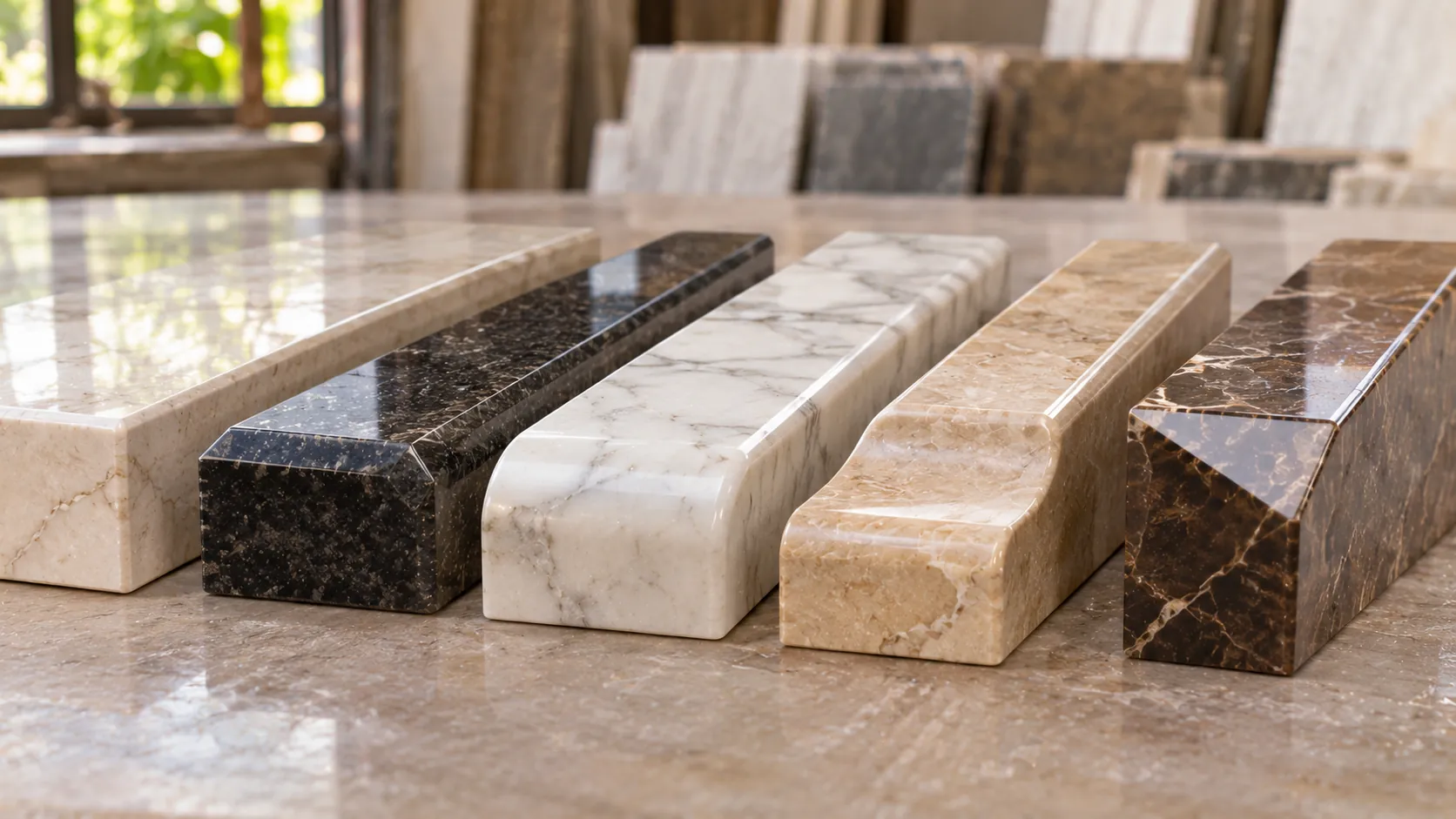
Key takeaways
- An eased or straight polished edge is included in our installed rate; bevel, bullnose, ogee, laminated and mitred edges are itemised per running foot.
- Our cost estimator plans edges at about PKR 250 per running foot for a bevel, 400 for bullnose, 600 for ogee and 1,400 for a mitred edge.
- A full bullnose has no sharp corner, so it chips least and is the safest edge for homes with small children.
- Ogee and other moulded edges trap ghee, flour and dust in the curve and chip at the thin top lip on soft marble.
- A laminated or mitred edge makes 2 cm stone look 4 cm or thicker without paying for a thicker slab across the whole top.
The short answer
The seven countertop edge profiles you will be offered are eased, bevel, half bullnose, full bullnose, ogee, laminated and mitred. An eased edge is included in our installed rate; the others are itemised, from about PKR 250 per running foot for a bevel to PKR 1,400 for a mitre in our cost estimator, as of November 2026.
For a busy Pakistani kitchen, an eased or half-bullnose edge on 2 cm stone is the practical default: it wipes clean in one pass, it does not hold ghee or atta, and it chips less than a sharp square corner. A full bullnose is the softest choice for a house with toddlers. Ogee belongs in formal rooms where nobody chops onions. Laminated and mitred edges are not shapes so much as ways of making a thin slab look thick, and they cost the most.
This guide explains how each edge is made, how it looks, how it stands up to knocks and cleaning, which suits kitchens, vanities, tables and window sills, and what it adds to a quotation. Each profile has its own entry in our stone glossary with a drawing, if you want to see the shape before you read on.
How we priced this: stone rates are our catalogue quote ranges per square foot as of November 2026, fabricated and installed in our service area with a standard eased edge and polished finish. Decorative and built-up edges are itemised per running foot; the per-foot figures below are the planning adders our cost estimator uses, and your written quote sets the final line. Cut-outs, seams and freight outside our fitting cities are also itemised.
What is an edge profile, and how is it made?
An edge profile is the shape cut and polished into the exposed front or side of a stone top. Every piece leaves the saw with a raw, square, slightly rough edge. In the workshop that edge is shaped with profiled diamond wheels on an edge-polishing machine, a CNC router or a hand grinder, then taken through finer and finer polishing pads until it matches the face of the slab. A polished top gets a polished edge; a honed top gets a honed one.
The shapes fall into three families, and it helps to think of them that way before you look at a sample board:
- Simple edges remove only the sharp corner: eased (also called straight or flat polished) and bevel. They are quick to cut and the cheapest.
- Rounded and moulded edges cut a curve through most of the thickness: half bullnose, full bullnose and ogee. They need more machine passes and hand polishing through the curve.
- Built-up edges glue a second strip of stone to the slab so the front looks thicker: laminated (strip glued flat underneath) and mitred (strip joined at 45 degrees). Most simple and rounded shapes can also be cut on a built-up edge.
Only the visible edges are profiled. The back edge against the wall and any edge hidden by a tall unit or a fridge are left square and unpolished, so you pay for the running feet you can see, not the whole perimeter. When you count running feet for a quote, count the front of every run, the exposed ends, and all four sides of an island or a dining table.
The edge is the part of a top that people touch, knock and clean every day. It is worth deciding it on a real sample of your chosen stone, not from a catalogue drawing: the same shape reads bold on polished black granite and almost invisible on matte white marble. You can order cut pieces from our samples page.
The seven edges, one by one
Eased (straight polished)
An eased edge is a square edge with the top and bottom corners softened to a small radius, usually about 3 mm. From across the room it reads as a clean block of stone; up close the corner feels smooth to the hand. It is the edge most modern Lahore and Islamabad kitchens choose, it shows the full thickness of the slab, and it lets bold veining do the talking. A pencil round is the same idea with a bigger radius, roughly 5 to 10 mm, so the corners look visibly rounded. Ask for the radius on the drawing, because one workshop's "straight" is another's "pencil".
Bevel
A bevel edge is a 45-degree flat facet cut along the top corner, typically 6 to 12 mm wide. The facet catches light as one bright line, which gives a tailored look on polished Galaxy Black granite and a softer one on honed white marble. A double bevel cuts the bottom corner as well, which makes the edge look slimmer and protects the underside when a pot is lifted off. A bevel also hides small differences in thickness between two pieces at a seam, which is a real advantage on long L-shaped runs.
Half bullnose
A half bullnose rounds the top corner in a generous curve and leaves the underside flat. It is the most popular compromise in Pakistani family kitchens: it feels soft against a hip or a child's forehead, it sheds water and crumbs, and its flat bottom sits neatly over cabinet doors. It costs more than eased or bevel work because the curve needs a profiled wheel and hand polishing. Our glossary lists it under the bullnose edge entry.
Full bullnose
A full bullnose rounds the whole thickness into a half-circle, top and bottom. There is no corner left to chip, so it is the most forgiving edge on soft stone and the classic choice for stair nosings, bathroom vanities and kitchens in homes with toddlers. On 2 cm stone it can look like a thin pencil; on a laminated 4 cm front it becomes a fuller, furniture-like curve. Its one drawback in a kitchen is drips: water rolls round the curve and runs down the cabinet doors rather than dropping clear.
Ogee
An ogee edge is an S-curve: a hollow cove at the top flowing into a rounded bead below. It is the traditional moulding, at home in a formal drawing room, a dining table, a powder-room vanity or a fireplace hearth alongside carved woodwork. A double ogee stacks two curves and needs a built-up edge of around 4 to 6 cm. The cove leaves a thin lip of stone at the top corner, which can chip on soft marble, and the hollow collects dust and kitchen grease. It is one of the dearest shapes per foot.
Laminated (built-up)
A laminated edge glues a strip of the same stone under the front of the slab with colour-matched epoxy, then shapes and polishes the two together. It turns 2 cm stone into a 4 cm front, or 3 cm into 6 cm, without buying a thick slab for the whole top. It accepts almost any shape: eased, bevel, bullnose or ogee. On calm stones such as Tavera Light the horizontal glue line is barely visible; on strongly veined stone it shows as a thin line across the front.
Mitred
A mitred edge joins the slab and a drop strip, both cut at 45 degrees, so the joint sits exactly on the corner and the veining appears to fold over the edge. It can make 2 cm stone look 5 to 10 cm thick, and at full height it becomes the waterfall end of an island. It only suits square or lightly eased shapes, it needs the drop strip cut from right next to the top piece for the pattern to carry over, and it is the most expensive edge. Our waterfall island guide covers that build in detail.
Which edge chips least, and which is easiest to clean?
A full bullnose chips least, because there is no corner for a steel pot or a cooker lid to strike; a half bullnose and an eased edge with a decent radius come next. The sharper or thinner the corner, the more it chips: a dead-square edge and the top lip of an ogee are the weak points. For cleaning, the flat and gently rounded shapes win, and anything with a hollow in it loses.
| Edge | Look | Chip resistance | Cleaning | Child safety |
|---|---|---|---|---|
| Eased (about 3 mm radius) | Clean, modern, square block | Good; ask for a 5–10 mm pencil round on soft marble | Excellent: one wipe | Fair; corners still firm |
| Bevel | Crisp line of light | Good; flat facet spreads a knock | Excellent | Fair |
| Half bullnose | Soft, family-kitchen classic | Very good on top; bottom corner square | Excellent | Good |
| Full bullnose | Rounded, traditional | Best: no corner at all | Good; drips run under the edge | Best |
| Ogee | Formal, moulded | Weakest at the thin top lip | Poor: cove holds grease and dust | Fair |
| Laminated 4 cm | Heavy, furniture-like | As the shape cut on it; extra stiffness at the front | As the shape; glue line needs a sound seal | As the shape |
| Mitred | Thick, seamless block | Good if the corner is lightly eased; razor-sharp mitres chip | Excellent | Fair; the deep square front is firm |
The stone matters as much as the shape. Granite and dense black marbles such as Jet Black hold a crisp edge for years. Soft beiges and whites are more forgiving to cut but dent more readily, so they deserve a rounder shape on any edge that takes daily traffic. Onyx is soft and brittle at the edge, and we advise keeping it to bar fronts and powder rooms rather than cooking counters.
Cleaning in a Pakistani kitchen means oil, haldi and atta, and a hot, dusty summer. A flat or gently rounded edge is wiped clean in one pass of a damp cloth. An ogee cove or the fillet step on a decorative moulding collects a fine line of grease and dust that needs an old toothbrush. If a stain does settle into an edge, our guide on how to remove stains from marble covers the poultice method; the edge takes it just like the top.
Whatever the shape, ask for the sharp line where a mitre or a square edge meets the face to be eased slightly. A razor-sharp arris chips at the first knock from a steel karahi, while a 1–3 mm ease is invisible from a step back and survives for years. If a chip does happen, our guide to marble crack repair explains how an edge chip is filled and polished.
Which edge is safest for a home with small children?
A full bullnose is the safest edge for a house with toddlers, followed by a half bullnose. Both remove the hard corner that sits, in most kitchens and vanities, at exactly the height of a small child's head. The kitchen counter in a Pakistani home is usually around 34 to 36 inches high, which puts the edge right where a two-year-old runs past.
- Round the corners in plan as well. The worst knocks happen at the outside corner of an island or a peninsula. Ask for a radius corner, seen from above, as well as a rounded edge profile.
- Avoid a sharp mitred corner at child height. A deep mitred front looks superb, but it is a hard, square block. If you want the look, ask for a generous ease on the corner.
- Think about the dining table too. Tables are at an even more dangerous height for small children. A bullnose or a soft pencil round is kinder than a bevel; our marble table design guide covers table tops in full.
- Stairs and window sills. A rounded nosing is standard on stair treads because it is gentler on bare feet and chips less; low window sills in children's rooms deserve the same treatment.
A soft edge is not a replacement for corner guards on a very young child's route through the house, but it is a permanent improvement that costs little to specify at the drawing stage and a lot to change later.
Which edges suit kitchens, vanities and tables?
Kitchens suit eased, half-bullnose or mitred edges; vanities suit eased, bullnose or a laminated 4 cm front; dining and centre tables suit bullnose, bevel or ogee. The table below goes surface by surface, with the stones we see most often on each.
| Surface | Best edges | Avoid | Why |
|---|---|---|---|
| Kitchen worktop | Eased, half bullnose, bevel | Ogee, square | Daily oil and flour; steel pots knock the front |
| Kitchen island | Mitred, eased, half bullnose | Ogee on a modern island | Seen from all sides; the edge sets the style of the room |
| Bathroom vanity | Eased, full bullnose, laminated 4 cm | Deep ogee | Hard water dries in a cove; a thick front looks like furniture |
| Dining or centre table | Bullnose, bevel, ogee | Sharp square or mitred corners | Child height; a moulded edge suits formal rooms |
| Window sill | Half bullnose, eased | Ogee | Dust settles; sills get leaned on |
| Stair tread | Rounded nosing, half bullnose | Square | Feet and luggage strike the front |
| Fireplace hearth | Eased, bevel, ogee | Thin laminated build-up near heat | Formal look; keep glue lines away from the hottest zone |
Kitchens
A kitchen edge has to survive karahis, pressure cookers and a daily wipe with soapy water. An eased or half-bullnose edge does that with the least fuss. Mitred fronts look sharp on islands and in handleless kitchens, especially on figured stone such as Black & Gold where the vein can wrap the corner. Our kitchen countertops page lists the edges we cut as standard: eased, bevelled, bullnose, ogee and mitred.
Vanities
Bathroom tops are smaller, so a decorative edge costs less in total, but hard water and soap residue make a moulded cove a cleaning chore. A 4 cm laminated front with an eased or bullnose shape gives a vanity weight without the cost of thick stone. The bathroom vanities page shows finished tops, and our vanity guide covers basins and sizes.
Tables, sills and stairs
A dining table is where an ogee or a bevel earns its keep: nobody cooks on it, and the moulding is seen at eye level. Window sills and door frames usually take a half bullnose or eased front; our door frame and window sill guide has the standard sizes. Stair treads get a rounded nosing, as our stair marble design guide explains.
What do edges cost, and which are included in our installed rate?
A standard eased or straight polished edge is included in our installed rate per square foot. Bevel, bullnose, ogee, laminated and mitred edges are itemised per running foot of finished edge. Our cost estimator plans them at the figures below, as of November 2026; your written quote sets the final line for your stone and drawing.
| Edge | In our installed rate? | Planning adder per running ft | 15 ft kitchen front | 23 ft island (8 x 3.5 ft, all sides) |
|---|---|---|---|---|
| Eased / straight polished | Yes | Included | 0 | 0 |
| Bevel | No, itemised | 250 | 3,750 | 5,750 |
| Half or full bullnose | No, itemised | 400 | 6,000 | 9,200 |
| Ogee | No, itemised | 600 | 9,000 | 13,800 |
| Mitred (drop front or waterfall) | No, itemised | 1,400 | 21,000 | 32,200 |
| Laminated 4 cm front | No, itemised | Quoted per running ft for your stone | On quote | On quote |
Put those numbers next to the stone. A 45 sq ft kitchen in Verona Plain at PKR 600–1,100 per sq ft installed comes to about PKR 27,000–49,500 for the stone with a standard edge. A bullnose on 15 running feet of front edge adds about PKR 6,000 at the planning rate, roughly 12–22% more; a mitred front adds about PKR 21,000. The same kitchen in Ziarat White at PKR 850–1,600 per sq ft is about PKR 38,250–72,000 before the edge, so the edge is a smaller share of a dearer stone.
A full-height waterfall end is a separate, larger item: in our catalogue each one adds roughly PKR 35,000–90,000 over a standard edge, depending on the stone and the height of the leg, because it adds both stone and precision mitring. Islands, with all four sides exposed, are where edge choice moves the total most; see our kitchen island tops for finished examples.
When you compare quotes from different workshops, check which edge each one has priced. A low rate that assumes a raw, machine-cut edge, or that leaves the profile off the quote altogether, will grow on fitting day. Ask for the edge shape, the radius or facet size, the front thickness and the running feet to appear on the quotation as their own line.
Planning adders, not a price list: the per-foot figures are what our online estimator uses so you can see the effect of an edge before you call. The final figure depends on the stone (granite and dense whites cut more slowly than soft beiges), the number of corners and returns, and whether the edge is cut on a built-up front.
How do thickness and finish change the way an edge looks?
Thickness decides how much room a shape has: a full bullnose or an ogee looks thin and pinched on a 2 cm slab and fuller on 3 cm or a 4 cm laminated front. Finish decides how the shape reads: polish puts bright highlights on every curve and facet, while a honed or leathered surface softens them.
Most Pakistani yards supply 2 cm stone, about 18–20 mm, and that is what we use for most kitchen tops on a ply or steel sub-frame; 3 cm is available on many stones. On 2 cm, an eased, bevel or half-bullnose edge looks light and modern. If you want the presence of a thick slab, laminating or mitring the front is cheaper than buying 3 cm for the whole top, because the extra stone runs only along the visible edge. Our marble thickness guide explains when 3 cm is worth it for strength, not just looks, and the glossary compares 2 cm and 3 cm slabs.
One structural point is often misunderstood: a laminated or mitred front does not let a 2 cm slab span further. The strip only stiffens the edge. Overhangs still follow the rules for the thinner slab, which in our kitchens means up to about 250 mm unsupported and brackets beyond that.
On finish, the edge should match the top. A polished ogee on Jet Black shows two bright bands that emphasise the moulding; the same ogee honed on Ziarat White is soft and almost invisible. A honed edge also hides small chips and wear better than a mirror polish. Our comparison of polished, honed and leathered marble covers the finishes themselves.
Common mistakes when choosing an edge
- Choosing from a drawing. The same shape looks different in every stone and finish. See an edge sample in your actual stone.
- A dead-square edge on soft marble. It chips the first time a steel lid catches it. Specify at least a small ease.
- An ogee in a frying kitchen. The cove fills with a line of grease and dust that never quite comes out.
- Forgetting the drip. A full bullnose sends water round the curve and down the cabinet doors. Over a dishwasher or wooden units, a half bullnose or eased edge drips clear.
- Mixing edges without a plan. A mitred island beside a bullnose wall run can look deliberate or confused. Decide whether they should match, then put it on the drawing.
- Not counting running feet. Islands and tables are profiled on every side, so the edge line on the quote is far larger than on a wall run.
- Not asking where the glue line sits. On a laminated edge the joint lands in a predictable place for each shape. On veined stone, ask to see it on a sample.
- Leaving edges until fitting day. Edges are cut in the workshop. A shape changed on site with a hand grinder is never as straight or as well polished.
What to put on the drawing before cutting starts
Edges are decided at the drawing stage, after the site measurement and before the slab goes under the saw. Make sure the drawing or cutting list states:
- The edge shape for each visible edge, and which edges are left square against walls and tall units.
- The radius for an eased or pencil-round edge, or the facet width for a bevel.
- The front thickness: plain 2 cm, plain 3 cm, laminated 4 cm, or a mitred drop of a stated depth.
- Corner treatment in plan: square or radius, especially on islands and tables.
- The finish of the edge (it should match the top).
- Where seams fall, and that the edge profile runs continuously across them.
- The running feet of each itemised edge, priced as its own line.
For any edge beyond the standard one, the safest step is to approve a short cut sample in the actual stone before the full run is made. It takes a few minutes in the workshop and removes the biggest source of disappointment on fitting day.
Get your edges priced
Send us your kitchen, vanity or table sizes, the stone you have in mind and the edge you like, and we will return a free itemised quote with the edge as its own line. To see the effect first, run your layout through the cost estimator, which adds each edge per running foot, or browse more layout ideas in our kitchen marble design guide.
Written by
The Captivating Marble Design Team
Fabricators, templaters and stone designers
We template, cut and install natural stone every day and write about what we learn — pricing, layouts, care and the mistakes we help clients avoid.
Book a free design consultation