Marble Table Design: Dining, Centre and Side Table Tops for Pakistani Homes
A 6-seater marble dining top costs about PKR 12,000–32,000 cut and finished (Nov 2026): sizes, 2 vs 3 cm, edges and bases for every table. Get a free quote.
Captivating Marble Design Team · · Updated · 19 min read
Key takeaways
- A 6 x 3 ft six-seater marble top costs about PKR 12,000–32,000 cut, edged and finished in Verona Plain or Ziarat White at our November 2026 quote ranges.
- Marble weighs about 5 kg per sq ft at 2 cm and 7.5 kg at 3 cm, so a six-seater top is roughly 90–135 kg.
- A 2 cm table top needs a plywood sub-top or a steel frame; a mitred apron makes it look 4–8 cm thick without the weight.
- Honed marble hides lemon, chutney and chai marks better than polish; reseal a dining top every 6–12 months.
- Onyx suits side and centre tables only; for outdoor tables choose granite such as Galaxy Black.
The short answer
Good marble table design comes down to size, stone, thickness, edge and base, planned together. A six-seater 6 x 3 ft top in Verona Plain or Ziarat White costs about PKR 12,000–32,000 cut, edged and finished at our November 2026 quote ranges, weighs roughly 90 kg at 2 cm, and is easiest to live with in a honed finish.
The weight is the part most people underestimate: stone runs to about 5 kg per square foot at 2 cm and 7.5 kg at 3 cm, so a pedestal, trestle or four-leg base has to be designed for it, and a 2 cm dining top needs a plywood sub-top or a stiff steel frame underneath.
We supply the stone top: cut to size and shape from our slabs, edge-profiled, polished or honed, and crated for delivery. We do not make furniture bases, so the base comes from your furniture maker or metal fabricator. This guide explains how to plan the two together for dining, centre (coffee) and side tables, which of our stones suits which table, what a finished top costs at our current quote ranges, and how to look after a stone top in daily use.
How we priced this: rates in this post are our current catalogue quote ranges per square foot as of November 2026, covering the stone, cutting to shape, a standard edge profile and the finish. Mitred aprons, sub-tops and freight outside our fitting cities are itemised, and bases are bought from your own furniture maker.
Sizing the top: dining, centre and side tables
Start from the room and the number of people, not from a slab you liked in the yard. The sizes below are common furniture-planning conventions; your furniture maker may adjust them to suit your chairs.
Dining tables
| Seats | Rectangular | Round | Notes |
|---|---|---|---|
| 4 | 4 x 2.5 ft to 4.5 x 3 ft | 3.5 to 4 ft diameter | Suits a breakfast nook or an apartment dining corner |
| 6 | 6 x 3 ft | 4.5 to 5 ft diameter | The most common family size |
| 8 | 7.5 to 8 x 3.5 ft | 5.5 to 6 ft diameter | Needs a slab long enough to avoid a joint (see below) |
| 10 or more | 9 ft and longer | Not practical in one piece | Usually two pieces with a planned joint, or an extending design |
- Height: a dining top sits at about 29 to 30 inches from the floor, including the stone thickness. Tell the base maker the stone thickness so the base is cut short enough.
- Width per diner: allow about 24 inches of edge per person so elbows do not clash.
- Clearance: leave about 36 inches between the table edge and a wall or sideboard so chairs can be pulled out and people can walk behind them.
- Round vs rectangular: a round top seats people more sociably and has no corners to bump in a busy house, but above about 5 ft diameter the centre becomes hard to reach. An oval or a rectangle with rounded corners is the compromise for six to eight.
Centre (coffee) tables
A centre table usually sits 16 to 18 inches high, roughly level with the sofa seat, and is about two-thirds the length of the sofa it serves. A 4 x 2 ft rectangle or a 3 to 3.5 ft round suits most drawing-room sofas. Leave about 16 to 18 inches between the table and the sofa so knees and feet fit. In a family lounge where children play, a round or rounded-corner top is safer than sharp stone corners.
Side tables and bedside tops
A side table top is small, typically 16 to 22 inches across, and sits at or just below the height of the sofa arm or mattress. Because the piece is small, it is the best place for an expensive stone such as onyx or Black & Gold, and the cheapest place to use a remnant left over from a larger job.
Which marble is best for a dining table?
Verona Plain is the most forgiving marble for a family dining table, Ziarat White and Ziarat Supreme are the classic white choices, and Black & Gold makes the statement table. A dining table is a working surface: hot dishes, lemon on the salad, raita, achar, chai rings and children with pencils. A centre table sees cups and feet. A side table sees a lamp and a phone. Match the stone to that use.
| Stone | Look | Largest slab we list | Best for | PKR / sq ft |
|---|---|---|---|---|
| Ziarat White (marble) | Ivory with soft grey drift | 96 x 60 in | Dining and centre tables up to about 7.5 ft | 850 – 1,600 |
| Ziarat Supreme (marble) | Whiter ground, tighter grain | 108 x 66 in | Large dining tables, round tops up to 5.5 ft | 1,100 – 2,100 |
| Verona Plain (marble) | Warm, even beige | 96 x 60 in | Family dining tables; hides crumbs and chai rings | 600 – 1,100 |
| Black & Gold (marble) | Black with gold and bronze veins | 108 x 66 in | Statement dining or centre tables | 1,400 – 2,800 |
| Jet Black (marble) | Near-solid black | 96 x 60 in | Modern centre and side tables; honed or leathered hides prints | 1,100 – 2,000 |
| Pak Green Onyx | Translucent jade-green bands | 78 x 48 in | Side and centre tables only, light use | 2,400 – 5,200 |
| Galaxy Black (granite) | Black with silver mica flecks | 108 x 66 in | Outdoor and garden tables, heavy-use dining | 900 – 1,700 |
White marble: the classic dining top
Ziarat White is the stone most people picture: an ivory field with soft grey drift that looks calm under a pendant light and suits both modern and traditional chairs. Its slabs we list run about 96 x 60 inches, which comfortably yields a six-seater top or a 5 ft round. For an eight-seater, or a round top larger than 5 ft, Ziarat Supreme is the better choice: its slabs run to about 108 x 66 inches, it is whiter with tighter grain, and the extra length leaves room to trim a damaged slab edge without shortening the table. White marble is the stone that shows haldi and tea stains most, so seal it well and use mats.
Beige marble: the forgiving family table
Verona Plain is the practical pick for a dining table that is used three times a day. Its warm, even beige hides crumbs, light stains and small etch marks far better than white, it costs less, and it sits well with sheesham, walnut and brass. It looks particularly good honed.
Black and veined stones: the statement table
Black & Gold turns a dining or centre table into the main feature of the room. Its slabs also run to about 108 x 66 inches. Keep the base simple, black steel or a slim brass pedestal, and let the veins do the work. On black, etch marks from lemon and fizzy drinks show as dull pale patches and fingerprints show on polish, so a honed finish is worth considering for a table that is actually eaten on. Jet Black is the plainer option for a modern centre table.
Onyx: side and centre tables only
Pak Green Onyx from Chaghi is translucent, so a small top can glow if lit from below through a base with a diffuser panel. It is also soft, fissured and acid-sensitive, which is why its slabs arrive resin-backed and why we do not recommend it for a dining table. On a side table or a centre table that holds a vase and a few books, it is spectacular. Honey Onyx is the warm amber alternative, and our onyx price guide compares the grades.
Granite: outdoor and heavy-use tables
For a garden, terrace or rooftop table, marble loses its polish in sun and rain within a season or two. Galaxy Black granite takes full sun, monsoon rain and hot dishes without damage. Be aware that a black top in direct summer sun gets too hot to touch by afternoon, so place it under shade or choose a lighter granite.
We do not supply imported stones such as Carrara or Calacatta, and we do not make parchin kari (inlaid pietra dura) table tops, which are a specialist craft. If you want a white Italian look, Ziarat Supreme is the closest stone we sell; our Carrara, Calacatta and Thassos comparison explains the differences.
How thick and how heavy is a marble table top?
A marble table top is usually 2 cm or 3 cm thick and weighs about 5 or 7.5 kg per square foot respectively. Most Pakistani yards cut slabs at 2 cm and 3 cm, and both work for tables. The difference is stiffness, weight and how the top is supported. Our glossary entry on 2 cm vs 3 cm covers the trade-off for worktops; for tables it looks like this.
- 2 cm: lighter and cheaper. For a dining table it should be bonded to a plywood or MDF sub-top, or sit on a steel frame that supports it around the perimeter and across the middle. On its own, a large 2 cm top on four point supports can crack if someone sits on the edge.
- 3 cm: stiffer and more solid-looking. It can sit on fewer support points and spans a pedestal more comfortably, but it is half as heavy again, so the base, the floor protection and the carrying team all need to allow for it.
- Thicker look without the weight: a mitred apron or a laminated edge makes a 2 cm top look 4 to 8 cm thick at the edge while the field stays 2 cm. This is how most chunky-looking stone tables are made.
| Top | Area | At 2 cm | At 3 cm |
|---|---|---|---|
| Side table, 20 in round | About 2.2 sq ft | About 11 kg | About 16 kg |
| Centre table, 4 x 2 ft | 8 sq ft | About 40 kg | About 60 kg |
| Round dining, 4 ft | About 12.6 sq ft | About 63 kg | About 94 kg |
| Round dining, 5 ft | About 19.6 sq ft | About 98 kg | About 147 kg |
| Rectangular dining, 6 x 3 ft | 18 sq ft | About 90 kg | About 135 kg |
| Rectangular dining, 8 x 3.5 ft | 28 sq ft | About 140 kg | About 210 kg |
Granite weighs about the same as marble for the same size. Add the weight of a sub-top or mitred apron where you have one. These figures matter in three places: the base design, carrying the top up stairs in a house without a lift, and the floor under a pedestal, where the whole load sits on one foot.
Will it fit through the door and up the stairs?
Stone tops are carried on edge, never flat, because a slab carried flat can crack under its own weight. Measure the doorways, stair landings and any tight turn before ordering a large round or long rectangular top. A 6 ft top carried on edge needs a clear diagonal through every turn; on narrow stairs in an older Lahore or Karachi house that can be the deciding factor between one piece and two. An 8 ft top usually needs four people to carry safely.
Edges and corners
The edge is what people touch, lean on and bump, so it shapes how the table feels as much as how it looks. Our edge profile glossary shows each option; the ones that work best on tables are listed here.
- Eased (softened square): clean and modern; the sharp arris is rounded just enough not to chip. The default for most contemporary tables.
- Half bullnose or full bullnose: rounded and comfortable for forearms; good for family dining tables and for homes with small children.
- Bevel: a 45-degree chamfer on the top edge that catches light; looks crisp on black stone.
- Knife or under-bevel edge: the underside is chamfered so a 2 cm or 3 cm top looks razor-thin from a seated position; very modern, slightly more fragile.
- Mitred apron: a strip of the same stone mitred at 45 degrees under the edge so the top looks thick and solid, with the veining wrapping over the corner. The usual way to give a 2 cm top a substantial look.
- Ogee: a moulded S-profile that suits traditional and colonial-style rooms but collects crumbs.
On rectangular tops, ask for rounded corners with a radius of at least a few centimetres. A square stone corner at a child's head height is a real hazard, and rounded corners also chip far less often.
Marble dining table design: bases that work with stone
The base is where most stone tables go wrong, usually because it was designed for a wooden top and then given a stone one. Share the top size, thickness and weight with your furniture maker or fabricator before they cut anything.
Base types
| Base | Looks | What to check |
|---|---|---|
| Four legs with a frame (apron rails) | Classic; works in sheesham, walnut or steel | The frame should support the top around the perimeter, not just at the four legs |
| Single pedestal | Elegant on round tops; no legs in the way of chairs | Foot wide and heavy enough not to tip when someone leans on the edge; a top plate large enough to spread the load |
| Double pedestal or trestle | Suits long rectangular and oval tops | A stretcher between the two supports, and top plates under the stone |
| Metal frame (powder-coated MS, stainless, brass-finish) | Slim and modern | Gauge of the steel and welded cross members under a 2 cm top |
| Stone base (mitred box or cylinder) | Monolithic, sculptural | Very heavy; check floor loading on upper storeys and how it will be moved later |
For a round top on a single pedestal, a common rule of thumb among furniture makers is that the foot should spread to at least about half the diameter of the top, and more for a heavy top. A heavy stone top actually makes a well-centred pedestal table more stable, but it also makes it more dangerous if it does tip, so do not cut corners on the foot.
Fixing the top to the base
- Do not drill or screw into the stone. The top is either bonded to a plywood or MDF sub-top, which the base is then screwed to, or it rests on the base on clear silicone or rubber pads.
- Use a few dabs of clear silicone between a resting top and the frame so it cannot slide; the top can still be lifted off later for moving.
- Check the base is level before the top goes on. Stone will not flex to follow a twisted frame, and an uneven frame concentrates load at one corner.
- Protect the floor. Felt or rubber pads under each foot stop a heavy table from scratching a marble or tiled floor.
Base and stone pairings that work
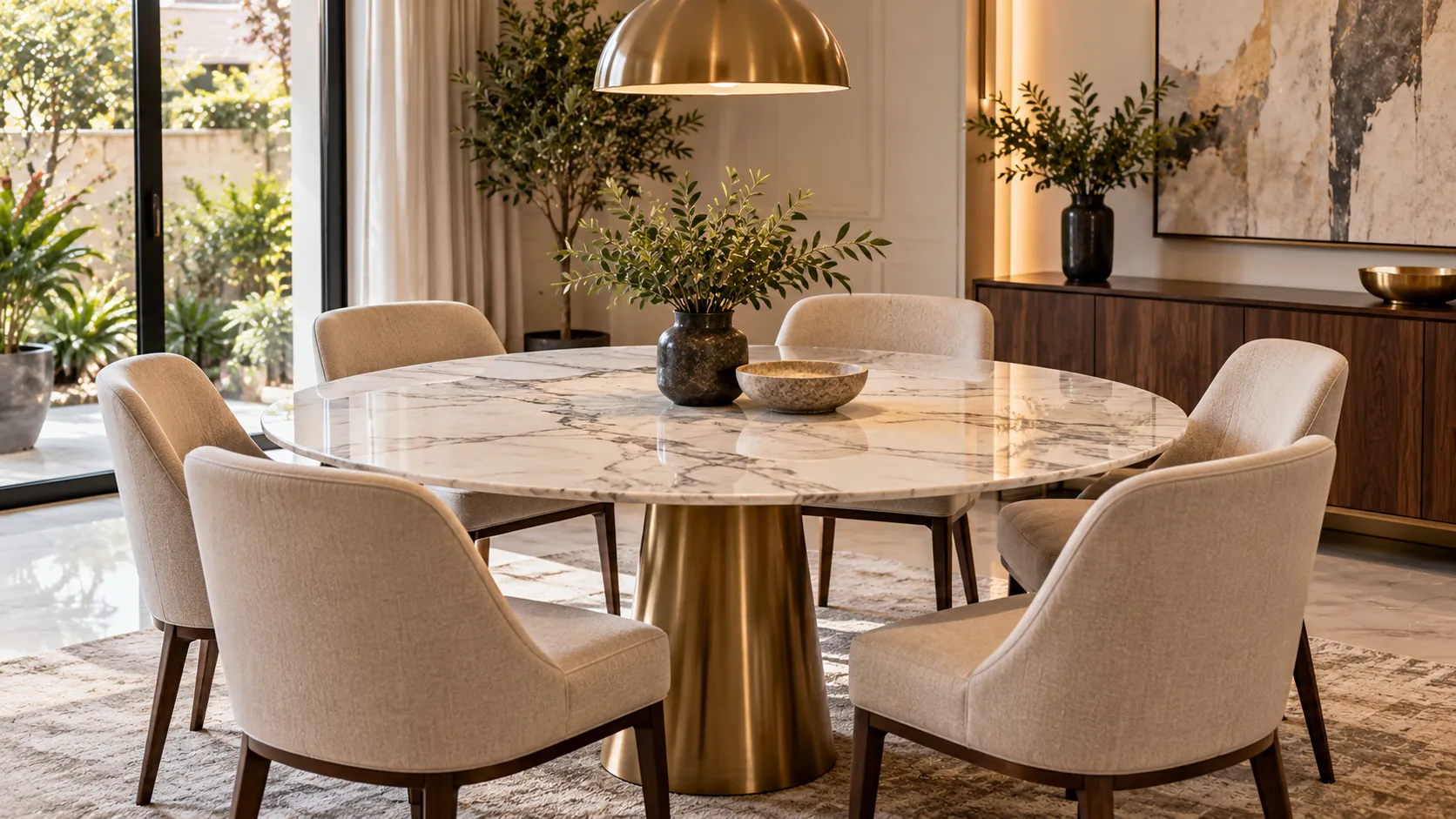
- White or Ziarat Supreme round top on a slim brass pedestal: light, classic and suits a dining room with beige upholstered chairs.
- Black & Gold rectangle with a mitred apron on black steel legs: a modern statement for a large dining hall.
- Verona Plain on a sheesham or walnut trestle: warm, practical and in keeping with traditional Pakistani furniture.
- Jet Black centre table, honed, on a low steel frame: a strong anchor in a white drawing room.
- Onyx side table on a lit base: a lamp and a table in one, for a corner of a lounge.
How much does a marble table top cost?
A finished marble table top costs from about PKR 1,800 for a small Verona Plain side table to PKR 56,000 for a Black & Gold six-seater, at our November 2026 quote ranges. Rectangular tops need about 10% extra for trimming. A round or oval top is cut from a rectangle of slab, so you normally pay for the square or rectangle it is cut from, and the offcuts may come back as small side-table pieces if you ask. Ask any yard how it measures a round top before comparing rates. The table shows the finished-top cost at our current quote ranges.
| Stone | 6-seater 6 x 3 ft (about 20 sq ft) | 5 ft round (25 sq ft square) | Centre table 4 x 2 ft (about 9 sq ft) | Side table 20 in (about 3 sq ft) |
|---|---|---|---|---|
| Verona Plain | 12,000 – 22,000 | 15,000 – 27,500 | 5,400 – 9,900 | 1,800 – 3,300 |
| Ziarat White | 17,000 – 32,000 | 21,250 – 40,000 | 7,650 – 14,400 | 2,550 – 4,800 |
| Ziarat Supreme | 22,000 – 42,000 | 27,500 – 52,500 | 9,900 – 18,900 | 3,300 – 6,300 |
| Black & Gold | 28,000 – 56,000 | 35,000 – 70,000 | 12,600 – 25,200 | 4,200 – 8,400 |
| Galaxy Black granite | 18,000 – 34,000 | 22,500 – 42,500 | 8,100 – 15,300 | 2,700 – 5,100 |
| Pak Green Onyx | Not recommended | Not recommended | 21,600 – 46,800 | 7,200 – 15,600 |
Our rate already covers cutting to shape, a standard edge profile and the finish. A mitred apron, a sub-top where one is needed (your furniture maker can also fit it) and freight outside our fitting cities are itemised on our quote; other suppliers may also charge separately for shaping, edges, sealing and crating. The base is a separate purchase from your furniture maker. Ask every supplier to write each line as included or extra, or run your sizes through the cost estimator first.
Ways to keep the cost down
- Use a remnant for side and centre tables; a leftover piece from a kitchen or floor job often costs less than cutting into a fresh slab.
- Choose 2 cm with a mitred apron instead of a full 3 cm top when you want a thick look.
- Go rectangular with rounded corners instead of a large round top, which wastes the corners of the slab.
- Order the dining and centre tables together from one lot, so offcuts from the large top can become the smaller pieces and the stones match.
Polished or honed, and daily care
A polished top looks glamorous and reflects the pendant light, but every etch mark from lemon, vinegar, cold drinks or tomato shows as a dull patch, and on dark stone so do fingerprints. A honed top is satin-matte, so small marks blend in and the surface feels warmer to the touch. For a table eaten at every day, honed is the easier finish to live with; for a formal dining room used for guests, polish is fine with a little care.
Sealing
Seal a marble table top with a penetrating (impregnating) sealer when it is delivered, and reseal every 6 to 12 months on a dining table, less often on a side table. The water-drop test tells you when: if water darkens the stone within ten minutes, reseal. Sealer slows staining from oil, haldi and chai; it does not prevent acid etching. Our guide on sealing marble in Pakistan explains products and timing.
Everyday habits
- Use placemats under plates and coasters under cups and glasses; chai and cold drinks are the most common marks on Pakistani dining tables.
- Wipe spills of lemon, achar oil, chutney and raita straight away and dry the surface.
- Clean with water and a pH-neutral stone cleaner; avoid vinegar, lemon-based sprays, bleach and glass cleaners with ammonia.
- Put hot karahi and serving dishes on trivets; a single hot dish rarely cracks stone, but repeated heat marks the polish.
- Dust with a dry microfibre cloth in dusty months before wiping with water, so grit is not dragged across the polish.
- Do not stand on the table to change a bulb, and do not let anyone sit on the edge of an unsupported overhang.
Should you put glass over a marble table?
Many Pakistani homes put a clear glass sheet over a stone dining top. It does stop etching and staining, but it hides the stone you paid for, gives a cold, reflective surface, and can trap moisture and grit underneath that leaves marks where the glass sits. If you choose glass, lift it every few months and clean both surfaces. A honed, well-sealed top with mats is usually the better answer.
If a top does lose its shine or collects etch marks over the years, it can be re-polished or re-honed in place by a stone polisher, which is one of the real advantages of natural stone over laminate or painted finishes. Our marble polishing guide explains what the job involves.
How ordering a stone top works
- Decide the size and shape using the room measurements and the guidance above, and choose the base design with your furniture maker.
- Choose the stone and finish from samples in your own room light, morning and evening.
- Send us a drawing with the top size, shape, corner radius, edge profile, thickness and how the top will be supported on the base.
- Approve the slab and the layout. For veined stones such as Black & Gold or Ziarat Supreme, we mark the cut on a photograph of the slab so you decide where the veins fall.
- Workshop cutting and finishing, then sealing and crating on an A-frame for delivery.
- Fix the top to the base on site with your furniture maker, on pads or silicone as described above, after checking the base is level.
Give your furniture maker the final top size before the base is finished. It is far easier to adjust a base by a centimetre than a stone top.
Get a quote for your table top
Order samples of two or three stones and look at them next to your chairs and floor. Then send us the size, shape, edge and thickness you have in mind, and we will return a free written quote for the finished top at our rate, with any mitred apron, sub-top and freight itemised, ready to share with your furniture maker.
Written by
The Captivating Marble Design Team
Fabricators, templaters and stone designers
We template, cut and install natural stone every day and write about what we learn — pricing, layouts, care and the mistakes we help clients avoid.
Book a free design consultation