Carrara Marble vs Calacatta, Thassos and Pakistani White Marble
Carrara, Calacatta and Thassos explained: look, hardness, landed cost and care, plus the Pakistani whites that come closest to each. Get a free quote.
Captivating Marble Design Team · · Updated · 15 min read
Key takeaways
- Carrara, Statuario and Calacatta are calcite marbles from the Apuan Alps in Tuscany; Thassos is a dolomitic marble from the Greek island of Thassos.
- All of them are about 3 on the Mohs scale like Pakistani whites, so a famous name does not make a marble harder or acid-proof.
- Ziarat White from Balochistan (PKR 850–1,600 per sq ft) is the closest local alternative to Carrara, though warmer in tone.
- Perlino Crystal Plain from Chaghi (PKR 900–1,700 per sq ft) is the nearest Pakistani stone to plain, crystalline Thassos.
- No Pakistani white we stock has the thick gold veining of Calacatta Gold; book-matched Ziarat Supreme is the closest premium alternative.
The short answer
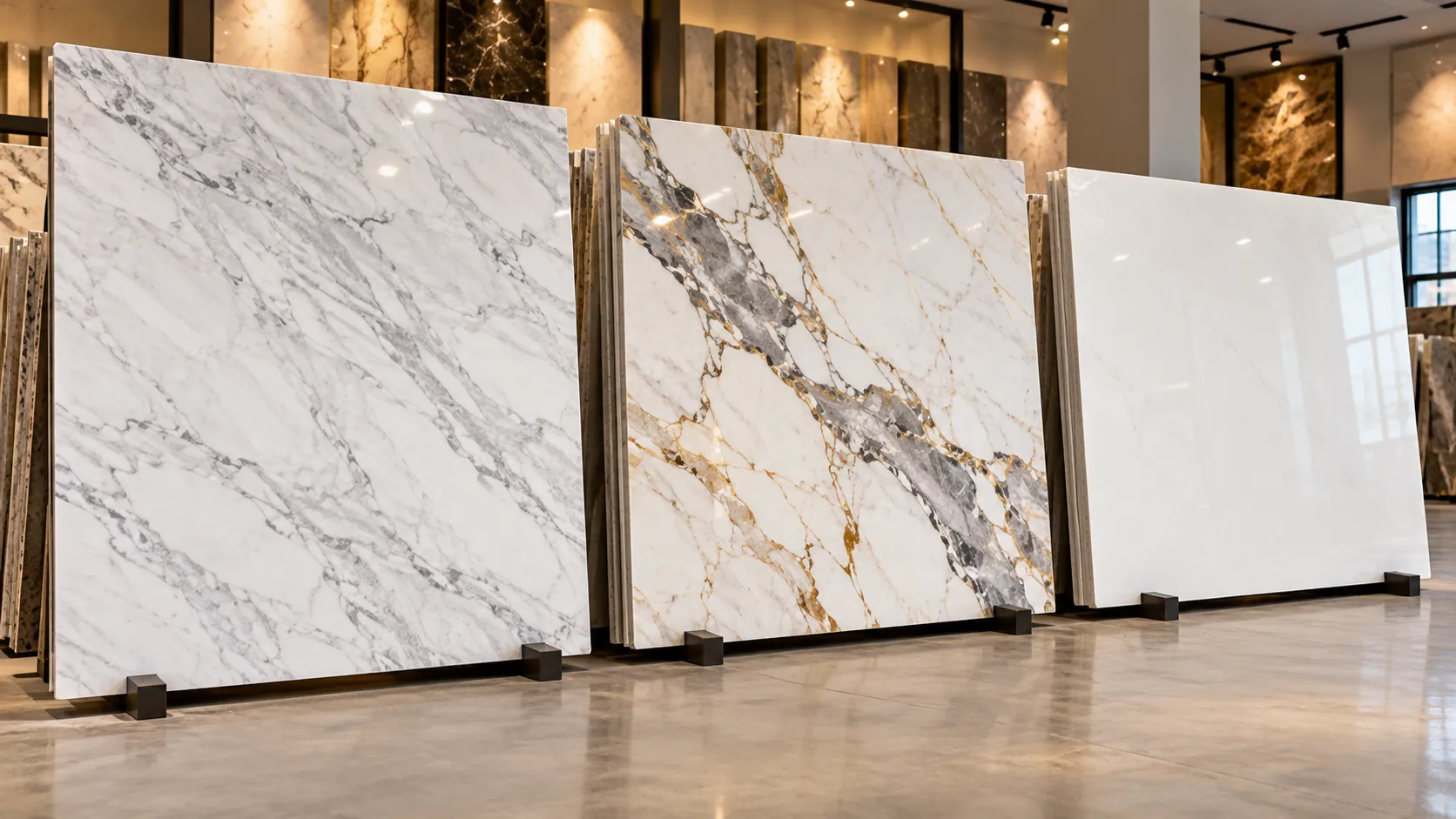
Carrara marble is an Italian white-to-pale-grey stone with soft, feathery grey veining, quarried around Carrara in Tuscany. Calacatta, from the same mountains, is rarer: brighter white with bold, thick veins. Thassos is a near-pure white Greek marble with little veining. In Pakistan the closest local matches are Ziarat White (PKR 850–1,600 per sq ft) and Perlino Crystal Plain.
All three imported names reach Pakistan through a handful of importers and are priced off foreign currency, freight and duty. Calacatta Gold adds warm gold and beige to the veins, and nothing quarried locally matches that.
We do not import or sell any of them. What we do supply are Pakistani whites that cover much of the same ground: Ziarat White and Ziarat Supreme for a soft, lightly veined white; Medium White, China White and Pampo White for budget floors and cladding with grey movement; and Perlino Crystal Plain or Snow White Onyx when you want the plain, bright white people associate with Thassos. No Pakistani stone we know of has the heavy gold veining of Calacatta Gold, and we say so plainly below.
Rates for our stones are our current quote ranges per square foot, cut, polished and fitted (November 2026). We do not quote rates for imported marble; any comparison with imported stone is indicative only. Confirm any imported price with the importer in writing, with the exchange-rate date on the quote.
Where the Italian and Greek names come from
The Carrara district has been quarried since Roman times, and its stone has been carved into sculpture and laid as floors for two thousand years; Michelangelo's David was carved from it. Today "Carrara" in the trade is both a place and a family of commercial names. Each name describes a look and a grade rather than a single quarry, and the boundaries between them are drawn by the market, not by geology.
| Trade name | Origin | Ground colour | Veining | Relative cost |
|---|---|---|---|---|
| Bianco Carrara | Carrara district, Tuscany, Italy | White to pale blue-grey | Fine, soft, feathery grey; often dense | The most affordable of the Italian whites |
| Statuario | Carrara district, Italy | Bright white | Bold, dramatic grey veins on a whiter ground | Premium |
| Calacatta | Carrara district, Italy | Bright white to warm white | Thick, bold grey veins, often widely spaced | Among the most expensive whites |
| Calacatta Gold | Carrara district, Italy | Warm white | Bold veins in grey with gold and beige tones | Among the most expensive whites |
| Thassos | Thassos island, northern Greece | Very bright, snow white | Little or none; a sugary crystalline look | Premium, especially the whitest grades |
Within each name there are grades. A whiter, cleaner Carrara slab with even veining costs much more than a greyer, busier one, and Thassos is sold in grades that run from pure white to whites with grey or creamy spots. When someone quotes "Carrara" or "Thassos", ask which grade, and ask to see the actual slabs.
What is the difference between Carrara, Calacatta and Thassos?
The difference is in ground colour and veining: Carrara is a soft grey-white with fine, dense veins; Calacatta is brighter white with thick, widely spaced veins; Thassos is snow white with almost none. Carrara and Calacatta are calcite, while Thassos is dolomite.
Carrara: the soft grey white
Bianco Carrara has a white to light blue-grey ground with fine grey veining that looks brushed or feathered rather than drawn. The veins are usually dense and spread across the whole slab, so the stone reads as a soft, cool grey-white from across a room. That even pattern is why it is so popular for bathroom walls, floors and mosaic: offcuts and tiles from different slabs sit together without obvious mismatch. It is a calcite marble, so it scratches and etches like any other marble.
Calacatta and Calacatta Gold: bold veins on bright white
Calacatta marble is defined by contrast. The ground is whiter than Carrara and the veins are thicker, darker and more dramatic, often running in broad diagonal sweeps with large clear areas in between. Calacatta Gold adds warm gold, beige and caramel tones to the grey veins, which is why it is paired with brass taps and walnut joinery in so many design photographs. The bold veining means every slab is different, so it is usually bought as a set of consecutive slabs and book-matched on islands and feature walls, with each pair opened like the pages of a book so the veins mirror across the joint. Supply is limited, and that is reflected in the price.
Thassos: the pure white
Thassos marble is the stone people mean when they ask for a white with no veins at all. It is a dolomitic marble, made mostly of the mineral dolomite rather than calcite, with a crystalline, slightly sugary texture that sparkles under direct light. The top grades are close to pure white; lower grades carry grey or cream spots. Because it is so uniformly white it suits modern bathrooms, mosaic and anywhere a clean, bright surface matters more than pattern.
Statuario, the one in between
Statuario sits between Carrara and Calacatta: a whiter ground than Carrara with stronger grey veins, but usually finer and more linear than Calacatta's broad sweeps. It is often what people actually have in mind when they show a photograph and say "Carrara".
Hardness, etching and staining: how they behave
A famous name does not make a marble tougher. Carrara, Statuario and Calacatta are calcite marbles at about 3 on the Mohs hardness scale, the same as the Pakistani whites. Steel, sand and grit scratch them; lemon, vinegar, tomato, imli and acidic cleaners etch them, leaving dull spots on a polished face. Haldi, oil and chai stain any white marble that is not sealed.
Thassos behaves a little differently. Dolomite is slightly harder than calcite and reacts more slowly with acid, so a lemon spill marks it less quickly. It is still a marble: it still etches, still scratches with grit and still needs sealing. Do not choose it for a busy cooking counter on the belief that it is acid-proof.
| Property | Carrara / Calacatta / Statuario | Thassos | Pakistani whites (Ziarat, Pampo, China White) |
|---|---|---|---|
| Main mineral | Calcite | Dolomite | Calcite |
| Scratch resistance | Low (about Mohs 3) | Slightly better than calcite | Low (about Mohs 3); China White softer |
| Acid etching | Etches readily | Etches more slowly | Etches readily |
| Staining | Needs sealing | Needs sealing | Needs sealing |
| Heat from pots | Tolerates; use trivets | Tolerates; use trivets | Tolerates; use trivets |
| Re-polishable | Yes | Yes | Yes |
If you cook with lemon and tomato every day and want a white worktop that will not etch, no marble will satisfy you; look at granite instead, as our marble vs granite guide explains.
Why is imported marble so expensive in Pakistan?
Imported marble costs more because every slab carries sea freight, port and clearing charges, customs duty and taxes, inland transport and the importer's margin, all priced off the euro or dollar. An imported slab arrives in Karachi by container and is priced off a supplier invoice in euros or dollars. Before it reaches a Lahore or Islamabad showroom it has carried sea freight, port and clearing charges, customs duty and taxes, inland transport and the importer's margin. Each of these moves with the exchange rate and with fuel prices, which is why importers often hold a price only for a short time.
- Limited stock. An importer brings in what it can sell, often a few bundles of each name. Large projects may need stone from more than one bundle, which can differ in tone.
- Matching later. Adding a bathroom a year later and finding the same lot is unlikely. Buy the whole quantity at once, plus spare.
- Breakage risk. Thin, veined slabs travel a long way. Ask who carries the loss if a slab is cracked on delivery.
- Thickness. Many imported slabs are 2 cm; 3 cm stock is less common and dearer. Check what is actually in the yard before designing edges.
- Resin and mesh. Imported slabs are often resin-treated and mesh-backed at the factory to stabilise natural fissures. That is normal, but ask to see the back.
As an indicative market guide only, imported Italian and Greek whites usually cost several times our installed rate for our top local white once landed, cut and fitted, and Calacatta grades sit at the top of that scale. Ask every seller for a written price per square foot in rupees that states the slab numbers, thickness, finish, what is included and the date the price was fixed.
How to check that "Carrara" is really imported
Trade names travel. A local grey-white can be offered as "Carrara" in the same way local beiges are sold as Verona or Botticino (our guide to Botticino and Perlino explains those two names). If you are paying an import price, ask the seller to show the import paperwork (the customs Goods Declaration for the consignment) and the supplier's slab or bundle labels. A genuine importer will have both. Our guide to choosing a marble supplier lists the other checks worth making before you pay an advance.
White Carrara marble tile and lookalikes
Much of what is sold as "Carrara" in Pakistani tile shops is not stone at all. The look is so popular that porcelain and ceramic makers print it on tiles and large-format slabs, and engineered quartz makers copy it in resin. Searches for carrara white tile usually land on these products. They can be good choices, but they are different materials with different behaviour, and you should know which one you are buying.
| Check | Natural marble tile | Porcelain or ceramic print |
|---|---|---|
| Edge | The same stone and colour through the full thickness | A plain body colour under a printed top layer |
| Pattern repeat | No two tiles alike | The same veins repeat every few tiles |
| Back | Sawn stone, sometimes mesh-backed | Moulded ridges or a printed brand pattern |
| Weight and feel | Cool and dense | Lighter for the same size |
| Acid (on an offcut) | A drop of lemon leaves a dull spot | No mark |
| Re-polishing | Can be ground and polished again | Cannot be re-polished; damage is permanent |
We do not sell porcelain, ceramic or quartz. If you want a natural stone floor or wall with the same calm grey-white effect, the closest options in our range are below; if you need a surface that never etches, a printed porcelain or quartz from a tile specialist may serve you better than any marble.
Pakistani white marble that comes closest
No local stone is a copy of an Italian or Greek one, and anyone who tells you otherwise is selling a name. What Pakistani quarries do produce is a range of whites that cover the same uses, with their own character, at a fraction of the landed cost and with the advantage that more of the same lot can usually be found later.
| Our stone | Origin | Look | Closest imported look | PKR / sq ft |
|---|---|---|---|---|
| China White | Chiniot, Punjab | Chalky off-white with fine grey threads | Budget stand-in for a fine-veined Carrara on sills, cladding and second baths | 450 – 800 |
| Pampo White | Mohmand, KP | Cool white with grey shadow and pale gold flecks | The cool cast of Carrara; slabs vary, choose from photos | 500 – 900 |
| Medium White | Ziarat, Balochistan | Warm white with grey cloud and light spotting | Economy Carrara-style floors across a whole house | 550 – 950 |
| Ziarat White | Ziarat, Balochistan | Ivory to milk-white with soft grey drift | A softer, warmer alternative to Carrara for floors, vanities and islands | 850 – 1,600 |
| Perlino Crystal Plain | Chaghi, Balochistan | Plain crystalline white with a faint sugar sparkle | The nearest to Thassos: plain, bright and crystalline | 900 – 1,700 |
| Ziarat Supreme | Ziarat, Balochistan | Whiter ground, tighter grain, fewer spots | Our premium white for book-matched walls; quieter than Calacatta | 1,100 – 2,100 |
| Snow White Onyx | Chaghi, Balochistan | Milky, translucent white with faint grey ghosting | A pure-white feature panel, especially backlit; not a floor stone | 2,600 – 5,600 |
For a Carrara feel
Choose Ziarat White and pick slabs from the lot with the most visible grey drift, or Pampo White if you want a cooler cast. Hone rather than polish if you want the soft, chalky look of an Italian bathroom. Pair with grey grout, brushed nickel or chrome, and neutral 4,000 K lighting, which keeps the white cool rather than creamy. Ziarat is warmer than Carrara, so under warm yellow light it will read ivory.
For a Calacatta feel
Honestly, there is no local equivalent to Calacatta's thick grey veins, and nothing we stock has the gold veining of Calacatta Gold marble. The closest approach is Ziarat Supreme bought as consecutive slabs and book-matched on one wall or an island, which gives a bright, premium white with movement that mirrors across the joint. The drama comes from the matching and the scale of the slab rather than from bold veins. If heavy gold veins are the whole point, the real stone or a quartz or porcelain copy from a specialist is the honest answer.
For a Thassos feel
Perlino Crystal Plain is the closest match: an even crystalline white with almost no veining and a sparkle under direct light. It suits large floors, shower walls and modern vanities. For a reception wall, bar front or bath panel where you want a pure white that glows, Snow White Onyx can be backlit; our guide to backlit onyx feature walls covers how that works. Onyx is softer and is a display stone, so keep it off floors and worktops.
Worked costs with our whites
These examples use our current cut-and-fitted ranges and include sensible wastage. Feature walls that are book-matched need consecutive slabs and more waste than a plain floor.
| Job | Stone | Area incl. wastage | Estimated cost (PKR) |
|---|---|---|---|
| Vanity top 5 x 2 ft with upstand | Ziarat White (850 – 1,600) | About 15 sq ft | 12,750 – 24,000 |
| Bathroom floor, 8 x 7 ft | Medium White (550 – 950) | About 62 sq ft (10%) | 34,100 – 58,900 |
| Shower walls, three sides to 7 ft | Perlino Crystal Plain (900 – 1,700) | About 140 sq ft (10%) | 126,000 – 238,000 |
| Book-matched feature wall, 10 x 9 ft | Ziarat Supreme (1,100 – 2,100) | About 104 sq ft (15%) | 114,400 – 218,400 |
| Lounge and passage floor | Ziarat White (850 – 1,600) | About 660 sq ft (10%) | 561,000 – 1,056,000 |
Multiply your own room sizes in feet, add the wastage for your layout and apply the rate. For more detail on every local white, its grades and the yard checks that keep a lot consistent, see our white marble price guide.
Which white for which room
- Kitchen worktops. All of these whites etch. If you love the look, choose a honed finish, seal well and accept a lived-in patina, or keep marble to the island and use granite by the hob.
- Bathroom vanities. Ziarat White, Ziarat Supreme and Perlino all work well. Wipe hard-water drips before they dry into white rings.
- Floors. Medium White for whole-house value, Ziarat White for main rooms, Perlino where you want an almost seamless white field. Hone wet areas for grip.
- Feature walls and islands. Ziarat Supreme, book-matched. Plan the slab layout on a drawing before cutting.
- Backlit panels. Snow White Onyx, thin and resin-backed, with even LED lighting behind. More onyx ideas for the home.
- Sills, cladding and second bathrooms. China White or Pampo White keep the budget down.
Care for white marble in Pakistani conditions
Imported or local, white marble asks for the same care. Pakistani conditions add three particular risks: fine dust that scratches a polished face, hard water that leaves white rings, and turmeric and oil that stain an unsealed surface yellow within minutes.
- Seal after fitting with a penetrating sealer and reseal roughly once a year, sooner on kitchen and vanity tops.
- Wipe spills of haldi, oil, chai and lemon at once; sealing slows stains but does not stop acid etching.
- Clean with plain water or a pH-neutral stone cleaner; avoid vinegar, bleach and acid tile cleaners.
- Dry-mop floors daily and put mats at every outside door.
- Use a white adhesive, not a grey sand-cement bed, when fixing white stone, so the mortar does not shadow through.
- In monsoon humidity, let walls and screeds dry before fixing and sealing.
See the stone before you decide
Photographs of Italian and Greek marble are taken under studio light; your room is lit by Pakistani sun and tube lights. Order samples of the whites you are considering from our samples page, look at them morning and evening, and set a lemon drop on the back of one to see how it etches. When you are ready, send us your room sizes and the look you are after, and we will return a free written quote that states the installed rate and itemises any cut-outs, seams, book-matching and freight.
Written by
The Captivating Marble Design Team
Fabricators, templaters and stone designers
We template, cut and install natural stone every day and write about what we learn — pricing, layouts, care and the mistakes we help clients avoid.
Book a free design consultation