Marble Shop Near Me? How to Choose a Supplier, Factory or Yard in Pakistan
Shop, factory or stone yard? How to compare sellers, read a rate per sq ft, inspect a lot and avoid the common traps. Read the checklist and get a free quote.
Captivating Marble Design Team · · Updated · 19 min read
Key takeaways
- A trustworthy stone seller names the quarry district, shows the whole lot, writes down what the rate includes and stands behind cutting and fitting.
- Online list rates of PKR 65–90 per sq ft cover basic grey floor tile off the pile; our installed quote range for Sunny Grey is PKR 560–1,000.
- Expect 10% or more wastage on a stone quotation, and buy the full quantity from one lot so the shade matches.
- Tie any advance to specific tagged slabs, and stage later payments on delivery and completed fitting rather than dates.
- Stock stone is usually cut and delivered within days to two weeks; special-order container stone takes 4 to 8 weeks from block selection.
The short answer
A search for a marble shop near me returns dozens of pins; the right one passes four tests. It names the quarry district of every stone, shows you the whole lot you will receive, writes down what its rate per square foot includes, and stands behind cutting and fitting. Whether it calls itself a shop, factory or yard matters less.
The cheapest rate on a list rarely meets all four tests. What counts is whether the seller controls the stone, the cutting and the paperwork under one roof.
This guide explains who does what in the Pakistani stone trade, how to shortlist sellers from a map search, the questions to ask on the phone, how to read a quotation line by line, what to check at the yard, the red flags that should end a conversation, and how lead times, delivery and payment usually work for a home or a building project.
Rates for our own stones in this post are our current quote ranges per square foot (November 2026). Every other figure, including online list rates and labour, is an indicative market range only. Always confirm the final number against a written quotation.
Who is who in the Pakistani stone trade
Marble moves through several hands between the quarry face and your floor. Most of what goes wrong on a job comes from not knowing which of those hands you are dealing with, because each one controls a different part of the quality and the price.
| Seller | What they actually do | Good for | Watch out for |
|---|---|---|---|
| Quarry or block trader | Extracts or buys raw blocks in Balochistan, KP or Sindh and sells them by the tonne | Exporters and large factories | Not a retail option; no cutting or finishing |
| Cutting factory | Saws blocks into slabs and tiles on gang saws and block cutters, then polishes them | Bulk tile, builders, dealers | Little help with design, templating or fitting; grade can vary by truckload |
| Stone yard or showroom | Holds slabs and tile from several factories, often with its own cutting shop | Homeowners comparing stones side by side | Ask which stones are in stock and which are ordered on demand |
| Neighbourhood marble shop | Keeps tile and small pieces, takes orders, often subcontracts the cutting | Small jobs, sills, steps, quick repairs | Limited choice; the shop may not see the lot before you do |
| Fabricator and installer | Templates, cuts to drawing, profiles edges and fits on site | Kitchens, vanities, stairs, cladding | Some buy stone only after you pay; check who chooses the slabs |
Many businesses combine two or three of these roles. The question is not the label on the signboard but which steps happen under the same roof. A seller who holds the slabs, cuts them and sends its own fitters has nobody else to blame, which is the strongest guarantee you can get in this trade.
Where the stone comes from
Most marble sold in Pakistan is quarried at home. The whites and soft greys come largely from Ziarat in Balochistan and from Mohmand in Khyber Pakhtunkhwa, the beiges and the black-and-gold stones from Chaghi and Khuzdar, golds from Nowshera, and granites from Nagar Parkar in Sindh and from Swat. Our guide to types of marble in Pakistan maps the main families. Knowing the origin lets you compare like with like: two "white marble" quotes can be for completely different stones.
Searching for a marble shop near me: how to shortlist
A map search for a marble factory near me in Lahore, Karachi or Rawalpindi returns dozens of pins, many with only a phone number and a few photos. Distance is useful, because visiting the yard is the single best way to judge stone, but it should not be the main filter. Use the listing to decide who is worth a call.
- Photos of real slabs, not catalogue images. A seller that posts dated photos of slabs on its own A-frames usually has stock. Glossy imported-stone renders tell you nothing.
- A physical address you can visit in daylight. A yard is a working site; a mobile number with no location is a broker.
- Named stones with origins. "Ziarat White, Balochistan" is useful; "Italian look white, best quality" is not.
- Rates per square foot that state what is included. A number with no explanation is an advertisement, not a price.
- Reviews that describe a job. Short, generic five-star comments with no detail are worth little. Look for reviews that mention a stone, a room and a problem that was solved.
- A response within a working day. If a seller is slow before you have paid, it will be slower after.
Whether the names come from a search for marble suppliers near me or from friends who have just built, shortlist three. Fewer leaves you without a comparison; more turns into a week of phone calls and yard visits for the same stones. If you are outside the big cities, check whether a supplier delivers to you before you go further. We list the places we serve on our delivery page for Lahore and the other city pages, including Karachi and Islamabad.
Questions to ask before you visit
A ten-minute phone call or WhatsApp exchange saves a wasted trip. Have your rough sizes ready, in feet, and ask every seller on your shortlist the same questions so the answers can be compared.
- Which quarry district is this stone from, and is it in stock now? In stock means slabs or crates standing in the yard today, not "we can arrange it".
- Is it tile or slab, and what thickness? Floor tile is commonly much thinner than the 2 cm and 3 cm slabs used for counters and cladding. A 3 cm slab is stiffer and heavier than a 2 cm one, so ask which you are being quoted. Our guide to slab or tile explains the difference.
- How much of one lot do you have? For a floor or a long wall you need the full quantity, plus wastage, from one block so the shade matches.
- What finish? Polished, honed, brushed or leathered changes both the look and the rate.
- What does the rate include? Cutting to size, edges, on-site grinding and polishing, resin and mesh, transport, fitting, sealing, wastage.
- Who does the cutting and fitting? Your own team, a regular subcontractor, or "the customer arranges a mistri"?
- What is the lead time from approval to fitting? Ask separately for stock and special-order stone.
- What happens if a piece breaks or is cut wrong? A clear answer, ideally in writing, is a good sign.
Write the answers into a simple table: seller, stone, origin, thickness, finish, rate, what is included, lead time. It becomes your comparison sheet, and it makes the yard visit much faster.
What should a marble rate per square foot include?
A complete rate per square foot should name the stone, grade, thickness and finish, and state whether wastage, cutting, edges, resin, transport, fitting, polishing and sealing are included or extra. Almost every argument between a buyer and a seller in this trade starts with a rate that meant one thing to the seller and another to the buyer. In Pakistan stone is priced per square foot of finished face, but that figure can describe anything from rough tile picked off the pile to selected slabs cut, polished, delivered and fitted. Our glossary entry on price per square foot covers the basics; the table below shows the lines that sit behind a full quotation.
| Line | What it covers | Question to ask |
|---|---|---|
| Stone | The material itself, per sq ft, for a named stone, grade, thickness and finish | Which lot, which slabs, and can I see them? |
| Wastage | Extra stone for offcuts, breakage and pattern matching, usually 10% or more | What percentage, and who keeps the offcuts? |
| Cutting and fabrication | Cutting to drawing, sink and hob cut-outs, holes for taps and sockets | Per piece, per running foot or included? |
| Edges | Eased, bevel, bullnose, mitred or laminated edges, per running foot | Which profile, on which edges? |
| Resin and mesh | Filling fissures and backing thin or fragile slabs | Already done at the factory or extra? |
| Transport | Loading, freight and unloading at site | To the gate or to the floor where it is fitted? |
| Fitting | Laying or fixing, adhesive or mortar, clamps on walls | Materials included? Who removes the old surface? |
| On-site grinding and polishing | Levelling and polishing a laid floor (ragrai) | How many passes, and is crystallisation included? |
| Sealing | Penetrating sealer after fitting | Which product, how many coats? |
Why two quotes for the "same" stone differ
Online rate lists for Pakistani marble are useful as a floor, not as a quote. They usually show yard prices for basic machine-cut floor tile, before cutting, polishing, transport and fitting, and the grade on the pile can change with each truck. A quotation for selected slabs, matched and cut to your drawing and fitted by the same team, covers far more stone and far more work.
| Stone | Source of figure | PKR / sq ft |
|---|---|---|
| Sunny Grey, floor tile | Indicative online list rate | 65 – 75 |
| Ziarat Grey, floor tile | Indicative online list rate | 80 – 90 |
| Ziarat Grey, kitchen grade | Indicative online list rate | 340 – 360 |
| Sunny Grey | Our current quote range | 560 – 1,000 |
| Ziarat White | Our current quote range | 850 – 1,600 |
| Verona Plain | Our current quote range | 600 – 1,100 |
| Black & Gold | Our current quote range | 1,400 – 2,800 |
The gap between those two kinds of figure is not a markup on the same thing. Our ranges are for slabs in 2 cm and 3 cm, chosen from tagged lots and priced fabricated and installed in our service area, with the final figure depending on thickness, finish and how much cutting and edge work the job needs. Put any two rates side by side only after each seller has written down what is included. For the wider picture across stones, see our Pakistani marble price guide, or work out your own area in the stone cost estimator.
Labour when you hire your own mistri
If you buy stone from one seller and hire a mistri separately, budget for labour as its own line. As an indicative market range only, floor laying is often quoted around PKR 60 to 150 per square foot, and wall cladding with clamps, stair work and on-site polishing all cost more. The trouble with split contracts is not the rate but the blame: when a slab cracks or a joint shows lippage, the seller blames the fitter and the fitter blames the stone.
At the yard: what to check before you pay an advance
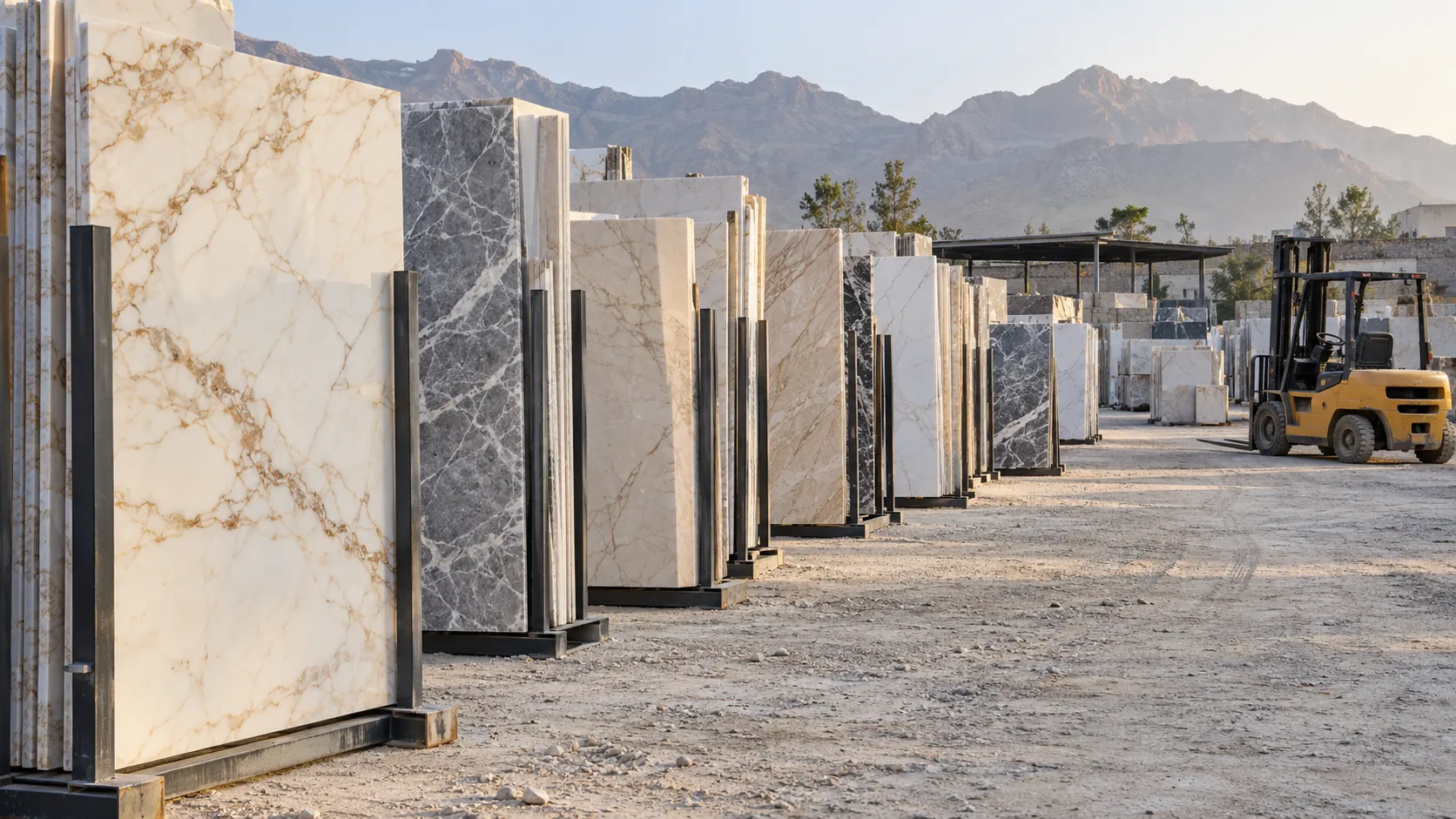
Go in daylight, during working hours, with a tape measure, a bottle of water, a soft cloth, your drawing and your comparison sheet. A good slab yard will be happy to pull slabs forward on the forklift so you can see them properly; a seller who only wants to show you a polished sample in the office is telling you something.
- See the whole lot. Colour and veining change across a block. Make sure every slab or crate you will receive is from the same lot, and ask the yard to mark them for you.
- Wet the surface. Water shows roughly how an unpolished or honed stone will look once finished, and it brings out hairline cracks.
- Run a fingernail across veins and fissures. A line you can catch with a nail is open. Ask whether it will be resin-filled and backed before cutting.
- Look at the back. Fibreglass mesh and resin on the back of thin or fragile slabs are normal. Fresh filler patches on the face are not.
- Measure thickness at several points. A slab that varies by more than a millimetre or two along its length will show lippage on a floor or wall.
- Check the polish under a tube light. Reflections should stay straight and sharp. Wavy reflections mean poor grinding that will show at every joint.
- Test dark stones for dye or oil. Rub an offcut edge with a cloth and a little acetone. Colour on the cloth suggests dye; a surface that greys out once dry suggests it was oiled to look richer.
- Photograph the slabs with their tag numbers. The photos are your record of what you approved.
- Agree the slab numbers, layout and vein direction in writing before any cutting begins.
If you cannot travel to the yard, ask for a video walk-through of the exact slabs, with the tag numbers visible, and order a sample to see the colour in your own light. Samples from our samples page cost PKR 500 each, which is credited back on your order.
Red flags that should end the conversation
Most sellers in the trade are honest small businesses, but the same few problems turn up again and again. Any one of these is a reason to slow down; two or more is a reason to walk away.
- A rate with no written scope. "Everything included" on WhatsApp is not a quotation.
- No origin, or an imported name on a local stone. Calling a Pakistani white "Carrara" or "Italian" to justify a higher price is common. Local stone is excellent; it should be sold under its own name. Our Carrara, Calacatta and Thassos guide shows how to tell them apart.
- Only a sample, never the lot. A beautiful hand-sized piece says nothing about the 400 square feet you will receive.
- Pressure to pay the full amount before the stone is selected. An advance to reserve specific, tagged slabs is reasonable; paying in full for stone you have not seen is not.
- No answer on breakage or wrong cuts. Ask what happens if a piece is cut short. "That never happens" is the wrong answer.
- Fresh filler or wax on the face that the seller will not explain.
- A lead time that changes every time you ask. It usually means the stone is not in stock.
- Refusal to put slab numbers or thickness on the invoice. Without them you have no way to prove a substitution later.
Factory, local shop or full-service supplier?
The right kind of seller depends on the job. A builder laying 10,000 square feet of corridor tile and a family fitting one kitchen island need different things, and paying for services you do not need is as wasteful as skipping the ones you do.
| Job | Usually best served by | Why |
|---|---|---|
| Large floor areas in plain tile | Cutting factory or wholesale yard | Volume pricing and one lot for the whole area |
| Kitchen counters and islands | Yard with its own fabrication and fitting | Templating, cut-outs, seams and edges need one accountable team |
| Vanities, sills and steps | Yard or a reliable local shop | Small pieces, short lead time |
| Feature walls and book-matched panels | Yard that holds sequential slabs | Matching needs consecutive slabs from one block |
| Contractor and developer projects | Trade account with a yard or factory | Held stock, scheduled releases, consistent lots |
| Repairs and re-polishing | Specialist polishing contractor | Different equipment and skills from supply |
Fabricators, builders and dealers buying by the slab, bundle or container should look at our wholesale slab programme, which explains trade accounts, bundle sizes and container lead times. Homeowners get the same slabs at retail, with design help and fitting, through the normal quote.
How long do marble delivery and fitting take?
Stock stone is usually cut and delivered within days to two weeks of an approved drawing, a countertop can go from template to fitted in about two weeks in Lahore, and special-order container stone takes 4 to 8 weeks. A realistic timeline protects the rest of your build. Stone is usually one of the last trades in a kitchen or bathroom and one of the first on a floor, and a slipped delivery holds up carpenters, plumbers and painters. Ask every supplier for a lead time in writing, and ask what it depends on.
- Stock slabs and tile can usually be cut and delivered in days to a couple of weeks once the drawing is approved.
- Special-order stone has to be quarried or brought from a factory first. For container orders we quote 4 to 8 weeks from block selection at the quarry.
- Countertops need templating after the kitchen units are fixed and level. Our stone installation process runs from template to sealed and finished in as little as two weeks in Lahore and most of Punjab.
- Delivery over long distances adds time. Our own trucks cover Lahore, and the motorway and N-5 routes reach Islamabad, Faisalabad, Multan and Karachi in one to three days.
How stone should travel
Slabs should travel upright on A-frames, strapped, with foam or wood at the corners; tile should travel in strapped crates. Slabs laid flat on a truck bed with loose stones under them crack. Be at the site when the truck arrives, count every piece against the delivery note, photograph any damage before signing, and make sure there is a clear path and enough hands to unload. A 3 cm slab is heavy and awkward on a narrow stair.
Weather and site conditions
Pakistani conditions affect both delivery and fitting. In June and July adhesives cure fast in the heat, so good fitters work early in the day and keep fresh stone out of direct sun. During the monsoon, walls and screeds need longer to dry before cladding or sealing. In dusty areas ask the fitter to cover finished floors immediately, because grit under foot scratches a fresh polish. Our marble installation guide walks through measuring, templating and fitting day in more detail.
Paperwork, advances and after-sales
Stone is a large purchase made mostly in cash and bank transfers, often on trust. A few simple habits protect you without slowing anything down.
- Get a written, itemised quotation that names the stone, origin, thickness, finish, quantity, wastage and every service line.
- Link any advance to specific slabs or crates. The receipt should list tag or slab numbers, so the stone you reserved is the stone you receive.
- Agree payment stages tied to clear events, such as slab selection, delivery and completion of fitting, rather than dates.
- Ask whether rates include sales tax and whether you will get a proper invoice; businesses and contractors usually need one.
- Keep the care instructions. A supplier that hands over written care and resealing advice expects to be around if something goes wrong.
- Ask about workmanship cover. Natural stone itself varies and is not "guaranteed" against veining or colour, but cutting and fitting can and should be covered.
Keep the offcuts if they are yours under the quotation. A spare piece from the same lot is the best possible material for a future repair, a sill or a matching shelf.
How we work as a supplier
Since you are reading this on our site, here is how Captivating Marble measures up against the checklist, so you can hold us to it.
- Pakistani stone, named by origin. Every stone in our catalogue lists its quarry district, from Ziarat White to the Chaghi onyx and the Nagar Parkar granites. We do not sell imported Italian marble, and we do not rename local stones to sound imported.
- Tagged, photographed slabs in our Lahore yard. You can walk the yard or ask for a video of the exact slabs you will receive.
- Written quotes that state the installed rate for the stone you choose and itemise cut-outs, seams and freight, usually within one business day of receiving your sizes or sketch.
- Our own crews template and fit in Lahore and most of Punjab. Elsewhere we cut to your fitter's drawings and send finished pieces crated on A-frames anywhere in Pakistan.
- Samples first if you are unsure: PKR 500 each, credited against your order.
Whoever you buy from, the same tests apply: named origin, a visible lot, a written scope and one team accountable for the result.
Get a quote or see the stone
Send us your sizes or a rough sketch, the stone or look you have in mind and your city, and we will send a free itemised quote that you can put side by side with any other supplier's. If you are still deciding between stones, order samples and look at them in your own light before you commit to a full lot.
Written by
The Captivating Marble Design Team
Fabricators, templaters and stone designers
We template, cut and install natural stone every day and write about what we learn — pricing, layouts, care and the mistakes we help clients avoid.
Book a free design consultation