Marble Types in Pakistan: 27 Names, Colours, Origins and Uses
27 Pakistani marbles by name, colour and quarry, from Ziarat White to Black & Gold, with PKR rates per sq ft and the best stone for each room. Order samples.
Captivating Marble Design Team · · Updated · 17 min read
Key takeaways
- Most Pakistani marble is quarried in Balochistan (Ziarat, Chaghi, Khuzdar) and Khyber Pakhtunkhwa (Mohmand, Nowshera, Tippi).
- Quarried marble in our catalogue runs from PKR 450 per sq ft (China White, Denso) to PKR 2,800 (Black & Gold), as of November 2026.
- Ziarat White costs PKR 850–1,600 per sq ft; the hand-picked Ziarat Supreme grade costs PKR 1,100–2,100.
- Marble sits at about Mohs 3–4, so it scratches and etches more easily than granite at Mohs 6–7.
- Pakistani marble names are trade names: one stone can carry several names, so judge the slab and ask for the quarry area.
What are the main types of Pakistani marble?
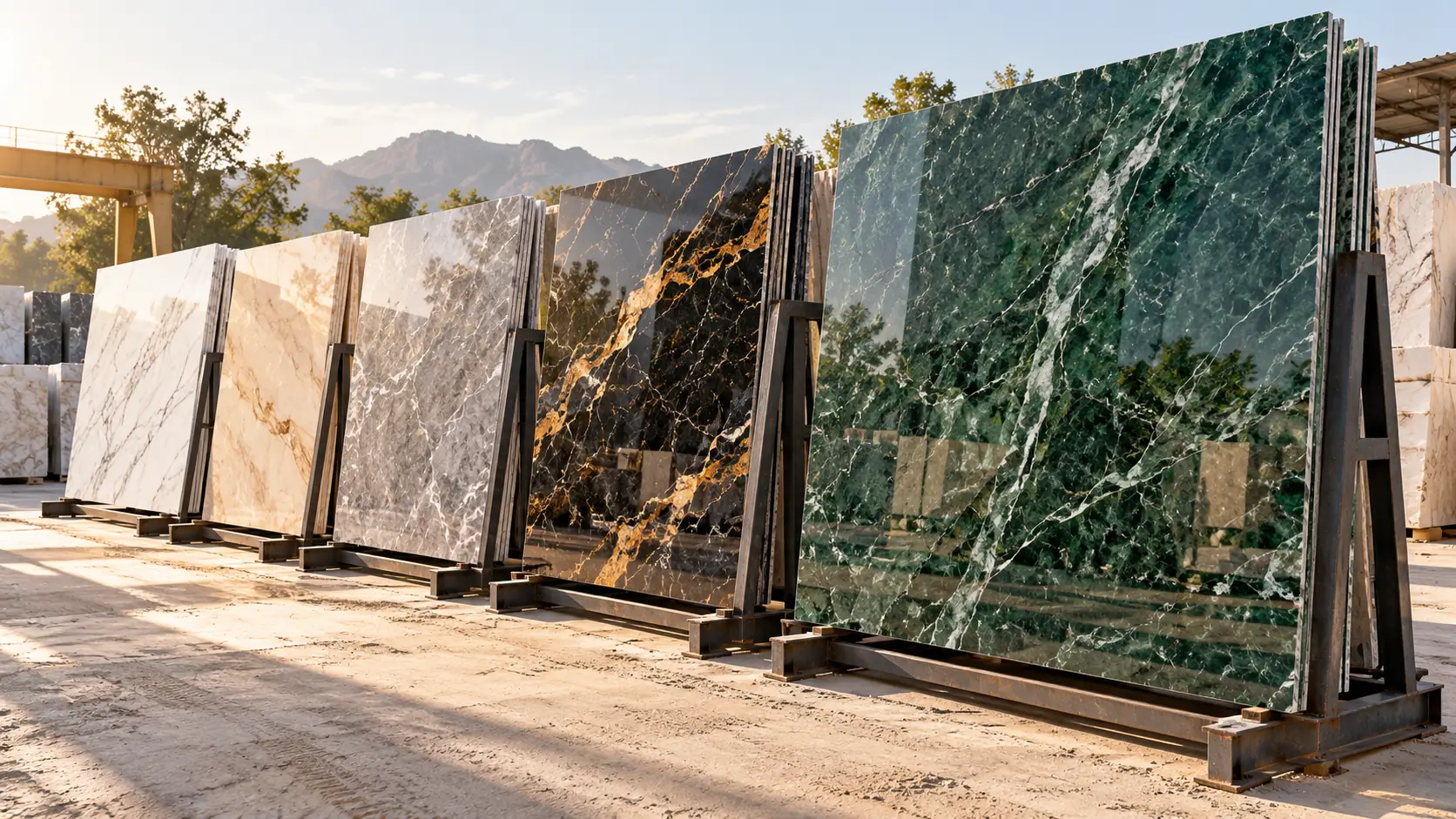
The main marble types in Pakistan are Ziarat whites (Ziarat White, Supreme, Medium White), Chaghi and Khuzdar beiges (Verona, Tavera), greys (Sunny Grey, Superline Grey, Denso), dark Chaghi stones (Black & Gold, Jet Black, Zebrano) and the colourful Mohmand Fancy family. Our installed quote ranges run from PKR 450 to PKR 2,800 per sq ft.
Alongside them, yards sell onyx, travertine and granite, which are related but different stones. Balochistan and Khyber Pakhtunkhwa supply most of the marble; Lahore, Karachi and Peshawar do most of the cutting and polishing. This guide lists each stone by its trade name, colour, quarry region and our current quote range per square foot, explains what the names actually mean, and ends with a practical answer to the question buyers really ask: which one should I use, and where?
How we priced this: every figure is our current quote range (November 2026) in PKR per square foot, fabricated and installed in our service area, for stones in our catalogue. The final figure depends on grade, thickness, finish and job size, and cut-outs, seams and freight outside our fitting cities are itemised, so treat the ranges as a starting point.
What do Pakistani marble names mean?
Pakistani marble names are trade names, not geological ones. They come from three places: the quarry area (Ziarat, Tippi, Dawezai), a look the stone resembles (Badal means cloud, Tiger for striped Verona, Commando for a camouflage pattern), or an imported stone it is sold as an alternative to (Verona, Perlino, Botticino). That has some practical consequences.
- One stone, several names. The same black-and-gold Chaghi stone is sold as Black & Gold in one yard and Michael Angelo in another. Grey, cloudy Mohmand stones are sold as Badal in some markets and under other names elsewhere.
- One name, several grades. Ziarat White covers everything from a clean, hand-picked white to a spotted commercial lot. The word Supreme, Super or A-grade is a selection label, not a separate stone.
- Borrowed names. A stone sold as Verona or Botticino in Pakistan is a local stone with a similar look to the Italian original, not an import, unless the seller says otherwise and can show paperwork. If you are weighing the two beiges, see how Botticino compares with Perlino.
- Names are not the same in every city. A buyer in Peshawar, Lahore and Karachi may hear three names for one stone. Always judge the slab, not the label.
That is why published lists of marble types in Pakistan rarely agree with each other. The practical rule is simple: use the name to start the conversation, then insist on seeing the actual lot. Two slabs both called Ziarat White can differ more than a Ziarat White and a Sunny Grey White.
Where is marble quarried in Pakistan?
Most Pakistani marble is quarried in Balochistan (Ziarat, Chaghi, Khuzdar) and Khyber Pakhtunkhwa (Mohmand, Nowshera, Tippi). The belts sit mainly in the mountains of Balochistan and northern Khyber Pakhtunkhwa, with smaller sources in Punjab and Sindh. Blocks travel by truck to processing centres where they are sawn into slabs on gang saws or cut into tiles on block cutters, then polished. The table below groups the stones we stock by the origin recorded for each one in our catalogue.
| Province | Area | Stones |
|---|---|---|
| Balochistan | Ziarat | Ziarat White, Ziarat Supreme, Medium White, Sunny Grey, Sunny Grey White |
| Balochistan | Chaghi | Verona Plain, Tiger Verona, Perlino Crystal Plain, Black & Gold, Black & White, Jet Black, Zebrano, Strawberry, Red & White; also Pak Green, Honey and Snow White onyx |
| Balochistan | Khuzdar | Tavera Light, New Tavera |
| Khyber Pakhtunkhwa | Mohmand (incl. Dawezai) | Pampo White, Dawezai Basaf, Superline Grey, Denso, Tropical, Green Fancy, Royal Fancy, Commando Fancy; Dawezai Badal travertine |
| Khyber Pakhtunkhwa | Nowshera | Indus Gold |
| Khyber Pakhtunkhwa | Tippi | Tippi Flower |
| Punjab | Chiniot | China White |
| Punjab | Lahore (workshop products) | Design Patti, Dighin Border, Chips Dana |
| Sindh | Gadap, Karachi | Gadap Stone (a limestone sold as marble) |
Granite comes from different ground: Nagar Parkar in Sindh, the Karachi belt, Nowshera and Swat in KP, and Chaghi. Our marble vs granite comparison explains why that difference matters in a kitchen.
Why origin matters to a buyer
Origin tells you roughly what to expect: Balochistan whites tend to be harder and cleaner than the cheaper whites, Khuzdar beiges are consistent and available in volume, and Mohmand produces the widest colour range. It also affects supply. Remote quarries, winter snow in Ziarat and road conditions can slow block deliveries, so popular stones sometimes go short for weeks. If a large floor depends on one stone, buy the full quantity, plus spares, from one lot.
White marbles
White is the biggest-selling marble colour in Pakistan, and the range runs from export-grade to budget. The differences are in whiteness, spotting, veining and how hard the stone takes a polish. Our white marble price guide compares the whites grade by grade.
Ziarat White, Ziarat Supreme and Medium White
The Ziarat family from Balochistan is the reference point for Pakistani white. Ziarat White (PKR 850 – 1,600 per sq ft) has an ivory to milk-white ground with faint grey drift. Ziarat Supreme (PKR 1,100 – 2,100) is the hand-picked top grade, whiter, tighter-grained and far less spotted, and only a small share of production qualifies. Medium White (PKR 550 – 950) is the working lot from the same belt, with grey cloud and light spotting, and it covers a large floor for a sensible figure.
Perlino Crystal Plain
Chaghi's crystal white (PKR 900 – 1,700) is valued for having almost no veins: an even, crystalline white with a faint sugary sparkle. Large floors and wall panels read nearly seamless, which makes it a favourite for minimal interiors and for rooms where the furniture should do the talking.
China White, Pampo White and Dawezai Basaf
These are the economical whites. China White (PKR 450 – 800) is cut near Chiniot in Punjab despite the name, a chalky off-white with fine grey threads that stays closer to matte. Pampo White (PKR 500 – 900) from Mohmand is cooler, with grey shadowing and the occasional pale gold fleck, and it varies between blocks. Dawezai Basaf (PKR 480 – 880) is a warmer creamy white-beige with soft horizontal banding that pairs easily with wooden doors.
Beige, cream and gold marbles
Beige marbles hide dust and wear better than whites, suit warm lighting and wooden joinery, and come in large volumes, which is why so many Pakistani houses are floored in them.
Verona Plain and Tiger Verona
The Verona family from Chaghi is the workhorse beige of the market. Verona Plain (PKR 600 – 1,100) is a flat honey-beige with only faint movement, so large areas look calm rather than busy. Tiger Verona (PKR 750 – 1,350) is cut against the bed to show bold brown striping; it suits feature walls and directional floors where the stripes can be vein-matched end to end.
Tavera Light and New Tavera
From Khuzdar, Tavera Light (PKR 520 – 980) is a pale cream with fine sandy grain, close to a limestone in feel, and it brightens rooms with little daylight. New Tavera (PKR 580 – 1,050) comes from newer benches in the same field: denser, slightly darker and better at holding an edge on stair nosings and thresholds.
Indus Gold
Nowshera's golden marble (PKR 700 – 1,300) carries amber drift across a warm beige ground, broken by thin dark mineral lines. Under warm light it reads almost metallic, which is why it turns up on reception counters, fireplace surrounds and decorative cladding.
Grey and brown marbles
Greys and browns sit between beige and black: they hide dust like a beige but read cooler and more modern. For a deeper look at the greys, see our grey marble guide.
Sunny Grey and Sunny Grey White
From Ziarat, Sunny Grey (PKR 560 – 1,000) is a warm grey that drifts between dove and light ash with no hard lines. It is easy to buy in quantity because small slab-to-slab differences blend in. Sunny Grey White (PKR 600 – 1,080) is the lighter selection from the same seam, with grey reduced to a soft wash; many yards sell the very lightest of this family as Sunny White.
Superline Grey
This Mohmand grey (PKR 620 – 1,150) has straight, ruler-like pale veins on a mid-grey ground. Because the lines stay parallel, vein-matched walls and long corridor floors are easy to set out, and it gives a modern, almost engineered look.
Denso and Tropical
Denso (PKR 450 – 820) is a hard-wearing, tight-grained grey with a faint green cast that stays semi-matte even after a full polish, which hides scratches on stairs and lobby floors. Tropical (PKR 650 – 1,200) is a warm brown with tan drift and fine dark threading, dark enough to hide traffic marks without making a room feel closed in.
Black, fancy and coloured marbles
Chaghi produces Pakistan's most dramatic dark stones, and Mohmand its most colourful ones. They are expensive because blocks are smaller and heavily selected, and they are mostly used in limited areas where they can be seen up close. The black marble price guide covers the dark stones in more detail.
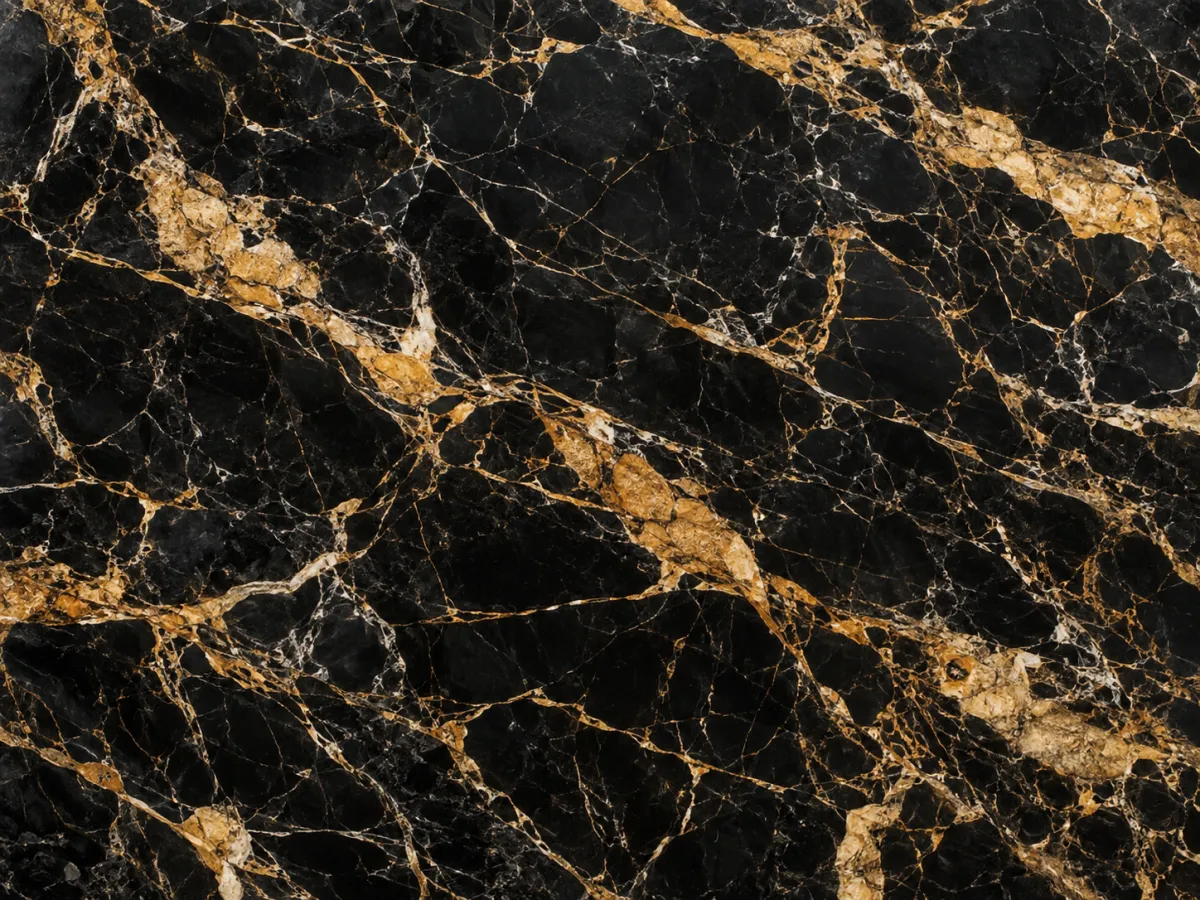
- [Black & Gold](/products/black-and-gold) (PKR 1,400 – 2,800): a near-black ground crossed by gold, bronze and white veins that pool into wide flashes. Often sold as Michael Angelo. Best on islands, vanities, fireplace surrounds and borders.
- Black & White (PKR 900 – 1,700): bright white veins across a charcoal-to-black field, wide and irregular, so no two slabs repeat. Suits modern feature walls and vanities.
- Jet Black (PKR 1,100 – 2,000): dense, near-uniform black that takes a glass-like polish. The stone fabricators use for skirting, risers, chequerboard squares and inlay.
- Zebrano (PKR 900 – 1,650): cream and chocolate in tight parallel stripes that read like timber grain. Orientation matters: vertical stripes stretch a wall, horizontal ones widen it.
Fancy and coloured marbles
The Fancy family from Mohmand and a handful of Chaghi and KP stones give Pakistan a range of colours that few other countries quarry. They are random by nature, so layout planning matters more than for any other group.
- Green Fancy (PKR 780 – 1,450): bottle-to-olive green laced with white, cream and rust threads.
- Royal Fancy (PKR 820 – 1,550): amber, rust, cream and charcoal swirled together, the most painterly of the family.
- Commando Fancy (PKR 740 – 1,380): irregular patches of green, grey and cream, more muted than Green Fancy and easier over larger areas.
- Tippi Flower (PKR 680 – 1,250): rust, ochre and grey blooms on a cream ground, quarried near Tippi in KP.
- Strawberry (PKR 850 – 1,550): rose to brick red with white veins, one of the few genuinely red marbles in the country.
- Red & White (PKR 700 – 1,300): broad white veins across a brick-red field, bolder than Strawberry.
Because two slabs from one Fancy block can look like different stones, buy them by photographed slab rather than by sample chip, and number each piece in the yard before cutting.
Utility stones, borders and the stones that are not quite marble
Workshop products
Design Patti (PKR 300 – 700) and Dighin Border (PKR 320 – 740) are not quarry stones but decorative borders cut and assembled in Lahore from coloured offcuts. Chips Dana (PKR 180 – 420) is marble chips set in cement, laid in situ and ground flat, the terrazzo-style floor of schools, offices and porches. Our guide to marble floor designs and borders shows how these are combined with a field stone. Our border design guide goes deeper on patti and dighin work.
Limestone, onyx and travertine
Gadap Stone (PKR 260 – 520) is sold across Sindh as marble but is honestly a limestone: sandy beige, flecked with fossil shell, softer and more absorbent than true marble, and best used outdoors or on covered porches. Onyx in the stone trade means banded, translucent calcite; Pak Green, Honey and Snow White onyx from Chaghi run PKR 2,200 – 5,600 and are used for backlit panels and vanities, not floors. Travertine forms from mineral springs and has natural pits; our Dawezai Badal Travertine (PKR 640 – 1,180) is supplied resin-filled and honed.
The science in one paragraph
True marble is limestone or dolomite recrystallised by heat and pressure. Calcite marble sits at about 3 on the Mohs hardness scale and dolomitic marble a little higher, which is why marble scratches more easily than granite (around 6 to 7, because of its quartz and feldspar) and why acids such as lemon juice, vinegar and many bathroom cleaners etch its polish. That is not a defect; it is the trade-off for a stone that is easy to cut, easy to polish and can be re-polished in place for decades.
Marble types in Pakistan side by side
The table puts the stones buyers ask about most in one place, with colour, origin and our current quote range. Use it to build a shortlist, then see the stones in person.
| Stone | Colour | Origin | Quote range | Best for |
|---|---|---|---|---|
| Ziarat Supreme | Clean white | Ziarat, Balochistan | PKR 1,100 – 2,100 | Feature floors, islands, vanities |
| Ziarat White | Ivory to milk white | Ziarat, Balochistan | PKR 850 – 1,600 | Floors, worktops, vanities |
| Perlino Crystal Plain | Plain crystalline white | Chaghi, Balochistan | PKR 900 – 1,700 | Seamless floors, walls |
| Medium White | Warm white, grey cloud | Ziarat, Balochistan | PKR 550 – 950 | Large floors, walls |
| Pampo White | Cool white, grey shadow | Mohmand, KP | PKR 500 – 900 | Floors, walls, showers |
| Dawezai Basaf | Creamy white-beige | Mohmand, KP | PKR 480 – 880 | Floors, vanities |
| China White | Chalky off-white | Chiniot, Punjab | PKR 450 – 800 | Budget vanities, walls |
| Verona Plain | Honey beige | Chaghi, Balochistan | PKR 600 – 1,100 | Floors, corridors |
| Tiger Verona | Striped beige-brown | Chaghi, Balochistan | PKR 750 – 1,350 | Feature walls, fireplaces |
| Tavera Light | Pale cream | Khuzdar, Balochistan | PKR 520 – 980 | Large floors, bathrooms |
| New Tavera | Darker cream | Khuzdar, Balochistan | PKR 580 – 1,050 | Stairs, thresholds |
| Indus Gold | Gold-beige | Nowshera, KP | PKR 700 – 1,300 | Cladding, fireplaces |
| Sunny Grey | Warm grey | Ziarat, Balochistan | PKR 560 – 1,000 | Wall-to-wall floors |
| Sunny Grey White | Light grey-white | Ziarat, Balochistan | PKR 600 – 1,080 | Bright lounges, walls |
| Superline Grey | Grey, straight veins | Mohmand, KP | PKR 620 – 1,150 | Corridors, feature walls |
| Denso | Fine grey | Mohmand, KP | PKR 450 – 820 | Lobbies, stairs |
| Tropical | Warm brown | Mohmand, KP | PKR 650 – 1,200 | Corridors, kitchens |
| Black & Gold | Black with gold veins | Chaghi, Balochistan | PKR 1,400 – 2,800 | Islands, fireplaces |
| Black & White | Black with white veins | Chaghi, Balochistan | PKR 900 – 1,700 | Vanities, feature walls |
| Jet Black | Solid black | Chaghi, Balochistan | PKR 1,100 – 2,000 | Borders, skirting, risers |
| Zebrano | Cream and brown stripes | Chaghi, Balochistan | PKR 900 – 1,650 | Feature walls |
| Green Fancy | Green, multicolour threads | Mohmand, KP | PKR 780 – 1,450 | Fireplaces, accents |
| Royal Fancy | Amber, rust, charcoal | Mohmand, KP | PKR 820 – 1,550 | Feature panels |
| Commando Fancy | Green, grey, cream patches | Mohmand, KP | PKR 740 – 1,380 | Floors, accents |
| Tippi Flower | Cream with rust blooms | Tippi, KP | PKR 680 – 1,250 | Floors, fireplaces |
| Strawberry | Pink to red | Chaghi, Balochistan | PKR 850 – 1,550 | Vanities, small features |
| Red & White | Brick red, white veins | Chaghi, Balochistan | PKR 700 – 1,300 | Feature floors, walls |
For every stone in one list, with granite, onyx and travertine added, see the marble price guide.
Which is the best marble in Pakistan for each job?
There is no single best stone. The right one depends on where it goes, how hard that surface works and what the room looks like. This is how we match them.
| Use | Strong choices | Avoid | Reason |
|---|---|---|---|
| Living and drawing room floors | Ziarat White, Perlino Crystal Plain, Verona Plain, Sunny Grey White | Busy Fancy stones wall to wall | Calm field, takes a border |
| Entrances, lobbies, stairs | New Tavera, Denso, Tropical, Jet Black nosings | Mirror-polished whites at the door | Density and colour hide grit |
| Kitchen worktops | Ziarat White or Supreme (honed and sealed), or granite | Soft, absorbent stones like Gadap | Oil, turmeric and acids |
| Bathroom vanities | Ziarat White, Black & White, Strawberry, onyx | Very porous light stones without sealer | Hard water and soap |
| Bathroom floors and showers | Sunny Grey, Tavera Light, Superline Grey (honed) | Polished finishes | Grip when wet |
| Fireplaces and feature walls | Black & Gold, Tiger Verona, Indus Gold, Royal Fancy | Plain stones if you want drama | Pattern seen up close |
| Covered outdoor areas | Gadap Stone, Denso, Chips Dana | Polished dark marble in full sun | Texture, heat, easy repair |
The best floor marble in Pakistan for most homes
If we had to pick for a typical family house: Sunny Grey White or Tavera Light for the main living floors, Ziarat White where light is poor and you want brightness, New Tavera on stair landings, honed Sunny Grey in bathrooms, and a Jet Black or Black & Gold border to tie it together. That combination balances looks, upkeep and budget.
Buying checklist: telling stones apart, and caring for them
- Ask for the origin, not just the name. A seller who knows the quarry area usually knows the grade too.
- Wet the slab. Water shows how the polished colour will look and reveals fissures and resin filling.
- Check the back. A mesh or resin backing is normal on onyx and some fragile stones, but it means the slab needed support.
- Look for consistency across the lot. Lay several slabs or tiles side by side, especially for whites and greys.
- Test hardness discreetly. A steel key will scratch calcite marble; it should not scratch granite. If a "granite" scratches, it is not granite.
- Test for acid only on an offcut. A drop of lemon juice on calcite marble dulls the polish within minutes. That confirms marble, and reminds you why kitchens need care.
- Confirm thickness and finish in writing. 2 cm or 3 cm, polished or honed, and whether the price includes cutting, edges and fitting.
- Order samples before deciding. See them in your own light, next to your joinery and paint.
You can order stone samples of the stones on your shortlist before you visit a yard, cut from current slabs at real thickness.
Care differs by type
All marble needs the same basics: pH-neutral cleaning, quick spill clean-up, and no acids or harsh powders. Beyond that, the type changes the routine.
- Whites and creams show stains from tea, turmeric, rust and hard water first. Seal them in kitchens and bathrooms.
- Dark polished stones do not stain visibly but show dust, water spots and scratches. Dust-mop daily and keep grit out with mats.
- Open-textured stones such as travertine, Gadap Stone and some Fancy lots absorb more. Seal them and refill pits when they open up.
- Onyx is softer and more brittle than marble. Keep it away from heavy wear and treat it as a decorative surface.
Our guide on how to seal marble in Pakistan covers which sealer to use, how often, and how dust, heat and monsoon humidity change the schedule.
Next steps
Shortlist two or three stones from the tables above for each area of the house, order samples, and look at them in your own light. Browse every stone with photos in our marble range, or run rough numbers through the cost estimator. When you are ready, send us your measurements or drawings for a written quote that states the installed rate and itemises cut-outs, seams and freight. If a cheaper stone from the same family will give you the look you want, we will say so.
Written by
The Captivating Marble Design Team
Fabricators, templaters and stone designers
We template, cut and install natural stone every day and write about what we learn — pricing, layouts, care and the mistakes we help clients avoid.
Book a free design consultation