Travertine vs Marble Flooring: Which Suits a Pakistani Home?
Pores, finishes, summer heat, porches, slip, pocha mopping, sealing and PKR per sq ft: how travertine and marble floors compare room by room. Get a free quote.
Captivating Marble Design Team · · 16 min read
Key takeaways
- Marble is the better choice for most indoor floors; travertine is better on porches, courtyards, terraces, pool decks and wet bathrooms.
- Our Dawezai Badal travertine from Mohmand, KP costs PKR 640–1,180 per sq ft installed (November 2026), mid-range against floor marbles at about PKR 450–1,600.
- Unfilled travertine absorbs about 1–2% water and filled travertine under 0.5%, so filled and honed is the indoor standard.
- A polished floor of either stone is slippery when wet; honed, brushed or tumbled travertine grips far better.
- Seal travertine about once a year indoors and twice a year outdoors, with an extra coat before grouting.
The short answer
In the travertine vs marble question for floors, marble wins inside the house and travertine wins outside. Polished marble such as Ziarat White or Verona (about PKR 450 to 1,600 per sq ft) gives a bright, re-polishable indoor floor. Honed or brushed travertine such as Dawezai Badal (PKR 640 to 1,180) grips better on porches, courtyards, bathrooms and pool decks.
Marble in Ziarat White, Verona or Tavera gives the clean, bright look most Pakistani buyers want and can be re-polished for decades. Travertine's honed, brushed or tumbled face grips better when wet, and its open texture forgives dust and weather.
On price the two overlap: our Pakistani travertine, Dawezai Badal from Mohmand, sits in the middle of the floor-marble range. This guide compares pores and filling, finishes, summer heat, outdoor use, slip, daily pocha mopping, sealing and cost, then gives a room-by-room verdict and a way to use both in one house.
Stone rates in this post are our current quote ranges per square foot (November 2026), fabricated and installed in our service area. Separate laying, grinding and polishing figures are indicative market ranges for stone-only jobs. Confirm the final figure against a written quotation.
Travertine vs marble at a glance
Both stones are calcium carbonate, so they share some habits: lemon, vinegar and tile acid etch them, and grit scratches them. The difference is in how they formed. Travertine is laid down by mineral springs, layer on layer, trapping gas bubbles that become its pores. Marble is limestone that has been buried and recrystallised under heat and pressure, which closes the pores and grows the crystals that take a mirror polish. Pakistani yards call both "marble", which is why buyers search for "travertine marble"; our travertine page explains the naming.
| Travertine (Dawezai Badal) | Marble (Ziarat, Verona, Tavera and others) | |
|---|---|---|
| Surface | Natural pores, filled at the factory or left open | Dense, crystalline, no visible pores |
| Water absorption | 1–2% unfilled, under 0.5% filled | Low |
| Usual floor finishes | Honed, brushed, tumbled | Polished, honed |
| Mirror polish | Soft sheen only; fills polish differently | Yes, the main reason people buy it |
| Grip when wet | Good honed, very good brushed or tumbled | Fair honed, poor polished |
| Look | Warm, textured, layered; Badal is grey-clouded | Clean and bright, from plain white to bold veins |
| Colour range we stock | Grey and grey-beige (Badal) | White, beige, grey, black, green, brown and more |
| Acid etching | Yes | Yes |
| Our current quote, PKR / sq ft | 640 – 1,180 | About 450 – 1,600 for common floor marbles |
| Best at | Porches, courtyards, terraces, pool decks, bathrooms | Lounges, drawing rooms, bedrooms, stairs, lobbies |
For the background on the stone itself, including the imported travertine sold in DHA and Clifton showrooms and the full Badal range, read our guide to travertine prices and types in Pakistan. This post stays on one decision: which one to put underfoot, and where.
Pores, porosity and filled vs unfilled
The pores are the biggest practical difference. A sawn travertine tile is full of small holes and channels. The factory either fills them with a colour-matched resin or cement paste and hones the face flat, or leaves them open so they are grouted full on site, giving a rustic, aged surface. Marble needs none of this: its face is already closed, and only the occasional natural pit or fissure is filled.
| Filled travertine | Unfilled travertine | Marble | |
|---|---|---|---|
| Dust in the surface | Little | Pores collect dust; needs a brush | Little |
| Wet mopping | Mops clean | Water sits in pores; dries slowly | Mops clean |
| Stain risk | Low once sealed | Higher; seal more often | Low to moderate once sealed; light marbles show stains |
| Long-term repair | An occasional fill pops out; epoxy fix in minutes | Grout top-ups | Scratches and etch marks ground out by re-polishing |
| Best for | Indoor floors, bathrooms | Courtyards, pool surrounds, garden paths | Most indoor floors |
Most Lahore and Islamabad clients choose filled and honed travertine for any indoor use, because open pores in a lounge turn grey with dust within a season. Outdoors the logic flips, and a few dirty pores simply look like age. Our glossary entries on porosity and resin-filled slabs explain the terms you will see on a quote.
Some filled tiles lose a plug of fill in the first year or two, especially outdoors where the stone heats and cools sharply. This is normal, not a defect, and a colour-matched epoxy repair takes minutes. Keep a small tub from the fitting team.
Finishes: honed, tumbled, brushed and polished
Finish changes both looks and safety, and here the two stones point in opposite directions. Marble is bought for its polish; travertine is bought for its matte, textured faces.
| Finish | On travertine | On marble |
|---|---|---|
| Polished | A soft sheen at best; slippery when wet. Walls and tops only | The classic mirror floor for drawing rooms and lobbies; slippery when wet |
| Honed | The standard indoor floor finish: smooth matte, hides fine scratches | A calm matte floor that shows fewer scratches and less glare; grips better than polished |
| Brushed | Suede-like texture with real grip; first choice for verandahs and shower floors | Offered on a few stones such as Denso; uncommon on floors |
| Tumbled | Rounded edges, aged face; pool decks and rustic courtyards | Rare in Pakistan; not a stock floor finish |
Badal is supplied honed or brushed as standard, with tumbled and polished available through the Badal range. Our floor marbles are supplied polished or honed. A practical rule: honed indoors, brushed for anything wet or semi-open, tumbled for pools, and polished only where the floor stays dry.
Re-polishing over the years
A polished marble floor can be ground and re-polished on site (ragrai) every few years, which removes scratches and etch marks and brings back the shine. That ability is one of marble's great strengths. Honed travertine is re-honed rather than polished, and an open-pore floor is simply cleaned, re-grouted where needed and re-sealed. Our marble polishing guide covers how ragrai works and how often it is needed.
Summer heat and how each floor feels underfoot
Pakistani buyers rightly ask which floor stays cooler in June (our guide to marble flooring in summer goes deeper). The honest answer is that colour and sun exposure matter more than stone type. Indoors, in shade, both stones feel cool to bare feet, which is one reason stone floors are so common in Lahore, Multan and Karachi houses. Both are dense and hold the temperature of the room.
Outdoors, in direct sun, differences appear. A pale honed travertine or a white marble reflects more sun than a dark stone and stays noticeably more comfortable than dark granite on an open terrace. Where travertine pulls ahead outside is not temperature but texture: a honed or brushed face does not throw glare back into your eyes on a bright afternoon the way a polished white marble does, and it does not show every dusty footprint.
- Indoors: both feel cool; choose on looks, polish and cleaning.
- Covered verandah: both work; honed travertine is easier on the eyes and safer in monsoon spray.
- Open roof or courtyard in full sun: pale travertine, brushed or tumbled, is the more comfortable choice. Avoid dark stone on surfaces people walk barefoot.
- Northern winters: in Islamabad, Murree and Peshawar, stone floors feel cold in December; rugs indoors, and sealed stone outdoors so water in open pores does not freeze and spall the surface.
We have not measured surface temperatures, so we do not quote degree figures. Before deciding on an open terrace, put a sample of each stone in full afternoon sun for an hour and touch them.
Is travertine or marble better outdoors?
Travertine is better outdoors: a brushed or tumbled face grips in monsoon rain, hides dust and weathers gracefully, while polished marble loses its shine and turns slippery. This is where travertine clearly earns its place. A Pakistani porch, gate entrance, verandah or courtyard takes sun, dust storms, monsoon rain, car tyres and sometimes a generator or a parked motorcycle. A polished marble in the same spot loses its shine quickly, becomes slippery in rain and shows every tyre mark.
Where travertine works outside
- Verandahs and covered porches: filled and honed or brushed 12 x 24 inch tile, the best-selling format.
- Open courtyards and roof terraces: brushed or tumbled, laid to a gentle fall towards a drain so monsoon water does not stand.
- Pool decks: 30 mm brushed or tumbled pavers with bullnose copings; rinse chlorine splash and seal about twice a year.
- Garden paths: tumbled tile with wider joints, which also hides small level differences.
When marble is still used outside
Marble does appear outdoors, most often as a honed porch floor in the same colour as the drawing room, or as steps and borders. If you want that, choose a honed finish, not polished, and accept that it will weather and need re-honing. For a car porch that takes vehicle weight and oil, a granite such as Nagar Parkar Grey at PKR 650 to 1,200 per square foot is tougher than either calcium stone. For a budget boundary area or driveway, a local limestone such as Gadap Stone at PKR 260 to 520 is the economical option; our limestone guide compares it.
Oil is the real outdoor enemy. Put a drip tray or mat under any generator, motorcycle or car parked on travertine or marble, and clean spills the same day.
Slip resistance in bathrooms, entrances and wet areas
Slip is about finish first and stone second. A polished floor of any stone is slippery when wet, and a honed or brushed one is far safer. Because travertine floors are almost always honed, brushed or tumbled, they are generally the safer choice where water is around. Marble floors are often polished, which is beautiful in a dry lounge and risky at a wet entrance. Our guide to anti-slip finishes covers the options.
| Area | Travertine | Marble |
|---|---|---|
| Shower floor | Brushed or filled honed; a good choice | Honed only, or small tiles with many grout lines |
| Bathroom floor | Filled and honed; sealed before and after grouting | Honed is safer than polished |
| Wuzu (ablution) area | Brushed; handles daily water well | Honed, with a good fall to the drain |
| Main entrance in monsoon | Honed or brushed | Polished needs a large mat; honed is safer |
| Kitchen floor | Filled and honed | Honed; polished shows oil and is slippery |
We do not quote slip-test ratings because none have been measured for our stones. If someone in the house is elderly or unsteady, choose honed or brushed in every wet area, whichever stone you pick, and keep soap and algae off the surface.
Daily mopping, dust and stains
In most Pakistani homes the floor is swept and wet-mopped (pocha) every day, often with a bucket of water and a strong cleaner, and in many cities the tap water is hard. That routine affects the two stones differently.
- Marble: mops clean and dries quickly, but a polished light marble shows streaks, hard-water marks and every footprint. Strong floor cleaners and anything acidic dull the polish in patches over time.
- Filled travertine: mops much like marble and hides streaks and dust better because of its matte, textured look.
- Unfilled travertine: water sits in the pores and dries slowly, and dirty mop water leaves grey in them. Indoors this is the main reason to avoid open pores.
A mopping routine for both
- Sweep or vacuum first; grit under a wet mop scratches calcium stone.
- Use a pH-neutral stone cleaner, never phenyl-acid cleaners, tile acid, vinegar or bleach.
- Wring the mop well so water does not pool in pores or along skirting.
- Change the water when it turns grey; dirty water leaves a film.
- Wipe chai, oil, turmeric and pickle spills at once, before they etch or stain.
Tell the cleaning staff which floors are stone. Most etch marks we see come from the same acidic cleaner used on bathroom tiles.
Sealing and long-term maintenance
Both stones should be sealed with an impregnating sealer after fitting. The intervals differ.
| Task | Travertine | Marble |
|---|---|---|
| Sealing indoors | About once a year | About every 6 to 12 months in kitchens and bathrooms; less often in bedrooms |
| Sealing outdoors | About twice a year | Every few months if used outside |
| Sealing during fitting | Before and after grouting | After grouting |
| Surface renewal | Re-hone; fill pop-out repairs | Grinding and re-polishing (ragrai) every few years |
| Water-drop test | Every few months | Every few months |
The water-drop test is the same for both: leave a spoonful of water on the floor for fifteen minutes, and if the stone darkens, it is time to reseal. Our guide on how to seal marble in Pakistan explains sealer types and the full method, which applies to travertine too, with the extra coat before grouting.
Is travertine cheaper than marble?
Not necessarily: at PKR 640 to 1,180 per square foot (November 2026), our Dawezai Badal travertine costs more than China White or Tavera Light but less than Ziarat White. Travertine is not a budget alternative to marble, nor a luxury one; it sits in the middle of the range. Here is how it compares with the marbles most often laid on Pakistani floors.
| Stone | Type | PKR / sq ft | Typical floor use |
|---|---|---|---|
| China White | Marble | 450 – 800 | Budget whole-house floors |
| Tavera Light | Marble | 520 – 980 | Whole-house floors |
| Sunny Grey | Marble | 560 – 1,000 | Lounges, open-plan floors |
| Verona Plain | Marble | 600 – 1,100 | Warm beige floors, kitchens |
| Dawezai Badal Travertine | Travertine | 640 – 1,180 | Verandahs, courtyards, bathrooms |
| Ziarat White | Marble | 850 – 1,600 | Drawing rooms, stairs, lobbies |
Worked example: a 15 x 20 ft lounge
The floor is 300 sq ft. Add about 10% for cutting and breakage and order roughly 330 sq ft.
| Stone | Estimated installed cost (PKR) |
|---|---|
| China White | 148,500 – 264,000 |
| Tavera Light | 171,600 – 323,400 |
| Verona Plain | 198,000 – 363,000 |
| Dawezai Badal Travertine | 211,200 – 389,400 |
| Ziarat White | 280,500 – 528,000 |
If you buy stone only and hire your own team
Our rates already include laying and the finish in our service area; cut-outs, seams and freight outside our fitting cities are itemised. The figures below are indicative market rates that apply only when you buy stone alone.
- Laying labour: an indicative PKR 60 to 150 per square foot when a mistri is hired separately, similar for both stones.
- On-site polishing: a polished marble floor is usually ground and polished after laying, which your own polishing team charges for separately. Honed travertine tile arrives finished and needs only cleaning and sealing.
- Filling and finish: resin filling, brushing and tumbling are factory passes; ask any supplier whether the travertine rate includes them.
- Adhesive, grout and sealer: white stone adhesive under pale stone of either kind, plus an extra sealer coat for travertine before grouting.
Redo the sums for your own rooms in our stone cost estimator. For a broader view of floor costs, patterns and borders, see our marble floor design guide, and if porcelain is also on your shortlist, our marble vs tiles comparison.
Where each one wins: a room-by-room verdict
| Area | Better choice | Why |
|---|---|---|
| Drawing room and lobby | Marble, polished | Bright, formal, re-polishable; the look most guests expect |
| Lounge and TV room | Either | Marble for a clean look; filled honed travertine for a warm, relaxed one |
| Bedrooms | Either | Low traffic; choose on looks and budget |
| Stairs | Marble | Clean nosings and edges; honed treads for grip |
| Kitchen floor | Either, honed | Avoid polished; oil and water make it slippery |
| Bathrooms and wuzu areas | Travertine | Brushed or honed grips better and hides water marks |
| Covered verandah | Travertine | Grip in monsoon spray; less glare |
| Open courtyard and roof | Travertine | Brushed or tumbled handles sun, rain and dust |
| Pool deck | Travertine | Brushed or tumbled pavers are the classic choice |
| Car porch | Granite | Tougher than either under tyres and oil |
If you want marble indoors, start with Ziarat White for a bright, premium floor, Verona Plain for warm beige, Tavera Light or China White for whole-house value, and Sunny Grey for a soft grey that hides dust. For travertine, the stone is Dawezai Badal Travertine.
Using both in one house
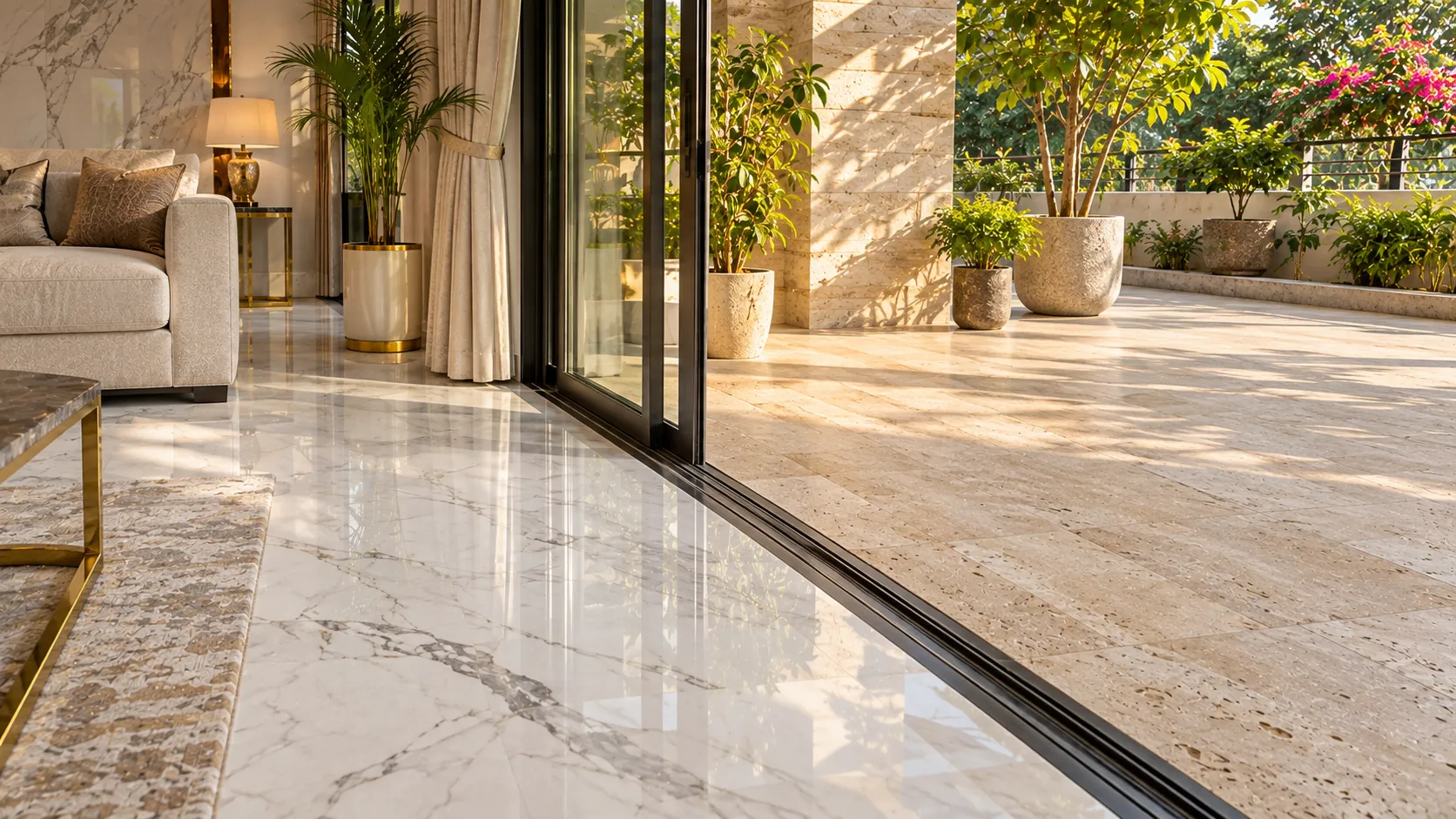
Many of the best Pakistani houses do not choose at all. They lay polished or honed marble inside and travertine on the verandah, terrace and pool deck, so each stone does the job it is good at. Done well, the change of material at the door reads as intentional.
- Pick related colours. A grey-clouded Badal outside sits naturally next to Sunny Grey or Ziarat White inside; a warm beige marble such as Verona pairs with a warmer-toned travertine.
- Change material at a clear line, such as a door threshold, a step or a border, never in the middle of an open space.
- Match the finished levels. Travertine pavers are often thicker than indoor tile, so plan the bed so both finish level at a sliding door, or use a small step down to the outside.
- Repeat one stone as a border. A strip of the indoor marble around the edge of the terrace ties the two areas together.
- Keep a drain line at the threshold. Monsoon water should run away from the door, not into the house.
Our installation service plans these transitions at the measuring stage, so levels, falls and borders are agreed before any stone is cut.
See both stones and get a quote
Send us your room and outdoor areas, a few photos and how each space is used through our free quote form. We will suggest a stone and finish for each area, check the lots in stock and quote the installed rate for each area, with cut-outs, seams and any freight itemised. To compare colour, pores and grip in your own light, order samples of the marble you like and of Badal, and put them side by side in the sun and in the shade.
Written by
The Captivating Marble Design Team
Fabricators, templaters and stone designers
We template, cut and install natural stone every day and write about what we learn — pricing, layouts, care and the mistakes we help clients avoid.
Book a free design consultation