Travertine Marble Price in Pakistan: Types, Finishes and Uses
Travertine marble price in Pakistan: Dawezai Badal at PKR 640–1,180 per sq ft, imported types, filled vs unfilled, finishes and tile sizes. Get a free quote.
Captivating Marble Design Team · · Updated · 17 min read
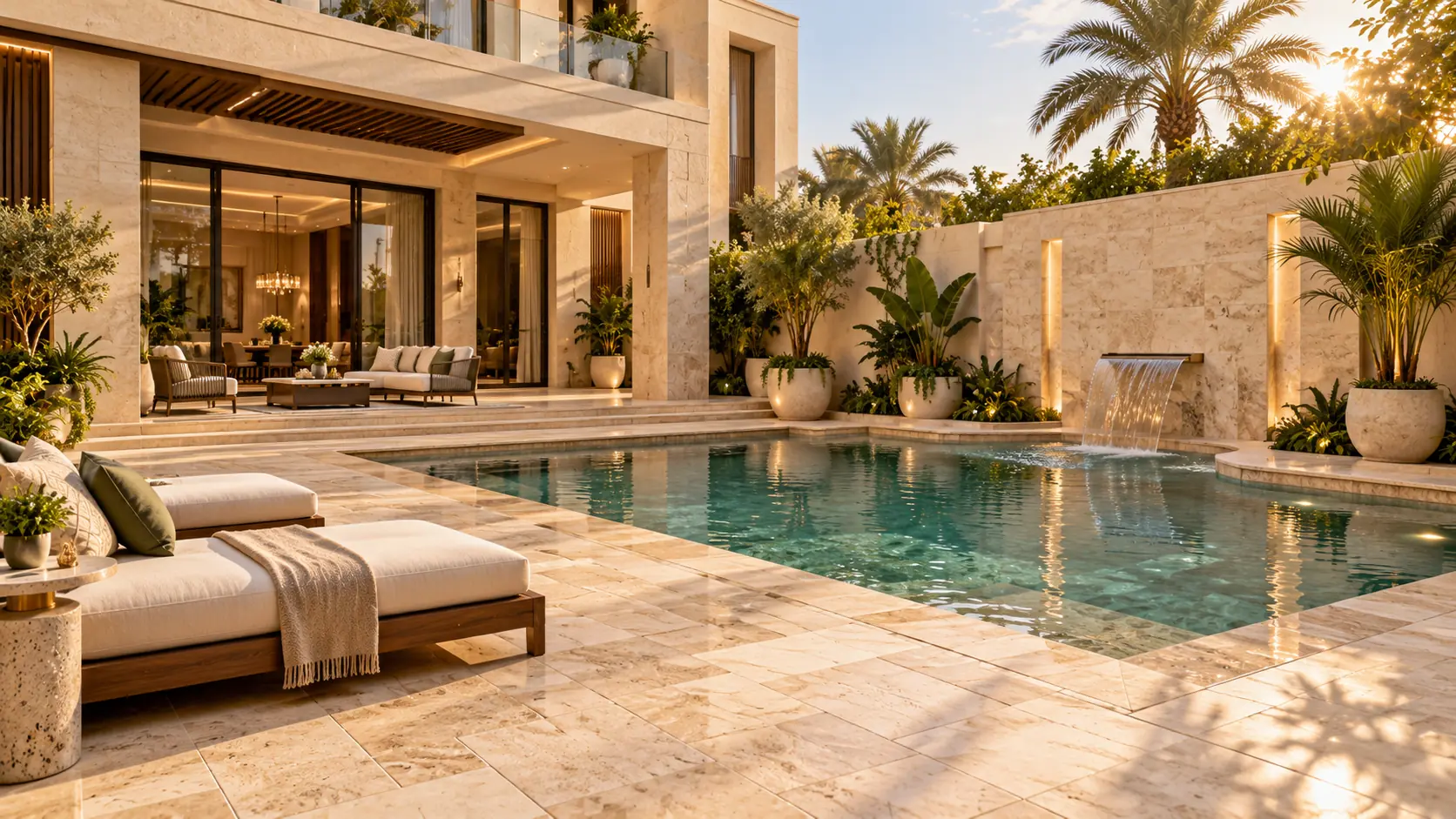
Key takeaways
- Dawezai Badal travertine from Mohmand, Khyber Pakhtunkhwa, costs PKR 640–1,180 per sq ft installed on our November 2026 quotes.
- Travertine is a spring-deposited limestone, not a true marble; it etches with acids and rates about Mohs 4–5.
- Unfilled travertine absorbs about 1–2% water; resin-filled stone absorbs under 0.5%.
- Use filled and honed travertine indoors, brushed for wet areas and tumbled 30 mm pavers for pool decks.
- Reseal travertine about once a year indoors and twice a year outdoors.
How much does travertine cost in Pakistan?
The travertine marble price in Pakistan is PKR 640–1,180 per sq ft on our November 2026 quotes for Dawezai Badal, the grey-clouded travertine quarried in Mohmand, Khyber Pakhtunkhwa. Filled and honed floor tile sits at the low end and selected vein-cut slabs at the top. Imported Turkish and Iranian travertine usually costs more once freight and duty are added.
Strictly speaking, travertine is not a marble: it is a spring-deposited limestone with natural pores and soft, layered banding, which the Pakistani trade sells as marble. This guide explains what the stone really is and how it differs from Ziarat or Verona, what Pakistan produces and what is imported, the filled versus unfilled question, which finish to choose for a floor, a pool deck or a fireplace, standard tile sizes, worked costs, and how to look after it in Pakistani heat, dust and monsoon rain.
How we priced this: rates for Dawezai Badal are our own current quote range per square foot from the product catalogue, fabricated and installed in our service area, as of November 2026. Figures for imported travertine (supply only), stone-only labour, adhesive and look-alike tiles are indicative market ranges only — confirm them against a written quotation.
Is travertine a marble?
No: travertine is a limestone deposited by mineral springs, while marble is limestone recrystallised by heat and pressure. Both are calcium carbonate, which is why Pakistani yards sell them under the same name.
How it forms
Travertine forms where calcium-rich spring water reaches the surface and drops its dissolved calcite as it cools and loses carbon dioxide. Layer after layer builds up, trapping gas bubbles, plant matter and water channels. Those trapped voids become the holes and pits you see on a sawn face, and the layers become its bands. Marble, by contrast, is limestone that has been buried and recrystallised under heat and pressure over a much longer time, which closes the pores and grows the sparkling crystals that take a mirror polish.
Both are made of calcium carbonate, so they share the same weaknesses: lemon, vinegar, tamarind and acidic bathroom cleaners etch them, and a steel blade will scratch either one. The real differences are porosity, texture and the way each looks under light.
Why Pakistani yards call it marble
In Lahore, Karachi and Peshawar yards almost every polished calcium stone is sold as "marble" (sang-e-marmar), whether it is a true marble, an onyx, a limestone or a travertine. That is why buyers search for "travertine marble" and why Badal is often called "badal marble" at the counter. The label is harmless as long as you know you are buying a more porous, more textured stone and you fill, finish and seal it accordingly.
| Travertine (Dawezai Badal) | Marble (e.g. Ziarat White) | Limestone (Gadap Stone) | Granite (Nagar Parkar Grey) | |
|---|---|---|---|---|
| How it forms | Spring deposit, layered | Recrystallised limestone | Sedimentary, compacted | Cooled magma |
| Surface | Natural pores, filled or open | Dense, crystalline | Fine, even, matte | Granular, very dense |
| Water absorption | 1–2% unfilled, under 0.5% filled | Low | Higher | Very low |
| Acid etching | Yes | Yes | Yes | No |
| Grip when wet (honed/brushed) | Good | Fair (honed), poor (polished) | Good | Good (flamed/leathered) |
| Hardness (Mohs) | 4–5 | About 3 | About 3 | 6–7 |
| Our current quote, PKR / sq ft | 640 – 1,180 | 850 – 1,600 | 260 – 520 | 650 – 1,200 |
| Best at | Courtyards, cladding, bathrooms | Drawing rooms, stairs | Budget outdoor paving | Kitchens, heavy traffic |
If you are choosing between the two for a floor, our travertine vs marble flooring guide compares them room by room, from porches and pool decks to lounges and bathrooms.
Pakistani travertine: Dawezai Badal from Mohmand
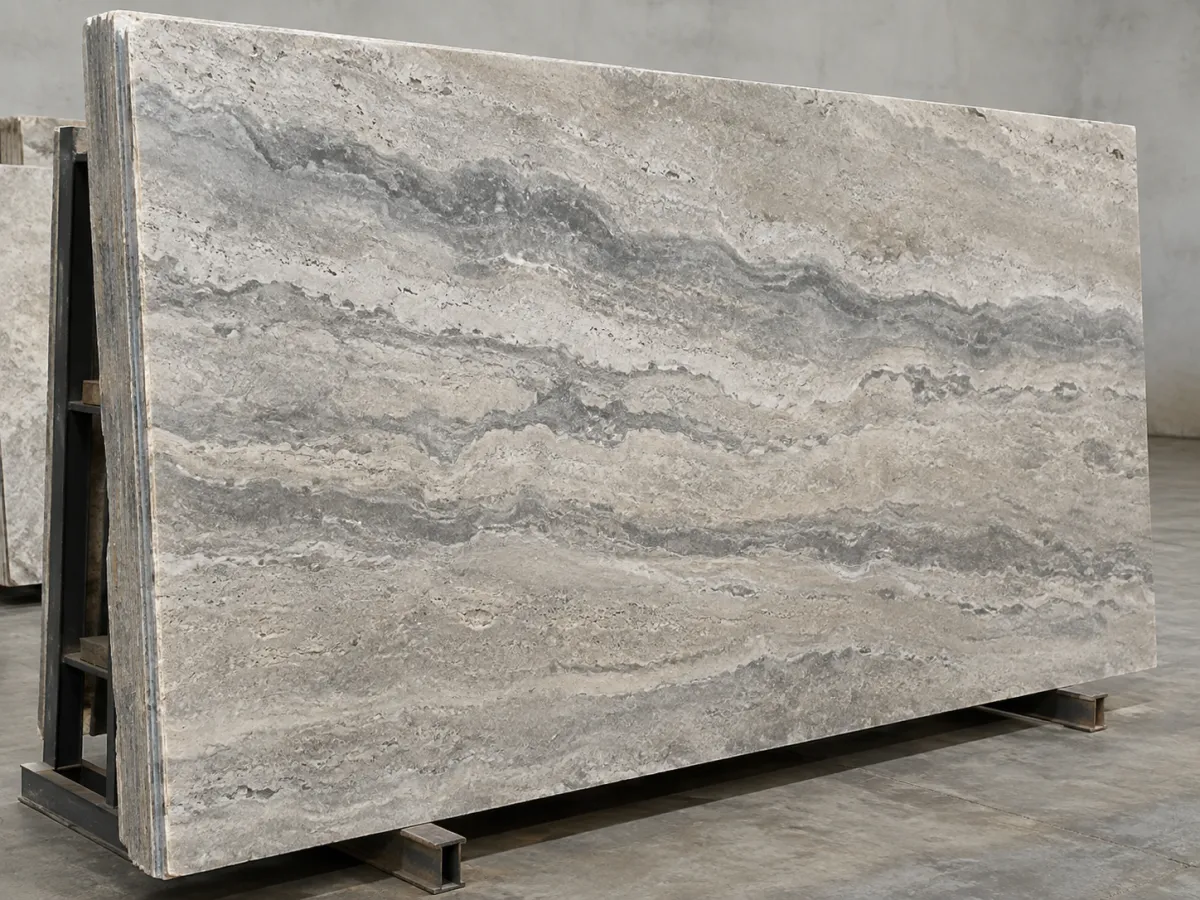
Pakistan's commercial travertine comes from the Dawezai belt in Mohmand district, the same part of Khyber Pakhtunkhwa that supplies Superline Grey, Denso and the Fancy marbles. Blocks are trucked down to processing units and cut in Lahore into gauged slabs and floor tiles. The stone we sell from this belt is Dawezai Badal Travertine: a warm off-white body with grey, smoky drifts across it. Badal means cloud, and the name is literal. Our Badal marble guide shows floor and wall layouts in this stone.
Cross-cut clouds or vein-cut stripes
How the block is sawn decides the look more than any other choice. Sawn across the bedding (cross-cut), the layers show as rounded, drifting cloud shapes. Sawn along the bedding (vein-cut), they show as calm, straight horizontal lines, which is the look in most modern fireplace and feature-wall photographs. Tell the yard which one you want before sawing; a block cannot be cut both ways. Our glossary entry on vein-cut vs cross-cut shows the two side by side.
The Badal range
- Dawezai Badal (filled and honed) — the standard interior grade for floors, bathrooms and walls; the cheapest end of the range.
- Badal Vein-Cut — straight linear figure for fireplace cladding, TV walls and vanity tops; the top end of the range.
- Badal Brushed — a textured, grippy face for verandahs, lawn kitchens and wet areas.
- Badal Tumbled — softened, rounded edges and an aged surface for courtyard and pool paving.
You can compare them, with slab photographs and specifications, on our Badal collection page. Colour shifts from block to block, so for any floor larger than a single room we hold the whole quantity from one lot.
Imported travertine you will see in Pakistani showrooms
Most of the world's travertine comes from Turkey, Iran, Italy and Mexico, and some of it reaches showrooms in DHA Lahore, Clifton and Islamabad, mostly as tile rather than full slabs. These are the names you will meet and what to expect from each.
| Type | Typical source | Colour and character | Indicative PKR / sq ft |
|---|---|---|---|
| Classic / light beige | Denizli, Turkey | Cream to light beige, even, the "classic" pool-deck look | 900 – 1,800 |
| Ivory / white | Turkey | Pale ivory with soft banding | 1,100 – 2,200 |
| Silver / grey | Iran, Turkey | Cool grey vein-cut lines, close in mood to Badal | 1,200 – 2,500 |
| Yellow, red and walnut | Iran (Hajiabad and others), Turkey | Warm gold, rust or chocolate tones | 1,200 – 2,600 |
| Roman (Travertino Romano) | Tivoli, Italy | Warm beige, open pores, the stone of Roman monuments | 2,500 and up, by order |
Imported stone makes sense when you want a colour Mohmand does not produce, such as a pale ivory pool deck or a walnut accent. Its drawbacks are price, lead time and repeat orders: a second consignment months later rarely matches the first. If your design calls for grey or grey-beige, Badal gives a similar mood at a lower rate, with stock close at hand for repairs and extensions.
Ask an importer for the country of origin and the batch number on the crate label. "Turkish travertine" in a showroom is sometimes a porcelain print, and a genuine stone always shows a slightly different pore pattern on every tile.
Travertine rates per sq ft against marble, limestone and granite
Our current quote range for Dawezai Badal is PKR 640 to 1,180 per square foot, installed. Standard filled and honed floor tile sits at the bottom of that band, and selected vein-cut slabs at the top. Here is where it sits against the other stones people compare it with for floors and outdoor areas.
| Stone | Type | Origin | PKR / sq ft | Typical use |
|---|---|---|---|---|
| Gadap Stone | Limestone | Gadap, Karachi | 260 – 520 | Budget outdoor paving, boundary walls |
| Tavera Light | Marble | Khuzdar, Balochistan | 520 – 980 | Whole-house floors |
| Verona Plain | Marble | Chaghi, Balochistan | 600 – 1,100 | Floors, kitchens |
| Dawezai Badal Travertine | Travertine | Mohmand, KP | 640 – 1,180 | Courtyards, bathrooms, cladding |
| Nagar Parkar Grey | Granite | Nagar Parkar, Sindh | 650 – 1,200 | Outdoor steps, kitchens |
| Ziarat White | Marble | Ziarat, Balochistan | 850 – 1,600 | Drawing rooms, stairs |
Badal and Gadap Stone are the two that most often end up on the same shortlist for a courtyard. Gadap costs roughly half as much but is a plainer, softer, more absorbent limestone; Badal has more character, takes a finer finish and is the one we would put indoors as well. The limestone price guide covers Gadap and the other local limestones.
What moves a quote up or down the range
- Cut. Vein-cut costs more than cross-cut because fewer blocks give a clean, straight figure.
- Grade. Even colour, few large voids and no open cracks across the bands raise the grade. Heavy fill patches and colour patches lower it.
- Format. Stock tile is cheapest; gauged slabs and cut-to-size pieces (steps, copings, fireplace legs) cost more because of yield loss and workshop time.
- Finish and fill. Resin filling, brushing and tumbling are extra passes on the line. Ask whether the rate includes them.
- Thickness. 30 mm paving and slabs cost more per square foot than 18–20 mm tile.
Worked installed costs at our range
| Job | Area incl. about 10% wastage | Estimated installed cost (PKR) |
|---|---|---|
| Bathroom floor, 8 x 6 ft | About 53 sq ft | 33,920 – 62,540 |
| Shower walls, 3 walls of 4 x 8 ft | About 106 sq ft | 67,840 – 125,080 |
| Fireplace surround and hearth | About 30 sq ft | 19,200 – 35,400 |
| Verandah, 25 x 8 ft | About 220 sq ft | 140,800 – 259,600 |
| Pool deck, 4 ft band around a 30 x 12 ft pool | About 440 sq ft | 281,600 – 519,200 |
Redo the arithmetic for your own sizes in our stone cost estimator. Measure each area in feet, multiply length by width, add the wastage and multiply by the rate. For an L-shaped verandah, split it into two rectangles.
What our rate covers, and what is itemised
- Included. The stone, cutting, the finish, a standard edge and laying or fixing in our service area.
- Edges and cut-to-size. Bullnose pool copings, step nosings and mitred fireplace corners are itemised per running foot, as are cut-outs and seams.
- If you buy stone only. A mistri hired separately charges an indicative PKR 60–150 per sq ft for floors, more for clamped wall cladding, plus white adhesive for pale stone, sanded grout for unfilled stone and an impregnating sealer.
- Transport. Stock tile usually leaves Lahore within a few days; cut-to-size slabs take about 5–10 days. Freight outside our fitting cities is quoted separately.
Should you choose filled or unfilled travertine?
Choose filled and honed travertine indoors and unfilled or tumbled stone for courtyards and pool surrounds. Every travertine tile starts with open pores. The factory either fills them with a colour-matched resin or cement paste and then hones the face flat, or leaves them open for a rougher, older-looking surface that is grouted full on site.
| Filled (and honed) | Unfilled / open | |
|---|---|---|
| Look | Smooth, calm, slightly modern | Rustic, textured, Mediterranean |
| Cleaning | Mops clean, does not trap dirt | Pits hold dust; needs a brush |
| Absorption | Under 0.5% | About 1–2% |
| Grip when wet | Good if honed or brushed | Very good |
| Best for | Interior floors, bathrooms, vanity tops, walls | Courtyards, pool surrounds, garden walls |
| Maintenance | Occasional pop-out fill, repaired with epoxy | Grout top-ups; re-seal more often |
Most Lahore clients choose filled and honed for anything indoors. In a kitchen, a bathroom or a lounge where dust blows in daily, open pores turn grey with dirt within a season. Outdoors the logic flips: around a pool or on a sunny courtyard, open or tumbled stone grips better, and a few dirty pores simply look like age.
One honest caution: some filled tiles lose a few plugs of fill over the first year or two, especially outdoors where the stone heats and cools sharply. This is normal. A colour-matched epoxy repair takes minutes, so keep a small tub from the fitting team.
Finishes: honed, tumbled, brushed or polished
Finish changes both the look and the safety of the floor. Badal is supplied honed or brushed as standard, with tumbled and polished available through the Badal range.
Honed
Ground flat to a smooth matte or satin face. Honed is the default for indoor floors, bathrooms and walls: it hides fine scratches, does not glare in strong sun through a window and is far less slippery than a polish when wet.
Tumbled
Small tiles or pavers are rolled in a drum with grit and water until the edges round off and the face softens. The result looks centuries old, grips well underfoot and suits pool decks, garden paths and rustic courtyards. Tumbled stone is laid with wider joints, and its edges hide small level differences on site.
Brushed
Wire or nylon brushes take the face back to a gentle, suede-like texture and round the rims of the pores. Brushed sits between honed and tumbled: still a crisp, square tile, but with real grip. It is our first choice for verandahs, roof terraces, lawn kitchens and shower floors.
Polished
Filled travertine can be polished to a soft shine for a feature wall or a vanity top, but the gloss never reaches marble level, because the stone is less crystalline and the fills polish differently from the body. Avoid polished on any floor that gets wet; it becomes slippery.
Quick rule: honed indoors, brushed for wet and semi-open areas, tumbled for pools and rustic courtyards, polished only on walls and tops.
Travertine tile sizes, thickness and slabs
Pakistani travertine tile is cut in the same imperial sizes as marble floor tile, and slabs are gauged to standard thicknesses for worktops and cladding.
| Format | Size | Thickness | Where it goes |
|---|---|---|---|
| Small tile | 12 x 12 in | 18–20 mm | Bathrooms, small verandahs, tumbled paving |
| Plank tile | 12 x 24 in | 18–20 mm | Verandahs, courtyards, lounges — the best-selling size |
| Large tile | 24 x 24 in | 20 mm | Open-plan floors, big terraces |
| Paver / coping | Cut to size | 30 mm | Pool decks, driveways, pool edges with bullnose |
| Gauged slab | About 7–8 ft x 4–5 ft | 2 cm or 3 cm | Vanity tops, fireplace cladding, feature walls, islands |
In the wider market you will also see "French pattern" sets that mix four sizes in a repeating layout, thin 10–12 mm wall tile and mesh-backed mosaic. These are market options and are cut to order rather than held as stock.
How much to order
Add about 10% to the measured area for a straight lay in a rectangular room, 15% for a diagonal or a room with many corners, and keep two or three boxes back after fitting. Because colour shifts between blocks, a top-up order a year later can look different. For a deeper look at floor tile rates and laying costs across all stones, see our guide to marble tiles prices in Pakistan.
Where travertine works indoors and outdoors
This stone is at its best where marble struggles: wet, sunny, semi-open spaces where grip and a cool surface matter more than a mirror shine.
Pool decks and courtyards
Light travertine stays noticeably cooler underfoot than dark granite through a Lahore or Multan June, and a brushed or tumbled face grips in rain and around splashing water. Use 30 mm pavers on a properly compacted, sloped base, bullnose copings at the pool edge and expansion joints every few metres. Pool chemicals are a real risk to calcium stone, so keep chlorine and acid dosing at the plant room, rinse splash zones, and seal twice a year.
Facades, boundary walls and cladding
Vein-cut travertine makes a quiet, expensive-looking front elevation, gate pillar or boundary wall. On external walls, fix each piece mechanically with stainless steel clamps as well as adhesive; never rely on a cement dab behind a tall panel. Expect the surface to mellow and darken slightly with years of dust and rain; most owners like the weathered look. Fixing methods for every cladding stone are in our stone wall cladding guide.
Floors inside the house
Filled and honed travertine makes a warm, calm floor for lounges, TV rooms and bedrooms, and it pairs well with oak, rattan and lime plaster. It shows dust less than polished white marble and is kinder to bare feet in summer. In a busy entrance or a passage to the kitchen, use a doormat at every outside door; grit is what wears any calcium stone.
Bathrooms, fireplaces and kitchens
Filled and honed tile is a good shower and bathroom floor, sealed before and after grouting. Fireplace surrounds are a classic use, and the vein-cut figure suits modern TV walls. A kitchen worktop is possible but demanding: lemon, tomato and vinegar etch it, so choose it only for an island or a light-use pantry, sealed and wiped promptly, and use granite beside the hob.
| Works well | Use with care | Avoid |
|---|---|---|
| Courtyards, verandahs, roof terraces | Kitchen islands (sealed, wiped promptly) | Main cooking worktop beside the hob |
| Pool decks (brushed or tumbled) | Garage floors (oil stains) | Polished finish on any wet floor |
| Bathroom floors and shower walls | High-traffic shop or office entrances | Areas cleaned with acid or bleach |
| Fireplaces, TV walls, facades | Unfilled stone in dusty interiors | Unsealed stone around a pool |
What does a travertine front elevation cost?
A travertine house front costs PKR 640–1,180 per sq ft installed on our November 2026 quotes, the same range as indoor work, so the total depends almost entirely on how much of the façade you cover. Mechanical fixing with stainless steel clamps and any scaffolding are itemised separately on the quote.
The table uses the three typical façades worked out in our front elevation stone design guide: stone on the plinth, gate pillars, porch columns, door surround and one or two feature panels, with 10% wastage already added.
| House | Stone area incl. wastage | Installed at PKR 640–1,180 / sq ft |
|---|---|---|
| 5 marla, 25 ft frontage | 165 sq ft | 105,600 – 194,700 |
| 10 marla, 35 ft frontage | 275 sq ft | 176,000 – 324,500 |
| 1 kanal, 50 ft frontage | 540 sq ft | 345,600 – 637,200 |
Travertine is a porous calcium stone, so keep it on sheltered panels, arch surrounds and walls under a deep overhang, in a honed or brushed finish, filled and sealed. Put dense granite on the plinth and gate pillars, where rain splash, scooters and mopping water hit hardest. That mix puts the harder, usually dearer stone only where the wear is.
Buying checklist: what to inspect at the yard
Take this list with you when you visit any stone yard, ours included. It takes fifteen minutes and saves most of the disputes we hear about later.
- See the actual lot. Ask to see the crates or slabs that will be delivered, not a showroom sample, and photograph the lot number.
- Check the fill. Run your hand across a filled tile. The fill should be flush, close in colour to the body and firmly bonded. Large, dark resin patches mean a lower grade.
- Look for cracks, not pores. Pores are normal. Hairline cracks running across the bands, especially near corners, are not.
- Check thickness and squareness. Measure a few tiles with a tape. Calibrated tile should be within about a millimetre; uneven tile costs more in levelling.
- Lay out a few tiles together. Six or eight tiles side by side show the real colour variation far better than one.
- Confirm cut and finish in writing. Vein-cut or cross-cut, filled or unfilled, honed, brushed or tumbled, thickness and size.
- Wet test. Splash a little water on the face. Honed and brushed should still feel grippy under a dry shoe.
- Read the rate line. Is it per square foot of finished area or gross area, and does it include filling, finishing, cutting and delivery?
How to avoid being overcharged: compare quotes on the same basis — same cut, same finish, same thickness, and the same lines included. A low tile rate with filling, cutting and transport added later often ends up higher than an all-in quote.
Installation and care in Pakistani conditions
Travertine is forgiving to live with but less forgiving to fit badly. The points below cover most of the failures we are called to look at.
- Full bed, no dabs. Every tile should sit on a full bed of adhesive. Hollow spots crack under a heavy charpai leg or a dropped pot.
- Seal before grouting. A first coat of impregnating sealer stops grout haze and cement water from staining the pores.
- Fall and drainage outdoors. Courtyards and pool decks need a gentle slope to a drain. Standing monsoon water seeps into the bed and leaves white salt bloom (efflorescence) on the surface.
- Avoid peak-heat curing. In May and June, lay outdoor stone early in the morning and keep the bed shaded and damp so it does not dry too fast; plan around load-shedding if the job needs a cutter or mixer on site.
- Expansion joints. Large sunny areas need soft joints at the edges and at intervals so the stone can move with day and night temperature swings.
For the full sequence from site measurement to the final clean, see our marble installation process guide; travertine follows the same steps, with the extra sealing pass before grouting.
Everyday care
- Sweep or vacuum grit daily in dusty months; dust is fine sandpaper under shoes.
- Mop with a pH-neutral stone cleaner. No vinegar, lemon, phenyl-acid toilet cleaners or bleach.
- Wipe spills of chai, oil and turmeric quickly, and put a mat under anything that drips, such as a generator or a parked motorcycle.
- Re-seal indoors about once a year and outdoors about twice a year; do the water-drop test to know when.
Our step-by-step guide on how to seal marble in Pakistan applies directly to this stone, including the water-drop test and which sealer type to buy.
Get a travertine quote and see the stone
Send us your areas, a few photos of the space and whether it is indoors, outdoors or around water through our free quote form. We will suggest the cut, fill and finish, check the lots in stock and quote the installed rate, with special edges, cut-outs and any freight itemised. To see the colour, the pores and the finish in your own light first, order a sample; samples cost PKR 500 each and the charge is credited when you order. Our travertine page has the full range of formats and finishes.
Written by
The Captivating Marble Design Team
Fabricators, templaters and stone designers
We template, cut and install natural stone every day and write about what we learn — pricing, layouts, care and the mistakes we help clients avoid.
Book a free design consultation