Chakwal Stone in Pakistan: What It Is, Price per Sq Ft, Uses and Alternatives
Chakwal stone is split-face Salt Range sandstone for boundary walls and elevations: how dealers price it, fixing at PKR 100–250 per sq ft and care. Read first.
Captivating Marble Design Team · · Updated · 17 min read
Key takeaways
- Most stone sold under the Chakwal name is sandstone from the Salt Range in Chakwal district, Punjab; some lots are limestone.
- No published Chakwal rate list could be found as of November 2026, so ask at least two dealers for a written rate per sq ft.
- Fixing split-face pieces on a ground-floor wall is indicatively PKR 100–250 per sq ft in labour, before coping, scaffolding and sealing.
- Order 10 to 15 per cent extra stone, because split-face pieces break during handling and the next lot will not match exactly.
- Our closest flat alternative is Gadap Stone, a sandy beige limestone from Karachi, at PKR 260–520 per sq ft installed.
The short answer
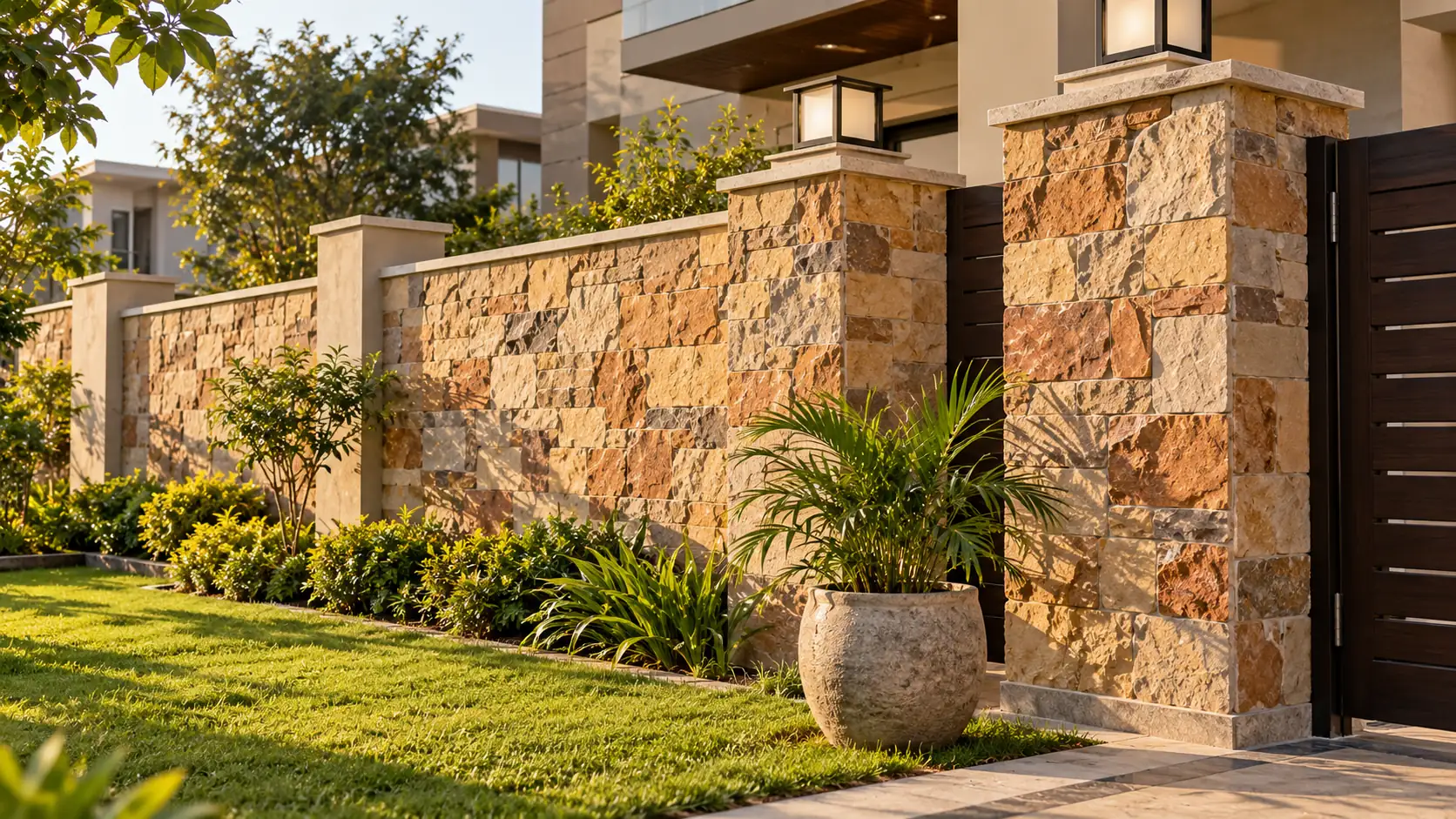
Chakwal stone is rough natural sandstone quarried in the Salt Range around Chakwal district, Punjab, sold in buff, rust, brown and grey split-face pieces for boundary walls, gate pillars, elevations and plinths. It is one of the cheapest façade stones, but no published rate list exists; dealers quote per job. Fixing labour runs an indicative PKR 100–250 per sq ft.
Because it is sold loose by the square foot and fixed in cement mortar, it is an easy way to give a façade a natural, textured look, and it also turns up on garden walls and barbecue areas.
We do not quarry or sell this material. We supply marble, granite, onyx and travertine cut in our Lahore workshop. This guide explains what you are buying when a dealer offers you stone from Chakwal, what it should cost, where it performs well, where it struggles in Pakistani sun and monsoon, and which of the stones we do sell are the closest substitutes if you want a flatter, denser or more weather-proof wall.
Rates for Chakwal sandstone and for fixing labour in this post are indicative market ranges only: no published rate list could be confirmed when this was written (November 2026). Prices quoted for Gadap Stone, Badal travertine and our granites are our current quote ranges per square foot, fabricated and installed in our service area. Always compare against a written quotation.
What the name actually covers
Like most stone names in the Pakistani trade, "Chakwal" describes where the material comes from and roughly how it looks, not a single quarry or a graded product. Dealers in Rawalpindi, Islamabad and Lahore use it for several related rocks, and the label can drift onto similar stone from neighbouring districts of the Potohar plateau. Treat the name as a family, then judge the actual pieces in front of you.
Sandstone first, limestone sometimes
Sandstone is made of sand grains, mostly quartz, glued together by a natural cement of silica, calcite or iron oxide. The grains themselves are hard, harder than marble, but the strength of the stone depends on that glue. A well-cemented sandstone is tough and rings when tapped; a poorly cemented one crumbles at the edges, sheds sand when rubbed and soaks up water. Iron oxide in the cement gives the rust, red and brown tones; cleaner quartz gives buff and cream; clay and organic matter push the colour towards grey.
Some lots sold under the same name are limestone rather than sandstone. Limestone looks similar in a rough split face but behaves differently: it is calcite, so it fizzes under a drop of dilute acid, it is softer, and acid-based cleaners and acid rain etch it. Our limestone price guide covers that family in more detail. If the dealer cannot tell you which you are buying, a scratch with a steel key and a drop of vinegar on an offcut will usually settle it. Sand that scratches out easily and no fizz points to a weakly cemented sandstone; fizzing points to limestone or a calcite-cemented sandstone.
How it differs from marble
Marble is limestone that has been recrystallised by heat and pressure, which is why it can be sawn into large slabs and polished to a mirror. Sandstone from the Salt Range is not recrystallised. It is cut or split along its natural layers and left rough, honed or sawn flat, but it will never take a high polish, and it is generally more absorbent than marble. That is not a weakness for a garden wall; it is a reason to keep it out of kitchens, bathrooms and floors that need a glossy, wipe-clean surface.
Colours, formats and sizes you will be offered
Visit a cladding dealer and you will usually see the material stacked in crates or piled loose by colour. The format matters more than the colour for cost, fixing method and final look, so decide on the format first.
| Format | What it looks like | Where it is used | Fixing |
|---|---|---|---|
| Split-face strips | Rectangular pieces with a rough, broken front face, often a few inches high and up to about a foot long | Boundary walls, gate pillars, elevations | Cement mortar or tile adhesive on a scratch coat |
| Sawn tiles | Machine-cut flat pieces with a natural or lightly rubbed face | Plinths, porch walls, garden steps | Mortar bed or adhesive |
| Irregular (crazy) pieces | Random-shaped flat pieces fitted together like a jigsaw | Garden paths, patios, feature walls | Mortar bed with pointed joints |
| Rubble and blocks | Uncut or roughly dressed stone | Load-bearing garden and retaining walls | Built in as masonry, not cladding |
| Ledge panels | Several strips glued to a backing in an interlocking panel | Quick feature walls and elevations | Adhesive; check the backing quality |
Colour mixes
The most common look is a mixed palette of buff, rust and grey pieces laid together, which hides colour variation between lots and suits the warm brick and plaster colours of most Pakistani houses. Single-colour orders (all buff or all grey) are possible but need a larger pick from the pile, and the result is more sensitive to lot-to-lot variation. If you want one colour, buy the whole quantity, plus spare, in one go.
Thickness and weight
Split-face pieces are thick because the rough face needs depth, so they are noticeably heavier per square foot than a 2 cm marble tile. On a ground-floor boundary wall that is no problem. On a first-floor parapet or a tall elevation, weight per square foot is the first question your structural engineer or contractor should answer, because heavy stone stuck to a wall at height needs mechanical support as well as mortar. Ask the dealer for the approximate weight per square foot of the format you choose.
Chakwal stone price in Pakistan per sq ft
There is no published rate list for this sandstone as of November 2026: dealers quote per job, sandstone ledge panels run an indicative PKR 250–800 per sq ft supply only, and our closest flat alternative, Gadap Stone, is PKR 260–520 installed. Rough sandstone from the Potohar region is one of the cheapest natural stones on the market because it needs little processing: it is split or sawn, sorted and sold. The price you are quoted depends far more on format, thickness and how much labour sits on top than on the colour.
| Stone and format | Source of figure | PKR / sq ft |
|---|---|---|
| Chakwal sandstone, loose split-face or sawn pieces | No published rate list (October 2026) | Ask two dealers for a written rate |
| Sandstone ledge panels on a backing | Indicative market range (supply only) | 250 – 800 |
| Gadap Stone (limestone, honed or brushed) | Our current quote range (installed) | 260 – 520 |
| Dawezai Badal Travertine (honed or brushed) | Our current quote range (installed) | 640 – 1,180 |
| Nagar Parkar Grey granite | Our current quote range (installed) | 650 – 1,200 |
| Balochistan Red Granite | Our current quote range (installed) | 780 – 1,450 |
What the low rate leaves out
A supply rate for loose pieces is the price of stone on the dealer's floor. It usually leaves out sorting a single colour, transport, the scratch coat and mortar, fixing labour, pointing the joints, coping stones on top of the wall, sealing and wastage. Split-face pieces also break during handling and trimming, so order 10 to 15 per cent extra. When two dealers give very different rates, ask each to write down the format, the thickness, whether the price is per square foot of face area or by weight, and what is included.
Labour and fixing
As an indicative market range only, fixing split-face pieces in mortar on a ground-floor wall is often quoted around PKR 100 to 250 per square foot, with the higher end for pillars, corners and neat raked joints. Scaffolding, high walls, mechanical ties and dressed coping stones are extra. Ask the mistri whether the rate includes the scratch coat, the cement and sand, and pointing. These figures apply to stone bought loose from a dealer; our quote ranges for the alternatives already include fixing.
Worked example: a front boundary wall with two gate pillars
Take a 50 ft front wall, 7 ft high, clad on the street side only, plus two gate pillars of 2 x 2 ft section, 8 ft high, clad on all four faces. The wall is 350 sq ft and each pillar is 64 sq ft, so the face area is 478 sq ft. With 10 per cent extra for breakage and cuts, order about 526 sq ft of stone.
| Stone | PKR / sq ft | Cost (PKR) |
|---|---|---|
| Chakwal sandstone pieces | Dealer quote | Rate × 526 sq ft |
| Gadap Stone (our quote range, installed) | 260 – 520 | 136,760 – 273,520 |
| Nagar Parkar Grey granite (our quote range, installed) | 650 – 1,200 | 341,900 – 631,200 |
For the Chakwal option, fixing labour on the 478 sq ft face would add roughly PKR 47,800 to 119,500 at the indicative range above, with coping, sealing and transport on top. Our Gadap and granite figures already include fixing; coping pieces, scaffolding and freight outside our fitting cities are itemised on the quote. Run your own sizes through our stone cost estimator to compare the flat-stone options side by side.
Where it works, and where it does not
The appeal of rough sandstone is texture. Sunlight raking across a split face throws small shadows that make a plain wall look crafted, and the warm mixed colours sit comfortably next to lawns, brick and terracotta. That same texture is what makes it unsuitable for anything that needs to be wiped clean.
Good uses
- Boundary walls and gate pillars. The most common use, and the one the stone suits best: a ground-level wall, exposed to weather, where a rough natural look is wanted and nobody touches the surface.
- Front elevation bands. A strip of split-face stone around the ground floor or on one projecting wall, with plaster or flat stone above.
- Plinths. The band at the base of an outside wall takes splashes, soil and mopping water; a dense, sealed stone there protects the plaster.
- Garden walls, planters and barbecue surrounds. Informal outdoor structures where a little weathering adds character.
- Indoor feature walls in lounges or farmhouses. With a wall-washing light above, a split-face wall gives a rustic look; seal it so dust and smoke can be brushed off.
Where to choose something else
- Floors and stairs indoors. Rough faces trap dirt and weakly cemented sandstone wears into hollows. Choose a honed marble or granite instead.
- Kitchens and vanities. Too absorbent and too rough for oil, haldi and toothpaste. Granite or sealed marble belongs here.
- Shaded, wet walls. On a north-facing wall under trees or next to a sprinkler, porous stone grows algae and moss and stays dark and damp after the monsoon.
- High walls with no mechanical support. Thick pieces glued to a wall several storeys up are a safety risk if the bond fails. Use a lighter format or a mechanically fixed system designed for the height.
- Pool copings and wet edges. Chlorinated water and constant wetting are hard on soft, porous stone; a brushed or flamed granite copes far better.
Does sandstone survive Pakistani sun and monsoon?
Yes, sandstone handles Pakistani sun well, but monsoon water is its weak point, because porous stone absorbs rain that carries salts, dirt and algae into the wall. Most problems with stone boundary walls show up in the first two or three years, and they are nearly always about water, not sun. Sandstone handles heat well: it does not fade like paint and it does not soften like some resins. What it does is absorb water, and water carries salts and dirt into the stone.
Monsoon and efflorescence
White powdery salt bloom on a new stone wall, called efflorescence, is very common. Water soaking into the wall dissolves salts from the cement, the brickwork or the ground and carries them to the surface, where they dry as a white crust. It is worst after the first monsoon. Brush it off dry; do not wash it with acid, which damages calcite-cemented stone and mortar. A coping with a drip edge on top of the wall, a damp-proof course at the base and a gap between the stone and the soil all reduce it.
Dust and hard water
In Lahore, Multan and Karachi the rough face collects dust in every ledge. A soft brush and plain water clear it; a pressure washer on a high setting can blast sand out of weaker pieces and open the joints, so use a fan nozzle at a distance. Lawn sprinklers fed by hard borewater leave white mineral rings on the lower course. Angle sprinklers away from the wall and keep a gravel strip at its foot.
Algae and shade
Green or black staining appears on walls that stay damp in shade. Better drainage, trimming back plants and a breathable water-repellent sealer help more than repeated scrubbing. Use a cleaner made for natural stone, test it on a hidden spot first, and avoid bleach on coloured stone.
Sealing
Outdoors, use a penetrating, breathable water-repellent sealer rather than a glossy surface coating. Coatings trap moisture behind them and peel in sun, leaving a patchy wall. A good penetrating sealer leaves the colour almost unchanged, makes rain bead up and slows down dirt and salt. Renew it when water stops beading, often every year or two on an exposed wall.
Fixing it properly
A rough stone wall that falls off or stains badly almost always failed in the preparation, not in the stone. Whoever fixes it, these are the steps to check on site.
- Let the wall cure. New brickwork and plaster should be dry and cured before stone goes on, or salts and shrinkage cracks follow.
- Damp-proof the base. A damp-proof course and a small gap above ground level stop the stone wicking water up from the soil.
- Scratch coat. A rough cement coat, scored with a comb, gives the mortar a key. Stone fixed straight onto smooth plaster or paint will fail.
- Butter every piece. Full mortar or adhesive contact on the back of each piece, not a few dabs. Hollow spots fill with water.
- Work from the bottom up, keeping courses level and mixing pieces from several crates so colour spreads evenly across the wall.
- Support at height. Above head height, and on any heavy format, add stainless steel ties or anchors as specified by your engineer. Never rely on mortar alone for thick stone high on a wall.
- Point the joints with a mortar slightly weaker than the stone, then clean off smears before they set; cement haze on rough stone is very hard to remove later.
- Cap the top. A coping stone or a sloped cement cap with a drip edge keeps rain out of the top of the wall, which is where most damage starts.
- Seal once the wall has dried, usually a few weeks after fixing, so the sealer is not trapping construction moisture.
For flat stone panels, which is what we fix, the method is different and covered step by step in our full stone wall cladding guide, which compares adhesive, wire-tie and mechanical fixing for interior walls and elevations.
Our closest alternatives (since we do not sell it)
If you came here because you want the warm, natural look of a Chakwal wall but in a material we can cut, supply and fit, these are the stones we would put in front of you. They are flatter and more refined than split-face sandstone, and most are denser and easier to keep clean.
| Our stone | Look | Finishes | PKR / sq ft | Why choose it over rough sandstone |
|---|---|---|---|---|
| Gadap Stone | Sandy beige limestone with fossil flecks | Honed, brushed | 260 – 520 | The closest in colour and spirit, flat and calm; among the cheapest stones we supply |
| Dawezai Badal Travertine | Grey cloud drift with fine linear pitting | Honed, brushed | 640 – 1,180 | Natural texture in a cut panel; unfilled on request for a rougher face |
| Nagar Parkar Grey | Even salt-and-pepper granite | Polished, honed, brushed, leathered | 650 – 1,200 | Hard, non-porous and indifferent to sun and monsoon |
| Nagar Parkar Pink | Salmon-pink granite with dark speckle | Polished, honed, brushed | 700 – 1,300 | Warm tone close to buff and rust sandstone; colour-stable in full sun |
| Balochistan Red Granite | Brick-red to maroon granite | Polished, honed, brushed | 780 – 1,450 | Strong colour for gate pillars and entrance cladding |
| Design Patti | Inlaid border strips in mixed coloured stone | Polished, honed | 300 – 700 | A crafted band on a porch or entrance floor to frame the gate area |
How we would usually combine them
- Budget boundary wall: brushed Gadap Stone panels with a granite coping, which sheds water and protects the softer limestone below.
- Gate pillars that last: brushed or honed Nagar Parkar Pink or Balochistan Red granite with mitred corners, so no cut edge shows.
- Textured feature elevation: Badal travertine supplied unfilled and brushed, with a recessed light above to rake across the pits.
- Plinth band: a granite strip at the base of every outside wall, whatever stone or plaster sits above it.
You can browse every travertine we stock on the travertine collection page, and our travertine guide explains filled versus unfilled finishes. A brushed finish is the one to ask for on almost any outdoor wall: it softens shine, hides dust and gives grip on steps.
Buying checklist at the dealer
- See the actual pile. Photos on WhatsApp flatter rough stone. Look at the lot that will be loaded on your truck.
- Rub and tap. Rub two pieces together and tap them with a key. Heavy sanding, crumbling edges or a dull thud are signs of weak stone.
- Check thickness consistency. Very uneven backs mean more mortar, more labour and a wavier wall.
- Ask sandstone or limestone. It changes which cleaners and sealers are safe.
- Buy it all at once, plus spare. Order 10 to 15 per cent extra and keep a few pieces for future repairs; the next lot will not match exactly.
- Get the rate basis in writing. Per square foot of face, per piece, per ton or per truck, with or without transport and loading.
- Plan the coping and the base. A cheap stone wall with no coping and no damp-proof course will look worse in two years than plain plaster.
- Agree who cleans up. Cement smears on rough stone should be cleaned the same day; put it in the fixing contract.
Care and upkeep
Rough sandstone needs very little: an occasional dry brushing, a rinse after dust storms, and a fresh coat of penetrating sealer when rain stops beading on the surface. Inspect the coping and the joints after each monsoon and repoint any cracked joint before water gets behind the stone. Never use tile-cleaning acid on it, and keep fertiliser, cement bags and wet soil off the base of the wall, all of which stain porous stone. If a piece cracks or spalls, chisel it out and fit a spare from your original order.
Flat stones need even less. Granite on a gate pillar needs a rinse and a neutral cleaner; Gadap Stone and travertine need their sealer renewed yearly outdoors. Each product page lists the specific care routine for that stone.
Get a quote for your wall
Send us the length and height of your boundary wall or elevation, a photo of the site and the look you want, and we will price Gadap Stone, Badal travertine and our granites side by side, with fixing, coping and freight itemised. Request a free quote, or order stone samples to hold against your brick and paint in daylight before you decide.
Written by
The Captivating Marble Design Team
Fabricators, templaters and stone designers
We template, cut and install natural stone every day and write about what we learn — pricing, layouts, care and the mistakes we help clients avoid.
Book a free design consultation