Brown Marble in Pakistan: Shades, Local Stones, Prices and Where It Works
Brown marble in Pakistan: Tropical from PKR 650 and Zebrano from PKR 900 per sq ft (Nov 2026), what coffee brown means, pairings and care. Get a free quote.
Captivating Marble Design Team · · Updated · 18 min read
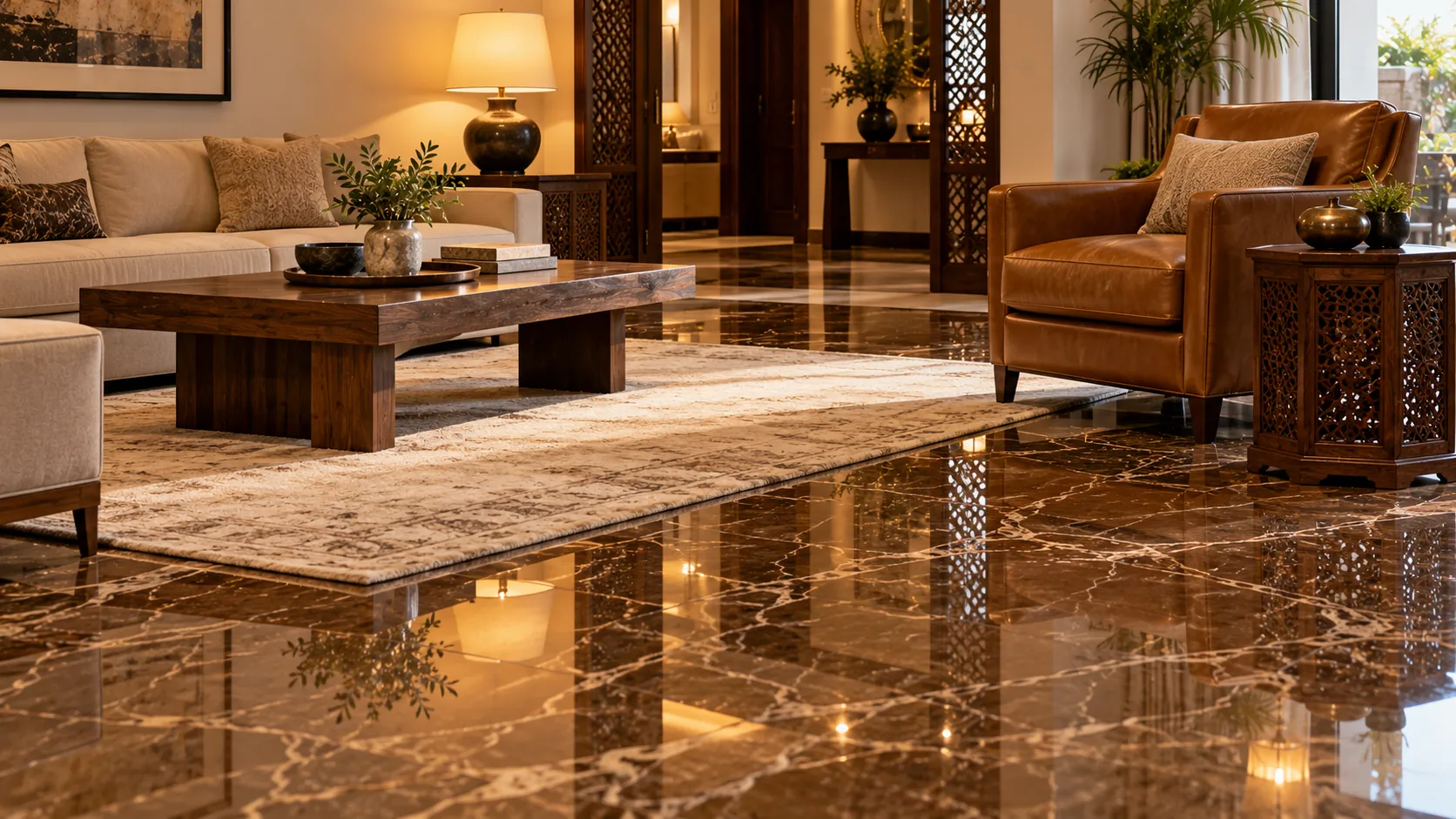
Key takeaways
- Tropical from Mohmand, KP is our closest local mid-brown at PKR 650–1,200 per sq ft (November 2026 quote range).
- Zebrano from Chaghi, Balochistan gives chocolate bands on cream at PKR 900–1,650 per sq ft and suits feature walls more than whole floors.
- Dark coffee-brown Emperador is an imported Spanish marble; no stone in our catalogue is a like-for-like local match.
- Brown and tan stones hide dust, scuffs and light stains better than white, which suits entrances, corridors and verandas.
- Brown colour comes from iron oxides and clay trapped in the original limestone, so warm stones are often banded or clouded.
The short answer
The closest local brown marble in Pakistan is Tropical, a warm mid-brown with tan drift quarried in Mohmand, KP, at PKR 650–1,200 per sq ft. Zebrano from Chaghi, Balochistan adds chocolate bands on cream at PKR 900–1,650 (our November 2026 quote ranges). Lighter warm tones such as Tiger Verona, Verona Plain and New Tavera cost PKR 580–1,350.
The famous dark, coffee-coloured stone with cream veins seen in hotel lobbies abroad is usually Emperador Dark, an imported Spanish marble. We do not sell it, and this guide says plainly where a local stone will or will not give you the same look, what each warm shade costs, where it works in a Pakistani home and how to look after it in heat, dust and hard water.
How we priced this: all rates in this post are our current catalogue quote ranges per square foot as of November 2026, for stones we actually supply, fabricated and installed in our service area. We give no prices for imported stones we do not sell. Labour is mentioned only as an indicative market range for buyers who purchase stone alone. Confirm the final figure against a written quotation.
What "brown" covers at a stone yard
Yards do not sort stone by a colour chart. A buyer who asks for brown may be shown anything from a near-black chocolate to a sandy beige, because the trade uses colour words loosely and names stones after how they look, not where they come from. It helps to know which part of the range you actually want before you go.
| Shade | What it looks like | Stones in our catalogue |
|---|---|---|
| Coffee / chocolate | Deep brown ground, usually with cream or white veins | None as a full field; Zebrano carries chocolate bands on cream |
| Mid brown | Warm brown with tan drift and dark threads | Tropical |
| Striped brown | Cream or beige crossed by brown bands | Zebrano, Tiger Verona |
| Golden / amber | Warm beige with amber and honey drift | Indus Gold; Honey Onyx (an onyx, not a marble) |
| Tan / honey-beige | Even warm beige to light tan | New Tavera, Verona Plain |
| Cream | Pale cream with sandy speckle | Tavera Light |
Where the colour comes from
Pure calcite marble is white. Brown, tan and gold come from small amounts of iron oxides and hydroxides and from clay that were trapped in the original limestone before heat and pressure recrystallised it. More iron and clay give deeper browns; carbon-rich material pushes the colour towards grey and black. Because these impurities were often laid down in layers, warm stones are frequently banded or clouded rather than flat, which is why so many of them have stripes, drifts or veins.
That geology has a practical side. The boundaries between bands can carry fine fissures, and the darker, clay-rich bands are sometimes softer than the lighter ones. That is normal, and yards routinely fill fissures with resin and back thin slabs with mesh, but it is worth looking along the bands for open cracks before you buy.
Coffee brown marble: what buyers usually mean
Search for coffee brown marble and most of the pictures show a dark, coffee-coloured ground crossed by a web of fine cream or white veins. The best-known stone with that look is Emperador Dark, quarried in Spain, with a lighter sister, Emperador Light. In the Pakistani market the "coffee brown" name is used loosely: it may describe imported Emperador, other imported dark browns, or porcelain tiles printed to look like them.
What we can and cannot offer
We do not sell Emperador or any other imported dark brown, and we do not quote prices for stones we do not supply. If the exact Spanish look is a must, ask an importer for the origin, the lot and a written rate, and check the slab rather than a photograph. If what you want is a warm brown floor or wall that suits Pakistani conditions and budgets, these are the local stones to look at:
- [Tropical](/products/tropical) is the nearest local stone to a mid coffee tone: warm brown with tan drift and fine dark threads. It is lighter and less heavily veined than Emperador Dark, but it gives a warm brown floor that hides traffic marks.
- [Zebrano](/products/zebrano) gives you true chocolate colour, but as bands on a cream ground rather than as a full dark field. It suits a feature wall better than a whole floor.
- Jet Black or Black & Gold with a brown stone as a border can give a darker, richer room if a full coffee field is not available.
The honest summary: no local stone in our catalogue is a like-for-like replacement for a dark Emperador floor. Tropical gets closest on colour; Zebrano gets closest on depth of brown. Order samples of both and look at them beside a photo of the look you want, in your own room light.
Our brown and warm stones at a glance
Every stone below is quarried in Pakistan and comes in 2 cm and 3 cm. Rates are our current quote ranges per square foot; the final figure depends on thickness, finish, lot and the cutting and edge work your job needs.
| Stone | Origin | Look | Finishes | PKR / sq ft |
|---|---|---|---|---|
| Tavera Light | Khuzdar, Balochistan | Pale cream with fine sandy speckle | Polished, honed | 520 – 980 |
| New Tavera | Khuzdar, Balochistan | Deeper cream to light tan, stronger clouding | Polished, honed | 580 – 1,050 |
| Verona Plain | Chaghi, Balochistan | Even honey-beige, barely any pattern | Polished, honed | 600 – 1,100 |
| Tropical | Mohmand, KP | Warm brown, tan drift, fine dark threads | Polished, honed, leathered | 650 – 1,200 |
| Indus Gold | Nowshera, KP | Golden beige with amber drift and dark lines | Polished, honed | 700 – 1,300 |
| Tiger Verona | Chaghi, Balochistan | Warm beige with darker brown tiger bands | Polished, honed | 750 – 1,350 |
| Zebrano | Chaghi, Balochistan | Tight cream and chocolate parallel bands | Polished, honed | 900 – 1,650 |
| Honey Onyx (onyx) | Chaghi, Balochistan | Amber-to-caramel translucent banding | Polished, honed | 2,200 – 4,800 |
You may also see Dawezai Badal grouped with warm stones because it looks softer than grey marble. It is a grey travertine with cloud-like drift, not a brown, so we leave it out of this range.
Tropical: the local mid-brown
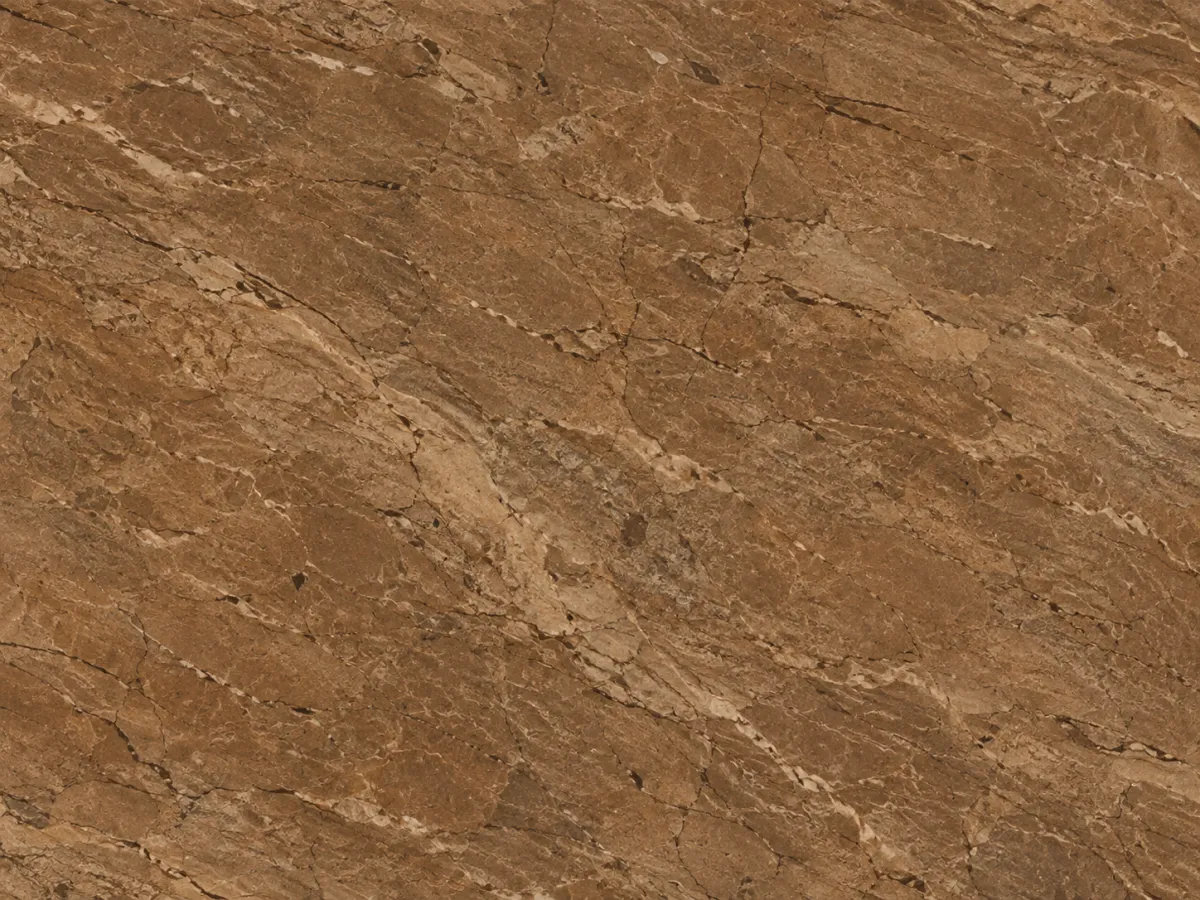
Tropical is the stone in our catalogue that most people would call plainly brown. The ground is a warm mid-brown, broken by lighter tan drift and fine dark threads that run through the slab in a loose, diagonal movement. It sits mid-list on price and works hard for it.
- Origin: Mohmand, KP.
- Finishes: polished, honed and leathered. Leathered gives a subtle texture that reads well outdoors and on verandas.
- Thickness: 2 cm and 3 cm.
- Slab size: the slabs we list are about 90 x 58 inches, roughly 36 sq ft each; sizes vary by lot. Our guide to slab dimensions has the wider picture.
- Best uses: corridors, veranda floors, guest bathrooms and shower walls, vanity tops and borders around a lighter floor.
- Our current quote range: PKR 650 to 1,200 per sq ft.
Its biggest practical advantage is tone. It is dark enough to hide the fine dust and foot traffic that make a white floor look grubby by evening, yet not so dark that a room closes in. Terracotta, cane, rattan and unfinished timber sit naturally against it, which makes it a good fit for verandas, courtyards and rooms that open onto a lawn.
Striped and golden warm stones
Zebrano and Tiger Verona: brown as stripes
If you want strong brown colour but not a dark room, put the brown into bands. Zebrano stripes cream and chocolate in tight parallel lines that read like timber grain from across a room. Tiger Verona is the softer cousin: warm beige with wider, darker brown bands, and stripe density that varies from lot to lot, so approve the actual pieces before cutting. Both are directional, so settle which way the bands run on a drawing before fabrication. Our guide to zebra marble covers layout, book-matching and orientation in detail.
Indus Gold: brown turned golden
Indus Gold from Nowshera carries amber drift over a warm beige ground with thin dark mineral lines. Under warm light it reads almost metallic, which is why it turns up on reception fronts and decorative cladding. Slabs range from softly golden to strongly figured, so the lot matters more than the name on the invoice. It pairs well with brass, walnut and deep green.
Verona Plain and New Tavera: the quiet warm floors
Verona Plain is a flat honey-beige with barely any movement, the workhorse warm floor of the Pakistani market, and supply is consistent enough to re-order matching stone months later. New Tavera is a denser, deeper cream from Khuzdar that sits between beige and light tan; being harder than the light grade, it holds an edge on stair nosings and thresholds. Neither is brown in itself, but both make the natural floor to sit under a brown feature wall, or the field around a brown border. Our Tavera vs Verona comparison helps choose between them.
Honey Onyx: warm light, not a floor
Honey Onyx is not a marble but an onyx, with amber-to-caramel banding that glows when lit from behind. It is soft and translucent, cut thin and resin-backed, and belongs on vanities, bar fronts, fireplace surrounds and backlit panels, never on a floor or a working kitchen top. A backlit honey panel next to a brown stone wall is one of the warmest effects you can create with Pakistani stone.
How much does brown stone cost per square foot?
Brown and warm marbles in our catalogue cost PKR 520–1,650 per sq ft as of November 2026, from Tavera Light up to Zebrano, while Honey Onyx runs PKR 2,200–4,800. Your cost is area times rate, plus wastage. Allow about 10 per cent wastage on a plain floor and 15 per cent or more on striped or book-matched work. The examples below use our current quote ranges and are installed costs; cut-outs, book-matching and freight outside our fitting cities are itemised on the quote.
| Job | Area incl. wastage | Stone | Estimated installed cost (PKR) |
|---|---|---|---|
| Drawing room floor, 14 x 16 ft | About 246 sq ft (10%) | Tropical | 159,900 – 295,200 |
| Drawing room floor, 14 x 16 ft | About 246 sq ft (10%) | New Tavera | 142,680 – 258,300 |
| Drawing room floor, 14 x 16 ft | About 246 sq ft (10%) | Verona Plain | 147,600 – 270,600 |
| Book-matched TV wall, 10 x 9 ft | About 104 sq ft (15%) | Zebrano | 93,600 – 171,600 |
| Book-matched TV wall, 10 x 9 ft | About 104 sq ft (15%) | Tiger Verona | 78,000 – 140,400 |
| Vanity top 5 x 2 ft with upstand | About 15 sq ft | Tropical | 9,750 – 18,000 |
| Backlit panel, about 4 x 5 ft | About 22 sq ft | Honey Onyx | 48,400 – 105,600 |
Our ranges already include fitting. If you buy stone only and hire your own fitter, budget labour separately.
As an indicative market range only, floor laying is often quoted around PKR 60 to 150 per sq ft, with on-site grinding and polishing, edge work, adhesive, grout, sealer and transport as separate lines. Get each line written down before work starts.
What moves the rate within a range
- Lot and grade. Even colour and clean, continuous pattern cost more than patchy lots. Our guide to marble grades explains how yards sort lots.
- Format. Stock tile is cheapest; full slabs and cut-to-size pieces carry yield loss and workshop time.
- Thickness. 3 cm costs more than 2 cm and is heavier to fix on walls.
- Finish. Honed and leathered faces and special edges are often itemised separately.
- Matching. Book-matching striped stone needs consecutive slabs from one block and more wastage.
- Resin and mesh. Fissured lots need filling and backing; ask whether it is already done.
Is brown stone a good choice for a Pakistani home?
Yes, brown stone is a good choice for high-traffic floors, verandas and feature walls, though less so for busy cooking counters and small dark rooms. Warm stones have one big advantage over whites in Pakistani conditions: they forgive. Dust, a faint haldi mark, a scuff from a chair leg and the grey film that builds up near an entrance all show far less on tan and brown than on Ziarat White. That makes them a sensible choice for the hardest-working parts of a house.
Good places for it
- Entrances, corridors and lounges. High-traffic floors where a pale stone would need constant mopping. Tropical, New Tavera or Verona Plain.
- Verandas and covered outdoor floors. Leathered Tropical gives texture and grip and hides dust blown in from the lawn.
- TV, headboard and feature walls. Zebrano or Tiger Verona, book-matched, as the one patterned plane in the room.
- Guest bathrooms and vanities. Brown hides hard-water residue better than white, and a small vanity top keeps the cost contained.
- Borders and inlays. A brown band around a cream or white floor frames the room and marks walkways.
- Fireplace surrounds. Warm stone frames a gas heater or electric fire well, and suits the winter living rooms of Islamabad, Peshawar and Quetta.
Where to think twice
- Busy cooking counters. All marble etches with lemon, tomato, imli and vinegar. On a polished brown surface the etch shows as a dull, paler patch. Use a granite worktop and keep the warm marble for the backsplash or a honed finish that hides etching better.
- Small, dark rooms. A deep brown floor in a room with little daylight can feel heavy. Choose a lighter tan or honey-beige, or keep the brown to a border.
- Polished outdoor steps. Any polished marble is slippery when wet and loses its shine in sun and rain. Use leathered or honed stone on covered areas and granite where it is fully exposed.
- Whole-house striped floors. Stripes across hundreds of square feet become tiring; keep banded stones to one surface per room.
Pairing warm stone with wood, metal, fabric and light
Brown stone is part of a palette, not a statement on its own. It looks richest when the materials around it share its warmth and when one element provides contrast. Brown stone is often weighed against timber; our guide to marble vs wooden flooring compares the two.
| Element | Mid brown (Tropical) | Striped (Zebrano, Tiger Verona) | Golden (Indus Gold, Verona Plain) |
|---|---|---|---|
| Walls | Warm white, sand or off-white plaster | Plain warm white; keep pattern off adjacent walls | Ivory, pale sage or soft white |
| Woodwork | Teak, walnut, unfinished timber, cane | Walnut or dark oak | Walnut, sheesham |
| Metals | Antique brass, bronze, black iron | Brushed brass, bronze | Polished brass, gold |
| Fabrics | Cream, rust, olive, terracotta | Camel, ivory, one solid accent | Deep green, navy, cream |
| Accent | A pale stone border or cream rug | Plain light floor under the striped wall | Dark green or black detailing |
Lighting changes the colour
Warm white light, around 2,700 to 3,000 K, brings out the red and gold in brown stone and makes it look rich. Cool daylight bulbs at 5,000 K and above can make the same floor look flat and slightly muddy. Cool tube lights are common in lounges; if you are investing in a warm stone floor, change the lamps too. On walls, a concealed strip light along the top edge grazes the surface and shows off texture, especially on honed and leathered faces.
Combining brown with white
A traditional Pakistani floor design is a light field with a darker border. A Tropical or Zebrano band 4 to 6 inches wide, set a foot or so in from the walls of a cream or white room, frames the furniture zone and hides the grime that collects along skirting. On stairs, a warm brown nosing strip on a beige tread gives contrast at the edge where people need to see it. Keep the brown stone and the field stone the same thickness so on-site polishing levels the joint.
Buying checklist for warm-toned slabs
- See the whole lot. Warm stones vary from block to block, more than whites do. Make sure every slab or crate comes from one lot, and reserve a little extra for repairs.
- Look in daylight. Shed lights in yards are often cool tubes that flatten brown tones; carry a slab corner into daylight and wet it to see the polished colour.
- Check along the bands. On striped and clouded stones, run a fingernail along the darker bands. A fissure you can catch is open; ask whether it will be resin-filled and backed.
- Test dark lots for dye or oil. Rub an offcut edge with a cloth and a little acetone. Colour on the cloth suggests dye; a surface that turns paler once dry suggests it was oiled to deepen the colour.
- Check the polish under a light. Reflections should stay straight across both light and dark areas; wavy reflections mean poor grinding.
- Agree finish and orientation in writing. For striped stones, note which way the bands run and the slab numbers.
- Ask what the rate includes. Cutting, edges, resin, transport, fitting, sealing and wastage should each be listed as included or extra.
If you cannot get to a yard, order stone samples of two or three warm stones and look at them on your floor, against your wood and fabrics, in morning and evening light.
Fixing and caring for warm stones in Pakistani conditions
Fixing
- Use a white stone adhesive under pale stones such as Tavera Light and Verona Plain; a grey cement bed can shadow through. Darker browns are less sensitive, but a full bed with no hollows matters for every stone.
- Back-butter every piece so there are no air pockets that crack under load, especially along band lines.
- Keep joints tight and colour-matched. A tinted epoxy or grout that matches the ground colour makes joints disappear on a brown floor.
- Polish floors on site. Grinding and polishing after laying levels joints so the surface reads as one.
Sealing and daily care
Seal warm marbles with a penetrating (impregnating) sealer after fixing and reseal roughly every 6 to 12 months in kitchens and bathrooms. A sealer slows staining from oil, haldi and chai; it does not stop acid etching. Our step-by-step guide on sealing marble in Pakistan covers products, timing and the water-drop test.
- Dust-mop daily. Fine dust and grit act like sandpaper on a polished face, even when the colour hides them.
- Wash with plain water or a pH-neutral stone cleaner. Avoid vinegar, lemon, bleach and acid-based tile cleaners.
- Wipe hard-water drips on vanities and shower walls before they dry. White mineral rings show clearly on a polished brown surface.
- Use felt pads under furniture and doormats at every entrance.
- If a polished floor dulls in the walkways, a professional re-polish restores it. Honed and leathered finishes hide wear for much longer.
Summer heat cures adhesive quickly and monsoon humidity slows it. Ask the fitter to work early in the day in June and July, keep fresh stone out of direct sun, and allow extra curing time in the rains before sealing.
Brown stones that are not marble
Some of the warm stones you will see in showrooms are not marble at all, and the difference matters for kitchens and outdoor work.
- Brown granites such as Baltic Brown and Tan Brown are imported granites with a speckled, crystalline look. They are far harder than marble and do not etch, which makes them good kitchen worktops. We do not sell them; our granites are black, grey, pink, red and white, as our granite colours guide shows.
- Honey Onyx is a translucent onyx for decorative and backlit use, softer than marble.
- Porcelain tiles printed with a marble-look brown pattern are cheaper, cannot be re-polished and repeat their pattern every few tiles. They are a fair choice for a rental or a quick refit, but they are not natural stone; see marble vs tiles for the trade-offs.
If you want a brown look on a cooking counter, a common route is a hard granite top with a warm marble backsplash, so the stone that faces lemon and masala every day is the one that can take it.
Get a quote or see the stones
Send us your room sizes, a photo of the space and the shade you have in mind, whether coffee, mid-brown, striped or honey, and we will come back with a free written quote giving the installed rate for your stone and wastage, with any cut-outs, book-matching or freight itemised. For a quick first figure, try the cost estimator. If you are torn between Tropical, Zebrano and a lighter warm beige, order samples first and look at them in your own light before committing to a full lot.
Written by
The Captivating Marble Design Team
Fabricators, templaters and stone designers
We template, cut and install natural stone every day and write about what we learn — pricing, layouts, care and the mistakes we help clients avoid.
Book a free design consultation