Backlit Pak Onyx Feature Walls: A Practical Guide
How backlit Pak onyx feature walls are built: slab selection, mesh backing, LED cavity depth, PKR rates and the mistakes that ruin one. Plan yours here.
Captivating Marble Design Team · · Updated · 7 min read
Key takeaways
- Pakistani onyx is quarried in Chaghi, Balochistan, and costs PKR 2,200–5,600 per sq ft on our November 2026 quote ranges.
- Backlit panels are 18 mm onyx reinforced with fibreglass mesh and resin, fixed on a frame with clips and adhesive.
- Set an even LED sheet and diffuser about 40–60 mm behind the stone so no hot spots show through the banding.
- Order the whole wall from one block in sequential slabs so it can be bookmatched; onyx blocks are small.
- Onyx is about Mohs 3, so it belongs on walls, bar fronts and reception counters, never on floors or worktops.
The short answer
A backlit Pak onyx feature wall is a set of thin, translucent onyx panels from Chaghi, Balochistan, fixed on a frame in front of an even LED light source so the banding glows from within. Our onyx runs PKR 2,200–5,600 per sq ft installed (November 2026), the panels are 18 mm and mesh-backed, and the light box is priced on top.
It is the most dramatic thing a stone workshop builds, and also the easiest to get wrong. The sections below cover the stone, the slabs, the light box, fixing and cost, in the order they need deciding.
Stone rates are our current quote ranges per square foot from our catalogue (November 2026), fabricated and installed in our service area. The light-box figure is an indicative range; every wall is quoted in writing.
Why does onyx glow when lit from behind?
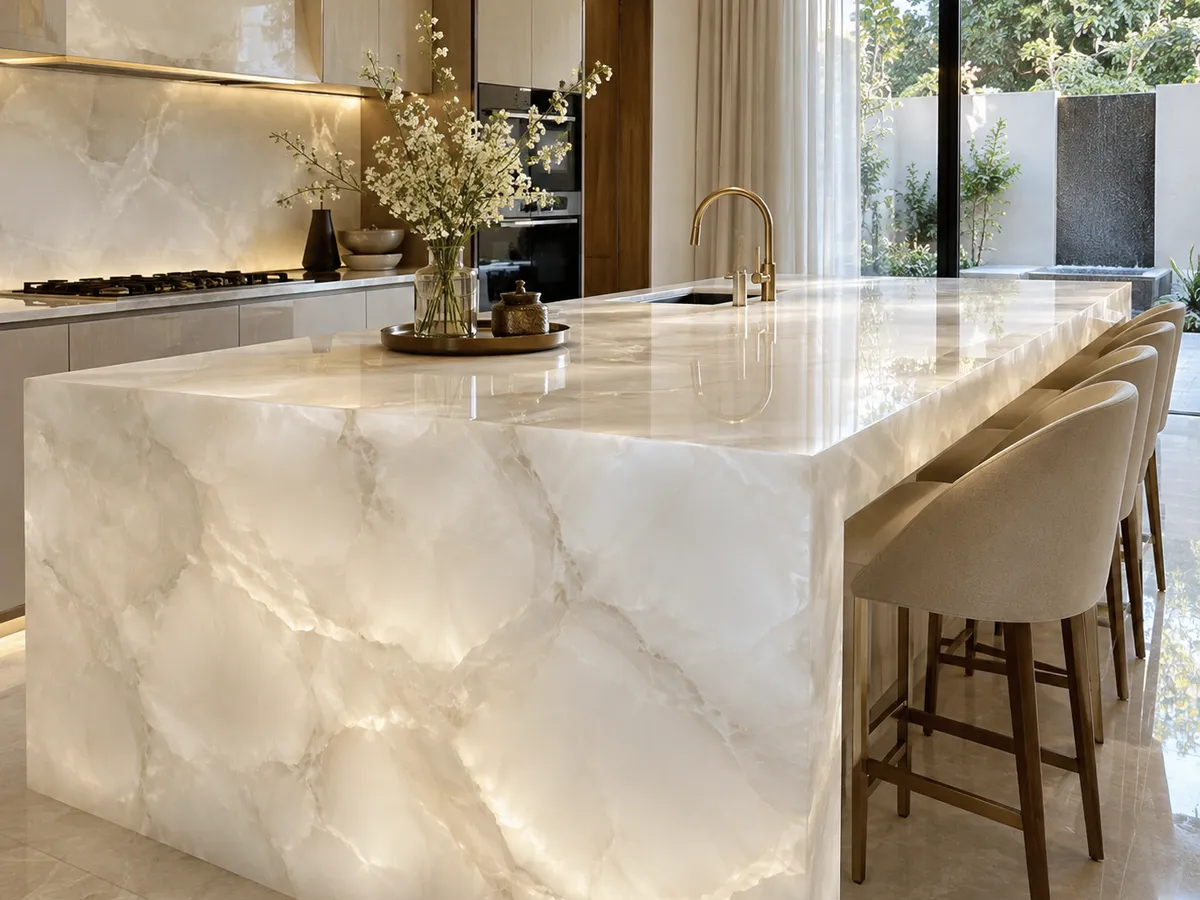
Onyx glows because, unlike marble, it lets light pass through. It is a banded, crystalline calcite formed in caves and springs, and when a light source sits behind a thin panel the bands light up from within. That is the whole reason a drawing room wall or a reception desk front gets specified in onyx.
| Stone | Look when lit | Our quote range (PKR / sq ft) | Typical slab |
|---|---|---|---|
| Pak Green Onyx | Deep green, jade-like banding | 2,400–5,200 | About 78 x 48 in |
| Honey Onyx | Warm amber and caramel bands | 2,200–4,800 | About 72 x 48 in |
| Snow White Onyx | Pale, icy glow; shows colour-changing LEDs best | 2,600–5,600 | About 72 x 44 in |
All three come from Chaghi district. The glossary entry on Pak onyx explains how the stone forms and how it differs from marble.
Choosing and bookmatching the slabs
Select in person, and select the whole wall at once. Onyx forms as a cave deposit, so blocks come out small and the banding changes quickly through a block; a panel added six months later will not match. Larger walls are made from several panels rather than one piece.
Ask for sequential slabs so the fabricator can bookmatch them, mirroring two adjacent cuts so the pattern opens like a butterfly across the centre line. A four-panel bookmatch reads as one symmetrical painting, and it costs nothing extra in stone if you plan it before cutting.
How is a backlit onyx wall built?
It is built as a light box: an even LED source and a diffuser against the wall, a cavity of about 40–60 mm, then 18 mm mesh-backed onyx panels on a frame in front. From the wall outwards:
- The wall, flat, dry and painted white so it reflects light rather than absorbing it.
- The light source: an LED light sheet or a dense grid of LED strips. Point sources and widely spaced strips show through as bright spots and lines.
- A diffuser, usually opal acrylic, which spreads the light evenly.
- The cavity, about 40–60 mm between the light and the back of the stone. Any shallower and every strip shows through the panel.
- The onyx panels, 18 mm, fixed to an aluminium or steel frame with mechanical clips as well as adhesive.
- The driver, mounted outside the box behind an access panel, so it can be reached without removing stone.
Use low-heat LEDs and give the cavity a path for warm air to escape. In a Lahore summer, a sealed box full of drivers gets hot, and heat is what kills the drivers and discolours the resin behind the stone. We build the light box, frame and panels as one assembly and dry-fit it in the workshop before it leaves Lahore.
Fabrication and fixing
Natural fissures mean every onyx slab is resin-filled and backed with fibreglass mesh before it is cut. That is normal practice, not a defect, but it does mean every panel should be handled on a frame; panels travel flat on padded frames rather than upright.
Fix onto the sub-frame with mechanical clips and a stone adhesive suited to the substrate. Never bed a translucent panel in thick cement mortar: every ridge and trowel mark will show as a shadow the moment the lights go on. Allow about two to three weeks for resin filling, cutting and dry-fitting; the stone installation page sets out the full timeline.
What does a lit onyx panel cost?
Installed onyx costs PKR 2,200–5,600 per sq ft on our current quote ranges, and the light box and frame add roughly PKR 600–1,200 per sq ft more as an indicative figure. The electrician, and any extra stone needed to bookmatch, come on top.
| Item | Honey Onyx | Pak Green Onyx | Snow White Onyx |
|---|---|---|---|
| Onyx installed, 48 sq ft | 105,600–230,400 | 115,200–249,600 | 124,800–268,800 |
| Light box and frame (indicative) | 28,800–57,600 | 28,800–57,600 | 28,800–57,600 |
Because the rate is high, keep the area small and deliberate. A 6 by 8 ft panel behind a dining table or a bar front does more for a room than a whole wall would, at a fraction of the cost. Grade-by-grade rates are in our onyx price guide.
Where it belongs, and where it does not
Good: a drawing room feature wall, a reception counter front, a bar back, a headboard panel, a stair-well niche, a powder-room vanity front. All low-traffic, mostly vertical, and seen from a distance.
Bad: a kitchen worktop, a bathroom floor, a stair tread, or any horizontal surface people put things on. Onyx is about Mohs 3, softer and more brittle than marble, and will not survive that duty. Use Ziarat White or a granite there and save the onyx for the wall. For other ways to bring stone onto walls, see our stone wall cladding guide.
Mistakes that ruin a backlit wall
- Too shallow a cavity, so every LED strip shows as a bright line through the stone.
- Point sources instead of an even sheet, giving hot spots in the middle of each panel.
- Bedding panels in cement mortar, so trowel marks appear as shadows once lit.
- A sealed box with the driver inside, which overheats in summer and yellows the resin.
- Buying panels in instalments from different blocks, so the banding never lines up.
- No access panel, so a failed driver means taking stone off the wall.
Send us the wall size and a photo of the room, and we will suggest a stone and panel layout and quote the wall with the light box itemised.
Written by
The Captivating Marble Design Team
Fabricators, templaters and stone designers
We template, cut and install natural stone every day and write about what we learn — pricing, layouts, care and the mistakes we help clients avoid.
Book a free design consultation