Kitchen Backsplash in Marble or Granite: Full-Height Slab, 4-Inch Upstand or Tile?
Full-height stone slab, 4-inch upstand or tile behind the cooking range: heat, oil and haldi, the best stones, sealing and installed costs. Get a free quote.
Captivating Marble Design Team · · 15 min read
Key takeaways
- A full-height stone splashback for an 18 ft L-shaped kitchen needs about 35 sq ft of stone including wastage, costing about PKR 21,000–98,000 installed.
- A 4-inch upstand uses one third of a square foot of stone per running foot, about 7 sq ft for an 18 ft kitchen.
- Granite is the safest stone directly behind a Pakistani cooking range because it does not etch from lemon, tomato or imli splashes.
- Keep gas burners at least 75 mm from a stone splashback and wipe oil and haldi splashes the same day.
- Seal a marble splashback before use and roughly every 6–12 months in a kitchen; dark granite rarely needs it.
The short answer
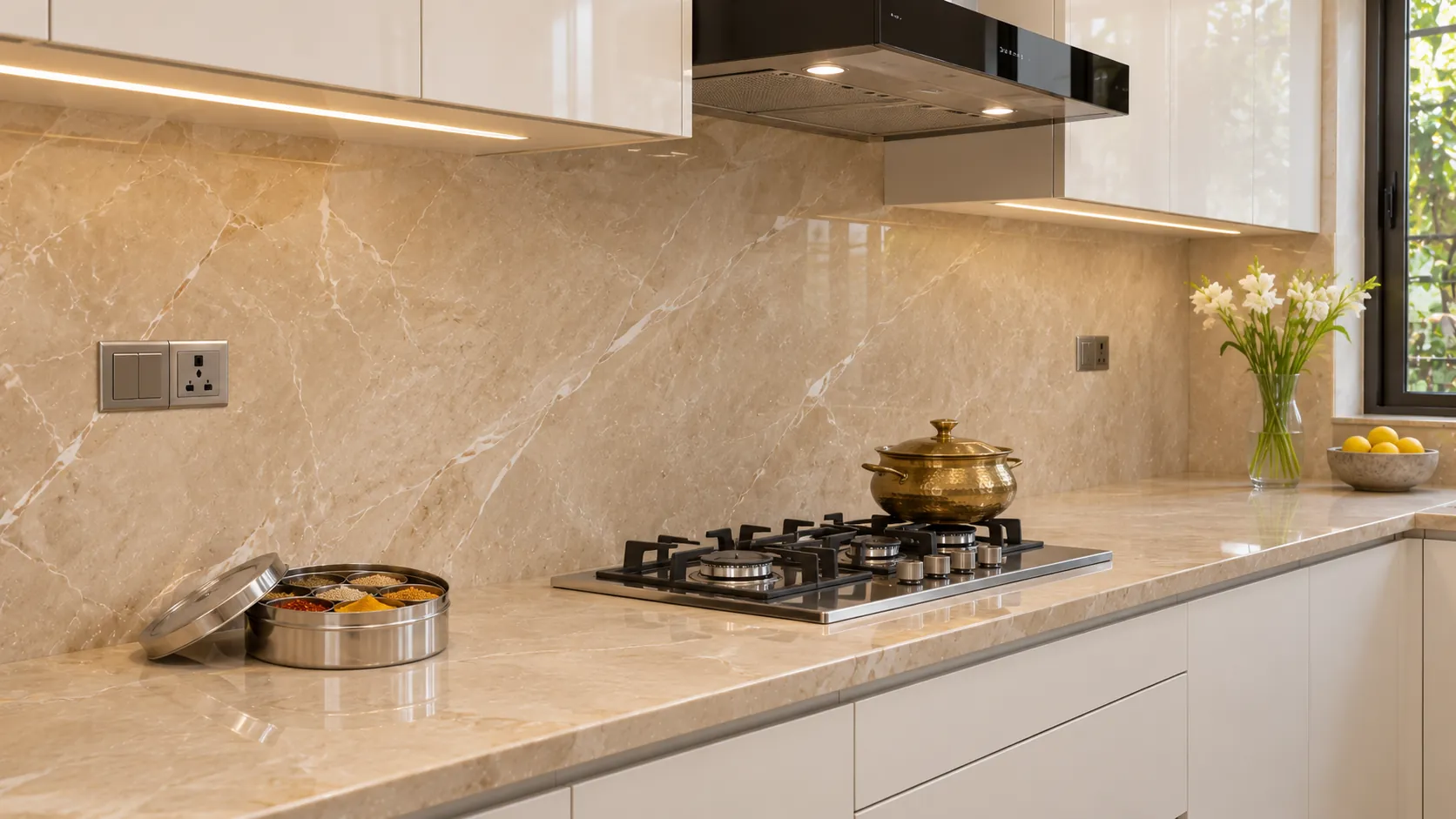
The best kitchen backsplash for a Pakistani home is a full-height stone slab, cut from the worktop block and run up to the wall cabinets, because it has no grout for oil and haldi to stain. For an 18 ft L-shaped kitchen it takes about 35 sq ft of stone, roughly PKR 21,000–98,000 installed at our November 2026 rates.
A cheaper alternative is a 4-inch upstand of the worktop stone along the wall, about PKR 4,200–19,600 for the same kitchen, with tile or paint above it. Ceramic or porcelain tile costs less again but brings grout lines that discolour behind a hob within a year or two. This guide compares the three options, explains what happens behind the cooking range where heat, tarka oil and turmeric meet the wall, names the stones that cope best, and shows how to seal, clean and price a stone splashback. For tiled kitchen walls and floors, see our kitchen tile design guide.
How we priced this: stone rates in this post are our current catalogue quote ranges per square foot as of November 2026. They are installed prices in our service area that include the stone, cutting, a standard edge, fitting and sealing on fitting day. Socket and switch cut-outs, mitred corners and freight outside our fitting cities are itemised on the quote. Kitchen dimensions in the examples are our assumptions; tile prices are indicative market ranges, because we do not sell tile.
Full-height slab, upstand or tile: which should you choose?
Choose a full-height slab if you cook daily with oil and spices and want the easiest wall to keep clean; choose a 4-inch upstand if budget is tight and you will paint or tile above it; choose tile only where cost matters most and you accept regrouting. A backsplash, also called a splashback, is the protective surface on the wall between the worktop and the wall cabinets or hood. Its job is to keep water, oil and food off the plaster and to seal the joint where the worktop meets the wall.
| Option | What it is | Cleaning behind a hob | Typical cost for an 18 ft kitchen | Best for |
|---|---|---|---|---|
| Full-height stone slab | Worktop stone carried up to the wall units or hood in large panels | Easiest: no grout, wipe in seconds | About PKR 21,000–98,000 installed (35 sq ft) | Daily cooking, resale, a seamless look |
| 4-inch stone upstand | A strip of worktop stone along the wall, with paint or tile above | The joint is sealed; the wall above still needs care | About PKR 4,200–19,600 installed (7 sq ft) | Tight budgets, rental homes, utility counters |
| Ceramic or porcelain tile | Small tiles fixed and grouted over the wall | Grout darkens with oil and haldi; needs scrubbing | Indicative market rates; we do not supply tile | Lowest upfront cost, easy to change later |
Many kitchens combine them: a full-height panel on the hob wall where the mess is, and a 4-inch upstand along the sink and prep runs. That keeps most of the cleaning benefit for about a third of the stone. Whatever you choose, plan it with the worktops, because the splash is cut from the same slabs; our guide to kitchen marble design covers the layout of the whole kitchen.
What a full-height slab involves
A full-height backsplash runs the worktop stone from the counter to the underside of the wall cabinets, the chimney hood or, on an open wall, the ceiling. In most Pakistani kitchens that is a band of about 18 to 24 inches between counter and wall units, rising to 30 inches or more behind the hood. You can see examples in our full-height splashback idea.
Thickness
Our stone is supplied in 2 cm and 3 cm. Wall panels are normally 2 cm: lighter to fix, easier to cut around sockets, and they do not push the wall cabinets forward. The worktop below may still be 3 cm; the difference does not show once the panel sits on the counter. Our glossary entry on 2 cm vs 3 cm stone explains where each thickness belongs.
Cut-outs and openings
Every socket, switch, shelf bracket and window return is templated on site and cut in the workshop before delivery, so nothing is ground out against your painted wall. That only works if the electrician has fixed the back boxes at their final position first. Tell the electrician the panel thickness so the boxes sit flush with the stone face, not buried behind it. Each opening is itemised on the quote.
Pattern and joints
Ideally the panels come from the same block as the worktop, so the veins appear to turn up the wall. Behind the hob, two panels can be book-matched to mirror each other as a centrepiece. Joints are best placed at the edges of the hob or at a cabinet line, where the eye expects a break. A busy stone such as Tiger Verona hides joints well; a plain white shows every one, so plan its layout on photographs of the actual slabs before cutting. Planning the pieces this way is called a slab layout.
Fixing
Panels are bonded to a sound, flat, dry wall with a stone-compatible adhesive and supported on the worktop while it cures. The joint between worktop and panel, and every internal corner, is finished with colour-matched silicone rather than rigid grout so it can flex. Fitting usually takes one to two days once the worktops are in.
Stone is heavy. A 2 cm marble panel weighs roughly 5 to 6 kg per square foot, so the wall must be solid brick or block with sound plaster. Loose distemper, damp patches or hollow plaster must be fixed before templating.
When a 4-inch upstand or tile makes sense
An upstand is a strip of the worktop stone, usually 4 inches high, fixed along the wall where the counter meets it. Its main job is to seal that joint so water from the sink and mop does not run down behind the cabinets, which is where many kitchens rot from the back. It uses one third of a square foot of stone per running foot, so an 18 ft kitchen needs only about 7 sq ft with wastage.
- Pros: cheap, quick, often cut from worktop offcuts, protects the most vulnerable joint.
- Cons: the wall above still needs protection. Painted plaster behind a hob yellows and blisters with oil and steam; washable enamel paint helps but is not a long-term answer.
- Heights: 4 inches is the common default; 6 inches gives more protection behind the sink. Keep one height around the whole kitchen.
- Top edge: eased or slightly rounded, polished to match the worktop; a sharp square edge chips easily. See our page on edge profiles.
Tile above an upstand
Tile remains the cheapest way to cover the full wall, and it is easy to replace when you redecorate. The problem is grout. Behind a Pakistani hob, oil and turmeric settle into grout lines and turn them grey-yellow; epoxy grout resists this far better than cement grout but costs more and must be laid well. If you go with tile, choose large-format pieces to cut the number of joints, and use epoxy grout at least on the hob wall.
| Item | Unit | Indicative PKR |
|---|---|---|
| Local ceramic wall tile, supply | Per sq ft | 120 – 300 |
| Imported or large-format porcelain, supply | Per sq ft | 300 – 900 |
| Fixing with adhesive and cement grout | Per sq ft | 60 – 150 |
| Epoxy grout upgrade | Per sq ft | 40 – 120 |
Tile can look excellent, but compare the five-year cost honestly: regrouting or replacing a stained hob wall is labour you pay again, while a stone panel is wiped and resealed. For a wider look at the trade-off across a whole house, our marble vs tiles comparison goes into durability and resale.
What goes behind the cooking range?
Directly behind the cooking range, granite is the safest stone, because it shrugs off heat and does not etch; a sealed marble also works if burners sit at least 75 mm from the wall and splashes are wiped the same day. This is the hardest-working square metre in a Pakistani kitchen: tarka oil, steam from a pressure cooker, haldi and chilli in every sabzi, tomato and imli in the salan, and heat from a hob that may run for hours a day.
Heat
Normal cooking heat does not harm natural stone. The risk is a burner set hard against the wall, where flame or a hot tawa sits against the panel for long periods; that can discolour marble or crack it through uneven heating. Keep at least 75 mm between the burner and the splashback, and with a freestanding cooking range leave the gap the range maker specifies. Fit the chimney hood so the stone panel stops neatly under it or runs behind it to the ceiling.
Oil
Oil comes off sealed stone with warm water and a neutral cleaner. On unsealed, light marble it soaks in and leaves a dark patch that a poultice is needed to draw out. Granite and dense, dark stones show oil the least.
Haldi, tomato and acids
Marble is a calcium-based stone (Mohs 3–4), so acidic splashes such as lemon, tomato, imli and vinegar dissolve the polish and leave a dull mark called etching. Sealer slows stains but does not stop etching. Turmeric is a dye rather than an acid; on sealed stone it wipes off if caught quickly, and a yellow mark left on light marble usually fades with time and daylight, or lifts with a poultice. Granite (Mohs 6–7) neither etches nor stains easily, which is why it is the practical choice behind heavy daily cooking.
A good compromise is common in Pakistani homes: granite worktops and hob wall for the working kitchen, with marble kept for the island or a lighter-use run. Our guide to granite kitchen countertops explains which granites suit a working kitchen, and the marble vs granite comparison covers the differences in detail.
A honed or leathered finish hides etch marks far better than a mirror polish. If you want marble behind the range, ask for it honed; the dull spots from lemon or tomato then blend into the surface instead of standing out against the shine.
Which stones work best for a splashback?
For the hob wall, dense granites and calm, warm marbles are the easiest to live with; dramatic black and veined marbles suit lighter-use walls and feature kitchens. The table lists stones from our catalogue that we fabricate for backsplashes, with our installed ranges.
| Stone | Type and origin | Look | Behind the hob? | PKR / sq ft |
|---|---|---|---|---|
| Khyber Black Granite | Granite, Nowshera | Dense charcoal, near-solid grain | Excellent | 850 – 1,600 |
| Galaxy Black | Granite, Karachi | Black with silvery mica sparkle | Excellent | 900 – 1,700 |
| Nagar Parkar Grey | Granite, Sindh | Even salt-and-pepper grey | Excellent | 650 – 1,200 |
| Swat White Granite | Granite, Swat | Pale ground, fine grey and black speckle | Very good; seal the paler lots | 720 – 1,350 |
| Verona Plain | Marble, Chaghi | Even honey-beige, hides oil marks | Good if honed and sealed | 600 – 1,100 |
| Superline Grey | Marble, Mohmand | Mid-grey with straight pale veins | Good if sealed | 620 – 1,150 |
| Ziarat White | Marble, Ziarat | Ivory with soft grey drift | Possible with care; shows haldi | 850 – 1,600 |
| Perlino Crystal Plain | Marble, Chaghi | Crystalline white, faint sparkle | Possible with care | 900 – 1,700 |
| Jet Black | Marble, Chaghi | Solid black, glass-like polish | Shows water spots and etch marks | 1,100 – 2,000 |
| Black & Gold | Marble, Chaghi | Black with gold and bronze veins | Best as a feature, not the busiest hob | 1,400 – 2,800 |
Onyx is sometimes used as a backlit splash behind a bar or a show kitchen, but it is soft and is not meant for a working hob wall. For a traditional detail at a lower cost, a single line of Design Patti inlay (PKR 300–700 per sq ft) or Dighin Border (PKR 320–740) can run above the upstand.
You can compare all of these on our backsplashes page, and if you want a dark scheme, our guide to a black marble kitchen shows how to balance black stone with light cabinets.
Matching or contrasting the worktop
A splashback in the same stone and lot as the worktop makes the kitchen read as one surface and is the safest choice for small kitchens. A contrasting splash, such as Black & Gold above a plain Verona Plain worktop, turns the hob wall into the feature; it works best when the cabinets are quiet. Avoid pairing two busy stones: veined worktop plus veined splash looks restless.
How do you seal and clean a stone splashback?
Seal a marble splashback with an impregnating sealer before first use and again every 6–12 months in a kitchen, and clean it daily with warm water and a pH-neutral stone cleaner. Dark granite rarely needs resealing; paler granite benefits from a yearly coat. Sealing does not make marble acid-proof; it buys time to wipe spills before they soak in.
- After cooking, wipe the hob wall with a damp microfibre cloth and a little neutral cleaner while the oil is still warm and loose.
- Catch acids quickly. Lemon, tomato, imli and vinegar should be wiped within the hour on marble.
- Never use tile acid, teezab, bleach, vinegar or scouring powder on stone. They etch or scratch polish that only re-polishing can restore.
- Test the sealer every few months: drip water on the panel near the hob. If it darkens the stone within a few minutes, it is time to reseal.
- Reseal the silicone joints when they yellow or lift, so water does not get behind the panel.
Our step-by-step guide on how to seal marble in Pakistan covers products and the water-drop test, and the glossary page on pH-neutral cleaners explains what to look for on a label. In areas with hard bore water, dry the splash after wiping so mineral rings do not build up around the sink.
How much does a stone splashback cost?
A 4-inch upstand for an 18 ft L-shaped kitchen costs about PKR 4,200–19,600 installed, a hob-wall panel alone about PKR 6,000–28,000, and a full-height splash across the whole kitchen about PKR 21,000–98,000, from Verona Plain to Black & Gold at our November 2026 rates. The method is simple: measure the wall area in square feet, add wastage, and multiply by the installed rate.
Assumed example kitchen
- L-shaped worktop: 10 ft along one wall and 8 ft along the other, so 18 running ft of wall.
- Splash height from worktop to wall cabinets: 20 inches. Full-height area: 18 × 20 ÷ 12 = 30 sq ft, plus about 15% wastage for pattern matching = about 35 sq ft.
- Upstand: 18 running ft × 4 in ÷ 12 = 6 sq ft, plus 10% = about 7 sq ft.
- Hob wall only: a panel about 4 ft wide by 2.5 ft high = 10 sq ft.
| Stone (PKR / sq ft) | 4-in upstand (7 sq ft) | Hob wall only (10 sq ft) | Full height (35 sq ft) |
|---|---|---|---|
| Verona Plain (600 – 1,100) | 4,200 – 7,700 | 6,000 – 11,000 | 21,000 – 38,500 |
| Nagar Parkar Grey (650 – 1,200) | 4,550 – 8,400 | 6,500 – 12,000 | 22,750 – 42,000 |
| Ziarat White (850 – 1,600) | 5,950 – 11,200 | 8,500 – 16,000 | 29,750 – 56,000 |
| Khyber Black Granite (850 – 1,600) | 5,950 – 11,200 | 8,500 – 16,000 | 29,750 – 56,000 |
| Galaxy Black (900 – 1,700) | 6,300 – 11,900 | 9,000 – 17,000 | 31,500 – 59,500 |
| Jet Black (1,100 – 2,000) | 7,700 – 14,000 | 11,000 – 20,000 | 38,500 – 70,000 |
| Black & Gold (1,400 – 2,800) | 9,800 – 19,600 | 14,000 – 28,000 | 49,000 – 98,000 |
Socket and switch openings, a window return or a mitred outside corner are itemised on top, and freight is added outside our fitting cities. Where a hob-wall panel and upstand are cut from the worktop slabs, the extra stone can sometimes come from the same slab offcuts, which lowers the figure; ask whether a quote assumes offcuts or extra slab. For the worktops themselves, see our kitchen countertops page, and our stone cost estimator adds an upstand or full-height splash to a full kitchen estimate.
Mistakes to avoid
- Ordering the splash after the worktops. A second order may come from a different block with a different shade. Count the splash into the worktop order.
- Templating before the electrician has finished. Socket boxes that move after templating mean recut panels. See when stone goes in during a build.
- Polished light marble behind a heavy-use hob. It will show etch marks and haldi within weeks. Choose granite, or honed marble with a good sealer.
- Burners pushed against the wall. Keep the 75 mm clearance; it protects the stone and makes cleaning possible.
- Grey cement behind light stone. It can shadow through the face. Use a white or stone-compatible adhesive.
- Rigid grout in the worktop joint. It cracks as the house moves; silicone flexes.
- Skipping the seal. An unsealed light splash can take a permanent oil shadow in its first month.
Plan your splashback with your worktops
Send us a sketch of your kitchen with the counter lengths, the height from worktop to wall cabinets, the hob and sink positions and where the sockets will go. We will suggest a stone for the hob wall and the rest of the kitchen, reserve worktop and splash from one block, and send a free written quote with the installed rate and each cut-out listed. To see how a stone handles your cooking, order samples and test them with a drop of oil, a smear of haldi and a squeeze of lemon before you decide.
Written by
The Captivating Marble Design Team
Fabricators, templaters and stone designers
We template, cut and install natural stone every day and write about what we learn — pricing, layouts, care and the mistakes we help clients avoid.
Book a free design consultation