Black Marble Kitchen Ideas for Pakistani Homes: Stones, Finishes and Care
Jet Black, Black & Gold or black granite? Which dark stone suits desi cooking, the finish that hides marks, layouts, costs and care. Get a free quote.
Captivating Marble Design Team · · Updated · 18 min read
Key takeaways
- Jet Black marble costs PKR 1,100–2,000 per sq ft and Black & Gold PKR 1,400–2,800 at our November 2026 quote ranges; both are quarried in Chaghi, Balochistan.
- Black granite (Galaxy Black PKR 900–1,700, Khyber Black PKR 850–1,600) is the safer main cooking worktop because it does not etch and takes heat.
- Marble is calcite at about Mohs 3; lemon, vinegar and imli leave dull etch marks that show clearly on polished black.
- Honed or leathered finishes hide fingerprints, hard-water spots and small etch marks far better than a mirror polish.
- Allow about 10% wastage on a straight worktop and 15% on a waterfall island or book-matched backsplash.
The short answer
A black marble kitchen works in Pakistan when each stone gets the right job: Jet Black (PKR 1,100–2,000 per sq ft) or Black & Gold (PKR 1,400–2,800) from Chaghi, Balochistan on the island and backsplash, and black granite (PKR 850–1,700) on the main cooking worktop. A honed or leathered finish hides fingerprints and etch marks far better than polish.
The reason for the split is chemistry. Marble is calcite, so lemon, imli and tomato etch it, and a hot karahi put down without thinking can mark the polish. Granite shrugs off all three. In a kitchen used mostly for tea, breakfast and light cooking, a black marble worktop is perfectly practical; in a house that fries twice a day, keep the marble for the surfaces nobody cooks on.
How we priced this: stone rates in this post are our current catalogue quote ranges per square foot as of November 2026, fabricated and installed in our service area with a standard edge. Sink and hob cut-outs, seams, waterfall mitres and freight outside our fitting cities are itemised separately on a written quotation.
What a desi kitchen does to dark stone
Every marble, white or black, is mostly calcite. It sits at about 3 on the Mohs hardness scale, so a steel spoon dragged across it, sand on the soles of shoes or a gritty pot base will scratch it, and acids dissolve its surface. Granite is a different rock altogether: interlocked quartz and feldspar crystals at roughly 6 to 7 on the same scale, which is why it shrugs off knives, heat and most spills. Our marble vs granite guide explains the chemistry in more detail. What changes with a black stone is not the chemistry but what you can see.
What black hides
- Haldi and masala stains. Turmeric, chilli oil and tea that leave yellow or brown rings on Ziarat White are close to invisible on a black field.
- Small chips and old repairs. A filled chip or a resin line disappears into a dark ground far more easily than into white.
- General wear patterns. The faint greying that builds up around a stove on light stone does not show on black.
What black shows
- Etching. Lemon juice, vinegar, tomato, imli, raw mango and some cleaning sprays eat into calcite and leave a dull, greyish patch. On white marble you have to tilt your head to see it; on polished black it looks like a pale ghost of the spill. This is the main drawback of using black marble in kitchen work zones. Our glossary entry on etching shows what it looks like and why sealer does not stop it.
- Hard-water marks. Tap water in much of Pakistan is hard, and every drip that dries leaves a white mineral ring. On a dark top beside the sink these rings are the first thing you notice.
- Fingerprints, smears and oil film. A high polish on black behaves like a mirror. Greasy fingerprints, a cloth wiped in circles and the thin film of oil that settles from tarka and frying all show in raking light.
- Dust. Fine dust that blows in during summer shows as a grey haze on black long before it shows on cream or white.
None of this rules dark stone out. It means you choose where it goes, which stone you use, and which finish, with the cooking routine in mind. Tell the yard honestly how you cook before you are shown any slabs.
Our black stones, and which kitchen surface each one suits
We supply three black marbles from the Chaghi belt in Balochistan and two black granites from Sindh and Khyber Pakhtunkhwa. All come in 2 cm and 3 cm thickness. The table puts them side by side for kitchen use.
| Stone | Look | Finishes | Best kitchen use | PKR / sq ft |
|---|---|---|---|---|
| Jet Black (marble, Chaghi) | Near-solid black, glass-like polish, occasional hairline white thread | Polished, honed, leathered | Worktops in light-use kitchens, backsplash, island, skirting | 1,100 – 2,000 |
| Black & Gold (marble, Chaghi) | Deep black with gold, bronze and white veins | Polished, honed | Island top, full-height backsplash, a feature run of worktop | 1,400 – 2,800 |
| Black & White (marble, Chaghi) | Charcoal with broad, irregular white veins | Polished, honed | Island top or backsplash; not our pick for a main worktop | 900 – 1,700 |
| Galaxy Black (granite, Karachi) | Black with fine silvery mica flecks | Polished, honed, leathered, brushed | Main cooking worktop, outdoor kitchen, heavy-use island | 900 – 1,700 |
| Khyber Black Granite (Nowshera) | Dense charcoal with a very fine, near-solid grain | Polished, honed, leathered | Main worktop where you want a plainer black than Galaxy | 850 – 1,600 |
Jet Black: the quiet, solid black
Jet Black is the stone to choose when the design calls for a solid dark plane rather than a pattern. It is dense and close-grained for a marble, takes a very deep polish and is the traditional Pakistani choice for splashbacks, stair risers and skirting. On a worktop it suits a household that cooks lightly or has a separate dirty kitchen for daily cooking, which many larger homes in Lahore, Islamabad and Karachi do. It is the only one of our black marbles offered leathered, a textured finish that hides fingerprints and water spots far better than polish. Slabs we list measure about 96 x 60 inches.
Black & Gold: one dramatic surface
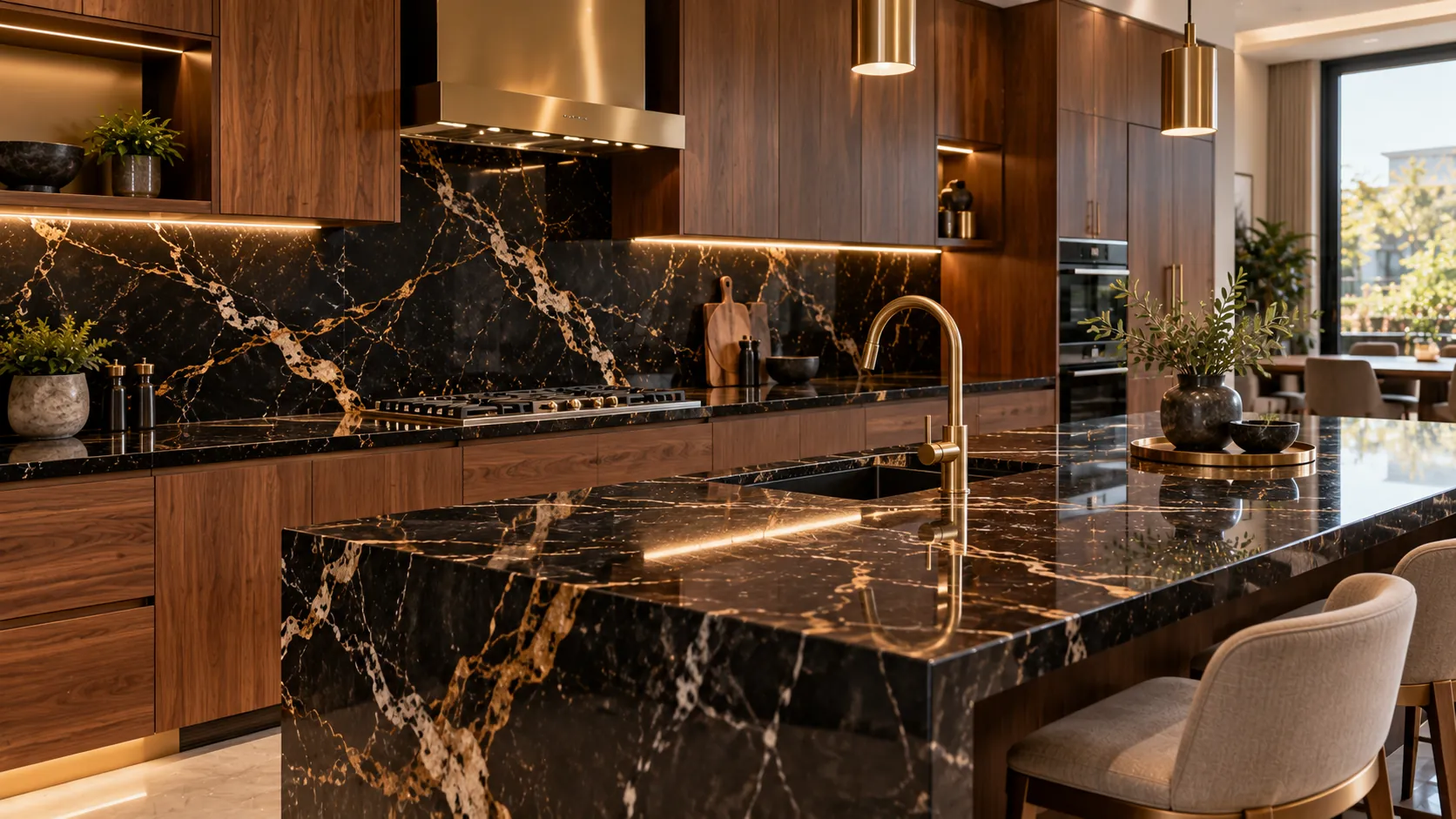
Black & Gold is the stone in most black kitchen photographs: a near-black ground crossed by gold, bronze and white veins that sometimes pool into wide flashes. Blocks are small and heavily selected, which is why it sits at the top of our marble range and why lots sell out. It is best spent on one move, such as an island top with a waterfall end or a full-height backsplash behind the hob, rather than on every counter. Its slabs run to about 108 x 66 inches, large enough to cover many islands in a single piece, and book-matching two consecutive slabs doubles the effect on a backsplash.
Black & White: graphic, but keep it off the cooking line
Black & White sets broad white veins against charcoal, closer to brushwork than to pattern. We list it for islands, backsplashes, vanities and fireplaces rather than for kitchen worktops, and we would rather say so now: its wide white veins are softer than the dark ground around them and show etching and staining first. On an island used for serving and homework, or as a splashback above a granite worktop, it is striking and practical enough.
Black granite: the dark look without the worry
Galaxy Black granite from the Karachi belt is the toughest surface on our list. Hot pans straight off a gas burner, steel utensils, lemon, hard water and full sun leave it alone, and it takes a deep polish. Its silver mica flecks sparkle under spotlights, which some people love and others find busy; Khyber Black Granite from Nowshera is the plainer alternative, fine-grained enough to look almost solid from a metre away. For a family that cooks two or three meals a day on the counter, either granite is the sensible worktop, and a black marble can still go on the island or the wall.
Very cheap "black marble" on some rate lists is dyed or oiled grey stone. Rub an offcut edge with a cloth and a little acetone: colour on the cloth suggests dye. Our black stones are natural colour. Our black marble price guide covers how to read black-stone quotations in more detail.
Which finish is best for a black kitchen worktop?
Honed or leathered is best for a working black worktop, because both hide fingerprints, water spots and small etch marks that a mirror polish shows at once. On a white stone, finish is mostly a question of looks; on a dark one it changes how often you will be wiping the surface. Jet Black and both of our black granites are available leathered; Black & Gold and Black & White come polished or honed.
| Finish | Look | Fingerprints and water spots | Etch marks | Good for |
|---|---|---|---|---|
| Polished | Deepest black, mirror reflections, veins at full contrast | Very visible | Very visible as dull patches | Backsplash, island tops used for serving, granite worktops |
| Honed | Satin-matte, slightly greyer black, softer veins | Much less visible | Blend in; the whole surface is already matte | Marble worktops in daily use |
| Leathered | Soft sheen with a gentle, touchable texture | Least visible | Less visible than polish; texture breaks up the mark | Busy worktops and islands in Jet Black or black granite |
Honing lifts a black stone slightly toward charcoal, because a matte surface scatters light instead of reflecting it. Some homeowners bring the depth back with a colour-enhancing impregnating sealer, which darkens the surface a shade; test it on an offcut first, because the change is permanent. A leathered texture is made with abrasive brushes rather than polishing pads, so it follows the natural grain of the stone.
A practical split that many kitchens use: polished on the backsplash, where nothing is chopped and the reflection bounces light around the room, and honed or leathered on the worktop, where the work happens.
Black marble kitchen ideas that suit Pakistani homes
Black absorbs light. In a large open-plan kitchen with a big window that is an asset; in a narrow kitchen in a 5-marla or 10-marla house it can make the room feel like a corridor. These layouts use dark stone where it adds the most and keep the room bright. Our guide to planning a Pakistani kitchen covers the rest of the room.
1. Black island, light perimeter
Put the drama on the island and keep the wall counters in a lighter, harder-working stone, or in granite. A Black & Gold island top with a waterfall end against white or pale grey perimeter counters is a popular layout in modern homes. The island is where guests gather and where serving happens, so it sees fewer acids and hot pans than the hob run. Our waterfall island guide explains how the mitred leg is cut so the veins wrap continuously to the floor.
2. Full-height black backsplash
A single slab running from worktop to wall cabinets, or to the ceiling where there are no wall cabinets, removes every grout line and gives a dark kitchen its focal point. Oil splashes wipe off in seconds. This is where a polished Black & Gold or Black & White face is at its best, because nobody chops on a wall. Plan sockets, the hood duct and any spice niche before the stone is cut, since a socket hole in the wrong place on a book-matched slab cannot be moved.
3. Black granite worktop with a veined marble wall
The most practical way to get the photographed look in a busy kitchen: a leathered Galaxy Black or Khyber Black worktop that takes the cooking, and a veined black marble on the backsplash that carries the drama. Because both are dark, the change of material at the back edge barely registers.
4. All-black with timber
Black stone on both worktop and backsplash over walnut, teak or dark oak cabinets gives a warm, hotel-like room, provided there is good lighting. Matte brass or brushed bronze handles and taps pick up the gold veins in Black & Gold. Keep the floor a shade lighter, a warm beige or soft grey, so the room does not close in.
5. Black and white with a design patti
A traditional Pakistani detail that still looks fresh: a white or light worktop with a slim black inlay strip, or a Jet Black edge band and upstand. It gives contrast at a fraction of the area and cost. The same idea works in reverse, a black worktop with a thin white upstand.
Colour and material pairings
| Element | With Jet Black or black granite | With Black & Gold |
|---|---|---|
| Cabinets | White, pale grey, light oak, or matte black for a monolithic look | Walnut, teak, deep green, or warm white |
| Hardware and taps | Brushed steel, chrome or matte black | Brushed brass, bronze, champagne gold |
| Walls | Bright white or light grey | Warm white or soft sand |
| Floor | Light grey or white marble, light porcelain | Warm beige marble, honed light stone, timber-look tile |
| Lighting | Neutral 3,500–4,000 K under-cabinet strip | Warm 2,700–3,000 K strip to bring out the gold |
Light it properly
Under-cabinet strip lighting is not optional on a dark worktop; without it you will be chopping in shadow. Fix the strip toward the front edge of the wall cabinet so it lights the worktop rather than reflecting straight off a polished backsplash into your eyes. Over an island, pendants hung lower and closer together give enough light without spot glare on the stone.
Fabrication details that matter more on black
- Joints. Ask for colour-matched black epoxy and tight joints, and keep seams away from the sink and hob. A pale grout line across a black worktop is one of the most visible faults in a badly fitted dark kitchen.
- Edge profile. A simple eased or half-bullnose edge suits most black tops. Sharp square edges chip, and on a dark stone the chip shows as a pale scar. A mitred apron or laminated edge makes a 2 cm top look 4 cm or more without the weight; see the kitchen countertops page for the edges and overhangs we work to.
- Polish inside cut-outs. The inside edges of an undermount sink cut-out should be polished to match. A rough, grey edge around the sink is very visible on black.
- Thickness. 2 cm on a plywood or steel sub-frame is the standard for most Pakistani kitchens; 3 cm adds stiffness on islands with long overhangs and on wide unsupported spans.
- Overhang. Up to about 250 mm can be left unsupported on a breakfast bar; beyond that, ask for hidden steel brackets.
- Sink choice. A black composite or brushed steel undermount sink keeps the dark line continuous; a white ceramic sink makes a deliberate contrast.
On a veined stone such as Black & Gold, ask to see the layout drawn onto photographs of your numbered slabs before cutting, so you approve where the big gold flashes fall: on the island top, not lost under the hob or inside a sink cut-out.
How much does a black stone kitchen cost?
A typical 50 sq ft L-shaped worktop costs about PKR 42,500–100,000 in black granite or Jet Black, and PKR 70,000–140,000 in Black & Gold, cut and fitted at our November 2026 quote ranges. Stone is bought by the square foot of slab, not by the square foot of finished top, so measure your counters, add wastage and multiply by the rate. Allow about 10% wastage on a straight run and 15% on an island with a waterfall end or on a book-matched backsplash. The figures below are installed costs at our current quote ranges, before cut-outs and mitres.
| Stone | L-shaped worktop, about 50 sq ft | Island top 8 x 4 ft, about 37 sq ft | Backsplash 10 x 2 ft, about 23 sq ft |
|---|---|---|---|
| Jet Black | 55,000 – 100,000 | 40,700 – 74,000 | 25,300 – 46,000 |
| Black & Gold | 70,000 – 140,000 | 51,800 – 103,600 | 32,200 – 64,400 |
| Black & White | Not recommended | 33,300 – 62,900 | 20,700 – 39,100 |
| Galaxy Black granite | 45,000 – 85,000 | 33,300 – 62,900 | 20,700 – 39,100 |
| Khyber Black Granite | 42,500 – 80,000 | 31,450 – 59,200 | 19,550 – 36,800 |
Our ranges already cover cutting, a standard edge, the finish and fitting; our quote then itemises sink and hob cut-outs per piece, any waterfall mitre or seam, and freight outside our fitting cities. Other yards often quote slab only and add edges, transport and fitting as extras, so ask for each line to be written as included or extra before comparing two quotations. Our black marble price guide explains what moves black-stone rates up or down between lots.
Where to save and where not to
- Save by putting the expensive veined stone only on the island or backsplash and using black granite on the long worktop runs.
- Save on small pieces such as a window sill or a coffee-station top by asking about remnants from a larger job.
- Do not save on fitting. Dark stone shows lippage, wide joints and poor edge polish far more than light stone.
- Do not save on lighting. A cheap dark kitchen with poor lighting feels gloomy; a well-lit one looks expensive.
Living with it: care in Pakistani heat, dust and hard water
Sealing
Dense black marble absorbs little, but it should still be sealed with a penetrating (impregnating) sealer after fitting and resealed every 6 to 12 months on a working kitchen surface. Do the water-drop test: if a few drops darken the stone within ten minutes, it is time. Black granite rarely needs frequent resealing. A sealer slows oil and stain absorption; it does not stop acid etching. Our guide on how to seal marble in Pakistan covers products, timing and the test step by step.
A daily routine
- Wipe spills of lemon, vinegar, tomato, imli, chutney and fizzy drinks immediately. Seconds matter on polished marble.
- Clean with warm water and a few drops of pH-neutral stone cleaner, never with bathroom acid, bleach or scouring powder.
- Dry the area around the sink with a soft microfibre cloth so hard-water drips do not leave white rings.
- Use a chopping board always, and a trivet or wooden board under a hot karahi or tawa on marble.
- Wipe the backsplash behind the hob after frying so the oil film does not build up into a cloudy layer.
- Dust with a dry microfibre cloth during dusty months before wiping with water, so grit is not dragged across the surface.
Removing marks
- White hard-water rings: soak a cloth in pH-neutral cleaner, lay it on the mark for a few minutes and wipe; repeat rather than scrubbing. Do not use descaling acids on marble.
- Light etch marks on polish: a marble polishing powder used as directed can restore small dull spots; widespread etching needs a professional re-polish, which is quick on a worktop.
- Oil stains: rare on dense black stone, but a baking-soda poultice left overnight draws out most of them.
Heat and monsoon affect fitting. In June and July ask the fitter to work early and keep slabs out of direct sun, because adhesive cures fast and dark stone gets hot to touch in the sun. In the monsoon, allow longer curing before sealing. In an outdoor or rooftop kitchen, black granite in full sun becomes very hot by afternoon; a honed or brushed finish and some shade make it usable.
When is a dark stone kitchen the wrong choice?
A dark stone kitchen is the wrong choice for a small, poorly lit room or for polished marble on a heavy-cooking counter. We would rather talk you out of the wrong stone than fit it. Think again, or put the black on the island and wall only, if any of these describe your kitchen.
- Small, north-facing or windowless kitchens where the only light is a ceiling tube light. Dark worktops will make the room feel smaller; a light stone with a black design patti or upstand gives contrast without the gloom.
- Very heavy daily cooking on the main counter with polished marble. Choose granite for that run.
- No routine for wiping and drying. If the household, or the domestic help, is used to leaving the counter wet, polished black will look spotted most of the time. A leathered granite is far more forgiving.
- Rental properties where you cannot control how the surface is cleaned.
If you are weighing up light and dark stone for the whole kitchen, our kitchen marble design guide compares the main options for desi cooking, and our granite kitchen countertops guide covers the granite side in full. Torn between the two veined blacks? See Black & Gold vs Black Zebra marble.
See the stone and get a quote
Black stones look different in the yard, under a tube light and in your own kitchen at night. Order samples of Jet Black, Black & Gold and Galaxy Black, put them next to your cabinet colour and splash a little lemon juice on the back of each to see how they react. Then send us your kitchen drawing or rough sizes and the way you cook, and we will return a free written quote with the installed rate for each stone and any cut-outs, mitres and freight itemised. For a rough figure first, the cost estimator works from your counter sizes.
Written by
The Captivating Marble Design Team
Fabricators, templaters and stone designers
We template, cut and install natural stone every day and write about what we learn — pricing, layouts, care and the mistakes we help clients avoid.
Book a free design consultation