Marble Thickness Guide: 18 mm, 20 mm or 30 mm for Floors, Counters, Stairs and Walls
Which stone thickness suits floors, kitchen tops, stairs, vanities and cladding: 18, 20 or 30 mm, laminated edges, weight and cost. Get a free quote today.
Captivating Marble Design Team · · 13 min read
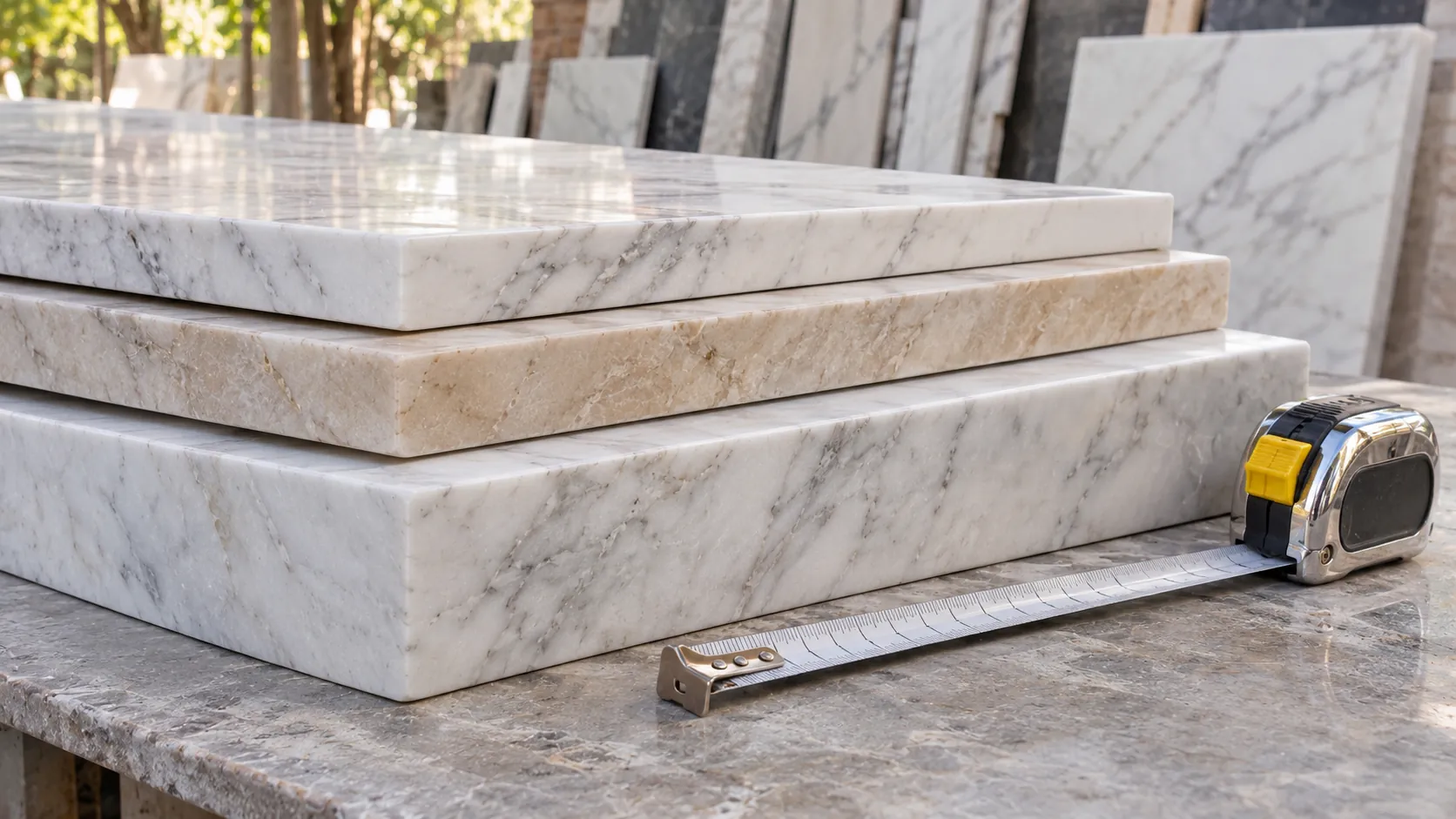
Key takeaways
- Most Pakistani stone is cut in two nominal thicknesses, 2 cm and 3 cm; gauged slabs usually measure 18 mm or 20 mm, with 30 mm cut on order.
- Indoor floors use 16–20 mm stone; steps and driveways use 25 mm or more; walls, splashbacks and shower panels use 18 mm.
- A 20 mm kitchen top on a ply or steel sub-frame is our standard; 30 mm suits islands, long spans and unsupported outdoor counters.
- Marble weighs about 5 kg per sq ft at 20 mm and 7.5 kg at 30 mm: a 32 sq ft top is 160 to 240 kg.
- A laminated edge glues a strip under the front so 20 mm stone shows a 40 mm edge, giving the thick look without the weight.
The short answer
The right marble thickness depends on the job: 16–20 mm for indoor floors, 18 mm for wall panels, splashbacks and vanities, 20 mm for kitchen tops on a supporting base, and 25–30 mm for stair treads, islands, outdoor counters and anything that spans without support. Thicker stone weighs about 50% more and costs more to cut, carry and fix.
In the Pakistani trade the two nominal sizes are "2 cm" and "3 cm". Gauged slabs, which are ground to an even thickness, usually come out at 18 mm or 20 mm, and 30 mm is cut on order from the block. Every stone on our product pages is offered in both 2 cm and 3 cm. This guide explains what each thickness is for, how laminated edges let a thin slab look thick, what extra weight means for cabinets, floors and freight, and how thickness feeds into the price.
How we priced this: stone prices in this post are our catalogue quote ranges per square foot as of November 2026, fabricated and installed in our service area, covering stone, cutting, a standard edge, finish, fitting and sealing on fitting day. Cut-outs, seams, mitres, laminated edges and freight outside our fitting cities are itemised on the quote. Weights are calculated estimates, and any market labour figure is labelled indicative.
What is the standard marble thickness in Pakistan?
There are two standard slab thicknesses, 2 cm and 3 cm, and most domestic work in Pakistan uses the 2 cm cut. Yards and workshops gauge that cut to 18 mm or 20 mm; floor tiles are often cut at 16–20 mm, and 30 mm is reserved for heavy-duty and unsupported work.
Gauged stone has been run through a calibrating machine that grinds the back so every piece is the same thickness. Ungauged stone, common in cheaper yard tile, can vary by a few millimetres from one corner to another, which shows up as lippage on a floor and uneven joints on a counter. When you compare rates, compare like for like: an 18 mm gauged slab and a 20 mm ungauged one are not the same product, even if both are sold as "2 cm".
| Thickness | Trade name | Typical uses | Notes |
|---|---|---|---|
| 10–12 mm | Thin tile | Wall tile, light cladding | Cheap; fragile on floors (indicative, see note below) |
| 16 mm | Floor tile | Indoor floor tile, especially Tavera | Fine on a full bed; less stone for future grinding |
| 18 mm | Gauged 2 cm | Walls, splashbacks, shower panels, wall-hung vanities, fireplace cladding | Lightest slab for vertical work |
| 20 mm | 2 cm | Floors, kitchen tops on a base, vanities, risers, sills | The everyday workhorse |
| 25 mm | Heavy tile | Steps, driveways, porches | Better against point loads and impact |
| 30 mm | 3 cm | Islands, long spans, outdoor counters, hearths, shelves, mechanically fixed cladding | Stiffest; about 50% heavier than 20 mm |
| 40 or 60 mm edge | Laminated edge | Kitchen and island fronts | A strip glued under 20 or 30 mm stone; not a solid slab |
You will also see thin 10–12 mm tile sold cheaply in many markets. It is acceptable on a wall but, on a floor, it is more likely to crack over a hollow spot and leaves little stone for future grinding. Our marble tiles price guide explains how thickness, size and calibration change tile rates.
Which thickness do you need for each job?
Use 18–20 mm for anything fully supported or vertical, and 25–30 mm for anything that spans, overhangs, takes impact or sits outdoors without a solid base. The table sets out the thickness we recommend for each common job in a Pakistani house, followed by the reasoning for the jobs people ask about most.
| Application | Recommended | Why |
|---|---|---|
| Indoor floor (bedrooms, lounges, corridors) | 16–20 mm | Fully bedded, so stiffness is not needed; leaves stone for re-grinding |
| Stair treads | 20 mm with a laminated nosing, or 25–30 mm | Nosings take knocks and project over the riser |
| Stair risers and skirting | 18–20 mm | Vertical, no load |
| Kitchen countertop on a base | 20 mm | Our standard, on a ply or steel sub-frame |
| Kitchen island with seating | 20 mm up to 250 mm overhang; 30 mm or flat steel beyond | The overhang needs stiffness or support |
| Waterfall island end | 20 mm mitred | Vertical leg mitred to the top |
| Bathroom vanity top | 18 mm wall-hung; 20 mm floor-standing or over 60 in | Weight on brackets versus span |
| Backsplash or full-height splash | 18 mm | Vertical, lighter on the wall |
| Shower walls | 18 mm panels | Full-height panels, grout-free |
| Fireplace cladding / hearth and shelves | 18 mm / 30 mm | Light on the chimney breast; hearth takes impact |
| Interior wall cladding (adhesive) | 16–20 mm | Weight on adhesive must stay low |
| Exterior cladding on anchors | About 30 mm | Pins and kerfs need edge depth |
| Outdoor counter | 20 mm on a supported frame; 30 mm unsupported | Sun, rain and spans |
| Driveway, car porch, steps outside | 25 mm or more | Point loads from tyres and furniture |
Floors
A floor tile is bedded on mortar or adhesive across its whole back, so it does not need to be stiff; it needs to be well supported. That is why 16–20 mm is normal indoors. The extra few millimetres still matter, though. A Pakistani marble floor is ground flat after laying and may be re-ground and re-polished several times over its life, and each round removes a little stone. A 20 mm tile simply has more to give than a 12 mm one. Our flooring and wall tile page lists the formats we cut.
Kitchen countertops
Our standard kitchen top is 20 mm stone on a ply or steel sub-frame, with the front edge often laminated so it reads as 40 mm. Choose 30 mm where the stone must carry itself: an island with a breakfast ledge, a long run between supports, or a large sink cut-out where 20 mm would be weak. Our kitchen marble design guide covers stone choice and costs for the whole kitchen, and the 2 cm vs 3 cm glossary entry gives the short version of the trade-off.
Islands and overhangs
On 20 mm stone we allow up to 250 mm of overhang without support. For a 300–380 mm breakfast ledge we let a flat steel plate into the unit top so the stone appears to float, or use 30 mm stone. A waterfall end is cut from the same slab and mitred at 20 mm; our waterfall island guide shows how the leg is taken from the right part of the slab.
Stairs
Most house stairs use 20 mm treads on a full bed with a second strip glued under the front, so the nosing looks 40 mm thick and resists chipping. Wide steps, commercial stairs and outdoor steps are better in 25–30 mm. Risers are vertical and carry no load, so 18–20 mm is enough. Our stair marble design guide covers nosings, grooves and riser details.
Bathroom vanities and shower walls
Either 18 mm or 20 mm works for a vanity top. Choose 18 mm for wall-hung units, where every kilogram hangs on brackets, and 20 mm over floor-standing cabinets and on anything wider than 60 inches. Shower walls are lined in 18 mm panels cut to full height. See our bathroom vanities page for basin and upstand options.
Walls, cladding and fireplaces
Wall work is about weight, not stiffness. Adhesive-fixed interior cladding stays at 16–20 mm so the load on the adhesive is modest. Exterior panels held on pins, kerfs or clamps usually need about 30 mm so the fixing has enough edge to grip. On a chimney breast we clad in 18 mm and keep 30 mm for the hearth and shelves, which take knocks and weight. Our guide to tile bond for stone explains which adhesive suits each job. Fixing methods are covered in our stone wall cladding guide.
What is a laminated edge, and when is it worth it?
A laminated edge is a strip of the same stone glued under the front of a slab and profiled with it, so 20 mm stone shows a 40 mm edge and 30 mm stone a 60 mm edge. It is worth it on kitchen tops and islands where a thin edge would look flimsy next to solid cabinets.
The strip is cut from the same slab, bonded with colour-matched epoxy, and the combined edge is ground and polished as one. On plain stone the joint is hard to spot; on strongly veined stone a horizontal line shows where the layers meet. A mitred edge avoids that by cutting both pieces at 45 degrees so the face pattern wraps down the front, at a higher cost in workshop time.
| Option | Visible edge | Weight | Best for |
|---|---|---|---|
| Plain 20 mm | 20 mm | Lightest | Modern kitchens, vanities, budget runs |
| 20 mm with laminated edge | 40 mm | Light; extra only at the front | Most Pakistani kitchens; rounded profiles hide the joint |
| 20 mm with mitred apron | 40–60 mm or deeper | Light | Strongly veined stone; island ends |
| Solid 30 mm | 30 mm | About 50% heavier | Islands with overhang, long spans, outdoor counters |
| 30 mm with laminated edge | 60 mm | Heaviest | Statement islands |
Rounded profiles such as a half bullnose suit lamination best, because the curve passes over the glue line. Square and eased edges suit mitring. Either way, ask the workshop where the joint will sit before you approve the drawing.
How much does thicker stone weigh?
Marble and granite weigh roughly 5 kg per square foot at 20 mm and about 7.5 kg at 30 mm, so moving from 2 cm to 3 cm adds about half again to the load. That matters for wall-hung vanities, kitchen cabinets, upper-floor flats, staircases carried up by hand and freight to another city.
| Thickness | Per sq ft | Per square metre | 32 sq ft kitchen top | 12 x 14 ft floor (168 sq ft) |
|---|---|---|---|---|
| 16 mm | about 4.0 kg | about 43 kg | about 128 kg | about 670 kg |
| 18 mm | about 4.5 kg | about 49 kg | about 144 kg | about 760 kg |
| 20 mm | about 5.0 kg | about 54 kg | about 160 kg | about 840 kg |
| 25 mm | about 6.3 kg | about 68 kg | about 200 kg | about 1,050 kg |
| 30 mm | about 7.5 kg | about 81 kg | about 240 kg | about 1,260 kg |
These figures are for the stone alone. The mortar or adhesive bed under a floor adds substantially more, which is why a structural engineer should be consulted before laying stone over an old roof slab or a mezzanine. In an apartment, ask the building management about the floor build-up allowed before choosing a thicker tile.
Where the weight bites
- Wall-hung vanities. A 60 x 22 inch top is about 9.2 sq ft: roughly 41 kg at 18 mm and 69 kg at 30 mm, before the basin. Brackets must be fixed into solid masonry.
- Kitchen cabinets. Board carcasses carry 20 mm stone on a ply deck comfortably; 30 mm on long runs needs checking, especially on older units.
- Stairs and upper floors. Every piece is carried up by hand. A 4 ft x 11 in tread is about 3.7 sq ft, roughly 18 kg at 20 mm and 28 kg at 30 mm.
- Freight. Heavier crates mean more truck capacity used; for jobs outside our fitting cities, freight is itemised on the quote.
- Breakage in transit. Thin, long pieces are the most likely to crack on a bumpy road, which is one reason 30 mm is preferred for long island tops sent upcountry.
Does thicker stone cost more?
Yes, a 3 cm slab costs more than a 2 cm slab of the same stone, but less than many buyers expect, because cutting, edging and fitting are a large share of an installed price. The bigger cost drivers are usually grade, edge detail and how well the layout uses each slab.
Our catalogue quotes one installed range per stone, covering both thicknesses. Where your job falls within that range depends on grade, thickness, finish, edge detail and how much of each slab ends up as offcut. A 20 mm top with a laminated edge often costs about the same as a plain 30 mm top once the extra edge work is added, so choose on performance and look rather than on price alone.
| Stone | Type | Installed range | Product listing | Collection gauging |
|---|---|---|---|---|
| China White | Marble | 450 – 800 | 2 cm, 3 cm | — |
| Tavera Light | Marble | 520 – 980 | 2 cm, 3 cm | 16, 18, 20 mm |
| Sunny Grey | Marble | 560 – 1,000 | 2 cm, 3 cm | 18, 20, 30 mm |
| Verona Plain | Marble | 600 – 1,100 | 2 cm, 3 cm | 18, 20, 30 mm |
| Indus Gold | Marble | 700 – 1,300 | 2 cm, 3 cm | 18, 20, 30 mm |
| Royal Fancy | Marble | 820 – 1,550 | 2 cm, 3 cm | 18, 20 mm |
| Ziarat White | Marble | 850 – 1,600 | 2 cm, 3 cm | 18, 20, 30 mm |
| Jet Black | Marble | 1,100 – 2,000 | 2 cm, 3 cm | 18, 20, 30 mm |
| Black & Gold | Marble | 1,400 – 2,800 | 2 cm, 3 cm | 18, 20, 30 mm |
| Nagar Parkar Grey | Granite | 650 – 1,200 | 2 cm, 3 cm | 18, 20 mm; 30 mm for heavy use |
| Galaxy Black | Granite | 900 – 1,700 | 2 cm, 3 cm | 18, 20 mm; 30 mm for heavy use |
| Pak Green Onyx | Onyx | 2,400 – 5,200 | 2 cm, 3 cm | Panels about 18 mm, mesh-backed |
Two stone families need a check before you order a 3 cm piece. The Tavera collection is gauged at 16–20 mm for whole-house floors, and the Fancy collection at 18–20 mm, so confirm a 30 mm Tavera or Fancy island top on your written quote before you fix the design.
Worked example: an L-shaped kitchen top
Take a 10 ft run and a 6 ft return, both 2 ft deep: 32 sq ft of counter. In Verona Plain at our installed range of PKR 600 to 1,100 per sq ft, that comes to roughly PKR 19,200 to 35,200 before cut-outs. In Ziarat White at PKR 850 to 1,600, it is about PKR 27,200 to 51,200. The stone weighs about 160 kg at 20 mm and 240 kg at 30 mm.
Adding a laminated front edge along the 16 running feet of front is itemised on our quote. For buyers who purchase slab only and hire their own fabricator, an indicative Punjab market rate is PKR 250 to 600 per running foot, or about PKR 4,000 to 9,600 for this kitchen. To run your own sizes, try the cost estimator.
Onyx, granite, travertine and terrazzo
The same 2 cm and 3 cm logic applies to granite, which is harder and stiffer than marble and handles 30 mm outdoor spans well. Galaxy Black, Nagar Parkar and Khyber granites are our first suggestion for outdoor counters and hard-working kitchen tops. Other stones follow their own rules.
- Onyx is soft and translucent. Panels such as Pak Green Onyx are cut thin, about 18 mm, and bonded to a resin and fibreglass-mesh backing; vanity tops are cut slightly thicker. Thickness also changes how much light passes through a backlit panel, which our backlit onyx guide explains.
- Travertine such as Dawezai Badal is supplied resin-filled and honed. It follows the marble sizes, but treat thin travertine gently on floors because the natural pits weaken thin pieces.
- Chips Dana terrazzo is not a slab product. It is poured and ground on site, so its thickness is set by the floor build-up; pre-cast 24 x 24 inch tiles are available where pouring is impractical.
Checking thickness on delivery
Thickness is easy to check and often skipped. A slab sold as "2 cm" that measures 17 mm at one corner and 22 mm at another will give uneven joints, a wavy front edge and extra grinding on a floor.
- Get the thickness in writing on the quote for every piece: floor, top, edges, risers, skirting and sills.
- Measure with a tape or calipers at all four corners of a few tiles or slabs. More than a millimetre or two of variation means the stone is not gauged.
- Check the backs. Gauged stone has an even, ground back; ungauged stone shows saw marks and steps.
- Check edges on laminated pieces. The glue line should be straight, colour-matched and the same height along the whole front.
- Keep floor and skirting from one lot and one thickness, so the floor is level and the skirting line runs true. Our marble skirting guide covers the details.
- Plan finished floor levels with the thickness and bed in mind before doors are hung and frames fixed.
Thickness interacts with stain risk too: a honed or thin slab does not stain more easily, but a poorly sealed one does. If a mark does appear, our guide to removing stains from marble covers poultices for haldi, oil, chai and rust.
Get the thickness right on your quote
Send us your drawing or room sizes and tell us what each piece is for: floor, kitchen top, island with seating, vanity, stairs or cladding. We will recommend a thickness and edge for each, state it on a free itemised quote, and reserve the stone from one lot. To feel the difference between 2 cm and 3 cm before you decide, order samples of the stones on your shortlist.
Written by
The Captivating Marble Design Team
Fabricators, templaters and stone designers
We template, cut and install natural stone every day and write about what we learn — pricing, layouts, care and the mistakes we help clients avoid.
Book a free design consultation