Marble Skirting: Heights, Edge Profiles, Fixing and Costs in Pakistan
Marble skirting from PKR 150 per running foot fitted (Nov 2026): the standard 4-inch height, thickness, edge profiles, fixing and a room cost. Get a free quote.
Captivating Marble Design Team · · Updated · 17 min read
Key takeaways
- Marble skirting in Pakistani homes is usually 4 inches high and cut from 2 cm stone, with 3 to 6 inches used depending on the room.
- A 4-inch strip uses one third of a square foot of stone per running foot.
- Fitted 4-inch skirting costs about PKR 150–667 per running foot at our November 2026 quote ranges, from China White to Jet Black.
- Skirting a 12 x 14 ft bedroom costs about PKR 8,100 in China White to PKR 28,800 in Ziarat White, fitted, with mitred corners itemised.
- Fix skirting with a white polymer-modified stone adhesive, not grey cement, and mitre every external corner.
The short answer
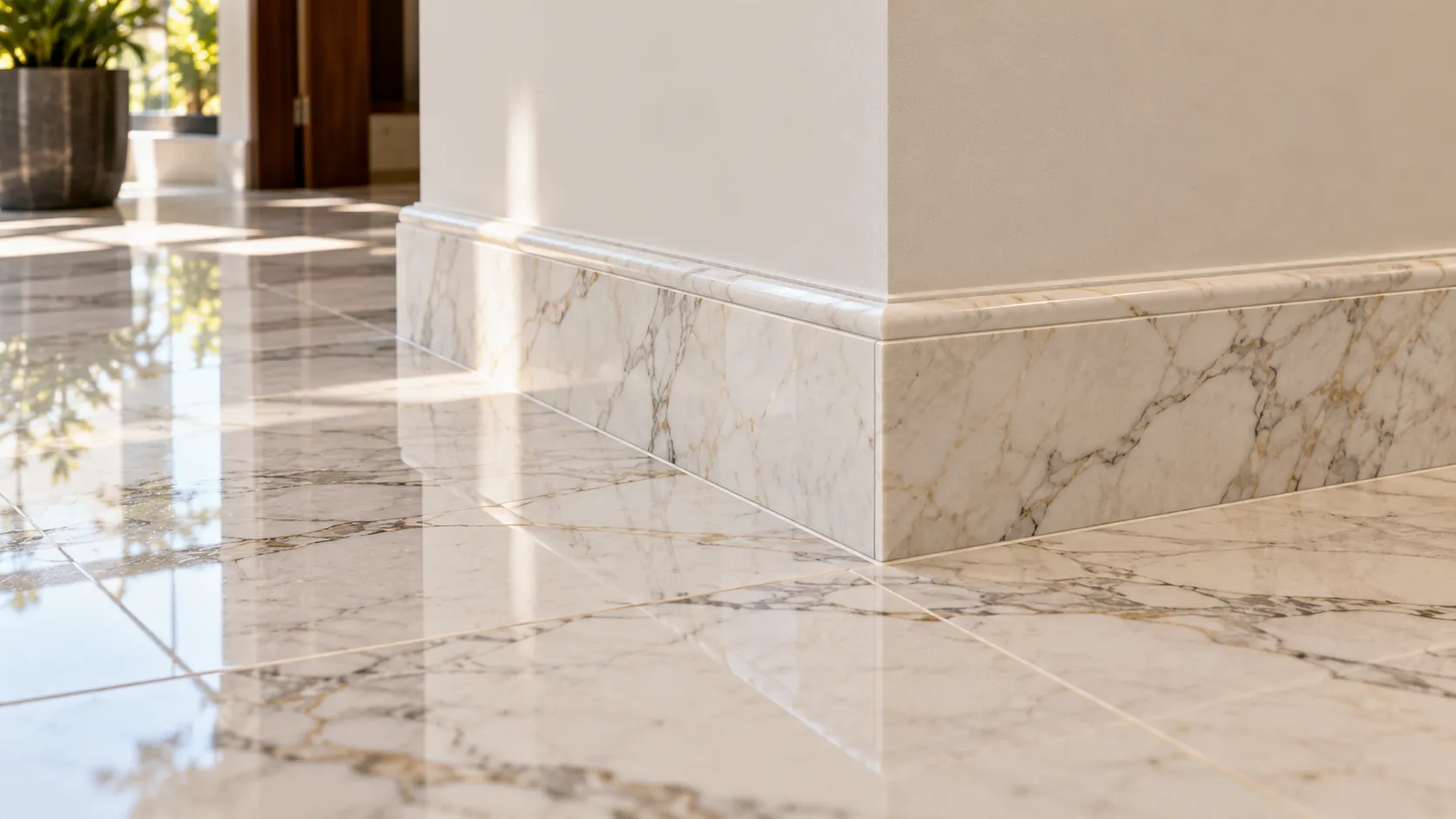
Marble skirting is the strip of stone, usually 4 inches high and cut from 2 cm floor stone, fixed along the base of a wall to protect the plaster from daily pocha. Skirting a 12 x 14 ft bedroom costs about PKR 8,100–28,800 at our November 2026 quote ranges, from China White to Ziarat White, cut, edged and fitted.
Heights run from 3 to 6 inches, the strip is fixed with a white stone adhesive, and it hides the uneven joint between floor and wall as well as taking knocks from furniture and shoes. It is priced by the running foot once the height is fixed: a 4-inch strip uses one third of a square foot of stone per running foot. This guide covers heights, thickness, edge profiles, matching or contrasting the floor, how to fix it so it stays put, a cost method you can check yourself, and how to keep it clean.
How we priced this: stone rates in this post are our current catalogue quote ranges per square foot as of November 2026. These are installed prices that include cutting, a standard top edge and fitting in our service area; mitred corners and freight outside our fitting cities are itemised. Separate labour rates per running foot are indicative market ranges for stone-only buyers. Confirm the final figure against a written quotation.
What skirting does, and why stone beats the alternatives
Skirting is easy to treat as an afterthought, but in a Pakistani house it does real work. Floors are wet-mopped (pocha) every day, often with a bucket of water and a strong cleaner, and the bottom few inches of every wall take the splash. Plaster and paint there soon go patchy, swell or flake. A stone strip takes that water without complaint.
- Protects the wall from mop water, the vacuum cleaner, shoes, chair legs and children's toys.
- Hides the floor-to-wall joint. Floor stone is never cut perfectly straight against a wall, and plaster is rarely perfectly plumb at the bottom. Skirting covers both.
- Finishes the room. A clean, continuous line at the base of the wall makes a marble floor look complete; without it, the floor seems to stop short.
- Lasts as long as the floor. Stone does not rot, swell or get eaten by termites, which wooden, MDF and some PVC skirting can in humid or monsoon-prone houses.
- Polishes with the floor. When the floor is re-polished years later, stone skirting can be polished by hand to match.
| Material | Strengths | Weaknesses |
|---|---|---|
| Marble or granite | Water-proof, matches a stone floor, long life, re-polishable | Higher cost, heavier, needs careful fixing and joints |
| Porcelain or ceramic tile | Cheap, matches a tile floor, easy to cut | Cut edge shows unless a finished skirting piece is bought; chips |
| Wood or MDF | Warm look, easy to shape | Swells with mop water, termites, repainting |
| PVC or aluminium profile | Cheap, quick, hides cables | Looks out of place against marble; can yellow in sun |
If your floor is marble or granite, stone skirting in a matching or deliberately contrasting colour is the natural finish. If you are still deciding on the floor itself, our guide to marble floor design in Pakistan covers layouts, borders and colours by room.
What is the standard skirting height?
There is no fixed standard, but 4 inches is the most common skirting height in Pakistani homes, with 3 to 6 inches used depending on room size and ceiling height. Height is the first decision because it sets the quantity of stone, the look of the room and where the electrician can put sockets. There is no single correct figure; the right height depends on ceiling height, room size and style.
| Height | Stone per running ft | Where it works |
|---|---|---|
| 3 in | 0.25 sq ft | Minimal, modern rooms; flats with low ceilings; behind furniture |
| 4 in | 0.33 sq ft | The common default for bedrooms, lounges and corridors |
| 5 in | 0.42 sq ft | Larger drawing rooms and dining rooms; more traditional interiors |
| 6 in | 0.5 sq ft | Lobbies, double-height halls, rooms with high ceilings |
Rules of thumb
- Keep one height throughout a floor so the line runs unbroken from room to room and along corridors.
- Go taller in big, tall rooms. A 3-inch strip looks thin in a 20 ft drawing room with a 12 ft ceiling; 5 or 6 inches looks proportionate.
- Go lower in small rooms and flats. A tall skirting in a small bedroom eats wall and makes the room feel shorter.
- Match the door architrave. If door frames have a plinth block at the bottom, the skirting should be the same height or a little lower so it meets the block neatly.
- Plan sockets above the top edge. Tell the electrician the skirting height before conduits are chased, so no back box ends up half in the stone.
On stairs, the skirting follows the steps either in a stepped zigzag or as a straight slanted band; our stair marble design guide explains both, including how much stone each needs, and our black granite steps guide covers skirting on granite stairs.
Thickness and how far it sits off the wall
Our stone is supplied in 2 cm and 3 cm thicknesses, and skirting is normally cut from 2 cm stone, often from the same lot as the floor so the colour matches. With a few millimetres of adhesive behind it, a surface-fixed strip stands out from the plaster by roughly an inch. That projection is what gives the skirting a shadow line and a top edge you can see and feel.
Surface-fixed or flush
- Surface-fixed: the strip is stuck onto finished plaster. Simple, cheap and easy to replace. The top edge shows, so its profile matters, and it collects some dust.
- Flush or near-flush: the plaster is stopped at skirting height, or a recess is left, so the stone face sits level with the wall or only a few millimetres proud. It looks very clean and modern, but it must be planned before plastering, and the plaster edge above has to be dead straight.
Projection matters for doors and furniture. A thick surface-fixed skirting can stop a door opening fully against a wall, and it pushes wardrobes, beds and sofas forward. Check door stops and built-in joinery against the finished thickness before you settle the detail.
Skirting height, the floor stone thickness and the bed beneath it all set the finished floor level. Decide them together before the plaster goes on, because changing them afterwards means chasing walls and cutting doors.
Edge profiles for the top edge
Only the top edge and the face of the skirting are seen, so the top profile does most of the design work. Every profile is ground and polished by the workshop before the strips are delivered, and each one is quoted per running foot. Our glossary page on edge profiles shows them side by side.
| Profile | Look | Practical notes |
|---|---|---|
| Square, polished top | Crisp and modern | Sharp arris chips more easily; flat top collects dust |
| Eased edge | Square with the corner softened slightly | The safe default; resists chipping, still looks clean |
| Bevel | Angled chamfer along the top | Sharp, architectural line; sheds dust better than a flat top |
| Half bullnose | Fully rounded top | Soft and traditional; the hardest to chip; costs a little more |
| Ogee | S-curve moulding | Classical rooms only; the most workshop time |
For most homes an eased or rounded top is the sensible choice. A sharp square arris on a 2 cm strip looks crisp on day one but is easily chipped by a vacuum cleaner head or a chair leg, and a chip on polished stone at eye level from a sofa is very noticeable. Whatever profile you choose, the face and top should be polished to the same level as the floor, or honed to match a honed floor.
External corners
Where skirting turns around a projecting corner, the two pieces should be mitred at 45 degrees so the joint is a fine line and no raw edge shows. Internal corners can simply be butted, with the face piece running past the other. Ask the workshop to polish the exposed ends where the skirting stops at a door frame.
Should skirting match the floor or contrast with it?
Match the floor for a calmer room that looks larger; contrast it for a framed look that hides mop marks but shows every crooked wall. Both work if they are done deliberately.
Matching skirting
Cutting the strips from the same stone and the same lot as the floor makes the floor appear to turn up the wall. The room reads as larger and calmer, and joints are less visible. This is the usual choice with light floors such as Ziarat White, Verona Plain or China White, and it is the easiest to get right because offcuts from floor slabs can be used. Order the skirting quantity with the floor so the yard reserves stone from one block.
Contrasting skirting
A darker strip frames the floor like a picture border and draws the eye to the room's outline. Black or charcoal skirting such as Jet Black under a white or beige floor is the classic version; a dark skirting also hides mop marks and scuffs that show on white stone. The risk is that a contrasting line exposes every wall that is not straight and every room that is not square, so it suits newly built houses with good plaster better than older ones.
| Floor | Matching skirting | Contrast option |
|---|---|---|
| Ziarat White (850 – 1,600) | Ziarat White, same lot | Jet Black (1,100 – 2,000) |
| Verona Plain (600 – 1,100) | Verona Plain, same lot | Tropical brown (650 – 1,200) |
| China White (450 – 800) | China White, same lot | Superline Grey (620 – 1,150) |
| Sunny Grey (560 – 1,000) | Sunny Grey, same lot | Jet Black (1,100 – 2,000) or Black & White (900 – 1,700) |
Tying skirting to a floor border
Many Pakistani floors carry an inlaid border a short distance in from the walls. Our Design Patti strips, cut in our Lahore workshop in widths from two to six inches, and the carved, slightly raised Dighin Border are both used this way. When a floor has a border, repeat one of its colours in the skirting, or keep the skirting the same as the field stone, so the border reads as a frame and the skirting does not compete with it. Keep the gap between border and skirting even on all sides; a border that wanders in and out against the skirting line is the first thing people notice. The glossary entry on design patti explains how these borders are made.
How much does marble skirting cost per running foot?
A fitted 4-inch strip costs about PKR 150–667 per running foot at our November 2026 quote ranges, from China White to Jet Black, including cutting, a standard top edge and fixing. Yards quote stone per square foot; fitters often quote skirting per running foot. To compare quotes, convert everything to the same unit. The stone in one running foot equals the height in inches divided by 12, in square feet.
Installed cost per running foot at our quote ranges
| Stone | PKR / sq ft | PKR per running ft at 4 in |
|---|---|---|
| China White | 450 – 800 | 150 – 267 |
| Verona Plain | 600 – 1,100 | 200 – 367 |
| Superline Grey | 620 – 1,150 | 207 – 383 |
| Ziarat White | 850 – 1,600 | 283 – 533 |
| Jet Black | 1,100 – 2,000 | 367 – 667 |
For a 6-inch skirting, multiply the per-running-foot figures by 1.5; for 3 inches, multiply by 0.75. Where skirting is cut from floor offcuts of the same lot, the cost can fall, because the yard is using material that would otherwise be a remnant. Ask whether your quote assumes offcuts or fresh slab.
Working out the quantity
- Measure the perimeter of each room: add up the lengths of all walls in feet.
- Subtract door openings, and any wall that will be hidden behind fitted wardrobes or kitchen cabinets.
- Add the corridors, landings and stair walls.
- Multiply the running feet by the height in inches and divide by 12 to get square feet.
- Add about 10% for cutting, corners and breakage.
| Step | Figure |
|---|---|
| Perimeter | 12 + 14 + 12 + 14 = 52 running ft |
| Less door opening | 52 − 3 = 49 running ft |
| Stone area | 49 × 4 ÷ 12 = 16.3 sq ft |
| With 10% wastage | About 18 sq ft |
| Installed cost, China White | About PKR 8,100 – 14,400 |
| Installed cost, Ziarat White | About PKR 15,300 – 28,800 |
If you buy stone only and hire your own fitter
| Item | Unit | Indicative PKR |
|---|---|---|
| Cutting strips to height | Per running ft | 20 – 60 |
| Top-edge polish, eased or bevel | Per running ft | 40 – 120 |
| Half bullnose or ogee top | Per running ft | 100 – 250 |
| Mitred external corner | Per corner | 150 – 400 |
| Fixing with adhesive, including grouting | Per running ft | 40 – 120 |
Labour figures are indicative market ranges only, apply when you buy stone only, and vary by city, contractor and how much wall preparation is needed. Some fitters include skirting in a whole-floor rate; others charge it separately. Ask each quote to state the height, profile, number of corners and whether adhesive is included.
Our stone cost estimator works out an installed figure for any of our stones once you know the square footage, and the same method applies to skirting if you enter the converted area.
Fixing skirting so it stays put
Skirting that falls off, sounds hollow when tapped or shows dark shadows through the face is nearly always a fixing problem. These points prevent most of them.
Sequence on site
- Finish plaster and let it cure fully. Fixing onto damp plaster traps moisture behind the stone.
- Fit door frames (chaukhats) first, so skirting can be cut tight to them.
- Lay the floor stone, then fix the skirting sitting on the finished floor line, or a hair above it.
- Agree with the fitter whether the floor will be ground and polished (ragrai) after the skirting goes on. If so, protect the bottom edge so the machine does not chip it, and leave the final grout until after grinding.
- Paint the walls last, cutting in neatly along the top edge of the skirting.
Adhesive, not a mortar bed
- Use a white, polymer-modified stone adhesive. A grey sand-cement mortar can shadow through light marble and leaves the strip standing further off the wall.
- Prepare the wall. Scrape off loose paint and distemper, and score glossy surfaces, so the adhesive bonds to sound plaster.
- Back-butter every strip and press it on, so there are no hollow spots. A hollow strip cracks when it is knocked.
- Set a level line, not the floor, as the reference for the top edge. Floors are rarely perfectly level, and a top edge that follows a dipping floor is far more visible than a hairline gap at the bottom that can be filled.
- Wedge and tape each strip while the adhesive sets, and keep joints to 1–2 mm.
- Fill joints with colour-matched grout or tinted epoxy, and line skirting joints up with the floor joints where possible so the two grids agree.
Damp walls
In older ground-floor rooms, rising damp and seepage from bathrooms often show first along the bottom of the wall. Stone skirting will hide the stain but not the cause, and moisture held behind the strip can darken light marble and loosen the bond. Fix the leak or damp-proof the wall first, let it dry, and only then fix the stone. Sealing the back and edges of light strips before fixing reduces the risk of staining from behind.
When skirting is part of a full floor job, the fitter should plan its height, joints and corners at the same time as the floor layout, not after the floor is down.
Cleaning and long-term care
Skirting gets dirtier than the floor in one way: the top edge collects dust, and the face takes splash from the mop bucket every day. A little routine keeps it looking new.
- Wipe the top edge weekly with a damp microfibre cloth. Fine Pakistani dust settles there within days, and a rounded or bevelled top sheds it more easily than a flat one.
- Mop with a pH-neutral stone cleaner, never tile acid, teezab, vinegar or bleach-based bathroom cleaners. Acid splashed onto polished stone etches a dull band along the bottom edge that only re-polishing removes.
- Wring the mop well. Standing dirty water dries into a tide line along the base of the skirting, especially with hard water.
- Seal light stone after fitting and roughly once a year, at the same time as the floor. Our guide to sealing marble in Pakistan explains the products and the water-drop test.
- Remove scuffs from shoes and furniture with a soft cloth and neutral cleaner; never use scouring powder on polished stone.
- Polish by hand when the floor is re-polished. Floor machines cannot reach skirting, so ask the polishing team to hand-polish it at the same time; our marble polishing guide covers the process.
Summer heat dries adhesive and grout too quickly on west-facing walls; ask fitters to work early in the day. In the monsoon, check that walls are dry before fixing, because trapped moisture behind fresh skirting is the most common cause of shadowing and loose strips.
Common mistakes to avoid
- Ordering the skirting separately from the floor. A second order may come from a different lot with a different shade. Count skirting into the floor quantity from the start.
- Fixing to a sloping floor line. Use a level line for the top edge.
- Butting external corners. A butt joint on a projecting corner shows a raw edge and chips. Mitre it.
- Forgetting sockets and door stops. A back box half-buried in stone or a door that hits a thick skirting are both expensive fixes.
- Wide grey grout lines. They break the line of the skirting; keep joints tight and colour-matched.
- Skirting behind built-in wardrobes. It wastes stone and pushes the units forward. Stop it at the edge of the joinery.
- Covering up damp. Stone over a wet wall stains and falls off. Solve the damp first.
Most of these problems cost nothing to avoid if they are settled on a drawing before the stone is cut.
Get a quote for floor and skirting together
Send us your room sizes, the number of doors, the skirting height and profile you prefer, and whether you want it to match or contrast with the floor. We will reserve floor and skirting stone from one lot and send a free written quote that states the installed rate and itemises mitred corners and freight. If you are choosing between a matching and a contrasting strip, order samples of both stones and hold them against your floor and wall colour before deciding.
Written by
The Captivating Marble Design Team
Fabricators, templaters and stone designers
We template, cut and install natural stone every day and write about what we learn — pricing, layouts, care and the mistakes we help clients avoid.
Book a free design consultation