Marble Yellowing: Why White Marble Turns Yellow and How to Fix It
Why white marble turns yellow: rusting iron, damp from the bed, old wax or sealer, dirty mop water and adhesive bleed, with a fix for each. Ask our stone team.
Captivating Marble Design Team · · 15 min read
Key takeaways
- Most yellow patches on white marble come from below or on top of the stone, not from the stone ageing: damp, cement salts, wax, sealer film or dirty water.
- Small orange or brown spots that grow out of the stone when it stays wet are iron minerals rusting; they need a stone-safe rust remover, never bathroom acid.
- Yellowing that follows tile edges or the trowel pattern points to moisture or alkali wicking up from a wet grey cement bed.
- Lay white stone on a white stone adhesive, let the floor dry fully, then seal with an impregnating sealer, never a wax or acrylic coat.
- Test before you treat: a drop of water, a scrape with a plastic card and a dab of acetone usually tell a surface film from a stain inside the stone.
The short answer
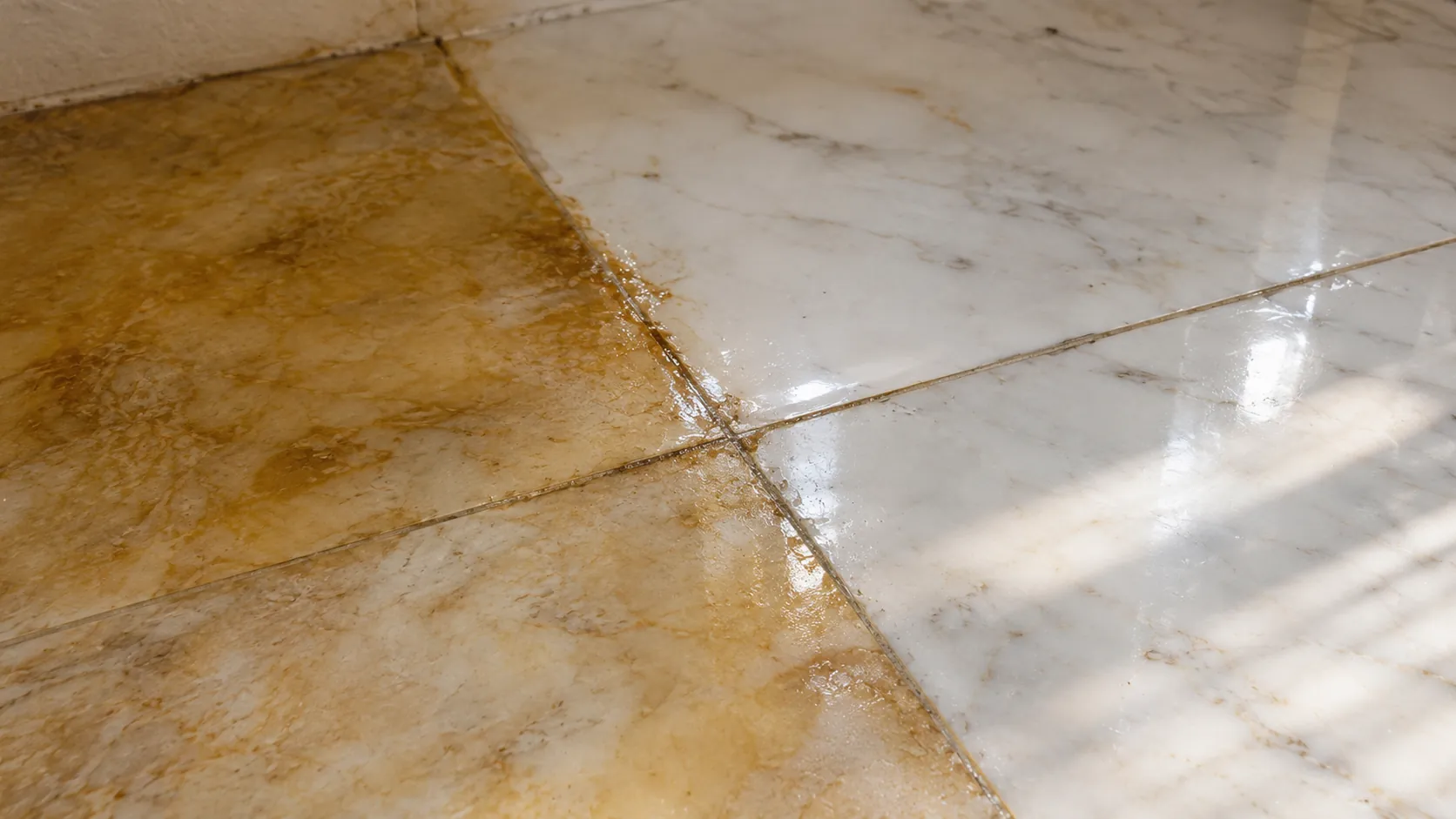
Marble yellowing is usually caused by something added to the stone rather than by the stone itself: iron minerals rusting when the stone stays wet, moisture and cement salts rising from a wet grey mortar bed, wax or the wrong sealer ageing on the surface, dirty mop water, or oil bleeding from an adhesive or sealant. Each cause leaves a different pattern, and each has its own fix.
Pure white marble is calcite, and calcite does not turn yellow on its own indoors. When a Ziarat or Perlino floor that was bright on fitting day looks cream or brown a year later, the colour has come from somewhere: from inside the stone, from the bed below it or from what has been put on top. Find the source first, because a poultice will not cure damp, and a re-polish will not stop rust that keeps coming back.
This guide explains the five common causes, how to tell them apart at home with simple tests, what fixes each one, and how to lay and look after white stone so it stays white. Stain-by-stain poultice recipes are in our guide on how to remove stains from marble; here we deal with the yellow tone that spreads across a floor, a vanity or a wall.
Is it really yellowing? Check the light and the comparison first
Before treating anything, make sure the stone has changed. Several things make white marble look yellow when nothing is wrong with it.
- Warm lighting. Warm-white LEDs and old yellow bulbs make an ivory stone read cream. Look at the floor in daylight with the lights off, and compare it with a spare piece or an offcut from the same lot if you kept one.
- The natural tone of the stone. Ziarat White is an ivory field, not a paper white, and Medium White is a warm white with light spotting. Next to a cool white such as Pampo White or a white porcelain tile, both will look warmer. That is the stone, not a fault.
- Lot-to-lot variation. Two deliveries bought months apart can differ in shade. If one room is warmer than the next from the day it was laid, it is a lot difference, not yellowing.
- A dull surface. A worn, scratched polish scatters light and looks greyer and duller, which some people read as yellow. A gloss test (below) separates dullness from colour.
If the colour really has changed, note three things before you call anyone: where the yellow is (whole floor, one room, near a bathroom, along joints, in spots), when it appeared (weeks after fitting, after a deep clean, after the monsoon) and whether it comes and goes with the weather. Those three answers point to the cause more reliably than any product label.
The five causes of yellow white marble
| What you see | Most likely cause | Quick check | Usual fix |
|---|---|---|---|
| Orange, rust or brown spots that grow, often in one area of the stone | Iron minerals in the marble oxidising | Spots darken after mopping or rain; colour sits inside the stone | Stone-safe rust remover in a poultice; replace a badly affected piece |
| Yellow or brown shadows following tile edges, joints or the trowel pattern | Moisture and cement alkali rising from a wet grey mortar bed | Worse after wet weather; joints stay dark; white powder may appear | Let the bed dry fully, then poultice; fix the moisture source |
| Even yellow-amber film across a whole floor, worse in corners and under furniture | Old wax, acrylic shine coat or a film-forming sealer | A plastic card scrapes off a residue; water sits on the surface | Strip the coating, then re-polish if needed |
| Dingy yellow-grey tone along walkways and in honed or textured areas | Dirty mop water, oily soap and grime in the pores | A strong neutral clean lightens a test patch noticeably | Deep clean, rinse well, change the cleaning routine |
| Dark or yellow halos along edges, sinks, shower joints or skirting | Oil or plasticiser bleeding from adhesive, silicone or putty | Halo hugs the joint line; acetone on a cotton bud lifts colour | Solvent poultice; reseal joints with a stone-safe sealant |
Sometimes two causes overlap. A damp bed can also feed iron spots, and a floor that has been waxed to hide yellow patches now has two problems. Work from the bottom up: stop the moisture, remove whatever is on the surface, then treat what is left in the stone.
Iron in the stone: rust spots that grow
Many marbles carry small amounts of iron-bearing minerals. In a dry, sealed piece they stay inert. When the stone is kept wet for long periods, the iron oxidises, much as a nail rusts, and leaves orange, yellow or brown spots that seem to grow out of the stone. You will often see them near a shower, under a leaking pipe, on an outdoor step or on a floor laid on a soaking-wet bed.
What makes iron spots worse
- Standing water and slow drying, such as a shower floor with poor fall or a terrace without a slope.
- Chlorine bleach, which speeds up oxidation of iron in the stone. Bleach also breaks down impregnating sealers.
- Acidic rust removers and tile acid (teezab), which etch the marble and can open the surface so more iron reaches it.
- Steel wool and wire brushes, which leave tiny steel fragments that rust on the surface within days.
How to fix it
Use a rust remover that is labelled safe for marble or natural stone, applied as a poultice so it draws the iron out instead of sitting on top. The rust removers sold for toilets and ceramic tiles are acidic and will etch marble badly, so never use them. Expect several rounds on old spots. Where iron is spread through the body of a piece, the colour can return each time it gets wet; the honest fix is to replace that tile or panel with a spare from the same lot.
How to avoid it
Inspect slabs and tiles in daylight before you accept a lot, and reject pieces with rusty pin spots, which is part of our marble quality checklist. For wet areas, choose a dense white with few spots, keep water moving off the surface with proper falls, and fix leaks quickly. In very wet outdoor positions, a pale granite such as Swat White Granite is often a better choice than white marble.
Moisture from the bed: the commonest cause on floors
Most yellow floors in Pakistani houses trace back to the way the stone was laid. The traditional method sets marble on a thick, wet sand and grey cement bed. That bed holds a lot of water. As it dries, the water travels up through the porous stone and evaporates from the face, carrying alkali, dissolved salts and colour from the cement and sand with it. The minerals stay behind in the top of the stone as yellow, beige or grey shadows.
Because the water escapes most easily at joints, the yellowing often shows first as a frame around each tile, or as patches that follow the trowel lines of a bed laid in dabs. In a bathroom or kitchen, a leak or poor waterproofing does the same thing years later.
Efflorescence: the white powder that comes with it
Sometimes the salts reach the surface and dry as a white, powdery or crusty bloom, called efflorescence. On white stone it shows mainly in joints and along edges; on grey and beige stone it is obvious. It is a sign that water is still moving through the floor. Brush or vacuum it off dry; do not wash it with acid, which etches marble and only dissolves the salt so it soaks back in.
How to fix it
- Stop the source. Repair leaks, waterproofing and blocked drains, and deal with rising damp in ground-floor rooms.
- Let it dry out. Keep the floor uncovered, ventilate the room and run fans. A thick wet bed can take weeks, sometimes months, to dry fully, and the colour often fades noticeably as it does.
- Do not seal a damp floor. A sealer slows the escape of water and can trap it, which makes the problem worse. Seal only once the floor is dry and the colour has stopped changing.
- Poultice what remains. Once dry, a poultice with an alkaline or peroxide-based paste often lifts the leftover shadows. Repeat as needed.
- Re-polish if the surface has dulled, as described in our marble polishing guide.
How to avoid it on a new floor
Lay white and light stone on a white stone adhesive or white cement, with a full, solid bed and no hollow dabs, rather than a thick wet grey sand and cement bed. Grey cement can shadow through pale marble even when it never gets wet again. Our glossary entry on Ziarat White puts it simply: yellowing on that stone is almost always trapped moisture from wet-bed fixing or a solvent sealer under the tile. A rapid-set adhesive on floors and an impregnating sealer keep it white. Our installation process explains how we prepare the base before stone goes down.
Wax, shine coats and the wrong sealer
The second big cause is something applied to make the floor shine. Floor waxes, acrylic "polishes" and some film-forming sealers sit on top of the stone. Over months they scuff in walkways, collect dirt in the softer film and turn amber with age and sunlight. The result is an even yellow tone across the whole floor, often darkest in corners and under furniture, where the film has built up and never worn away.
- Waxes and acrylic coats hide dullness for a few weeks, then yellow, smear and make the floor more slippery.
- Solvent-based or film-forming sealers used on white stone can amber, especially if applied thickly or over a damp floor.
- Colour-enhancing sealers are made to darken stone; on white marble they leave a cream or yellow cast that does not wash off.
- Excess sealer left to dry on the surface turns sticky, holds dirt and looks yellow in patches.
How to fix it
The coating has to come off. Test a corner first: scrape gently with a plastic card or wipe with a little acetone on a cloth. If a sticky or waxy residue lifts, you are dealing with a surface film. Use a stripper made for stone floors, following the label and testing on a hidden spot, then rinse thoroughly. On a large or heavily built-up floor, a polisher will usually strip and machine-polish in one job, which also restores the shine without any coating.
Which sealer to use instead
Use a penetrating, impregnating sealer that soaks into the pores and leaves nothing on top, applied thin and buffed off before it dries. It does not change the colour of white stone when used correctly. Our sealing guide covers the method and timing, and the glossary entry on sealing explains the difference between impregnating and topical products. In our catalogue care notes, marble is sealed on fitting day and resealed every 6 to 12 months in kitchens and bathrooms.
Dirty mop water, soap film and everyday grime
A slower, gradual yellow-grey tone along walkways usually comes from cleaning. Marble is slightly porous (see porosity), and the same bucket of water used across a whole house carries fine dust, cooking oil and soap residue back into the stone. Oily or perfumed floor soaps leave a film that holds dirt. A pocha cloth that is never washed spreads it further. Honed and brushed finishes, which have a more open surface, show it first.
- Change the water often and use two buckets, one for the cleaning solution and one for rinsing the mop.
- Use a pH-neutral stone cleaner at the dose on the label; more product leaves more residue. Our pH-neutral cleaner entry explains why.
- Avoid oily soaps, dishwashing liquid, phenyl and bleach on marble floors; they leave film or attack the sealer.
- Dry-mop grit first so you are not grinding dust into the surface with the wet mop.
- Wash or replace mop heads regularly.
To recover a dingy floor, do a deep clean with a stone-safe cleaner, scrub with a soft pad, rinse with clean water and dry it. If one test patch comes up noticeably whiter, the rest will follow. Our step-by-step routine is in how to clean marble floors.
Adhesive bleed, silicone and resin
The last common cause shows as a halo: a dark, yellow or greasy band that hugs a joint, the edge of a vanity top, a sink, a shower corner or the top of a skirting. Something in the fixing material has migrated into the stone.
- Silicone sealants. General-purpose silicones can contain oils or plasticisers that wick into marble beside the joint. Use a neutral-cure silicone labelled safe for natural stone.
- Putty, oil-based fillers and some mastics behave the same way, especially around window sills and old door frames.
- Grey cement and dark adhesives behind light marble, as above, can shadow through as a grey or yellow cast.
- Epoxy and resin. Most epoxies are not stable in sunlight and can turn amber where they fill a crack or a seam in direct sun, such as on a terrace or a sunny window sill. Resin-filled or mesh-backed stone can also amber where strong sun reaches the resin; see resin-filled slab.
How to fix it
For oil and plasticiser bleed, cut out the old sealant, then apply a solvent poultice (acetone with a powder such as talc or whiting) to draw the oil out, and reseal with a stone-safe product once the stone is dry. For an amber epoxy line, the filler itself has to be cut out and replaced with a UV-stable product or a colour-matched alternative; our marble crack and chip repair guide explains the options. Grey cement shadowing under a fixed piece usually cannot be drawn out; the piece has to be lifted and relaid on white adhesive.
Simple tests to run before you treat anything
These four checks take ten minutes and tell you whether the yellow is on the stone, in the stone or under it. Do them in a corner or under a rug.
| Test | How | What it tells you |
|---|---|---|
| Water drop | Put a few drops of water on the yellow area and wait 10 minutes | Beads and sits: a coating or sealer film is on top. Darkens quickly: the stone is open and unsealed, and stains or grime can be inside. |
| Plastic scrape | Scrape gently with a plastic card or an old credit card | Waxy or sticky residue: a wax or shine coat. Nothing lifts: the colour is in the stone. |
| Acetone dab | Rub a cotton bud dampened with acetone on the spot (not on onyx or resin) | Colour on the bud: oil, wax or solvent-soluble film. Nothing: try the next test. |
| Wet and dry | Note whether the patch changes after mopping, rain or a dry week | Darker when wet and fading when dry: moisture from below. Rust spots that darken after wetting: iron. |
Safety: test every product on a hidden spot or a spare tile first, wear gloves, ventilate the room when using acetone or strippers, and never mix chemicals. Do not use acetone or strong solvents on onyx, resin-filled travertine or resin-backed panels.
How to stop marble yellowing on a new floor or top
Prevention is cheaper than any fix, and most of it happens before and on fitting day. If you are about to lay white stone, give this list to your contractor.
- Choose the right white for the room. Dense, clean whites suit kitchens and bathrooms; softer, more absorbent whites suit drier rooms and walls.
- Inspect the lot in daylight for rust spots, open veins and repairs, and keep a few spare pieces from the same lot.
- Fix on white adhesive with a full bed, not a thick wet grey sand and cement bed. On a screed, make sure it has cured and dried before stone goes down.
- Waterproof wet rooms under the stone, with proper falls to drains in showers and on terraces.
- Use stone-safe silicone at sinks, shower corners and worktop joints, and a UV-stable filler wherever epoxy sees sun.
- Seal once the floor is dry with an impregnating sealer, buffed off, never a wax or acrylic coat.
- Set a cleaning routine with a neutral cleaner and clean water, and ban acid, bleach and oily soaps in writing to whoever cleans the house.
Our care guide has the full sealing and cleaning schedule for each type of stone we supply.
Which white stones resist yellowing best?
No natural white is immune to bad fixing or wax, but density, spotting and how the stone is finished all change how quickly it reacts. In our catalogue, the brighter, tighter-grained whites tend to be the more forgiving choices for kitchens and bathrooms.
| Stone | Character (catalogue) | Where it suits | Our quote range, PKR / sq ft |
|---|---|---|---|
| Ziarat Supreme | Whiter ground, tighter grain, fewer spots | Kitchen tops, vanities, feature floors | 1,100 – 2,100 |
| Perlino Crystal Plain | Crystalline white with a faint sparkle | Floors, walls, vanity tops | 900 – 1,700 |
| Ziarat White | Ivory field with soft grey drift | Whole floors, islands, bathrooms | 850 – 1,600 |
| Medium White | Warm white with grey cloud and light spotting | Whole floors where budget matters | 550 – 950 |
| China White | Chalky off-white, softer than the Balochistan whites | Drier rooms, sills, wall cladding | 450 – 800 |
| Swat White Granite | Pale granite with fine grey and black speckle | Wet outdoor areas, busy kitchens | 720 – 1,350 |
How we priced this: these are our current catalogue quote ranges per square foot as of November 2026. They are installed prices in our service area that include cutting, a standard edge, a standard polished finish, fitting and sealing on fitting day. Cut-outs, seams and freight outside our fitting cities are itemised on the quote. Prices change with the lot and grade; confirm on a written quote.
A softer, more absorbent white is not a bad stone; it simply needs more care in wet areas and a well-fixed, dry bed. Our guides to white marble prices and Pakistani whites against Carrara and Thassos compare the options in more depth, and you can browse every white in the Ziarat collection and the marble range. Ordering samples lets you see the true tone at home under your own lights.
When to call a professional
Spot treatment works for a few patches. Call a stone restorer or your fitter when:
- the yellow covers a whole floor or several rooms, which usually means a coating to strip or a bed problem to diagnose;
- the colour keeps coming back after poultices, which points to moisture, a leak or iron in the body of the stone;
- efflorescence keeps appearing in the joints months after fitting;
- the surface is etched or dull as well as yellow, and needs machine honing and polishing;
- pieces sound hollow when tapped, which means the bed has failed and the stone may need relaying.
Ask any restorer what they will apply after polishing. If the answer is a wax, a "coat" or a liquid that is mopped on to shine, keep looking: that is how the yellowing started on many floors. If we fabricated and fitted your stone in our service area, we can re-hone and re-polish it. For a new floor or worktop, send us your room sizes and the white you like for a free itemised quote, and we will specify white adhesive and an impregnating sealer as standard.
Written by
The Captivating Marble Design Team
Fabricators, templaters and stone designers
We template, cut and install natural stone every day and write about what we learn — pricing, layouts, care and the mistakes we help clients avoid.
Book a free design consultation