Marble Sink and Wash Basin Guide for Pakistan: Types, Stones, Prices and Care
Carved, integrated, undermount or vessel stone basins compared: which stones handle water, hard-water care, sealing and PKR costs. Get your free quote.
Captivating Marble Design Team · · Updated · 18 min read
Key takeaways
- A finished single 36 in stone vanity top in Tavera or Verona costs about PKR 18,000–28,000; a 60 in Ziarat Supreme double about PKR 55,000–80,000.
- Ziarat Supreme (PKR 1,100–2,100 per sq ft) and Perlino Crystal Plain (PKR 900–1,700) are the best marbles for carved or integrated bowls.
- An undermount ceramic bowl under a stone top is the most practical option for daily family use.
- Vinegar, lemon and acidic descalers dissolve marble; clean stone basins only with pH-neutral cleaners.
- Reseal a vanity top about once a year and the inside of a daily-use bowl about every six months.
The short answer
A marble sink is a wash basin made of natural stone: carved from one block, built into the vanity top, or a ceramic bowl set under a stone counter. A finished single 36 in vanity top costs about PKR 18,000–28,000, and dense whites such as Ziarat Supreme (PKR 1,100–2,100 per sq ft) make the best stone bowls.
In a Pakistani bathroom a stone basin works well when three things are right: a dense, lightly veined stone with little resin fill, a bowl shaped so water drains instead of pooling, and an owner who wipes it dry and reseals it on schedule. Hard water and acidic cleaners are the real enemies, not the water itself.
For most homes the practical choice is a stone vanity top with an undermount ceramic bowl: it costs least, is easiest to replace and keeps standing water off the stone. A carved one-piece bowl or an integrated stone basin is the statement option, best in a guest bathroom or powder room where it is admired more than it is scrubbed. In the kitchen, keep stone basins out of the plan and use steel or a granite worktop instead.
How we priced this: stone rates in this post are our current catalogue quote ranges per square foot as of November 2026, and finished-top examples come from our vanity price list. Ready-made carved bowls, ceramic basins and fabrication extras are indicative market ranges only; confirm every figure against a written quotation.
The five kinds of stone basin you will be offered
Sanitary shops, stone yards and online sellers in Pakistan use loose names: "marble basin", "stone wash basin", "carved sink", "counter-top bowl". Behind them sit five quite different products, each with its own cost, weight and maintenance.
| Type | How it is made | Water contact with stone | Best for |
|---|---|---|---|
| Carved vessel bowl | Hollowed out of one solid block and set on top of the counter | Whole inside of the bowl | Powder rooms, guest baths, statement corners |
| Carved pedestal or wall-hung basin | A bowl carved with its own column or back, fixed to floor or wall | Whole inside of the bowl | Entrance washrooms, small spaces without a cabinet |
| Integrated box basin | Built in the workshop from slab pieces with mitred, epoxy-filled joints, often with a sloped floor and slot drain | Floor and sides of the box | Modern master baths, long floating tops |
| Undermount ceramic bowl under a stone top | Ceramic bowl bonded under a polished cut-out in the stone | Only the polished rim of the cut-out | Family bathrooms, daily heavy use |
| Vessel ceramic bowl on a stone top | Ceramic bowl sits on the stone; only a waste hole is cut | Splashes on the counter around the bowl | Budget jobs, easy replacement later |
Carved one-piece bowls
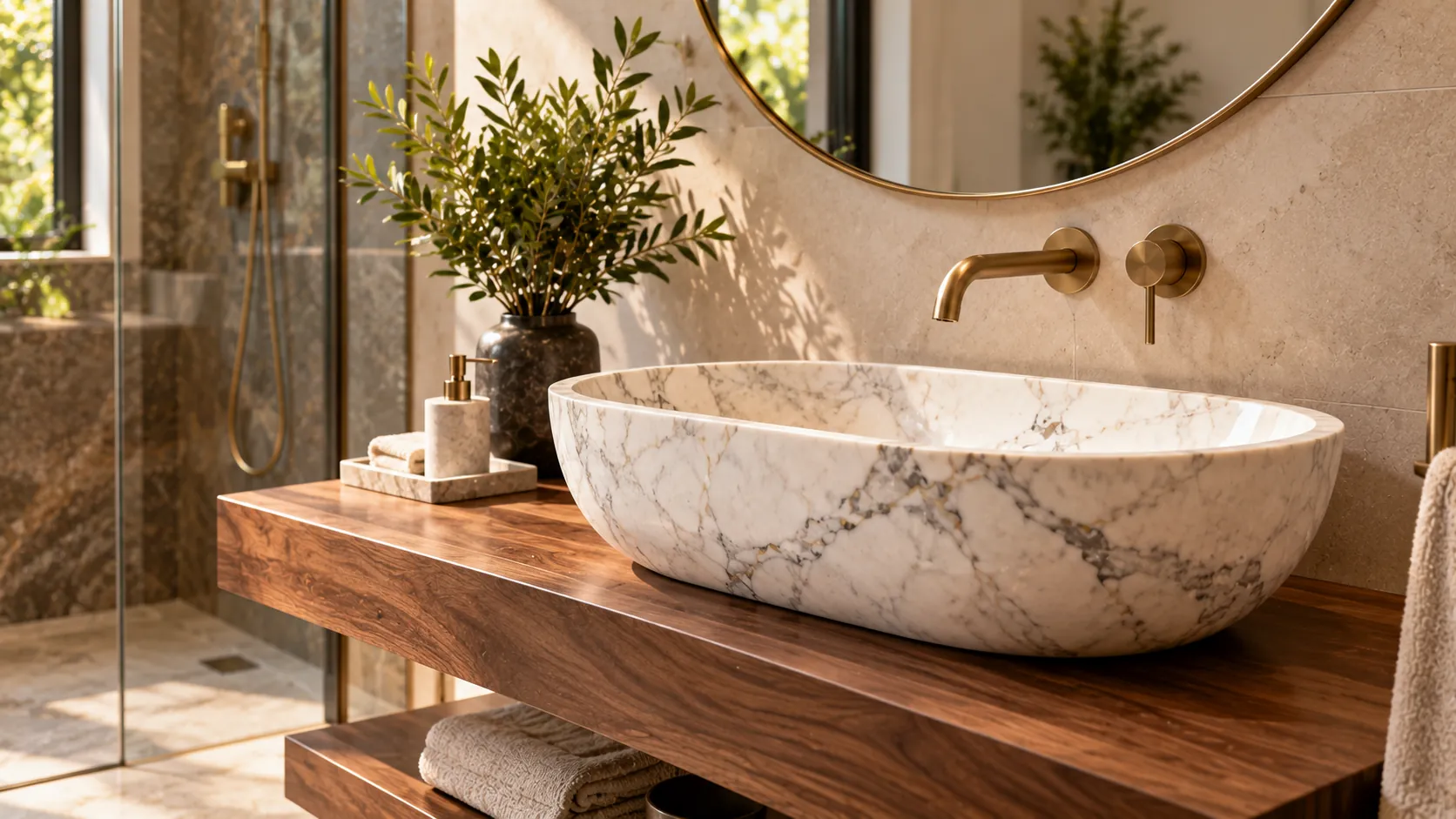
This is the picture most people have in mind: a round, oval or square bowl cut from a single piece of stone, sitting on a timber shelf or a slab like a large dish. Because the bowl and its walls are one piece, there are no joints to fail. The catch is that the whole inner surface is stone in constant contact with water, soap and toothpaste, and the inside of a bowl is the hardest area to re-polish later. Rounded inner corners and a generous slope to the waste hole matter more than the outside shape.
Integrated box basins
An integrated basin is fabricated from the same slab as the vanity top, so the counter flows into the basin with matching veins. The fabricator cuts the floor and sides from 2 cm or 3 cm stone, mitres the corners and bonds them with colour-matched epoxy. Many designs use a gently sloped floor running to a concealed slot drain at the back, which looks very clean but needs careful workmanship; a slope that is too shallow leaves a film of water on the stone after every use.
Ceramic bowls with a stone top
The undermount option hides the rim of a ceramic bowl below the stone, so you can sweep water and toothpaste straight off the counter into the bowl. The exposed edge of the opening must be polished in the workshop, and the bowl bedded and siliconed so it carries its own weight. Our glossary page on the undermount sink cut-out shows what a good opening looks like. A vessel ceramic bowl sits on the stone instead, needs only a waste and a tap hole, and can be swapped in ten minutes when styles change.
Which marble is best for a wash basin?
Ziarat Supreme and Perlino Crystal Plain are the best marbles for a wash basin, because they are dense, clean and need little resin fill. Every marble is calcite, roughly 3 on the Mohs scale, and every marble reacts with acids. What separates a stone that ages well as a basin from one that does not is its density, how much natural fissuring has been filled with resin, and how loudly its colour shows water spots and soap film. The guide below rates the stones we cut for bathrooms by those three things.
| Stone | Origin | Basin suitability | PKR / sq ft |
|---|---|---|---|
| Ziarat Supreme | Ziarat, Balochistan | Very good: dense, clean white, fine veining; our first pick for integrated and carved basins | 1,100 – 2,100 |
| Perlino Crystal Plain | Chaghi, Balochistan | Very good: crystalline, takes a mirror polish, little filling | 900 – 1,700 |
| Ziarat White | Ziarat, Balochistan | Good for tops with undermount bowls; choose a clean piece for an integrated basin | 850 – 1,600 |
| Sunny Grey | Ziarat, Balochistan | Good: the mid-grey ground hides dried water spots better than any white | 560 – 1,000 |
| Verona Plain | Chaghi, Balochistan | Good for tops; the warm beige forgives water marks | 600 – 1,100 |
| Jet Black | Chaghi, Balochistan | Use with care: hard-water rings and soap film show white on black | 1,100 – 2,000 |
| Honey Onyx | Chaghi, Balochistan | Powder rooms only: softer and more fragile, but beautiful lit from below | 2,200 – 4,800 |
| Fancy and multicolour stones | Mohmand, KP and others | Avoid for the basin itself: heavily filled, chips at cut-outs; fine on the wall behind | 680 – 1,550 |
Why filled stone and basins do not mix
Many Pakistani slabs have natural fissures that the yard fills with resin before polishing. On a wall or a floor that is perfectly normal. Inside a bowl, the same resin sits in standing water, hot water and soap every day. Over time the resin can dull, discolour or lift slightly away from the stone, and a hairline line of shadow appears along each repaired vein. For a carved or integrated basin, ask to see the actual block or slab and pick a piece with as little filling as possible in the area that will become the bowl.
Colour and hard water
Groundwater in many Pakistani cities is hard, and dissolved calcium and magnesium leave a white crust when drops dry. On a white or grey stone that crust is almost invisible. On Jet Black, Black & Gold or a dark green it shows as chalky rings around the tap and the rim within weeks. If you love a dark stone, use it for the counter with an undermount ceramic bowl, and choose a wall-mounted tap so less water lands on the stone.
Granite for heavy use
Granite is far harder and does not etch, so for a staff washroom, a mosque wuzu area, a busy school or office, or anywhere cleaning will be rough and frequent, a granite top such as Galaxy Black (PKR 900 – 1,700 per sq ft on our current quotes) with undermount ceramic bowls is the sensible choice. It will not look like a carved white bowl, but it will look the same in ten years.
Design details that decide whether it works
Most problems with stone basins are not caused by the stone. They come from details settled in a hurry: a tap that splashes onto the rim, a waste that does not suit the bowl, a bowl with no fall towards the drain. Settle these on paper before anything is carved or cut.
Taps
- Wall-mounted taps keep the counter clear and drip into the bowl rather than onto the stone. The concealed body must be fixed in the wall, at the right height and centred on the bowl, before plastering and tiling.
- Tall counter-top mixers suit vessel bowls. Check that the spout reaches past the rim and lands water near the centre of the bowl, not on the side wall.
- Deck-mounted taps on a stone top need a cleanly drilled hole; ask for single-hole, 4 in centreset or 8 in widespread drilling to match the tap you have actually bought.
- Aerated outlets soften the stream and reduce splashing onto the stone.
Waste and overflow
Most carved bowls have no overflow hole, so they need an unslotted (non-overflow) waste. A slotted waste fitted to a bowl without an overflow channel leaks water up through the slots and onto the counter. If you want a plug that closes, fit a click-clack waste and remember the bowl can then fill to the brim, so do not leave a tap running. Integrated slot-drain basins need the drain channel and its trap planned with the plumber, because there is little room for adjustment once the stone is bonded.
Shape, depth and height
- Rounded inner corners clean easily; sharp internal corners collect soap and limescale.
- A clear fall towards the waste stops water lying on the stone. Ask how the fabricator forms the slope on an integrated basin.
- Enough depth to wash hands without splashing: shallow decorative bowls look elegant but spray water onto the mirror and counter.
- Rim height for a vessel bowl: lower the counter by roughly the height of the bowl so the rim ends up at a comfortable height. Our vanity design guide gives standard heights, widths and clearances.
Weight and support
Marble weighs about 2.7 tonnes per cubic metre, so a 2 cm top comes to roughly 5 kg per square foot before anything else is added. A solid carved bowl adds considerably more, and a pedestal or wall-hung carved basin is heavier again. A floating timber shelf or a wall-hung vanity needs concealed steel brackets fixed into solid brick or concrete, not into a hollow partition. Go to 3 cm stone or a steel sub-frame under long floating tops and integrated basins.
Finish inside the bowl
A polished bowl looks richest on day one, but every acidic splash leaves a dull mark that shows against the shine. A honed (matte) finish hides etching far better and is easier to refresh, at the cost of absorbing stains a little more readily, which good sealing handles. Many owners choose a polished top with a honed bowl interior.
How much does a marble sink cost in Pakistan?
A stone vanity top with an undermount ceramic bowl costs from about PKR 18,000–28,000 for a finished single 36 in top, plus the bowl and tap, while carved and integrated basins are quoted per job. Prices depend far more on the type of basin than on the stone. Our stone tops for a ceramic bowl are priced by the square foot, fabricated and fitted, with the cut-out added; carved and integrated basins carry hours of workshop time that can cost more than the stone itself.
Finished vanity tops from our price list
- A single 36 in top in Tavera or Verona runs about PKR 18,000 – 28,000 finished.
- A 60 in double in Ziarat Supreme lands around PKR 55,000 – 80,000.
- An onyx top with a lit front can reach PKR 140,000.
- Our lead time is about 5 – 8 days after measurement, and on request we bed and silicone the undermount bowl in the workshop so your plumber only connects the waste and tap.
Integrated and carved basins are quoted per job, because the price depends on the block, the shape and the hours of carving or mitring involved. We do not keep a stock range of ready-made carved bowls; send us a sketch or a photo of the shape you want and the stone you have in mind.
Indicative market figures for basins and extras
| Item | Indicative range | What to check |
|---|---|---|
| Ceramic undermount or vessel bowl, local brand | About 4,000 – 15,000 | Glaze quality, overflow, exact cut-out template |
| Ceramic bowl, imported or designer | About 15,000 – 50,000+ | Spares and replacement availability |
| Ready-made carved marble vessel bowl | About 10,000 – 45,000 | Stone name and origin, filler inside the bowl, wall thickness |
| Ready-made carved onyx bowl | About 15,000 – 60,000 | Cracks held by resin, backing, how it will be lit |
| Undermount cut-out with polished inner edge | About 1,500 – 4,000 per basin | Whether the edge is workshop-polished |
| Tap and waste holes | About 300 – 800 each | Hole sizes match your tap and waste |
Online listings for carved bowls vary enormously, and the photo often shows a heavily polished, wax-filled sample. Before you pay, ask for the stone name and quarry, photos of the inside of the bowl wet, the wall thickness at the rim and the weight, and whether a waste hole is drilled.
Worked example
| Option | Installed top (our quote range) | Basin and extras (indicative) | Notes |
|---|---|---|---|
| Sunny Grey top, undermount ceramic bowl | About 9.5 sq ft x PKR 560 – 1,000 = 5,320 – 9,500 | Bowl 4,000 – 15,000 + cut-out 1,500 – 4,000 + tap hole | Lowest cost, easiest daily care |
| Ziarat White top, carved marble vessel bowl | About 9.5 sq ft x PKR 850 – 1,600 = 8,075 – 15,200 | Bowl 10,000 – 45,000 + waste hole | Lower the counter by the bowl height |
| Ziarat Supreme top with integrated box basin | Top plus basin pieces, roughly 13 – 15 sq ft x PKR 1,100 – 2,100 | Mitring, slope and slot drain quoted per job | Use 3 cm or a sub-frame; pick a clean piece |
Our quote ranges are installed prices, so fitting the top is already in the second column. The basin, its cut-out and holes, any brackets or sub-frame, and freight outside our fitting cities are added on top. Put your own top size into the cost estimator for an installed figure, then add the basin and extras. Ask about offcuts too: a single vanity uses well under half a slab, and premium offcuts on our rack often sell at 30 – 50% below full-slab rates.
How often should a stone basin be sealed?
Seal a stone vanity top about once a year and the inside of a daily-use bowl about every six months. Sealing fills the pores of the stone so water, soap, hair dye and cosmetics take longer to soak in. It does not stop acid from etching the surface, and it does not stop limescale forming; those are handled by daily habits. Our full guide to sealing marble in Pakistan covers products and method; the points below are specific to basins.
- Seal before plumbing. Seal the bowl or top in the workshop or on site before the tap and waste go in, so the sealer reaches every edge, including the inside of the waste hole and the cut-out rim.
- Use a penetrating (impregnating) sealer made for natural stone, not a topical wax or lacquer, which wears off unevenly in a wet bowl.
- Respect the cure time. Keep the basin dry for the period on the label. In monsoon humidity curing is slower; in June heat the sealer flashes off quickly, so work in the cool of the morning.
- Do the water-drop test. Drip water inside the bowl and on the rim. If it beads, the seal is working; if it darkens the stone within a few minutes, reseal.
- Reseal more often inside the bowl than on the counter. A top can usually go a year; the inside of a daily-use bowl may need resealing every six months, and onyx every six months as standard.
Stone with high porosity, such as some beiges and travertines, drinks sealer quickly and needs a second coat. Dense whites such as Ziarat Supreme and Perlino absorb very little, so wipe off the excess within the time on the label or it dries as a hazy film.
Hard water, limescale and daily care
This is where most stone basins in Pakistan are spoiled. The usual remedy for limescale on a ceramic basin is an acidic descaler, vinegar or lemon. All three dissolve calcium carbonate, and marble is calcium carbonate. They remove the scale and take the polish with it, leaving a rough, dull patch that only a re-polish will fix.
Daily and weekly habits
- Wipe the bowl and rim dry after the morning and evening rush. A microfibre cloth on a hook beside the basin prevents more damage than any product.
- Clean with a pH-neutral stone cleaner or a few drops of mild dish soap in warm water. The label should say it is safe for natural stone or marble.
- Keep perfume, aftershave, nail polish remover, hair dye and mouthwash off the stone. Many contain alcohol or acids; set them on a tray.
- Never use toilet cleaner, tile acid, bleach or scouring powder on or near the basin.
- Rinse toothpaste away rather than letting it dry; some whitening pastes are mildly abrasive.
If scale has already built up
- Soften light deposits with warm water and a pH-neutral cleaner, then lift them with a soft nylon pad, working gently.
- For heavier build-up, use a stone-safe limescale remover sold specifically for marble, tested first on a hidden spot.
- If the stone underneath is already etched and dull, the fix is mechanical: a stone polisher can hone and re-polish a top in a few hours, as our marble polishing guide explains. The inside of a carved bowl is slower work because of the curve, which is one more reason to protect it.
Reduce the hard water itself
If your home runs on bore water and the scale is heavy, a softener or filter on the bathroom supply protects the stone, the tap cartridges and the shower glass together. Even without one, a wall-mounted tap, an aerated outlet and a wipe-down habit cut the problem by most of the way.
Fine dust settles on every surface in a Pakistani summer, and dust on a wet bowl behaves like fine sandpaper under a cloth. Rinse before you wipe, and wipe with a clean cloth rather than one used on the floor.
Stone basins in the kitchen: our honest advice
Carved stone kitchen sinks look wonderful in magazines. In a Pakistani kitchen they face lemon, imli, tomato, vinegar, haldi, ghee and steel degchis every day. Marble etches from the acids, stains from turmeric and oil, and scratches under steel pots. A marble kitchen basin would need constant care and frequent re-polishing, and we do not recommend it.
The combination that works is a granite worktop with an undermount steel sink, or a granite top with an integrated granite sink if you want the stone look. Granite shrugs off heat and acids and only needs occasional sealing. See our kitchen countertops page for the sink options we fabricate, and keep marble for the backsplash or an island that is not used for washing up. Our granite kitchen countertops guide covers sink cut-outs in granite. For bowl sizes, mounting and placement, see our guide to sink design in the kitchen.
Buying checklist before you order
- Choose the tap and waste first. Bring the actual tap, waste and ceramic bowl, or their templates, to the measurement. Catalogue drawings are often a few millimetres out.
- See the actual stone. For a carved or integrated basin, see the block or slab that will be used and agree which part becomes the bowl.
- Wet the surface. Water shows the true colour and reveals hairline fissures and resin lines.
- Check inside a ready-made bowl. Look for filled cracks, pinholes and uneven wall thickness, and ask for its weight.
- Confirm the support. Bracket type and fixing, cabinet strength, or steel sub-frame for floating tops.
- Agree the finish for the top and the bowl interior separately: polished, honed or a mix.
- Get the quote itemised. Stone, cut-outs, holes, edges, basin, sealing, transport and fitting each written as included or extra.
- Ask who fits the bowl and connects the plumbing, and who is responsible if the bowl leaks at the silicone line.
If you are not near our yard, order stone samples of your shortlist (PKR 500 each, credited against your order). Leave a sample beside your basin for a week, splash it, let water dry on it and see how each colour copes with your own water.
Get a price for your basin or vanity
Browse finished options on our bathroom vanity tops page, then send a dimensioned sketch with your basin type, tap position and preferred stone through the free quote form. We will price the top installed in two or three stones, with the basin, cut-outs and holes itemised, so you can compare like with like before anything is cut.
Written by
The Captivating Marble Design Team
Fabricators, templaters and stone designers
We template, cut and install natural stone every day and write about what we learn — pricing, layouts, care and the mistakes we help clients avoid.
Book a free design consultation