Marble Design in Pakistan: Room-by-Room Ideas for Your Home
Marble design ideas for 8 rooms of a Pakistani home: TV walls, inlay, 3D panels, colour pairings and budgets from PKR 450 per sq ft. Plan yours and get a quote.
Captivating Marble Design Team · · Updated · 16 min read
Key takeaways
- Good stone schemes use one calm field stone, one bold accent and one trim stone per room, roughly a 70-20-10 split by visible area.
- A typical Pakistani TV wall is 10–14 ft wide and 9–11 ft high, about 90–150 sq ft of stone plus wastage.
- Our design stones cost PKR 450–2,800 per sq ft as of November 2026, from China White to Black & Gold; backlit onyx runs to PKR 5,200.
- Use honed or brushed finishes on bathroom floors, stairs and porches; keep mirror polish for dry formal rooms and walls.
- Book-matching adds roughly 10–25% extra stone and only works with consecutive slabs from the same block.
What makes a marble interior look expensive?
Good marble design in Pakistan puts a calm, light field stone on floors and large walls, one bold stone on a single feature (a TV wall, island, staircase or vanity), a honed finish wherever water or grit is involved, and joints planned so veins flow. Stone for these schemes costs PKR 450–2,800 per sq ft on our November 2026 quotes.
Get those four decisions right and almost any budget can look expensive. Get them wrong and even Ziarat Supreme looks ordinary.
This guide goes room by room through a Pakistani house, then covers feature walls, inlay and 3D work, colour pairings, finishes and edges, what each idea costs, the mistakes we see at handover and a checklist for the yard. Rates shown for stones we stock are our current quote ranges per square foot, installed in our service area. Fabrication extras such as book-matching, waterjet inlay and fluting are indicative market ranges, so confirm them on a written quote.
Decide where stone goes before the plaster, electrics and plumbing are finished. A TV wall needs conduits in the right place, a vanity needs its waste pipe at the right height and a stone-clad wall needs a few extra inches of depth. Moving these after the stone is up means breaking it. Our guide on when to install marble during construction sets out the order.
Five principles behind every good stone scheme
Every attractive marble interior we see, whether a two-marla flat in Rawalpindi or a one-kanal house in DHA Lahore, follows the same rules. They cost nothing and they prevent most expensive mistakes.
- One hero per room. Pick one surface to carry the drama (a book-matched wall, a Black & Gold island, a fireplace in green marble such as Fancy) and keep everything around it quiet. Two loud stones in one sightline fight each other.
- Field, accent, trim. Most rooms need no more than three stones: a field (floor or main wall), an accent (border, feature panel, island) and a trim (skirting, sills, thresholds). We call this the 70-20-10 split by visible area.
- Light decides colour. Whites and pale creams lift north-facing and low-light rooms; beige, grey and darker stones only work where daylight is strong. Look at samples in your own room at noon and again under the evening lights.
- Veins have direction. Linear stones such as Superline Grey, Zebrano and Tiger Verona should run with the long axis of a room or wall. Vertical veins make a low ceiling feel taller; horizontal veins make a narrow wall feel wider.
- Fewer joints look richer. A wall made of six large panels looks far more expensive than the same wall in forty 12 x 24 inch tiles, even in the same stone. Use slabs or large formats where the stone is the feature.
Marble is calcite, about 3 on the Mohs scale, and reacts with acids such as lemon, vinegar, tamarind and many bathroom cleaners. That is why where you put it matters as much as which stone you choose. Granite, a silicate rock around 6 to 7 on the same scale, takes the hard jobs (outdoor kitchens, busy worktops) better. Our marble vs granite comparison covers that trade-off in detail.
Room-by-room ideas for a Pakistani home
Houses here are used hard: big family gatherings, guests who arrive without notice, heavy dust for half the year and humid monsoon weeks. The ideas below are chosen for how rooms are actually used, not how they look in a catalogue photo. For a fuller plan, see our room marble design guide.
Drawing room and formal lounge
This is where people want the wow factor, and it is the safest room to have it because traffic is light. A polished white or cream floor in Ziarat White or Perlino Crystal Plain, a thin dark border, and one feature: a book-matched wall behind the sofa or TV, a marble-clad fireplace in a green Fancy stone, or a medallion under the chandelier. Keep the skirting in the floor stone, 4 to 6 inches high, so the walls and floor read as one. Our marble fireplace design guide covers surrounds and hearths.
Family lounge and TV room
The room the family actually lives in needs a floor that forgives. Sunny Grey White, Tavera Light or Medium White hide slab-to-slab variation and small marks. Spend the money on the TV wall instead (see the next section), and choose a honed or soft-polished floor if children play on it, because a mirror polish shows every scuff. If you are split between the two Sunny stones, our Sunny Grey and Sunny White comparison helps.
Bedrooms
Bedrooms suit quiet, warm stones: Verona Plain, Dawezai Basaf or Sunny Grey on the floor, with a headboard wall in a soft-veined stone as the only feature. A full stone headboard wall is heavy and cold to lean on, so many designers clad a panel 4 to 5 feet high behind the bed and finish the rest of the wall in paint or wood. If you are deciding between marble or wooden flooring for a bedroom, our comparison sets out the trade-offs.
Kitchen
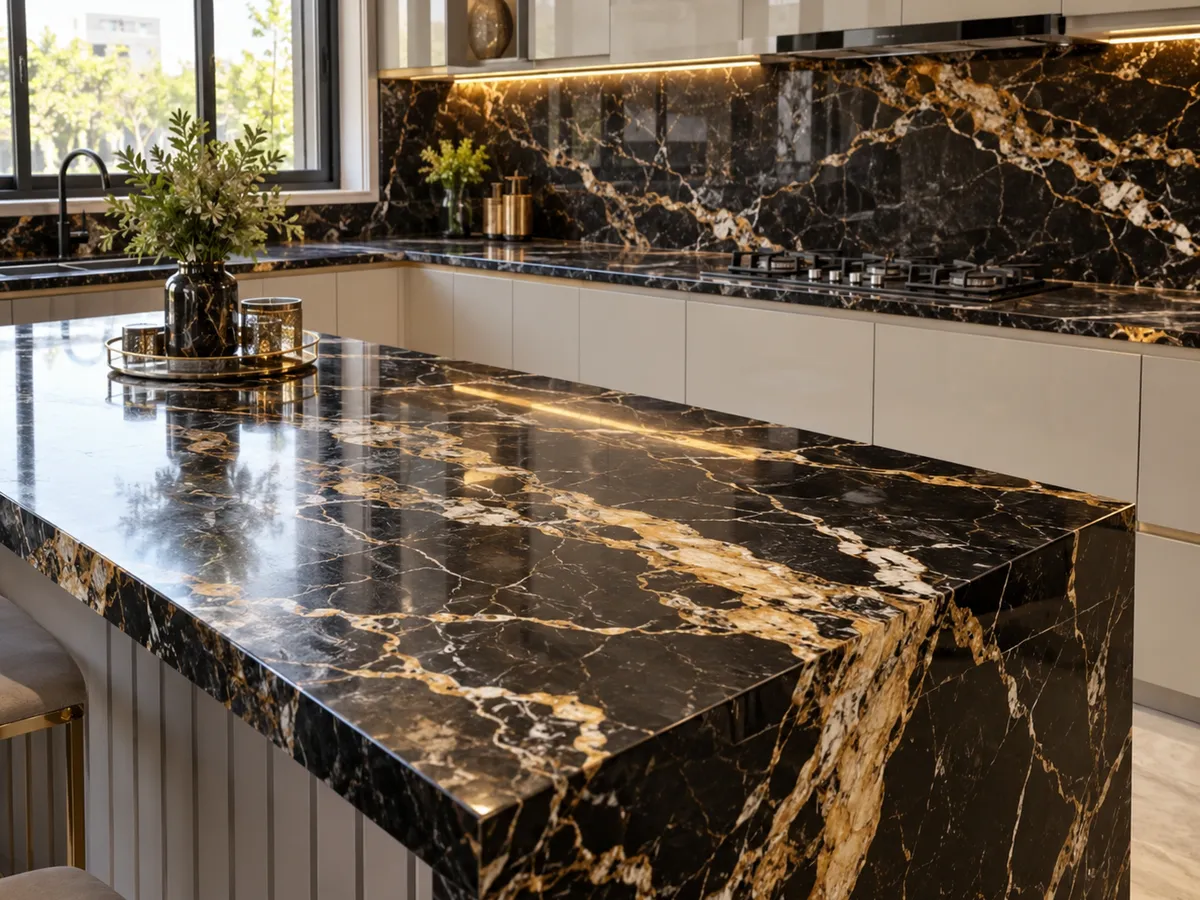
In a desi kitchen, worktops face haldi, oil, lemon and hot karahis every day. A dense, darker or busier stone (Black & Gold, Jet Black, Tropical, Royal Fancy) hides wear far better than a pure white. If you want white, go honed and seal it, or put granite on the cooking run and keep the marble for the island. Our guide to kitchen slabs and worktops covers slab sizes, edges and prices for this room in depth.
Bathrooms and vanities
Hone the floor for grip, run the same stone up the shower wall to the ceiling for a seamless look, and use a contrasting vanity top as the accent. Hard water leaves white rings on dark polished stone, so lighter stones such as Sunny Grey, Tavera Light and Pampo White are easier to live with. Read choosing marble for a bathroom vanity before you order a top.
Staircase
Stairs are a feature people walk on. A light tread with a dark nosing strip or riser, such as Tavera with Jet Black, gives definition and safety in one move. Use 3 cm or a thickened front edge on treads, and hone or groove the nosing. Our staircase stone guide has tread sizes, nosing profiles and costs.
Entrance, porch and car porch
Entrances take grit from the street and water from mopping. Use denser or textured stones (Denso, New Tavera, Gadap Stone, Chips Dana) with a honed or brushed finish. In open car porches, granite such as Nagar Parkar Grey or a brushed surface is safer than polished marble, which turns slippery in rain.
Prayer room and dining
A prayer room is best kept calm: a plain honed beige or white floor with a simple border, so prayer mats sit flat and the room stays cool. A dining area can take a herringbone or chevron panel under the table, framed by a plain field, and a stone-topped table to match; see marble table designs.
Floors in one paragraph
Floors deserve their own guide, and they have one. In short: large pieces in a calm stone, one border (patti) line, honed in wet areas and polished in dry formal rooms. Layouts, border styles and floor costs are all in our guide to floor patterns and borders.
How do you design a marble TV wall?
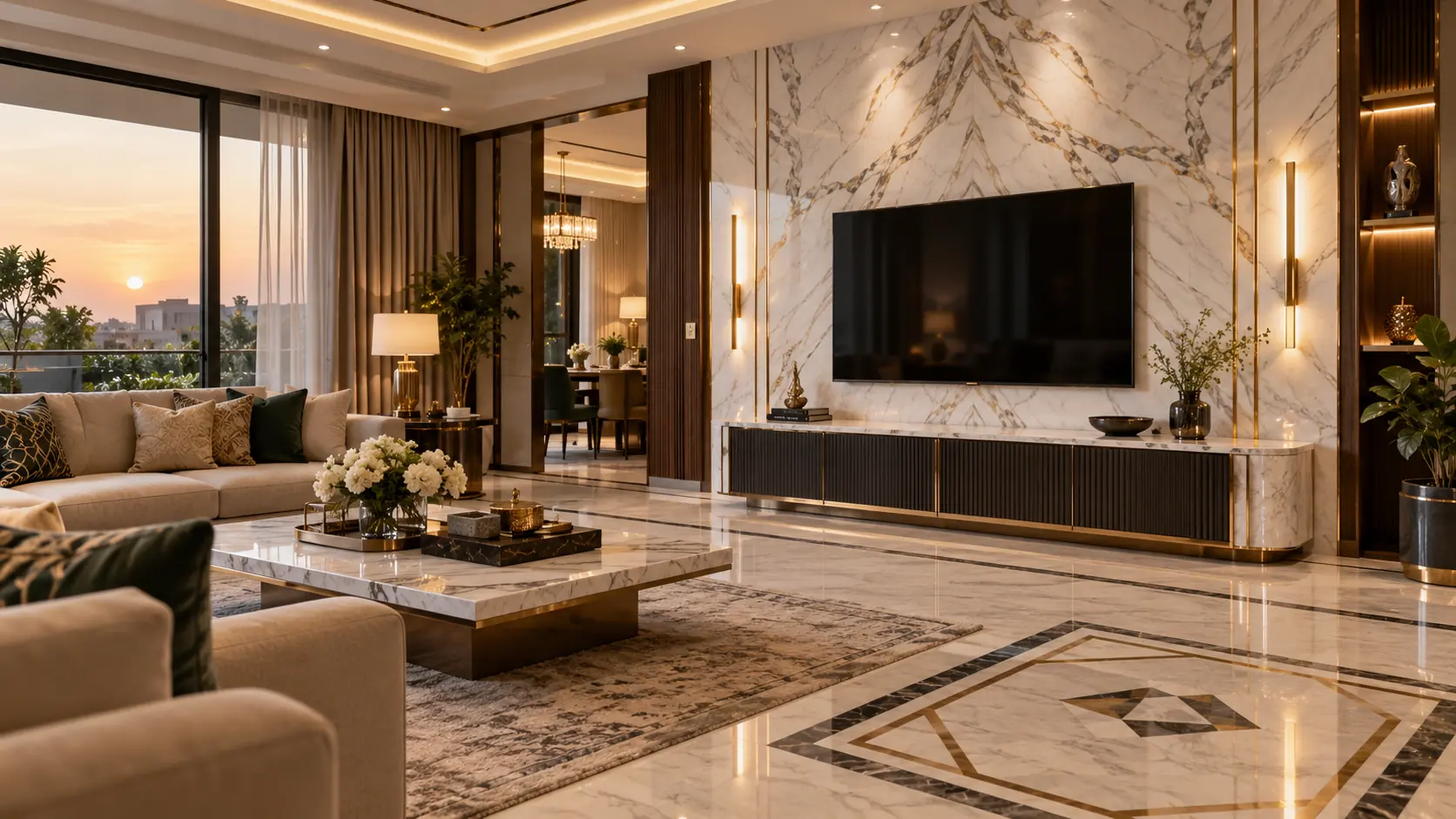
Design a marble TV wall as one feature in a single stone, book-matched or framed, fixed with mechanical clamps and planned around its conduits before any slab is cut. It has become the most requested feature in new Pakistani homes because a single wall gives a big visual return on a small area. A typical TV wall is 10 to 14 feet wide and 9 to 11 feet high, so you are buying roughly 90 to 150 sq ft of stone plus wastage, far less than a floor.
Layouts that work
- Full-height book-match. Two consecutive slabs opened like a book so the veins mirror around a centre line behind the TV. Strongest with Ziarat White, Black & White, Zebrano and Tiger Verona.
- Framed panel. A stone panel the width of the TV unit, framed by wood, fluted panelling or paint on either side. Cheaper and easier to fit around AC units and windows.
- Stone with a floating shelf. A slim stone ledge or a wall-hung console in the same stone, with a recessed LED strip above it to graze light across the veins.
- Vertical strips. Panels 12 to 24 inches wide run floor to ceiling with a small shadow gap, a good way to use a linear stone such as Superline Grey without book-matching.
- Backlit onyx. A translucent onyx panel lit from behind by LED sheets. It is the most dramatic option and the most specialised; our backlit onyx feature wall guide covers light boxes, heat and access for servicing.
How a stone wall is fixed
Wall stone is usually 2 cm thick and weighs roughly 5 to 6 kg per sq ft, so a full TV wall carries several hundred kilograms. Small tiles can go up on a good stone adhesive, but large panels need mechanical support as well: stainless steel clamps or pins anchored into the wall, or a steel frame on a weak wall, with adhesive as a secondary bond. Ask your fitter which method they plan to use and how the top row is held. Never let anyone fix large panels on cement mortar dabs alone.
Plan the cut-outs before the slabs are cut: TV bracket backing, switch boxes, the HDMI and power conduit, AC drain lines and speaker wiring. A cut-out in the wrong place cannot be moved, and on a book-matched wall a replacement panel will not match.
3D and inlay marble design
Inlay is the part of stone craft where Pakistan has deep roots. The Mughal tradition of parchin kari (pietra dura), coloured stones cut and set into white marble, still survives in the workshops of Lahore and Karachi, and modern machines have made versions of it affordable for homes.
Hand-cut, waterjet and flower inlay
Simple geometric inlays (stars, diamonds, Greek keys, borders) can be hand-cut. Floral (the "marble flower design" many buyers ask for), calligraphic and complex geometric designs are now cut by CNC waterjet from a digital drawing: a jet of water mixed with abrasive cuts each coloured piece to a tight tolerance, and the pieces are assembled on a backing mesh in the workshop. Ask to see the assembled panel laid out before it is packed, and keep the drawing so a damaged piece can be recut later.
Borders and patti work
Ready-made border strips are the most affordable inlay. Our Design Patti comes in standard geometric repeats, and Dighin Border is the carved version with a raised profile. Both can run along a floor, frame a wall panel or trim the edge of a stair landing.
3D panels: fluted, ribbed, carved and split-face
Searches for 3D marble walls usually mean one of four things, and they behave very differently:
- Fluted or ribbed panels. Parallel grooves (concave flutes or convex ribs) machined into the face of a slab by a CNC router or a profile saw. Very fashionable behind TVs, beds and reception desks. Grooves collect dust, so keep them out of kitchens and away from cooking smoke.
- Carved relief. Waves, leaves or geometric reliefs carved into the stone surface by CNC. Expensive and heavy, best kept to a single panel.
- Split-face and rock-face tiles. Strips with a rough, broken face that catches raking light. Used on exterior elevations, boundary walls and around fireplaces; they belong to stone wall cladding rather than fine interior work.
- Mosaic. Small chips or shaped pieces (hexagon, basket weave, herringbone) on mesh sheets. Good for shower niches, backsplashes and a mosque-style mihrab panel.
Machine-cut 3D and waterjet work is the line on a quote that varies most between workshops. Get a drawing with dimensions, the number of colours and the finish written on it, and compare quotes for the same drawing.
Colour pairings and the stones behind them
Most good schemes are a light field with a single darker or warmer accent. These pairings are the ones that consistently look right in Pakistani light, with the metal and wood finishes that suit them.
| Field stone | Accent stone | Use it for | Pairs with |
|---|---|---|---|
| Ziarat White | Jet Black | Drawing room floor with border, chequerboard hall | Brass, walnut, black frames |
| Perlino Crystal Plain | Black & Gold | Formal lounge with a feature island or wall | Gold fittings, cream upholstery |
| Sunny Grey White | Superline Grey | Family lounge with a linear TV wall | Chrome, oak, grey fabrics |
| Verona Plain | Tiger Verona | Bedroom floor with a headboard panel | Warm wood, brushed bronze |
| Tavera Light | New Tavera | Stairs (light tread, darker nosing), corridors | Wrought iron, teak |
| Medium White | Green Fancy | Lounge with a fireplace or a border | Antique brass, deep green |
| Dawezai Badal Travertine | Tropical | Bathroom walls and a warm vanity top | Matte black, rattan |
| China White | Design Patti | Budget floor with a decorative border | Any; keep walls plain |
Many buyers search by stone name. Ziarat whites suit formal, bright schemes and book-match well. Badal, sold by us as Dawezai Badal Travertine from the Badal collection, is a grey, cloud-drifted Mohmand stone supplied honed or brushed that looks best on bathroom walls and fireplaces. Sunny Grey (Sunny Grey collection) is the forgiving all-rounder for large floors and family rooms.
| Stone | Origin | Look | Best design role | Quote range |
|---|---|---|---|---|
| Ziarat Supreme | Ziarat, Balochistan | Milk white, faint drift | Book-matched walls, islands | PKR 1,100 – 2,100 |
| Ziarat White | Ziarat, Balochistan | Ivory white, soft grey | Formal floors, TV walls | PKR 850 – 1,600 |
| Perlino Crystal Plain | Chaghi, Balochistan | Even cream-white | Floors, vanities, walls | PKR 900 – 1,700 |
| Sunny Grey White | Ziarat, Balochistan | White with grey wash | Lounge floors, shower walls | PKR 600 – 1,080 |
| Sunny Grey | Ziarat, Balochistan | Warm grey | Large floors, bathrooms | PKR 560 – 1,000 |
| Superline Grey | Mohmand, KP | Straight grey lines | Vertical strip walls, corridors | PKR 620 – 1,150 |
| Verona Plain | Chaghi, Balochistan | Honey beige | Bedrooms, prayer rooms | PKR 600 – 1,100 |
| Tiger Verona | Chaghi, Balochistan | Beige with brown waves | Feature walls, islands | PKR 750 – 1,350 |
| Zebrano | Chaghi, Balochistan | Striped cream and brown | Book-matched walls | PKR 900 – 1,650 |
| Black & Gold | Chaghi, Balochistan | Black with gold veins | Islands, fireplaces, accents | PKR 1,400 – 2,800 |
| Jet Black | Chaghi, Balochistan | Deep black | Borders, nosings, chequerboard | PKR 1,100 – 2,000 |
| Green Fancy | Mohmand, KP | Green with random pattern | Fireplaces, borders | PKR 780 – 1,450 |
| Dawezai Badal Travertine | Mohmand, KP | Grey cloud drift | Bathroom walls, fireplaces | PKR 640 – 1,180 |
| Pak Green Onyx | Chaghi, Balochistan | Translucent green | Backlit panels, vanities | PKR 2,400 – 5,200 |
You can compare any two of these side by side, including finishes and thicknesses, with our stone comparison tool. For a deeper look at every Pakistani variety and where it is quarried, see marble types in Pakistan.
Finishes and edges change the whole look
The same slab can look formal, rustic or modern depending on its finish. Finish also decides grip, how much wear shows and how often you will re-polish.
| Finish | Look | Grip when wet | Shows wear | Best for |
|---|---|---|---|---|
| Polished | Mirror shine, deepest colour | Poor | Scratches and etch marks show | Dry formal rooms, walls, vanities |
| Honed | Smooth matte or satin | Fair | Hides wear well | Kitchens, bathrooms, stairs, busy floors |
| Leathered | Soft texture, slight sheen | Good | Hides fingerprints | Dark worktops, islands (Jet Black, Tropical) |
| Brushed | Worn, antique texture | Good | Very forgiving | Porches, travertine, outdoor areas |
Polish on Pakistani marble is achieved by grinding through finer and finer abrasives and then either crystallising with a polishing compound or finishing with diamond pads. A good diamond polish lasts longer than a chemical shine that fades in a few months. Our guide to marble polishing explains the difference and what each costs.
Edge profiles
- Eased (small bevel): clean and modern, the safest choice for vanities and worktops.
- Half bullnose and full bullnose: rounded and child-friendly, common on stair nosings and window sills.
- Ogee: a classic S-curve for formal counters and fireplace mantels.
- Mitred (laminated) edge: a second strip joined at 45 degrees so a 2 cm slab looks 4 to 6 cm thick. This is how waterfall islands and chunky vanity tops are made.
How much does marble design work cost?
A stone design budget has three parts: the stone, the fabrication (cutting, edges, book-matching, inlay, grooves) and the site work (fixing, grinding, polishing, transport). Our quote ranges above are installed prices: they cover the stone, cutting, a standard edge, the finish and fitting in our service area. Book-matching, mitres, cut-outs and freight outside our fitting cities are itemised, and specialist work such as CNC fluting or waterjet inlay is priced from the drawing.
| Item | How it is usually charged | Indicative market range |
|---|---|---|
| Wall fixing with adhesive (tiles), stone-only buyers | Per sq ft | PKR 80 – 180 |
| Large panel fixing with clamps, stone-only buyers | Per sq ft | PKR 200 – 450 |
| Book-matching and vein layout | Extra wastage on slab area | 10–25% more stone |
| Mitred edge | Per running foot | PKR 400 – 900 |
| Fluted or ribbed CNC grooves | Per sq ft of panel | PKR 500 – 1,500 |
| Waterjet inlay / medallion | Per piece or per sq ft of design | Often 3–6 times the field stone rate |
Treat these as indicative market ranges only, not our rate card: they move with city, job size, design complexity and fuel and power costs. The fixing rows apply only when you buy stone only and hire your own fitter.
Three example budgets
- Value scheme: Medium White or China White floors with a Design Patti border, a framed Sunny Grey White TV panel and Tavera stairs. Our installed quote ranges here sit roughly between PKR 300 (Design Patti) and PKR 1,080 per sq ft.
- Mid-range scheme: Ziarat White formal floors, Verona Plain bedrooms, a Superline Grey strip TV wall, Jet Black stair nosings and a honed Sunny Grey bathroom. Most stones fall between PKR 560 and PKR 2,000 per sq ft.
- Statement scheme: Ziarat Supreme book-matched TV wall, a Black & Gold waterfall island, a waterjet medallion in the entrance and a backlit onyx vanity wall. Our installed ranges run from PKR 1,100 to PKR 5,200 per sq ft, with book-matching, mitres and inlay itemised.
For a first figure on your own areas, use the cost estimator, and see the marble price guide for every stone we list.
Design mistakes we see at handover
- Too many stones. Four or five different marbles in one open-plan space look like a showroom, not a home. Three is the usual limit.
- Polished stone in wet areas. Bathroom floors, wash areas, porches and stair treads need a honed or textured finish. A mirror polish there is a safety risk.
- White marble on the cooking counter. It etches with lemon and stains with haldi. Hone and seal it, or use granite or a darker stone where you cook.
- Dark polished floors in dusty cities. Every footprint shows. Keep black stones for borders, nosings and accents.
- Book-matching without seeing the slabs. Mirrored veins only work if the slabs are consecutive from the same block. Ask for slab numbers and see them standing together.
- Cut-outs planned on site. Switches, TV brackets and AC lines must be on the drawing before the stone is cut.
- Buying in batches. Stone from a second lot bought months later rarely matches. Buy everything for one room, plus spares, at once.
- Ignoring the edge thickness. A 2 cm edge on an island looks thin. Plan a mitred edge or 3 cm stone where the edge is visible.
Buying checklist for the yard
Most problems are visible before the stone leaves the yard. Go in daylight, take a tape and a bottle of water, and work through this list.
- See the actual slabs or lot, not a showroom board. For feature walls, note the slab numbers.
- Wet the surface to preview the polished colour and expose hairline cracks and resin-filled areas.
- Stand book-match slabs side by side and check the veins really mirror at the joint.
- Measure thickness at the corners and the middle. Variation means extra grinding and uneven joints.
- Check edges and corners for chips that will show at joints.
- Confirm finish and edge in writing: polished, honed, leathered or brushed; eased, bullnose, ogee or mitred.
- Get the drawing signed off with cut-outs, inlay layout and vein direction marked.
- Agree spares and wastage: a few spare pieces from the same lot for future repairs.
- Ask how prices are quoted: per sq ft of stone only, or with cutting, fixing and polishing included.
If you cannot visit, order stone samples first (PKR 500 per sample, credited against your order) and ask for a video of the actual slabs before cutting.
Installation and care that keep it looking new
Floors normally go down on a sand-cement bed and are ground and polished in place. Walls go up on adhesive, with clamps for large panels. Our marble installation process guide walks through measuring, cutting, transport and fitting day.
- Weather matters. In peak summer, mortar and adhesive dry too fast; in the monsoon, damp beds need longer before grinding.
- Power matters. Grinding and polishing machines need steady supply; plan a generator on sites hit by load-shedding.
- Protect finished stone with board or thick sheeting until painters and carpenters leave.
- Seal the right surfaces. Honed kitchen and bathroom stone benefits most; our guide on how to seal marble explains when and how.
- Clean gently. Dust-mop daily, use a pH-neutral cleaner, wipe acids and oils quickly. Our care guide has a stain-by-stain list.
Next steps
List your rooms, decide the one hero surface in each, and shortlist a calm field stone plus one accent. Order samples to see them in your own light, then send us your plans or photos for a free written quote that states the installed rate and itemises cut-outs, seams and freight. We will tell you honestly when a simpler layout or a cheaper stone gives the same look; good marble design for home use is about restraint as much as budget.
Written by
The Captivating Marble Design Team
Fabricators, templaters and stone designers
We template, cut and install natural stone every day and write about what we learn — pricing, layouts, care and the mistakes we help clients avoid.
Book a free design consultation